ADVANCED RECOVERY AND INTEGRATED EXTRACTION
SYSTEM (ARIES): THE UNITED STATE'S DEMONSTRATION LINE
FOR PIT DISASSEMBLY AND CONVERSION
Dr. Timothy O. Nelson
The United States Pit Disassembly and Conversion Project Leader
Nuclear Materials Technology Division
MS E510
PO. Box 1663
Los Alamos National Laboratory
Los Alamos, NM 87545
ABSTRACT
The Advanced Recovery and Integrated Extraction System (ARIES) is a pit disassembly and conversion demonstration line at Los Alamos National Laboratory's plutonium facility. Pits are the core of a nuclear weapon that contain the fissile material. With the end of the cold war, the United States began a program to dispose of the fissile material contained in surplus nuclear weapons. In January of 1997, the Department of Energy's Office of Fissile Material Disposition issued a Record of Decision (ROD) on the disposition of surplus plutonium. This decision contained a hybrid option for disposition of the plutonium, immobilization and mixed oxide fuel. ARIES is the cornerstone of the United States plutonium disposition program that supplies the pit demonstration plutonium feed material for either of these disposition pathways. Additionally, information from this demonstration is being used to design the United States Pit Disassembly and Conversion Facility.
All of the ARIES technologies were recently developed and incorporate waste minimization. The technologies include pit bisection, hydride/dehydride, metal to oxide conversion process, packaging, and nondestructive assay (NDA). The current schedule for the ARIES integrated Demonstration will begin in the Spring of 1998. The ARIES project involves a number of DOE sites including Los Alamos National Laboratory as the lead laboratory, Lawrence Livermore National Laboratory (LLNL), and Sandia National Laboratories. Moreover, the ARIES team is heavily involved in working with Russia in their pit disassembly and conversion activities.
BACKGROUND
In September 1993 President Clinton issued a Nonproliferation and Export Control Policy in response to the growing threat of nuclear proliferation. Four months later, in January 1994, President Clinton and Russia's President Yeltsin issued a Joint Statement Between the United States and Russia on Nonproliferation of Weapons of Mass Destruction and the Means of Their Delivery. A little more than a year later, 1 March 1995, President Clinton announced that approximately 200 metric tons of US-origin weapons-usable fissile materials had been declared surplus to US defense needs. The Advanced Recovery and Integrated Extraction System (ARIES) Demonstration Program is one part of the scientific response to President Clinton's promise to reduce the nuclear weapons stockpile.
The goal of the disposition program is to remove and dispose of surplus weapon material simultaneously from both the United States and Russian inventories, never again to be used in nuclear weapons. (This paper addresses only the disposition of plutonium as the fissile nuclear weapon material that is removed from a pit, the core of a nuclear weapon that contains the nuclear material.) Pit disassembly and conversion refers to removal of plutonium from the nuclear weapon pit and conversion to an unclassified form. This unclassified form enables verification by inspectors of other nations that results in irreversibility of the host country to reuse the nuclear material. The subsequent plutonium disposition process, immobilization or mixed oxide (MOX) fuel, must allow for inspection all the way through its processing, use, and final end state. These international inspectors could be bilateral inspectors from Russia and the United States or others, such as the International Atomic Energy Agency (IAEA). The Advanced Recovery and Integrated Extraction System (ARIES) is the United States pit disassembly and conversion demonstration line that converts the nuclear weapon pit to an unclassified form that can be inspected and used in subsequent disposition processes. ARIES is sponsored by the Department Of Energy's Office of Fissile Materials Disposition (OFMD).
INTRODUCTION
The ARIES demonstration line1 for pit disassembly and conversion is modular in design to offer credible scaling, incorporation of modifications or new concepts, and future transportability and exportability capabilities. ARIES will develop and demonstrate the following modular elements:
A pit bisection module used to cut open and physically separate the various components of the weapon pits,
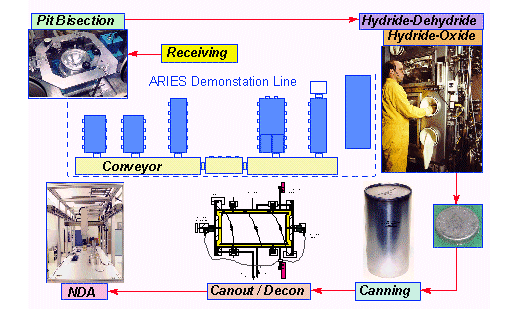
The sequence of activities by module and a general glovebox footprint are shown in Fig. 1. Note in the figure, the plutonium metal button that was produced by hydride-dehydride.
Fig. 1 The ARIES Demonstration Line modules.
The objective of ARIES is to demonstrate feasibility of a process for disassembly, extraction, and conversion of plutonium from weapons components into forms suitable for disposition and /or storage while emphasizing pollution prevention. Currently, no integrated system exists for the complete dismantlement and recovery of nuclear material from different weapons' designs. A second objective is to develop and demonstrate feasibility ARIES technologies that could be used by both the US and Russia.
PIT BISECTION
The pit bisector is a tool that physically separates the pit into two halves-hemishells. This tool operates similar to a can opener-it creases through the pit rather than sawing a groove or producing waste chips a standard lathe would leave. This glovebox operation substantially reduces the contribution to the waste stream compared to previous practices.
The bisector is operated by placing the pit into a vacuum chuck. The pit is rotated while the cutting wheel is swaged into it. LLNL is the laboratory lead for the pit bisector module and has successfully demonstrated the use of the pit bisector in their plutonium facility, Superblock, within the past year. The ARIES' pit bisector has had some modifications made to it that make it more user friendly and has successfully completed the last series of cold tests at Los Alamos National Laboratory before it goes into hot operations as part of the ARIES' line.
HYDRIDE/DEHYDRIDE PROCESS
The hydride-dehydride2 module converts the pit plutonium to an unclassified plutonium metal button. (In some cases, another process, a simple furnace casting, in the ARIES line may also be used convert pit plutonium to an unclassified plutonium metal button.) Hydride-dehydride takes advantage of plutonium metal's strong affinity for hydrogen gas, producing a reaction that forms plutonium hydride. The practice of hydriding plutonium metal had been in limited use in the DOE complex for many years. However, the ARIES version of the process incorporates recycle of hydrogen in a single furnace module that leads to a substantial reduction of hydrogen use and storage requirements, which increases the safety margin of this process resulting in a more viable process. Also, compared to the previous standard practice of dissolving plutonium metal with acid, the waste stream is substantially lowered. Because of the improvements that made hydriding plutonium a safer process and the substantial reduction of waste compared to the acid leaching process typically used, this work was awarded in 1995 one of the top one hundred most significant inventions by R&D magazine.
The hydride-dehydride reaction takes place in a vacuum chamber contained in a glovebox. The bottom portion of the chamber contains a crucible and is heated. The upper part of the chamber is the hydrogen-plutonium reaction zone that contains half of the pit-a hemishell. From a uranium-hydride storage bed, a small amount of hydrogen gas is introduced into the chamber to react with the plutonium. As the plutonium hydride forms, it spalls off the surface of the hemishell into the crucible. The temperature of the crucible is high enough to release the hydrogen from the plutonium and the hydrogen reacts with the plutonium hemishell once again. This recycle effect enables the amount of hydrogen needed to completely dissolve the plutonium hemishell to be very small. Also, after the reaction is complete, all of the plutonium is reacted with the hydrogen, the leftover hydrogen is recovered back onto the uranium-hydride storage bed to be used on the next plutonium hemishell. Because of the flammability of hydrogen, lowering the amount of hydrogen by use of the uranium storage bed and the recycle effect of this process substantially increases the safety margin of the process.
The previously used DOE complex extraction method, acid leaching, was a multi-step process in which plutonium was leached out with acids, isolated, converted to an oxide, and reduced to a metal. However, this traditional method generated about 360,000 kilograms of mixed waste a year. Mixed waste, containing both hazardous and radioactive waste, is the most difficult type of waste to dispose of. The hydride-dehydride process eliminates production of this type of waste stream.
The hydride-dehydride process has other advantages over acid leaching. It is simpler, a single step vs. a multistep process; faster, five hours vs. 16 hours, including formation of the final ingot; more efficient, 99.9 per cent of a weapon's plutonium is recovered within a 36-square-foot glovebox vs. acid leaching in which 96 per cent of the plutonium is recovered in 40 times the space.
The hydride-dehydride process is the baseline technology to remove plutonium from a pit and convert the plutonium to a metal ingot, shown in Fig. 1. This process has been demonstrated at Los Alamos National Laboratory over the past few years and upgrades to this process are being incorporated into the ARIES' version.
OXIDATION PROCESS
The oxidation process converts plutonium metal to plutonium oxide, which is used in the disposition options immobilization and MOX fuel. It has three criteria for becoming a successful process. The first involves instituting a process that will have an acceptable safety margin. The second is a process that will convert the metal to oxide in a timely fashion, adequate throughput rate. And the third criteria, is the production of acceptable feed for the use of the oxide in mixed oxide fuel. The preferred disposition option for clean weapons grade plutonium is to burn it as MOX fuel. For MOX fuel, the particle size and surface area are two of the most stringent characteristics. Currently, the pyrochemical process being studied most intensely for ARIES is the conversion of metal to oxide by hydriding, followed by nitriding, followed by oxidation, HYDOX. This process has shown promise from experiments done at LLNL, but further studies are required. An alternative process that is also being studied to make plutonium oxide is to simply directly oxidize the metal.
CANNING MODULE
The canning system receives the plutonium metal or plutonium oxide and places it into a material container. The limits for metal and oxide are 4.4 kg and 5.0 kg, respectively, which were set in the Department of Energy (DOE) Long Term Storage Standard (DOE-STD-3013-96). Once the metal or oxide is placed into the material container, it is hermetically sealed by welding and tested for leaks based on the 3013 standard. Each container is labeled for identification. The material container is removed from the glovebox line by the use of electrolytic decontamination, described later. Once outside the glovebox, the material container is placed into the boundary container, which is also hermetically sealed by welding and also leak tested. This two container package meets the criteria for long term storage of metal or oxide as described under the constraints of the 3013 standard. Packaging to the 3013-96 standard has been done at Los Alamos National Laboratory since the standard was released. The ARIES' long term storage package has completed the required testing and qualifications. There is a large number of engineering design requirements that went into this package's development including the following: cost, ease of manufacture, ease of welding, weight, ergonomics, potential container reuse, height, diameter, robotics handling ability, strength, etc.
ELECTROLYTIC DECONTAMINATION
The purpose of the electrolytic decontamination3 module is to remove the outer plutonium and americium surface contamination from the material container to alpha readings < 20 disintegrations per minute (dpm) per 100 square-centimeters swipable and 500 dpm/100 square-centimeters direct. Removing the contamination to these minute levels enables all subsequent operations to be done outside of the plutonium glovebox. Electrolytic decontamination is similar to the standard industrial practice of electropolishing. While the surface topography is being smoothed, contaminants are being removed. These contaminants can be dissolved or simply entrained as part of the surface removal during the electrolyte process. The elegance of this process is the use of a neutral to basic pH electrolyte, sodium sulfate, that leads to the formation of a precipitate of the contaminants and most of the stainless steel components. After separation of the precipitate from the electrolyte, the electrolyte is recycled with only the small amount of precipitate formed that results in a waste stream. This process for cleaning containers and removing them from plutonium gloveboxes was demonstrated at Los Alamos National Laboratory in December of 1995. The results of these tests showed that the contamination was removed to non-detectable alpha levels-much below the previously stated DOE requirements.
Other demonstrations of electrolytic decontamination have also occurred at Los Alamos National Laboratory, including the removal of contaminants in gloveboxes from TRU waste levels to low level waste and the removal of plutonium and americium surface contamination from highly enriched uranium (HEU) hemishells. The latter system is the baseline technology for the DOE complex. The electrolytic decontamination of HEU hemishells reduces the waste stream by more than an order of magnitude compared to decontamination by the previous method of acid spray leach process. And unlike acid spray leaching, the HEU electrolytic process does not produce a mixed hazardous radioactive waste. Also, the electrolytic process mechanism removes material from the surface more uniformly than an acid leach process, resulting in a higher rate of successful decontamination. The electrolytic decontamination of gloveboxes reduces waste in two ways. First, the process of electrolytically cleaning gloveboxes produces less waste than acid washes and unlike the acid wash, the waste from the electrolyte process is not a mixed hazardous radioactive form. Second, the gloveboxes waste level is lowered to that allows the glovebox to be easily discarded at a much lower cost to the taxpayer. Both of the latter applications of electrolytic decontamination have received awards for waste minimization. In the case of electrolytic decontamination of containers, there was no standard technology for the complex to remove containers from a plutonium glovebox without any contamination and this technology represents a significant advance.
NONDESTRUCTIVE ASSAY SYSTEM
The nondestructive assay (NDA) system4 accurately measures all of the output of the ARIES line, including waste items and the plutonium metal and oxide stored in the long term storage package. NDA enables verification of the material in the containers without opening for destructive analysis sampling. Eliminating the need for destructive sampling is a major reduction in the ARIES waste stream. Also, the NDA system is a stepping off point for international inspection and safeguards. It has been the most productive ARIES system with respect to interactions with the Russians, as the joint United States and Russian team are actively involved in developing a similar NDA system for Russia.
The NDA system is automated-telescoping gantry robot and consists of the following four NDA instruments: an active-induced/passive-spontaneous neutron counter for waste assay and possibly some fissile material assay, a calorimeter to measure heat generated from the radioactive decay of the fissile material, a segmented gamma scanner for waste assay, and a gamma spectrometer for isotopics of the fissile material. The mass measurement of the fissile material, plutonium as an example, that is contained in the doubly sealed container package is made by coupling the calorimeter and the gamma spectrometer measurements. Because of the development of the electrolytic decontamination of containers process, the current ARIES' NDA system is not housed in a glovebox, which greatly simplifies operation and maintenance. A host computer monitors all system functions, controls the instruments, schedules measurements, archive assays, and directs automation support for continuous 24-hour a day operation. Both the robot and NDA instruments have went through extensive successful testing and calibration at Los Alamos National Laboratory.
SUMMARY
The ARIES demonstration line integrates many new technologies to reduce the waste stream from the activities needed for pit disassembly and conversion and will be in full operation during the Spring of 1998. The approach of this work is to reduce the waste stream for pit disassembly and conversion by using technologies that lead to a reduction and not leave the waste stream for clean-up later. The data gathered from the demonstration line will enable proper design of the United States pit disassembly and conversion facility. Currently, the Title II design of this facility is scheduled to begin in October, 1999. Moreover, as the United States and Russia engage in the disposition of the plutonium from nuclear weapons, activities with our Russian counterparts may also include the use of some of the ARIES technologies, which will also reduce the waste streams generated in Russia.
REFERENCES
BACK