WATRP AND IAEA'S INTERNATIONAL PEER REVIEWS
ON GEOLOGICAL DISPOSAL OF RADIOACTIVE WASTE
Arnold A. BONNE
Head Waste Technology Section
WATRP Programme Manager
IAEA, Wagramer Strasse 5, P.O. Box 100, A -1400 Vienna (Austria)
tel.: + 43 1 206022662, fax.: + 43 1 20607; e-mail arnold.bonne@iaea.org
ABSTRACT
International peer reviews have become an important feature of IAEA's services to Member States. In areas of radioactive waste management and disposal in particular, such reviews are gaining greater attention among countries as an effective tool for objective technical feedback and assessment.
The Agency's peer review service for radioactive waste management - known as the Waste Management Assessment and Technical Review Programme (WATRP) - started in 1989, building upon earlier types of advisory programmes. WATRP's international experts today provided advice and guidance on ongoing or planned radioactive waste management programmes. A specif topic very often covered is waste disposal and peer reviews in this area dealt with concepts of disposal facilities, siting programmes and site investigation, R&D programmes, actual and planned disposal operations, monitoring, performance and safety assessments and general planning and management programmes.
The paper shortly presents IAEA's WATRP peer review process, discusses essentials related to these reviews, highlights benefits from such reviews and reports on some particular WATRP reviews organized by the IAEA on disposal projects.
INTRODUCTION
From the very beginning the IAEA has conducted missions to provide advice to Member States and review of Member States' programmes to enhance the performance in specific domains regarding the peaceful use of the atom. In radioactive waste management the Agency provides international peer review services to its Member States with established radioactive waste management programmes within its Waste Management Assessment and Technical Review Programme (WATRP). The WATRP service has been established to provide Member States the benefit of international peer reviews in the various aspects of radioactive waste management [1,2].
The scope of a WATRP review is proposed by the requesting country or organization. It can be focused on various matters, such as national radioactive waste management programmes; waste conditioning, storage and disposal concepts or facilities; research and development programmes devoted to a particular task; or the organizational and regulatory system. It may cover technical, safety, regulatory, economic, social or political aspects.
The WATRP review is conducted by a team (called review team) of senior experts (4 to 6 experts) from several countries, different from the requesting country. The experts serve in their individual capacities independent of their government or organization and the Agency. Their findings, conclusions and recommendations represent their own insights into the respective subject area and do not necessarily represent the views of the respective governments, organizations or of the Agency.
BENEFITS FROM WATRP
In the field of waste management, peer reviews are generally appropriate for:
Peer reviews are particularly recommended and used in the waste management area when the adequacy of information or suitability of procedures and methods cannot otherwise be established through testing, alternate calculation, or reference to previously established standards and practices. A peer review should be considered when, for instance:
The advantage of a WATRP peer review for the requesting Member State or organization is to obtain independent international expert's opinions and advice on a) proposed or ongoing radioactive waste management programmes, b) planning, operation or decommissioning of facilities or c) organizational and regulatory matters, such as safety assessments. WATRP can contribute to improve the level of confidence in waste management systems, planned or in operation, and help to assure that the systems perform in a safe and reliable manner. WATRP can also assist in improving public acceptance of national programmes.
As past experience has shown, issues of radioactive waste management attract considerable attention, particularly from the standpoint of feasibility, safety and environment. International peer reviews can be valuable components of national efforts to obtain objective assessments of their programmes, plans and projects in terms of conformance with international knowledge, practice and standards.
WATRP PEER REVIEW PROCESS
Upon request from a Member State, or an organization within a Member State, the Agency undertakes the responsibility of composing and convening an international review team of experts for performing an independent peer review. Considerable peer reviewing experience has been built up within the Agency's WATRP service, and a standardized working process has been developed for implementing such review efficiently. In Fig.1 is the overall WATRP review working process schematically shown.
The three principal stages in the review process are:1) off-site review of source material, 2) on-site WATRP team review meeting with technical discussions and exchange of information with experts of the requesting Member State or organization(s) including possibly site visits, and 3) preparation of a review report.
As the reviews may differ in type and scope, sufficient flexibility must be brought into the review process and mechanism in order to accommodate the actual needs of an individual request. As a consequence, the time span for a complete implementation may vary. A time span of seven months between transmittal of a request for a review and the submission of the final report to the requester may be considered as the shortest time needed for a WATRP peer review.
Off-site review of source material
The scope of the review, specified in the terms of reference, defines the areas to be covered in the review and also the contents of the source material to be submitted to the experts of the review team. The source material may include programme documents, technical documents, reports, publications, flowsheets, organization charts and regulatory manuals. To enable the review to be as efficient as possible, the source material (in English) for the on-site meeting is made available to all WATRP review team members well in advance (at least two months) so that they can familiarize themselves with the references.
The reviewers normally:
On-site WATRP review meeting
After the source material has been reviewed and replies to the questionnaire prepared, a WATRP review meeting is held to discuss and clarify all remaining unresolved questions, to elaborate and conglomerate the findings of the team and to formulate the recommendations and conclusions.
A typical attendance of the WATRP review meeting comprises:
Experience has shown that normally a one week meeting is sufficient to accomplish the task mentioned above. The core part of such a meeting consists typically of a two day discussion between the WATRP review team and the experts of the requesting and counterpart organizations, half a day for visiting the respective facilities, half a day for discussion among the WATRP review team and the presentation of the major findings to the requesting organization and two days for the preparation of the draft review report.
Final review report
This is a most important task and is the responsibility of the chairperson. The review report is based on contributions from all the WATRP review team members. The chairperson integrates and harmonizes the individual contributions and tunes the review results in one single final review report. It reflects the views of the experts and not necessarily those of their respective governments or the Agency.
The submission of the WATRP report to the requesting organization concludes the WATRP service. The final WATRP review report is the property of the requesting authority or organization, for use at its own discretion. In most cases the requesting organization publishes the final report [3],[4].
EXAMPLES OF REVIEWS
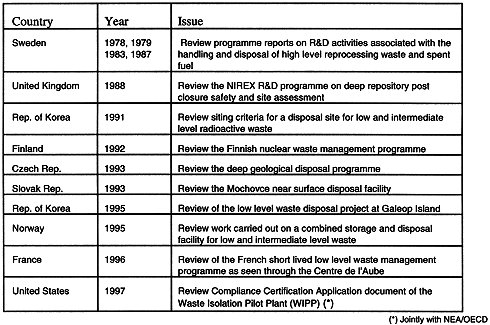
In the past several WATRP reviews were organized. These reviews dealt with general waste management programmes, disposal of low and intermediate level wastes and of high level wastes (see Table below). Eight of the thirteen WATRP reviews dealt with geological disposal of long-lived or/and high level radioactive waste. This illustrates that especially for geological disposal peer review seems to be an appropriate tool to increase or enhance confidence. The Table illustrates that the frequency of the reviews increased in recent years. Recent reviews dealing with geological disposal are discussed in more detail (Finland, Czech Republic and USA). This discussion allows to get a better understanding of the mechanisms involved in and of the type of output and effects of the WATRP-reviews.
Table I. WATRP Reviews Organized by the IAEA
Finland
In November 1992 the Finnish Ministry of Trade and Industry requested a review of the Finnish radioactive waste management programme mainly on the work being done in siting and building an encapsulation facility for spent nuclear fuel and siting and constructing a co-located repository. This review also included:
A review team of four experts from Canada, Belgium, Germany and Switzerland was set up to carry out this review. During the early summer of 1993, the team reviewed a large amount of documentation supplied by the Finnish industry, government and research organizations. In August 1993 the review team had a meeting in Helsinki in which detailed discussions were held with many staff members of several Finnish organizations involved in radioactive waste management. The review meeting included a site visit to Olkiluoto. The review team's recommendations are detailed in a report which has been published by the Finnish Ministry of Trade and Industry [3].
The review team was very impressed with the high standard of work being done in Finland and noted that although the Finnish nuclear power programme is quite young compared with that of many countries, Finland has had some notable successes in developing its radioactive waste management technologies and capabilities. It was also noted that Finnish scientists participate in many international working groups and committees in an effective fashion, both contributing to the international understanding of a difficult subject and obtaining increased knowledge which they can apply to their own national programme.
In many instances, the review team recommended that the Finnish organizations continue what they have been doing. In some instances new or different action was recommended. For example, the review team recommends that a full scale steel-copper canister such as the one being proposed for use in the repository can be identified as early as possible in the programme. The review team saw these as crucially important recommendations which, when carried out, will either stimulate changes in the conceptual design or bring greatly increased confidence in the design's feasibility.
Other recommendations were that:
The methodology used by the applicant in the initial preliminary safety reports was reviewed by the review team and found to be satisfactory. The review team noted that some of the data used in the preliminary report were of a generic nature. This is quite acceptable at the preliminary stage, although the data will need to become site specific for the final report. The review team also noted the prodigious amount of work performed within the site characterization programme and urged that the same effort and quality be continued.
At the end of the review meeting the Finnish Ministry of Trade and Industry arranged a press conference in order to discuss the results of the WATRP review. The press conference was well attended and the review of the Finnish radioactive waste management programme found a broad and positive coverage in the Finnish newspapers.
Czech Republic
In May 1993, the State Office for Nuclear Safety of the Czech Republic requested a review of the programme for the development of a deep geological repository. The main task was the assessment of the planned research and development programmes which have been outlined in the report "Programme of development of deep geological repository", funded equally by the Czech and Slovak power companies.
This study is limited to the deep underground geological disposal of high level and long lived low and intermediate level waste and described the planned technical programme for the disposal of this waste. As the deep geological disposal programme is just being initiated and is therefore at quite an early stage of development, the review has been limited to considering the general approach to the development of such a repository rather than to carrying out a detailed critique of methodology and experimental procedures. It was intended to have a calibration of the national programme against international levels at a very early stage.
The review team of five experts from France, Germany, Sweden, Switzerland and the USA evaluated the relevant documents supplied by the Czech Republic and had a meeting with Czech and Slovak scientists and engineers. This meeting in November/December 1993 included a visit to the Litomerice-Richard II repository for institutional radioactive waste. The review team recognized the knowledge and dedication of the Czech and Slovak scientists and engineers and encouraged them to continue with their co-operation. However, the review team regretted that they have been isolated from international co-operation and projects for the development and refinement of repository studies.
The review team made various recommendations with regard to the legal framework and organizational structure, in particular the necessity for a definitive separation between the operational and regulatory functions. The review team also recommends that the responsibilities of the State, the regulatory body, the waste generators and the operator of the disposal facility be clearly defined. The review team did not address the question of who should be responsible for such work. This was deliberately done in a conscious attempt to avoid interference with the still developing programme. It also recommends that a comprehensive set of regulations be prepared to include clear guidance on the responsibilities and limits of each party in the national HLW disposal programme. Assignment of responsibilities for specific research and development tasks should be considered a priority. The need to establish an unambiguous method of funding the national programme is emphasized.
Technical recommendations made by the review team include the need to obtain the maximum possible information from international experience, particularly on the design of waste packages, the design of geological repositories, underground test facilities, backfill and closure techniques and the use and validation of computer codes for safety assessments. It is recommended that dose/risk criteria appropriate to the chosen repository site be established in line with international practice. It was also recommended that the establishment and implementation of a programme of quality assurance be given priority. A quality assurance programme is an essential part of the regulatory framework.
The need for public interaction and involvement in the development and licensing of the disposal facility was highlighted.
The results of the review, including the recommendations of the review team, have been summarized in a report that was submitted to the State Office for Nuclear Safety for use at its own discretion.
USA
In January 1996, DOE Carlsbad Area Office (DOE-CAO) requested the IAEA and the NEA of OECD to jointly organize an international review of the 1996-post-closure performance assessment as described in the Compliance Certification Application (CCA) for the Waste Isolation Pilot Plant (WIPP), documented in a report issued in October 1996 [5]. After the general terms were accepted DOE-CAO, NEA and IAEA agreed upon the terms of reference for the peer review. A review team of seven international experts (Canada, Germany, Japan Spain, Sweden, and the UK) and representatives of the two international agencies was established as the review team. The review included an examination of the relevant parts of the CCA, a visit to the WIPP site and focused discussions between the review team and DOE staff and contractors.
The review team examined the contents of the CCA and the work documented in it, in accordance to the terms of reference, from the point of view of:
In its evaluation and conclusions the review team made the statement of fact that the WIPP project, and the CCA, are different in several respects from geological disposal projects and assessment documentation, in other countries and that these differences have been taken into account in formulating its conclusions.
The review team further concluded that:
The review team considered that by commissioning this review the DOE has demonstrated a commendable openness and commitment to improving confidence in the performance assessment of the WIPP facility.
The review team identified areas where improvements could be made in future iterations of assessments viz. in 1 / the assessment of the implications of the use of MgO backfill, and 2/ the assumption of reaching homogeneous conditions within the disposal rooms.
It was learned that DOE-Carlsbad commissioned further work in these areas to provide additional confidence in the technical basis for the performance assessments.
The peer review report was distributed by the requesting organization to the WIPP stakeholders and was made available to the public.
FINAL REMARKS
Countries or organizations considering to calibrate their programmes or approaches in the area of radioactive waste management with the international level of experience have shown to benefit from IAEA's WATRP peer reviews as described above. The area of geological disposal seems to be a particularly well determined area of interest for peer reviews since the interpretations and decisions to be made in this area are facing significant uncertainties, a complex system, and untried, unproven or non reproducible methods. However, experience is growing in some fields in this area and detailed technical criteria and standards are being developed internationally and in several countries. The comparison of a country's or organization's programme and activities in geological disposal with regard to these criteria and standards and the growing international experience are becoming more important dimensions in these reviews.
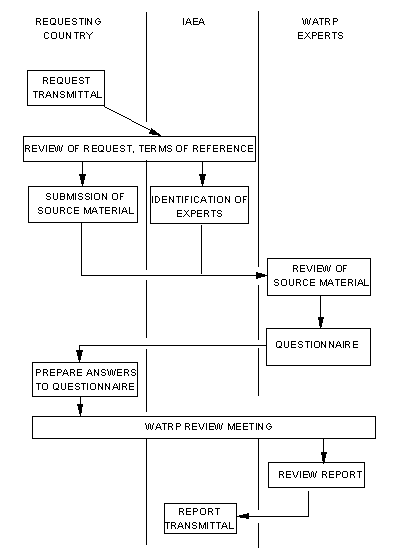
Fig. 1.
REFERENCES
BACK