THE WASTE MANAGEMENT PROGRAMMATIC
ENVIRONMENTAL IMPACT STATEMENT IS DONE,
SO LET'S TALK ABOUT DECISIONS
Karen C. Guevara
U. S. Department of Energy
ABSTRACT
The Department of Energy Final Waste Management Programmatic Environmental Impact Statement was issued on May 30, 1997. It analyzed alternative configurations of the Department's sites for managing five types of radioactive and hazardous wastes in support of future decisions for each waste type: low-level mixed waste treatment and disposal; low-level waste treatment and disposal; transuranic waste treatment and storage; high-level waste storage; and hazardous waste treatment. The WM PEIS considered existing waste and waste projected over a 20-year period at 54 of the Department's sites, with 17 sites analyzed as "major" sites to host treatment, storage and disposal activities.
The Final WM PEIS identified the Department's preferred alternatives for each of the waste types analyzed and discussed the criteria used for their selection. The preferred alternatives will serve as a basis, along with other relevant information, for developing separate Records of Decision for each waste type. Discussions with States, Tribal and regulatory officials and other concerned stakeholders is an important feature of the decision process. This paper describes the status of those discussions, current issues being addressed, the status of each anticipated Record of Decision, and the relationship that the Records of Decision will have to other planning and decision making initiatives for the Waste Management Program.
INTRODUCTION AND BACKGROUND
Conferees at Waste Management '97 may recall that the Department of Energy (DOE) was about to launch the Final Waste Management Programmatic Environmental Impact Statement (WM PEIS). At last year's conference, the analytical results of the study were summarized, along with an overview of the changes to the Draft WM PEIS resulting from an extensive analysis of public comments, and the criteria being used to select the Department's preferred alternatives1.
Issued on May 30, 1997, the Final WM PEIS is a Department-wide study examining the potential health, environmental, and cost impacts, over a 20-year period, of strategic management alternatives for five types of radioactive and hazardous wastes. This study will support specific programmatic decisions DOE needs to make for each waste type:
The creation of DOE's Environmental Management (EM) Program in 1989 was a hallmark in the Department's shift in emphasis from weapons production toward environmental cleanup and effective waste management. Initiated in 1990, the WM PEIS provided much of the early analytic work to help focus the EM program. The WM PEIS took one of the first steps, and continues to represent the most significant progress, toward one of today's most important goals for EM -- program integration.
The WM PEIS compares dozens of alternative, integrated programmatic configurations of DOE sites for managing each waste type in terms of their potential health and environmental impacts on waste management and transportation workers, as well as the general public residing in the vicinity of the sites, estimated at a total of over 50 million people. These alternatives fall into four broad categories.
No Action alternatives are generally consistent with current practice and serve as a baseline against which the action alternatives can be compared. Decentralized alternatives evaluated waste management activities generally at the sites where the waste is or will be generated. Regionalized alternatives consolidate waste management operations at a few sites throughout the nation and typically require more transportation of the waste than do the decentralized alternatives. Centralized alternatives consolidate waste management operations at fewer sites than regionalized alternatives, typically one to three sites, and require more transportation of the waste than do the regionalized alternatives.
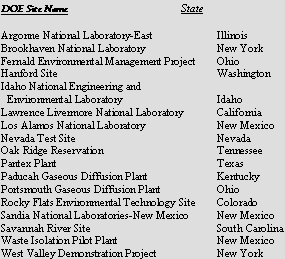
Fifty-four DOE sites were considered, with 17 major sites evaluated as host sites for waste management activities. Table 1 lists these sites and the states in which they are located.
Table 1. Management Activities in the WM PEIS
Although the Department will use the WM PEIS in making programmatic decisions about the nation-wide configuration of sites for waste management, it will not decide the specific location, construction and operation of any new facility at a site selected to host waste management activities until appropriate site-wide or project-specific environmental impact review is completed.
FINAL WM PEIS PREFERRED ALTERNATIVES
The Final WM PEIS identifies the Department's preferred alternatives for each of the waste types analyzed and discusses the criteria used in their selection. The preferred alternatives will serve as starting points, supplemented with other relevant information and considerations as appropriate, for developing separate Records of Decision for each waste type. The preferred alternatives identified in the Final WM PEIS for DOE sites are as follows. They do not preclude any sites from using commercial facilities for treatment, storage, or disposal activities.
Low-level Mixed Waste
:Treatment. The Department's preferred alternative reflects the configuration established under the Federal Facility Compliance Act. In general, sites would be responsible for treating their own low-level mixed waste, although some sites would send their mixed low-level waste to other DOE sites for treatment. The sites that would receive these wastes and treat them under the Department's preferred alternative are the Hanford Site, Idaho National Engineering and Environmental Laboratory, Oak Ridge Reservation, and Savannah River Site.
Disposal. Sites would send their mixed waste to regional disposal sites after it is treated. After consultations with State Tribal and other stakeholders, the Department plans to select two or three preferred sites from six DOE sites -- Hanford, Idaho, Los Alamos, Nevada Test Site, Oak Ridge and Savannah River -- although DOE may also use commercial disposal facilities, consistent with the DOE Radioactive Waste Management Order and policy. Following consultations, the Department will notify the public which specific sites it prefers for disposal of mixed waste by publishing a notice in the Federal Register. The Department will not issue a Record of Decision selecting any regional disposal sites for mixed waste until at least 30 days after the publication of its preferred sites for mixed waste disposal sites in the Federal Register.
Low-level Waste
:Treatment
Disposal. Sites would send their low-level waste to regional disposal sites after it is treated. After consultations with State, Tribal and other stakeholders, the Department plans to select two or three preferred sites from the six DOE sites -- Hanford, Idaho, Los Alamos, Nevada Test Site, Oak Ridge and Savannah River -- which currently dispose low-level waste. DOE may also use commercial disposal facilities. Following consultations, the Department will notify the public of which specific sites it prefers for disposal of low-level waste by publishing a notice in the Federal Register. The Department will not issue its Record of Decision selecting any regional disposal sites for low-level waste until at least 30 days after publication of the preferred sites in the Federal Register.
Transuranic Waste
:Treatment and storage
High-level Waste
:Storage
Hazardous Waste
:Treatment
STATUS OF DECISIONS BASED ON THE WM PEIS
Transuranic Waste Treatment and Storage:
The Department issued its first Record of Decision under the WM PEIS, for the treatment and storage of transuranic waste, in January 1998. It was developed in coordination with the Record of Decision prepared under the Waste Isolation Pilot Plant Disposal Phase Supplemental Environmental Impact Statement-II that was published in late 1997. Both Records of Decision can be obtained from EM's Center for Environmental Management Information and are on the Internet at:
http://www.em.doe.gov/em30/
The Record of Decision under the WM PEIS calls for preparing transuranic waste for disposal at WIPP and storing it on site until it is shipped for disposal. This means that each DOE site will treat, as needed, including packaging, and store its own transuranic waste where this waste currently exists or will be generated. The exception is that the Sandia National Laboratory-NM will ship its transuranic waste to the Los Alamos National Laboratory for treatment and storage until the waste is shipped to WIPP.
The potential impacts of this decision are identified in the WM PEIS Decentralized Alternative. The site configuration resulting from this decision differs from the configuration which would result under the preferred alternative identified in the WM PEIS, because it does not include intersite transfers of transuranic waste, other than from Sandia to Los Alamos. More recent information than was available when the preferred alternatives were prepared indicates that decisions regarding other intersite transfers of transuranic waste should await the completion of additional ongoing environmental reviews and transuranic waste characterization efforts.
The Record of Decision explains these differences and also notifies the public that DOE's Idaho, Oak Ridge, Savannah River and Hanford sites potentially could receive, in the future, transuranic waste from other sites for treatment and storage. Although the Department does not currently expect to transfer any other sites' transuranic waste to any of these four sites, such future transfers could be required if it becomes impractical to use mobile treatment facilities or to construct fixed treatment facilities at a DOE site having transuranic waste in order to prepare it to meet the waste acceptance criteria for disposal at WIPP. In that case, the Department would amend its WM PEIS Record of Decision to allow such a site without a treatment capability to transfer its transuranic waste to one or more of these four sites for treatment to meet WIPP waste acceptance criteria. These future decisions would be subject to appropriate review under the National Environmental Policy Act and other applicable regulatory requirements and to agreements between the Department and States regarding waste management activities. Development and implementation of these decisions would be coordinated with appropriate State, Tribal and local authorities.
The Department expects to issue decisions for the remaining four waste types beginning this calendar year. The current status of decision making for each waste type is as follows, in relative order of the expected timeframes for completing the necessary deliberations and discussions.
Hazardous Waste Treatment
:The Department expects to issue the Record of Decision for hazardous waste treatment in early to mid-1998.
High-level Waste Storage
:The Department is evaluating the merits of a proposal to allow high-level waste canisters from West Valley, New York to be transported to and stored at the Savannah River Site in South Carolina, to allow the Department to complete its cleanup activities at West Valley and close that site by the year 2006. Although the Department currently expects to issue its decision on where to store immobilized high-level waste in 1998, DOE will not issue its decision until completion of discussions with appropriate South Carolina and New York State officials.
Low-level Mixed Waste and Low-level Waste Treatment and Disposal
:The Department is currently considering options for issuing Records of Decision for the treatment and disposal of low-level mixed waste and low-level waste that include a single decision document for both waste types, although this approach has not been finalized.
Nevertheless, disposal decisions will be developed in parallel for both waste types due to the similar needs for technical, program and policy deliberations.
Many stakeholders have expressed interest in DOE's disposal decisions for low-level mixed waste and low-level waste. The WM PEIS preferred alternative was developed in response to their input. This preference is to narrow the range of preferred disposal sites after discussions with States, Tribal leaders, regulatory officials, and other concerned stakeholders. The Department is currently developing a consultation or discussion process that emphasizes ample opportunity for concerned stakeholders to provide input to the nature of the process itself as well as to the identification of preferred sites for disposal. Key features of this process will include:
STATUS OF DISCUSSIONS ON FUTURE DECISIONS FOR LOW-LEVEL MIXED WASTE AND LOW-LEVEL WASTE
In July 1997, DOE officials met with state regulators and Governors' representatives through the National Governors' Association, to kick off the process for selecting disposal sites. The state representatives at that meeting recommended that the Department propose a preferred configuration for further discussion. DOE has adopted the recommendation and is preparing a proposal, including potential options, within the alternatives analyzed in the WM PEIS, for discussion with state representatives and other stakeholders later this year. The discussions will include information on the criteria used in developing the proposal.
Issues to be Addressed
:DOE plans to share information about such issues as those associated with baseline data used for planning, transportation of wastes required for proposed treatment and disposal configurations, status of funding, and regulatory oversight. DOE will use a tiered approach to ensure that national, regional and local or site-specific issues and concerns from stakeholders are included in the information exchanged.
To date, the Department has hosted or attended numerous national and site-level forums to present information on the Department's upcoming waste management decisions and ensure that all affected parties have the early opportunity to provide input to the development of the discussion process. This includes initial meetings with DOE's Site Advisory Board Chairs, the State and Tribal Working Group, the Transportation External Coordination Working Group, and the national dialogue workshops held across the country last summer and fall. DOE is continuing to refine the discussion process and expects to meet again with these groups, the National Governors' Association, state regulators and other concerned stakeholders over the coming months.
Timing for issuance of the final Records of Decision for low-level mixed waste and low-level waste will depend in large part on providing sufficient time for the discussions to take place. Regardless of whether complete consensus among all participants across the country is achievable, DOE's objective is to develop the decisions within a process that is reasonable, open and fair. The Department expects to commit appropriate time as needed to meet this objective.
RELATIONSHIP OF THE WM PEIS TO OTHER FEATURES OF THE PLANNING AND DECISION PROCESS
WM PEIS Records of Decision and EM's 2006 Plan:
The Environmental Management program has been pursuing plans for an accelerated cleanup effort of the Department's sites through the year 2006. Accomplishing the identified goals will require integration among the sites. Though each the sites and laboratories is unique in their capabilities, their problems are often shared throughout the complex -- how to best treat, store and dispose of various types of radioactive and hazardous wastes and bring contaminated sites to acceptable cleanup levels. In June 1997, DOE developed a discussion draft, "Accelerating Cleanup: Focus on 2006" (the 2006 Plan), to describe how DOE sites can integrate existing capabilities to accomplish the EM mission more efficiently.
The 2006 Plan is not itself a decision making document. Rather, it incorporates and reflects decisions made through DOE's established decision making processes. These processes include Congressional authorization and appropriations which provide specific direction and allocate funds for carrying out DOE's programs; legally binding compliance agreements and consent orders; and public involvement through the National Environmental Policy Act -- NEPA. As WM PEIS Records of Decision are issued, decisions will be reflected in sites' 2006 Plans and baselines.
WM PEIS Records of Decision and Ongoing Transportation Activities
:DOE has, and will continue to, transport waste and materials. Attention has recently been focussed on building upon the Department's extensive transportation program of past years to integrate DOE's transportation management. The objective is to provide a consistent approach to safety, routing, emergency response training, and notification. To the extent that waste management decisions involve sharing treatment and disposal capabilities among sites, transportation would be a major factor in implementation planning. Thus this integrated focus will significantly affect the implementation of the WM PEIS Records of Decision.
Elements of this initiative include:
Any waste transfers resulting from Waste Management PEIS decisions may be subject to these protocols.
SUMMARY
In progress since 1990, the WM PEIS has not only been published, the first Record of Decision, for the treatment and storage of transuranic waste, has been issued. Today, the WM PEIS is providing a base on which to develop integrated waste management strategies across the complex of DOE sites. These strategies in turn will be a fundamental part of the framework for decisions that help shape the Department's Environmental Management program into the next century.
REFERENCES
1. "Now, What Does DOE Do With It? Results of the Final WM PEIS;" Waste Management '97 Conference, David F. Hoel, U. S. Department of Energy, et. al.