DECOMMISSIONING PROJECT AND WASTE MANAGEMENT
OF THE AVR REACTOR AT JÜLICH
R. Theenhaus, C. Marnet, S. Storch, J. Wahl
FZJ
Germany
ABSTRACT
Nine years after reactor shutdown, the AVR reactor contains an activity inventory of 2.5· 1015 Bq, of which 70% is formed by nuclides with a half-life >10 a. The disposal of this activity, as part of the dismantling of the reactor, involves a waste volume of 5,000 m3. The waste management concept for the 1st step, safe enclosure and a first draft on waste treatment during total removal of the AVR reactor, as the 2nd step, are described in the following.
INTRODUCTION
The AVR, a high-temperature reactor (46 MWth, 15 MWel) with spherical fuel elements, was operated as an experimental facility from 1968 to 1988. In March 1994, the AVR Experimental Reactor Group received a licence to create safe enclosure.
For reasons of radiation protection, the scope of dismantling was increased by amendments to this licence.
Only the reactor vessel with its internals, the containment, the reactor building and the turbine hall will remain in safe enclosure. The enclosure time for the reactor is anticipated to be 30 years.
A reference concept for dismantling the AVR reactor and restoring the green field site has been developed by a consortium of firms. A decision to continue the work is expected for 1998/99. If the decision should be merely taken for safe enclosure, then the infrastructure, largely consisting of:
will be demolished in about the year 2002. Later, after 30 years of safe enclosure, these systems would have to be reconstructed.
The solid and liquid waste will be treated at the Research Centre Jülich where the necessary facilities are available, e.g. evaporator, incinerator, high-pressure press and interim storage facility.
The type and volume of the material and radioactive waste arising during total removal as well as its economical treatment are of great interest and influence the total cost. Experience at the AVR and the Research Centre within the framework of disassembly for safe enclosure is important for these considerations.
THE RADIOLOGICAL SITUATION
Knowledge of the radiological conditions and their causes is necessary to understand the type and scope of waste and residual materials.
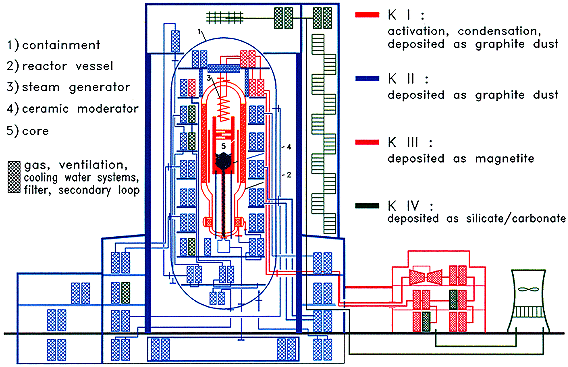
From the aspect of existing contamination, the AVR reactor can be divided into 4 zones (Fig. 1). The 4 contamination zones differ in their
Fig. 1. AVR Contamination Zones
Table I gives an overview of this situation for the AVR reactor.
Table I. Conditions of Contamination
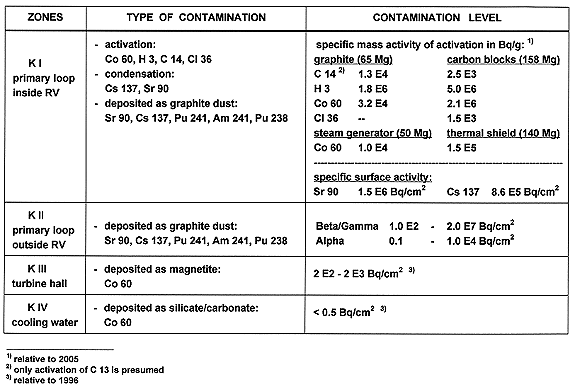
The contamination conditions are based on special features of the AVR reactor for structural or operational reasons. The activity level of the ceramic moderator material of the reactor vessel is relatively high for the nuclides Co 60, H3 and Cl 36, since not only pure reflector graphite was installed but also highly impure carbon blocks.
A further example of the design affecting the contamination of the AVR reactor is the thin neutron shielding of the reactor in the vertical direction so that the steam generator and the cooling water systems installed above were activated. Due to corrosion of the inside surfaces, the activation products were distributed to the secondary system and the cooling water circuits.
The high contamination with fission products such as Sr 90 and Cs 137 also has an operational background. A large variety of different fuel element types were tested in the AVR reactor. One batch of fuel elements released Cs 137, another Sr 90 and Eu 154/155. The entire contamination zones KI and KII have been contaminated with these nuclides. The nuclides were deposited in vapour form and with graphite dust.
The graphite dust was mainly produced by friction of the spherical fuel elements on their way through the reactor core.
As a consequence of untightnesses, the light graphite dust was able to contaminate regions outside the gas systems so that all plant components and structures in the containment became contaminated.
Due to the high level of system contamination, the secondary waste accounts for approx. 60% of the waste volume. During the 1st step, about 1,000 m3 of contaminated waste water will arise as well as a large number of safety tents and fully protective suits. The staff will have to wear fully protective clothing for most disassembly, dismantling and decontamination work. The graphite dust, which is the reason for the contamination, has a specific activity of approx. 2·107 Bq/g for Sr 90 as the most critical nuclide.
WASTE TREATMENT IN THE 1ST STEP
The defueling is nearly finished, only approx. 10,000 fuel elements are still in the reactor. The installations in the turbine hall, the cooling water system, the cooling towers and the cooling gas store in the annular extensions have been disassembled, as well as the shielding structures (100 Mg) of heavy concrete and sand-lime bricks, which have been directly emplaced in a repository as radioactive waste. About 144 m3 of insulating material was volume reduced at the Research Centre by high-pressure compaction for final disposal of 5 m3.
The disposal path for the waste and residual material will already be defined before disassembly.
The turbine hall was cleared in three disassembly steps. First plant components with surface contamination below the limit values , e.g. generator, electric motors, cables etc., were first dismantled, then plant components from contamination zone KIV and finally the secondary loop. This sharp separation enabled AVR to assigne the nuclide vectors, required for clearance measurements, to the residual materials.
Altogether 90 Mg non-metallic and 280 Mg metallic residual material have been measured for free release in the last 3 years.
The limit values for clearance are
The radioaktive metallic residual material can be melted if the specific activity is < 200 Bq/g.
If it can be expected, that the specific activity is higher than 0.1 Bq/g after melting, the material is melted in form of granule. The granule can be recycled in the nuclear industrie as shielding in containers or for the production of cast-iron and heavy concrete containers. If the expected specific activity is below 0.1 Bq/g after melting and therefore the material can unrestrictedly be recycled, it is melted into ingots. This path is open to material from contamination zone KII, where nuclides such as Sr 90 and Cs 137 for account for more than 96% of the activity and which evaporate during melting and are condensed in the slag. Experience shows that a decontamination factor of 1000 is possible by melting KII residual materials. This means that all metallic KII residual materials arising from the 1st step, which can be decontaminated economically below 200 Bq/g (about 700 Mg), can be delivered to the scrap trade as non-radioactive material after melting.
Repository acceptance conditions require accountancy for more than 70 nuclides. The limit values for nuclides of relevance for AVR waste are very low, which means that, for example, slag/ash waste from incineration at the Research Centre cannot be transferred to the repository due to its enrichment with uranium and thorium isotopes or with long-lived nuclides such as Zr 93, Tc 99 and Sn 126. In the case of supercompacted waste, however, the C14 and H3 nuclides are of significance although they only account for 2% of the total beta activity.
The low limit values and the situation that the AVR waste containing a large number of nuclides critical for final disposal necessitate systematic sorting and characterization of the various waste types.
The computer program installed at all German nuclear power plants, i.e. the AVK system (system for tracking the waste flow and for product control), documents the waste in transit and at all treatment and storage locations.
All waste to be treated is conditioned in the Research Centre's facilities (Fig.2). Liquid waste is vaporized and the product dried. Combustible solid and liquid waste is incinerated. Intermediate products, such as granular material and ash, are later pressed into pellets. The total volume of waste after conditioning is estimated to 850 m3 for the 1st step.
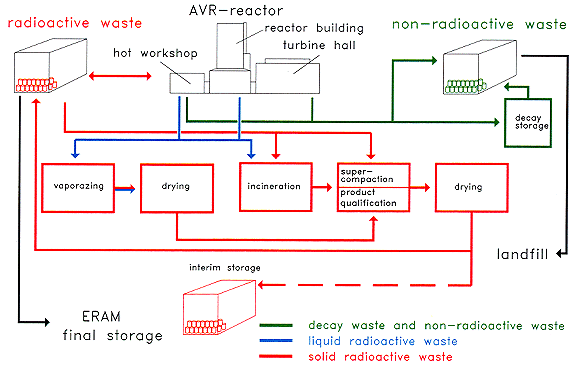
Fig. 2. Treatment of Radioactive Waste
Treatment of the metallic residual materials is carried out by the Research Centre and AVR in a labour share out. Large components from the turbine hall, such as turbine, condenser, pumps etc., as well as less highly contaminated components from the containment are disassembled and, if economic, decontaminted at the Research Centre. Accordingly high contaminated components are treated at AVR.
WASTE MANAGEMENT FROM DISMANTLING TO RESTORATION OF THE
GREEN FIELD SITE, 2ND STEP
In contrast to the 1st step, where Sr 90, a pure beta emitter is dominant, the gamma emitters Cs 137 and Co60 are of significance here for disassembly and disposal. Disassembly of containment internals will have to be performed by remote-controlled manipulator technology. According to plans, the steam generator, ceramic internals and thermal shield will be disassembled from top to bottom.
The metallic KI residual materials contain Cs137 diffused into the material and are thus also activated. In many cases, they are only to be disposed of as radioactive waste. Due to the high specific activity suitable packaging is required for KI residual materials (Table 1).
In compliance with an optimum volume ratio, a special procedure is envisaged for packaging the most highly contaminated components, i.e. the steam generator and thermal shield. Cast-iron containers are to be used which after loading at AVR will be transported to an appropriate foundry. The remaining void space will be filled with weakly contaminated steel to achieve the required shielding. The steam generator (50 Mg) could thus be packed in 25 cast-iron containers ready for final disposal. The number of cast-iron containers required for the 140 Mg thermal shield would only be slightly greater since it has a very favourable geometry for packaging.
Waste management of the ceramic internals presents a very special problem. The activity values given in Table 1 are based on calculations as well as analyses of the carbon blocks and represent maximum values of different, very contradictory contamination values.
In order to clarify actual conditions, it is planned to take samples from the region of the carbon blocks and the reflector graphite and to analyse these samples. The samples can be obtained by drilling a hole through the side reflector at the core, which is planned for 1998.
The activities of C 14 and Co 60 nuclides are decisive for the management strategy for the ceramic internals. Three disposal paths are possible:
None of these options is completely unproblematic.
Path 1 is the most expensive due to the large number of cast-iron containers but it can be completed fast.
Path 2 is cheaper than path 1 because interim storage is possible without major expenses.
Path 3 is the cheapest path if incineration and the associated emission of 1.3· 1012 Bq of the C 14 nuclide is approved.
SUMMARY
Special solutions are required to keep the costs of waste management for the AVR reactor within reasonable limits. Experience with such solutions is available for the 1st step but lacking for the 2nd step. Disposal of the residual materials does not pose any technical problems. However, the issues to be clarified must be resolved in the near future. Waiting for the activity inventory to decay is not of interest for the AVR since nuclides with half-lives of >12a and >30a are relevant for disassembly and waste management.