WASTE MANAMGEMENT AND DECOMMISSIONING OF
VVER-REACTORS IN GERMANY
Leushacke, Dieter F., Dr
Energiewerke Nord GmbH
Germany
ABSTRACT
At the Greifswald site, the Energiewerke Nord are performing the world´s largest decommissioning project. To this end, it is necessary to combine the experiences from the operation of the nuclear power plants on the site, from the decommissioning of other nuclear power plants, from waste disposal, project management and the licensing procedures for the decommissiong of nuclear power plants.
The experience has shown that the dismantling of nuclear facilities is basically not a technical problem but a challenge to project management and logistics. It becomes obvious that the dismantling and disposal of nuclear facilities is a normal process of economic activities.
GREIFSWALD SITE
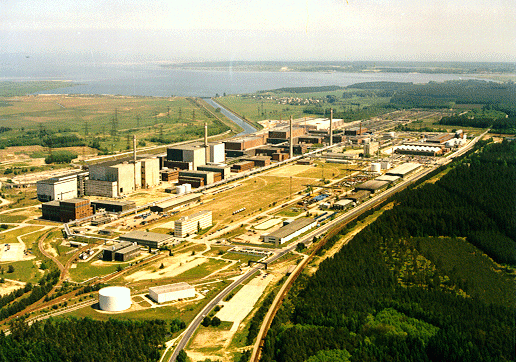
At the Greifswald site (KGR), there are in total 8 reactor units of the Russian pressurized water reactor type VVER 440. The units 1-4 are of the model 230 and the units 5-8 of the more recent model 213. There are also a wet storage for spent fuel, a warm workshop and additional buildings for the treatment and storage of radioactive waste (see fig. 1).
Fig. 1. Site
After the reunification of the German States, the 4 operating units of the Greifswald Nuclear Power Plant were shut down, the trial operation of unit 5 and all construction work for the units 6-8 were stopped. Investigations in view of the reconstruction of some units showed no acceptable economical solution. Finally, in 1990 the decision was taken to decommission the units 1-4, followed by the same decision for unit 5 in 1991.
The license for the decommissioning of the overall plant and for the dismantling of plant parts was issued on 30 June 1995. The dismantling works in the turbine hall units 1-5 and in the controlled area of unit 5 have started in October 1995.
STRATEGY
The possibilities for an immediate dismantling or a safe enclosure have been investigated. The decision for an immediate dismantling was taken based on financial and radiological factors.
The timely planning on the basis of a thorough technical and radiological registration of the plant and the organization of the overall waste management, covering the facilities for the treatment of residual material and waste as well as buffer and interim storage for the large amount of produced masses, are an absolutely necessary precondition for a successful project. Due to the limited reopening of the final disposal site in Morsleben (ERAM) and the lack of long term disposal possibilities in Germany, the Interim Storage North (ISN) on site - under construction since 1992 - as an independent integrated treatment and storage centre will become of central importance for the waste management scheme. The fuel elements will be loaded into CASTOR casks and transferred to the ISN for dry storage.
LICENSING
The licensing procedure is based on the conditions laid down in the decommissioning license issued 30 June 1995 (License for the decommissioning of the overall plant and for the dismantling of plant parts). The further dismantling of plant parts will be applied for step by step according to §7 (3) of the Atomic Law. The scope and time schedule is determined by the proceeding of the overall project and its optimisation. So, the consistent use of personnel capacities, a continuous planning work and the continuity in the licensing procedures and in-process control can be guaranteed.
According to the present project status, it can be distinguished between the following 7 license applications for the dismantling of plant parts:
Due to its relatively low activation, the reactor of unit 5 which was only in trial run will be transported in as large as possible parts (complete internals, reactor pressure vessel as a whole) to the ISN. It is assumed that a public hearing, it at all, will only be required by the authorities for the application of the remote dismantling of the reactors 1-4.
WASTE MANAGEMENT
Obviously, prevailing laws and regulations (Atomic Law, Radiological Protection Ordinance etc.) must be strictly followed. The removal of the fuel and operational waste is a precondition for the decommissioning and the subsequent dismantling. In order to be able to handle and treat the enormous mass flow, it is necessary to plan and install the waste management facilities at an early project state.
The waste management concept is mainly based on the following frame conditions and principles:
Fuel Elements
After the shut down of the plant in 1990, there were 5037 spent fuel elements - 3 of them are defect - and 860 fresh fuel elements on the Greifswald site. At this time, 1011 fuel elements were in the reactors, 1628 in the cooling ponds of units 1-5, and 2398 were stored in the wet interim storage.
The fuel elements from the reactors and the cooling ponds have been transferred as far as possible to the wet fuel storage. At present it contains 4547 fuel elements. The license for this storage (§6 Atomic Law) is valid according to § 57a of Atomic Law until 30 June 2000. Thus, the fuel elements have to be removed until this date. The will be loaded into CASTOR casks and stored in the Interim Storage North.
At present (December 97) there are 3 CASTOR casks with 252 fuel elements in unit 3 and 3 defect fuel elements in units 1/2. A part of the low burn-up fuel (235 elements) has been sold to Hungary (paks NPP). The 860 fresh fuel elements have been sold (231 fuel elements to Slovak Republic, 358 fuel elements to Chech Republic and 271 fuel elements to the USA).
In contrary to Western fuel elements, the Russian VVER 440 fuel elements are of hexagonal shape (width over flats of hexagonal nut 144 mm) with a length of 3217 mm. The total weight of a fuel element is approx. 220 kg, the share of Uranium is 121 kg.
For the dry storage of these fuel elements, inside adapted CASTOR casks will be used. This CASTOR type 440/84 can accomodate 84 of these fuel elements and has a weight of 116 Mg after loading.
Operational Waste
The already produced radioactive operational waste and the waste which will be generated during post and site operation has to be disposed off. Meanwhile (December 97), approx. 2487 m³ of conditioned waste could be disposed off in Morsleben (ERAM). Until the mid of 2000 (present expiration of the operational license in Morsleben) it is expected to store approx. 2500 m³ per year.
Included here are activated and high-contaminated solid waste, low-active and medium-active resins as well as liquid evaporator concentrates, sludges and sludge-resin mixtures, sludges from outside the controlled area, low-activated resins in the turbine hall and solid radioactive mixed waste in storage bunkers as well as in temporary buffer storages.
The major part of this operational waste can be treated by common conditioning techniques. For this purpose, the following facilities and devices are available on the Greifswald site: rotational thin film evaporator plant (max. 400 l/h), drum drying facilities, equipment for drying of ion exchanger resins, compaction facility (20 Mg), sorting facilities, and high efficiency suction devices for granular material.
After treatment and conditioning, the mentioned waste will be transported to the ERAM facility and disposed off there.
DECOMMISSIONING WASTE
Inventory
For the planning, it was absolutely necessary to record the actual state. This particularly includes the registration of masses and materials, dose exposure rates in the plant rooms and of the components as well as the preparation of a contamination catalogue.
In total, 1 800 000 Mg of material will be produced during the decommissioning of the Greifswald plant. The definitively non-radioactive and restrictless masses can be treated as conventional residues and utilized or removed according to the valid waste regulations. The remaining 570 000 Mg have to be classified as radioactive residuals or possibly contaminated material and must be treated accordingly. The resulting material flow in this dimension is unique and tremendously difficult to manage it logistically. Figure 2 shows an overview of the mass and activity flow during the decommissioning and their prospective classification to the disposal objectives.
The activity inventory of the Greifswald site in 1990 excluding spent fuel was approx. 3.5 E 17 Bq. The share of activated components is 99%. The remaining percentage includes the operational waste, contaminated plant parts, and the building structures of the controlled areas.
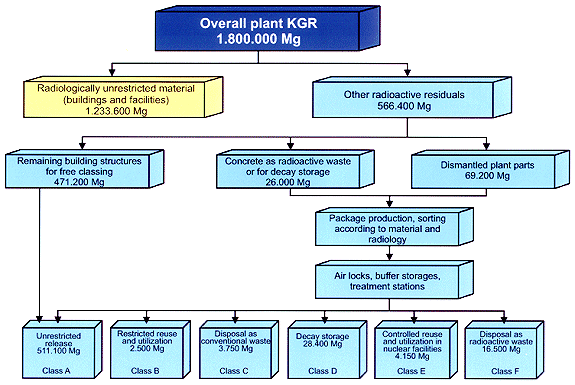
Fig. 2. Mass Flow at Greifswald Site
Disposal Objectives
The timely definition of the disposal objectives under inclusion of the collection and sorting of the produced masses and their classification makes it possible to proceed systematically and to reduce the amount of radioactive waste. It is distinguished between the following classes:
|
Class A |
Free release |
|
Class B |
Reuse |
|
Class C |
Disposal as conventional waste |
|
Class D |
Decay storage |
|
Class E |
Reuse in nuclear facilities |
|
Class F |
Disposal as radioactive waste |
The limit values for the classes A, B and C are an integral part of the license for decommissioning from 30 June 1995.
TREATMENT AND STORAGE
After the dismantling, the plant parts will be sorted and packed in appropriate packages for further treatment and storage. Geometrically homogeneous parts or individual large components can also be declared as a package. Immediately after the package is ready, it will be provided with a routing card with all important data for registration and tracking of the package over the whole treatment process until the corresponding disposal goal has been achieved. This system is supported by developed software routines. The main stations of the material flow will be shortly described below.
The free classing can be executed with surface contamination monitors and a free classing facility. The free classing equipment is used for all minor plant parts which can be filled into drums, pallets etc. These can be measured as a whole in an equipment consisting of a shielded chamber with several large g - detectors. Materials suitable for free classing with surface contamination monitors, i.e. thick walled components with a clear geometry, and others with additional sampling (wipe tests, material samples) will be measured in free classing areas.
The warm active workshop accomodates machine tools, baths for chemical decontamination, cranes etc. These facilities will be used and extended with additional facilities for decontamination (abrasive blasting and high pressure water procedures as well as electrochemical procedures). The aim of this decontamination is the unrestricted or restricted release of the treated materials (classes A and B).
For conditioned radioactive waste, buffer storages have been implemented in a previous workshop in unit 5 and in a wet condensation chamber in unit 6. Dismantled material (low activity content from unit 5) is stored in transport containers in the monitored area.
An interim storage facilitiy (ISN) has been constructed on the EWN-site Greifswald and will start operation in March 98, see figure 3. This storage will serve as a treatment station and buffer storage as well as interim storage. In this way, the logistic security needed for continuous dismantling is guaranteed.
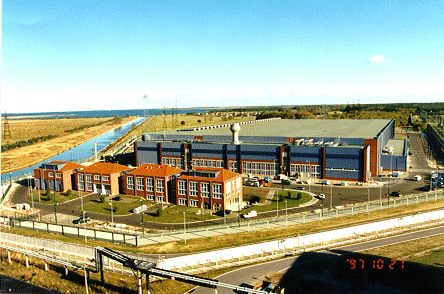
Fig. 3. Interim Storage North
The building comprises eight storage halls, a loading corridor and a conditioning area. The storage has a theoretically usable storage volume of 200 000 m³. Store 8 will house spent fuel elements in CASTOR casks. Stores 6 and 7 will be used for big components from the primary circuits, awaiting further treatment. In stores 1-5, all kinds of packages will be kept for both interim and buffer storage.
The conditioning area consists of five caissons, one of which is intended to be used for maintaining fuel element casks. The other caissons will be used for treating and conditioning activities, e.g. cutting, volume reduction, high pressure compaction, concentrating of liquid waste, drying and packaging.
PROJECT MANAGEMENT
On the basis of an analysis of the company development and personnel strategy, a technical concept was worked out and the project was broken down to working package level. The critical path goes over the mock-up remote dismantling in unit 5 to the remote dismantling in the units 1-4 and the dismantling of auxiliary systems and finally the building demolition, see figure 4.
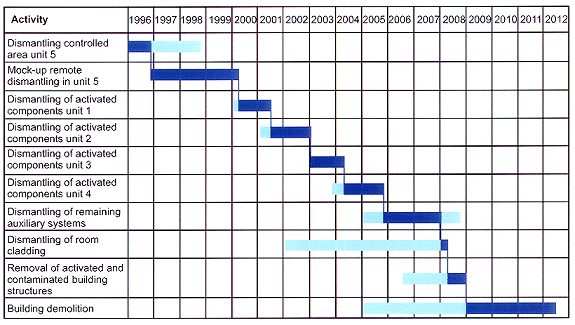
Fig. 4. Basic Time Schedule
The project was optimized from the cost and personnel point of view in order to obtain a constant personnel number.
For the project management, a software has been developed allowing in addition to the normal project control tasks to perform the technical planning, work preparation planning, tracking and control of dismantled material and radioactive waste etc. Actual data from the dismantling operations are registered, evaluated and fed back into the system.
STATUS OF THE PROJECT (DECEMBER 1997)
Non-contaminated and contaminated plant parts in the controlled area of unit 5 and in the turbine hall of the units 1-5 are being dismantled, packed and stored on the site or in hall 7 of the ISN. Totally, approx. 12 300 Mg plant parts have already been dismantled.
The reactors of the units 1-4 (approx. 2 000 Mg) must be remotely dismantled due to their high activity. The contractors for the necessary equipment and tools have already been selected. The preparation of the documents for execution, the manufacturing and mounting including commissioning will be finalized end of 1998. The execution of model dismantling at non-activated reactor components is planned for 1999. After the transport and installation of the equipment, the remote dismantling in unit 1 and 2 will presumably start at the end of the year 2000.
The status of the disposal of the already dismantled material is as follows. The free classing operation with the free classing facility has started at the beginning of 1996 and is temporarely performed due to the produced masses in two shifts. 5428 Mg have already been measured and 4635 Mg have been released by the authorities. The disposal of the operational waste in ERAM is performed according to schedule.
The construction of hall 7 of the ISN has been taken into operation already in March 1996 with a §3 license according to the Radiological Protection Ordinance for metallic residuals < 100 Bq/g. Ca. 2050 Mg radioactive waste and residuals have already been stored, including 6 steam generators (each 166 Mg) of unit 5. According to the time schedule, the commissioning of the ISN will start in the first quarter of 1998.
The costs only for dismantling are calculated with 400 Mio DM per unit, excluding the conventional demolition. Due to the serial effect and the availability of the ISN, the expenditures are clearly below the amount of 600 - 700 Mio DM which is estimated by the energy utilities for the dismantling of one PWR unit. For the conventional dismantling of the overall plant in Greifswald, additional costs of ca. 400 - 500 Mio DM have been estimated.
CONCLUDING REMARKS
After initial difficulties caused by massive personnel reductions combined with the introduction of a market economy and West German laws and procedures, EWN has succeeded in restructuring activities at Greifswald to arrive at a company size suited to the task of decommissioning. A positive atmosphere has now been created to enable work to proceed effectively and to prepare part of the personnel and the site for the new future tasks.
The decommissioning and dismantling of the Russian VVER type reactors do not pose specific problem when compared with the Western PWRs. However, the size of the project and the resulting mass flow is extraordinary. In order to achieve a safe and cost effective project, it is necessary that all stakeholders, i.e. EWN, authority and authorized experts, achieve a positive cooperation.
The project has proceeded very well: major licenses are obtained, agreement on licensing strategy, fuel elements have been transferred, disposal of radioactive waste in Morsleben is running on schedule and a sophisticated data base system has been built up.