MANAGEMENT OF WASTES FROM DECOMMISSIONING WITH THE DOCUMENTATION SYSTEM REVK
A. Bechtel, W. Boetsch, D. Maric
Institut für Sicherheitstechnologie (ISTec) GmbH
Köln, Germany
B. Hartmann, E. Kaffka, B. Syzmanski
EWN Energiewerke Nord GmbH
Lubmin, Germany
ABSTRACT
The worldwide largest decommissioning project takes places at the Greifswald and Rheinsberg sites in Germany. Within this project 9 nuclear power plant units have to be decommissioned resulting in app. 600.000 Mg of material, which has to be disposed of. The major part of this material is suitable for exemption as non-radioactive material or for recycling, but still some 20.000 Mg have to be disposed of as radioactive waste.
In order to manage this large amount of material a management system -the so called ReVK- has been developed and implemented at the Greifswald site. The primary purpose of this system is the recording and documenting of radioactive material and the corresponding treatment and disposal steps. In addition, it includes storage and transportation resource management modules as well as interfaces to common German documentation systems.
The ReVK is a FOXPRO based client server application with app. 25 terminals. ReVK was put in operation in autumn 1995. Up to November 1997 app. 19.000 waste packages and 3.700 transport procedures have been recorded. The operation experience of the system is good, and the users judge the system generally positive.
INTRODUCTION
Large amounts of radioactive wastes arise from the decommissioning of the Greifswald and Rheinsberg nuclear power plants. These wastes have to be removed in a suitable manner according to the current rules and guidelines. The removal includes clearance, interim storage, treatment and disposal.
Both the radioactive wastes and each step of their removal have to be documented. The resulting high data volume necessitates the use of a data processing systems, which has to be capable of on-site recording and tracking of data at the various sites involved in the decommissioning and waste treatment process.
On the behalf of the EWN GmbH (operator of the Greifswald and Rheinsberg NPPs) ISTec (Institute for Safety Technology) is currently developing a documentation system for the recording and tracking of the wastes at and between these plants. This documentation system was named ReVK, which is a German acronym for the waste tracking and control system. It is a client-server database system with modules for
ReVK is installed at the documentation department of the NPP Greifswald and is connected to the various sites involved in the waste decommissioning, storage and treatment process.
This paper describes ReVK concerning the operational experience with ReVK until November 1997.
OBJECTIVE OF REVK
The objective of ReVK is recording, tracking and control of data about radioactive wastes arising from the decommissioning of the Greifswald and Rheinsberg NPPs.
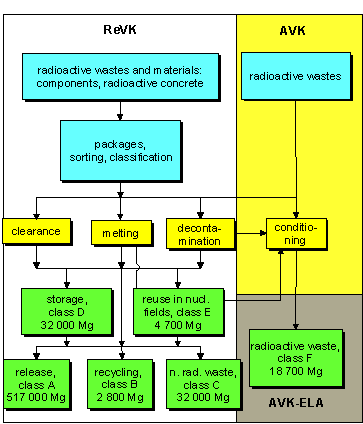
A simplified waste flow chart is shown in Fig. 1. It comprises several steps:
Firstly, the radioactive wastes are sorted according to the types of material and classified with respect to the planned means of removal. Thus sorted, the wastes are packed and transported to the appropriate sites for clearance, melting or decontamination. Secondary wastes arising in these processes are conditioned as radioactive waste and prepared for final disposal. Some wastes may be unrestrictedly released, recycled or disposed of as nonradioactive waste. To facilitate these removal paths, the activity level can be allowed to decay during prolonged interim storage. Fig. 1 lists the prognosticated masses for each waste disposal class.
The background of Fig. 1 is shown in three shades of color denoting three DV-documentation systems:
Note that the largest area in Fig. 1 is covered by ReVK.
Fig. 1. Scheme of the Waste Flow
Each step of removal and disposal is recorded by ReVK, thus ensuring a complete track of wastes. As soon as wastes exist in the form of a declarable package, data about the wastes are documented on the package sheets and dispatch notes. During data acquisition errors are precluded using validation clauses and input help-listboxes and masks. Thus ReVK ensures a high level of data quality.
The data are updated at each step of waste removal or disposal such as transport, storage and treatment. For this purpose ReVK contains modules and functions corresponding to the specific steps of removal and disposal, e.g. a storage module is related to the waste storage.
The correct and unique identification of packages is ensured by the use of the bar code technique. The bar code imprinted on the package sheet is scanned at a processing station ensuring that the correct record is updated. This data processing procedure is based on a client-server solution.
Materials classified as radioactive wastes have to be documented using the German documentation system AVK. Consequently, a synchronization interface between ReVK and AVK was developed.
In addition to the documentation of the waste flow, ReVK can also be used for
Appropriate interfaces to other data processing systems are also available.
DESCRIPTION OF REVK
The documentation system ReVK is a modular client server application with a Windows user interface (Windows 3.x, Windows 95 and Windows NT). The user interface is designed in such a manner to ensure simple operation and a clear presentation of the waste flow. Data about radioactive wastes recorded by ReVK are synchronously exported to AVK, where they are imported via a standard import interface (German: SIS). The SIS contains an additional data check routine.
The location and the flow of wastes recorded by ReVK are shown in Fig. 1. The wastes are primarily located within the NPPs Greifwald and Rheinsberg and at a planned facility known as "the interim storage north" (German: ZLN).
Although ReVK is connected to all sites involved in the waste flow and processing, on-site terminals allow the processing of data related only to the corresponding sites. This is ensured by preset default values, e.g. block and room numbers etc.
RECORDING AND TRACKING OF WASTES BY REVK
Wastes are recorded by ReVK as soon as they exist as declarable packages, i.e. after sorting and packaging of radioactive wastes.
Fig 2 shows the data contained in a package sheet (original presentation, only German), which have to be recorded. Data input is supported by presetting default values, reference lists and data check routines. The registered waste packages receive an unique identification number which is automatically printed in form of a barcode. The barcode simplifies the identification of waste packages entering and leaving the waste treatment facilities. All package movements are registered online in ReVK.
Data about waste packages including the bar codes are printed in form of the package sheets, such as that shown in Fig. 2, thus providing paper documentation of the stored data.
Data recorded in ReVK are updated after each removal or disposal step such as packaging, treatment and transportation. For this storage purpose ReVK supplies various dialogs. In these dialogs the waste packages are identified by the use of the bar code techniques ensuring a quasi-automatic registration of waste flow.
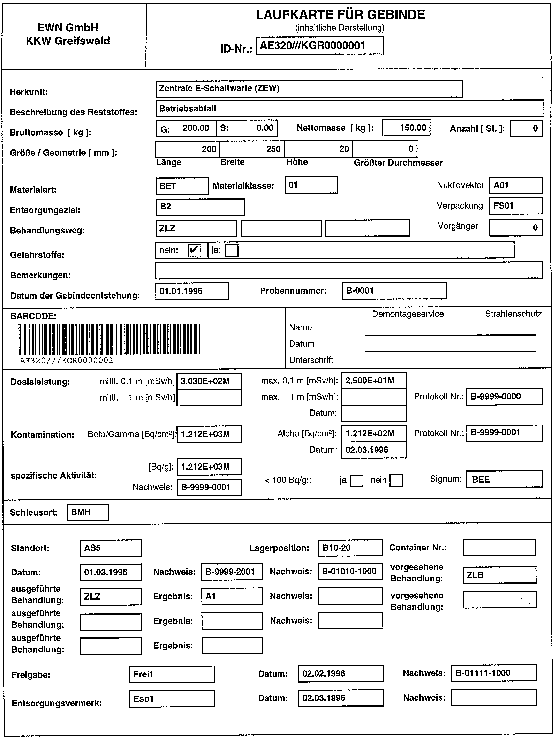
Fig. 2. Package Sheet
Waste entering and leaving storage facilities is recorded and documented with a distinct storage module.
Waste flow can be presented graphically and in form of tables. In both cases, data such as transport identification number, entrance date etc. are shown in form of chronological series for every site the package has passed.
Waste packages are recorded by ReVK up to the point of final disposal or removal or recycling. This means:
User Interface
An example of a ReVK-layout is given in Fig. 3, which shows the implementation of the package sheet in form of a corresponding input mask. Input fields are related to the list fields for standardized data input, plausibility checks and valid clauses.
Almost all ReVK dialogs were designed in a standardized manner. They consist of a page frame in which the distinct pages are called via registers. Each dialog consists of two pages. Page 1 (data input) contains an input mask such as that shown in Fig. 3, whereas page 2 gives a comprehensive presentation in tabular form.
ReVK is managed by a menu system and for the most common options by a tool bar. These include the following options:

Fig. 3. Dialog for input of the package sheet
Thus ReVK represents a modern software product, which meets in most aspects Windows 95 conventions. This means, that within a period of several years no changes in the hard- or software will be necessary.
STORAGE MANAGMENT
The storage management of packages in a buffer- or interim storage facility is simplified due to the use of ReVK 2.0 and its implemented functions. With the help of the configuration routine of the ReVK 2.0 each storage geometry can be defined as an independent storage. Number and location of the storage position as well as the quantity of the area foreseen for a storage position are definable with the configuration form. After the storage is configured once for an independent number of different storages each storage operation is reconstructable due to the use of ReVK 2.0.
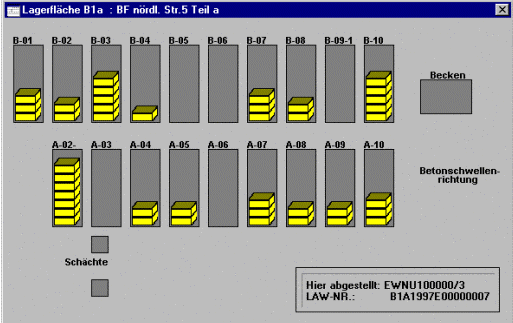
Fig. 4. Arranging of Packages
If a package is transported to a storage and its receipt at the receipt area of the storage is confirmed (confirmation of the transport campaign) the package occurs automatically in the storage management form at the position receipt area. The package can be put into the wanted position by the input of the storage position or by storage instruction. Therefore the corresponding plausibilities are tested and in case of success the storage management form is called up automatically. With the confirmation of the storage instructions the storage operation is completed. Without the confirmation the arrangement of the packages is cancelled automatically.
All data of stored packages are recallable via mouse click and can be actualised or handled in the corresponding input form if necessary. Any retrieval of a package can be carried out in a similar easy way as the storage.
Optimised Management of Transport- and Storage Resources
Next to the management of transport operations and the monitoring of all performed transport- and storage activities ReVK 2.0 is also able to give information about the available resources. By the use of the transport container management all necessary information about the location and available containers with their loading conditions are accessible.
The container management contents information about the number of empty containers and their location in the facility. The codes of the containers facilitate their independent administration and identification. The loading condition of the containers can be notified in the transport form. Each container being transported is labelled with the location TRANS.
The storage management form gives information about the storage resources either in a graphical way by showing the corresponding labels of the occupied storage positions or in form of report. It is possible to generate balance reports for each storage, which content information about the occupation and free capacities.
Operation Experience with ReVK
A particularly hard requirement imposed on the ReVK development was that the documentation system must be available already at the beginning of the decommissioning work. This requirement was fulfilled by developing ReVK in two phased.
Modules essential for the documentation and tracking of wastes were programmed in phase 1, whereas in phase 2 the complete capacity of ReVK, as described above, was developed. The basis software for phase 1 was Foxpro for Windows version 2.6 including a Foxpro database engine, whereas phase 2 was realized as an object oriented client server application (ORACLE).
Phase 1 development was completed with the begin of the ReVK operation at the EWN sites in September 1995. Up to November 1996 about 8500 waste packages and 1500 transports have been documented. Currently the ReVK system consists of 17 computer stations with the following tasks:
The acceptance of ReVK in NPP Greifswald is high. In the NPP Rheinsberg ReVK was taken into phase 2 operation in August 1997. Up to November 1997 about 18867 waste packages (including 1945 successers) and 3688 transports have been documented.
The ReVK system constists of 24 computer stations with the following task contribition:
The users judge the operation experience up to now generally positive:
BACK