LAUNDRY AND HOT SHOWER TREATMENT SYSTEM
DECANTER/ CENTRIFUGE
K. Tscheschlok, M. Szukala
Hansa Projekt Anlagentechnik GmbH
Tarpenring 4
D-22419 Hamburg
ABSTRACT
The liquid waste generated during the operation of nuclear power plants or other nuclear facilities include undissolved suspended solids which contains almost the main part of the activated products.
The Liquid Waste Treatment System, centrifuge type, (LWTS) removes undissolved solids from the liquid content for liquid waste decontamination and fills the dewatered product into disposal containers. The separated solids do not show free standing water.
The presented working principle of the LWTS based on a mechanical treatment step offers a most efficient and proven technology to reach a high decontamination factor with simultaneous high volume reduction.
INTRODUCTION
During the operation of nuclear power plants (NPP) or other nuclear facilities several waste water streams are generated. These are:
These waste water streams basicly include undissolved suspended solids, which contain almost the main part of the activated products. For this purpose a chemical pre-treatment step is often used for selective precipitation of special radionuclides and flocculents to agglomerate smaller sized particles (colloids) to make them separatable with the LWTS.
The separation of these undissolved solids with a LWTS is a usual standard treatment step for the processing of contaminated waste waters. Extensive operational experiences about these proven technology are available.
The liquid waste is mechanically processed by separating and drying the solid matter particles with the aid of centrifugal force. The dewatered product will be discharged into disposal containers with a residual moisture of approximately 40-60 weight-%. The produced solid matter does not show free standing water.
Following, the plant arrangement, the different modes of operation in dependence of several waste water steams and the collected operational experiences are described:
SYSTEM DESCRIPTION
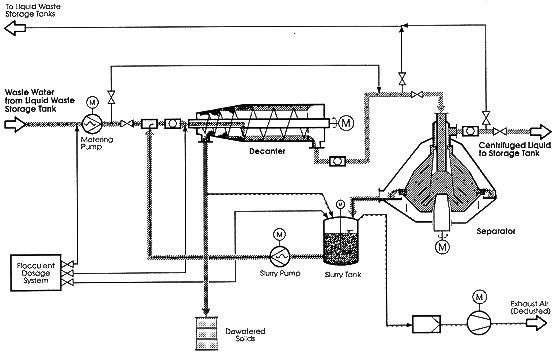
The principle of the dewatering process is shown in Figure 1.
Fig. 1. Principle of Solid Separation from Liqud Waste with WTS (Centrifuge Type)
After having been homogenized by agitation and recirculation, in order to be treated, the liquid waste coming from the waste water storage tank of the nuclear facility is delivered to the LWTS. A metering pump delivers the liquid waste into the decanter.
The decanter first separates the solids (larger particles and fibers) from the liquid waste or recirculated slurry and discharges them as dry residues to a waste container which is standing below the decanter. In all start-up`s and shut-down`s, the three-way ball valve of the drum filling unit is always positioned to give way from the decanter to the slurry tank. A paring disk installed in the decanter delivers the clarified liquid to the downstream-arranged separator.
In the separator, the smaller-sized solids which remained in the clarified liquid are separated through centrifugal force. They are discontinuously discharged as a slurry to a slurry tank situated below.
Depending on the slurry tank level, the separator slurry is again fed to the decanter by means of a slurry pump for being treated there. For a better separation of smaller particles, a flocculent can be added for agglomeration of themselves to make them separatable by using the decanter. The flocculent adding depends on various parameters, which are mainly based on the composition of the liquid waste.
The system is able to separate high density particles up to 0.1 µm. The separation grade of these particle sizes depends firstly on their surface structure and density and secondly on the specific weight and viscosity of the liquid surrounded particles.
Sight glasses are provided upstream and downstream the decanter as well as downstream the separator for process control purposes. They are necessary to control the performance of particle-separation. For this the transmission grade will be visually controlled with a camera-system. In addition to this, liquid samples can be taken to make further tests.
The operation of the LWTS is automated. Start-up and shut-down as well as drum transfer operations are performed by remote control.
The LWTS is connected to the controlled area exhaust air system. A negative pressure is maintained by means of a fan. The exhaust air line is equipped with a HEPA-filter.
The dewatered product is collected in disposal containers. It contains no free standing water.
WORKING PRINCIPLE OF THE DECANTER
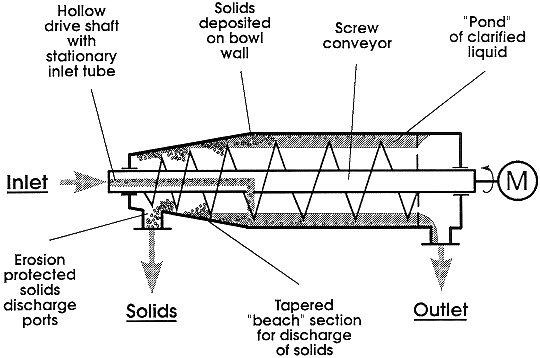
Fig. 2. Working Principle of the Decanter
Separation takes place in a horizontally arranged conical/cylindrical rotor consisting of a bowl and a screw conveyor that continuously scrolls out the solids. The conveyor rotates in the same direction as the bowl does, but at a slightly lower speed.
The suspension is fed through a concentric inlet tube into the hollow conveyor drive shaft at the tapered end of the bowl. At the outlet of this tube, the suspension is forced inside the bowl through centrifugal force.
The solids contained in the suspension are sedimented against the bowl wall and transported by the action of the conveyor to the tapered section of the bowl for being discharged through the erosion protected discharge ports.
In general, all particles with a density of > 1,1 kg/cm3 and > 10 µm will be separated with the decanter.
During CIP operation (cleaning in process) the bowl is driven up to the required speed (left/right) via a small frequency converter and an alternating rotation is effected, similar to that of a washing machine. The used flushing liquid is being fed to the slurry tank.
WORKING PRINCIPLE OF THE SEPARATOR
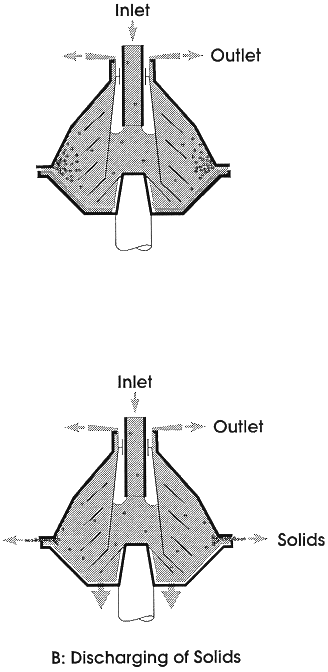
Fig. 3. Working Principle of the Separator
The separator is a self-cleaning, vertically arranged disk stack centrifuge, with a discharging bowl.
The liquid clarified in the decanter is fed to the separator from above through a concentric inlet tube and spread onto the bowl wall by means of a distribution cone. Centrifugal force causes the finest particles to settle instantaneously at the wall of the spinning bowl. Centrifugal force "shoots" accumulated solids out from the bowl, away from the process liquid. And it is the hydraulic pressure obtained by the centrifugal force that causes the solids discharge ports to open and close.
The bowl is of double-conical shape, consisting of a lower body and an upper hood. At its widest part the bowl body features a number of rectangular discharge ports. Fitted inside the body is an inverted conical bottom, free to move a few millimeters up and down. When this conical bottom, the so-called sliding bowl bottom, is in its upper position its edge is firmly pressed against the edge of the bowl hood. The result is that the two parts form a closed space where separated solids collect.
When the sliding bowl bottom is in its lower position an annular slit is opened between it and the hood, exposing the discharge ports. As a result, the collected solids are ejected by centrifugal force from the bowl interior through these into a collecting cover.
The solids discharge is effected discontinuously. The centrifuged liquid leaves the bowl upwards-directed via a paring-disk pump. In cleaning operation, the used flushing liquid is being fed to the slurry tank for further treatment with the decanter.
In general, 99 % of all particles of > 5 µm will be separated with the separator. For separation of smaller particles, a flocculent will be added to agglomerate them to greater particle-sizes.
PRODUCT CONTROL
The main criterion for the optimal operation of the LWTS is the achievement of the product quality. Therefore, the outlet of the centrifuged liquid and the separated solids from the decanter will be visually controlled. In addition, samples will be taken after different time periods.
The transmission grade of the centrifuged liquid after separator shows the performance of the total particle discharge. The transmission grade will be determined visually with a camera system. In case the centrifuged liquid is not clear, it will be returned back into the waste water storage tank. During this recirculating operation, flocculent will be added to various inlet-points. When the generated outlet has been reached the demanded quality for delivery, the optimal operation point of the LWTS is reached and the centrifuged liquid can be transferred into the storage tank. This operation is sufficient enough to reach the highest possible decontamination factor during waste water processing with the LWTS.
The throughput capacity of the waste water influent depends on the dewatering characteristic of the solids which are separated with the decanter. The main criterion is to get a dewatered product over the whole campaign of each liquid waste stream. After stipulating the specific throughput of each waste water stream a dewatered product will be produced continuously. The specific throughput capacity of each liquid waste stream is a characteristic value of the hold-up time of the solids separated with the decanter, depending on their different dewatering characteristics. The hold-up time will be adjusted over the differential speed between conveyor and bowl of the decanter.
OPERATING MODES
The liquid waste treatment is different in dependence of the waste water composition. For example, in the german NPP Philippsburg Unit 2 the waste water streams are collected in storage tanks as fractions. The fractioning is carried out into
The treatment of these different waste water streams are described as follows:
Treatment of Laundry Waste Water
The operating mode is shown in Figure 4.
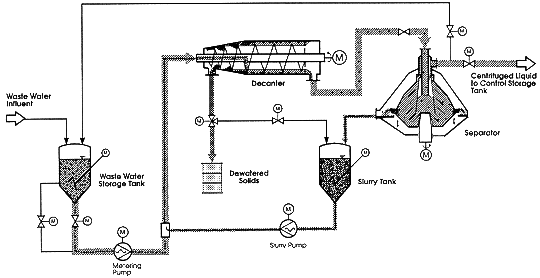
Fig. 4. Treatment of Homogenisized Waste Water
Before the laundry waste water is feeded to the LWTS, the pH-value must be adjusted during stirring in the relevant waste water storage tank. The homogenisized laundry waste water will be taken out at the bottom area for solid dewatering with the LWTS. The centrifuged liquid is being fed into the control storage tank for control analysis.
The operation experience has shown that the quality of centrifuged liquids generated from laundry waste water are not contaminated.
Treatment of Waste Water with Lower Activity
Before the waste water with lower activity is being fed to the LWTS, the pH-value must be adjusted during stirring in the relevant waste water storage tank. After pH adjustment the agitator will be switched off. During some time of residence, the largest amount of the decantable solids are sedimented on the bottom of the waste water storage tank.
The operating mode of the LWTS is shown in Figure 5.
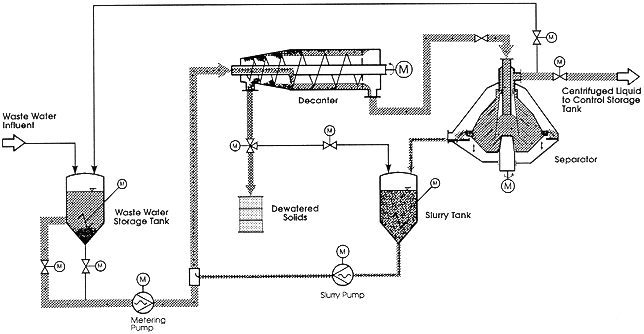
Fig. 5. Treatment of Pre-decanted Waste Water
After solid sedimentation, the decanted liquid will be extracted lateral of the storage tank above the cone area. The sedimented solids are being kept in the storage tank. They will be collected in the cone area for further treatment (see under "sludge operation" of this chapter). The extracted liquid will be fed to the LWTS. During centrifugation the centrifuged liquid will be visually controlled. If a muddy is registered in the centrifuged liquid, a flocculent is added into various inlet points for particle agglomeration.
The complete treatment is shown in Figure 6.
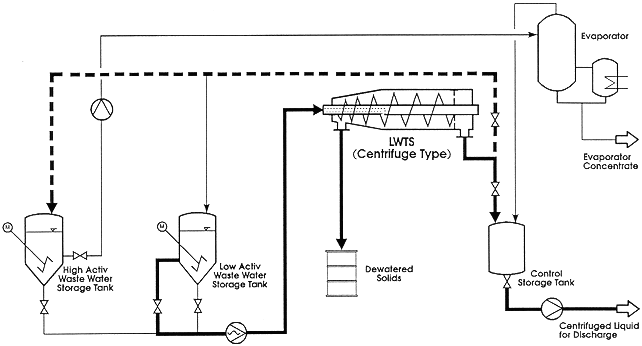
Fig. 6. Centrifugation after Sedimenation of Solids
If the activity content in the centrifuged liquid is less than the limit value, it will be fed into one of the control storage tanks for end control analysis. Normally, the quality of the centrifuged liquid is sufficient for delivery. If a small amount of residual decantable solids is registered, the liquid will be stored for some time again in the control storage tank to reach a complete solid sedimentation before discharge. In connection to this, the concentrated solids in the bottom area are recirculated into the waste water storage tank for further treatment with the LWTS (see under "Sludge operation" of this chapter).
If the activity content in the centrifuged liquid is higher than the limit value, it will be fed back into the waste water storage tank. When the centrifuged liquid includes decantable solids, it will be treated again with the LWTS. When the centrifuged liquid does not include decantable solids, it will be fed to the evaporator after lateral extraction out of the waste water storage tank above the cone area.
Treatment of Waste Water with Higher Activity
The treatment of waste water with higher activity is dependent on their contents in activity and sedimentable solids. Therefore, a sample will be taken from the decanted liquid after solid sedimentation in the storage tank to determine the activity content.
Sludge Operation
The sludge operation implements the treatment of the collected decanted solids in the cone area of the waste water storage tank.
Before the collected sludges from waste water with higher or lower activity is being fed to the LWTS of the centrifuge type, the pH-value must be adjusted during stirring in the waste water storage tank. After pH adjustment the sludge will be extracted at the bottom of the storage tank in the cone area under stirring operation (Figure 4). The sludge will be fed to the LWTS. During centrifugation the centrifuged liquid will be visually controlled. If a muddy is registered in the centrifuged liquid, a flocculent is added into various inlet points for particle agglomeration. The centrifuged liquid is being fed back into the waste water storage tank.
If a sludge will be treated from waste water with lower activity, the centrifuged liquid is being fed back into a waste water storage tank with lower activity instead in a storage tank for waste water with higher activity to prevent contamination-spreadings.
In dependence of the activity content, the centrifuged liquid will be further treated as described under "Treatment of waste water with lower activity" or "Treatment of waste water with higher activity" of this chapter.
OPERATING RESULTS
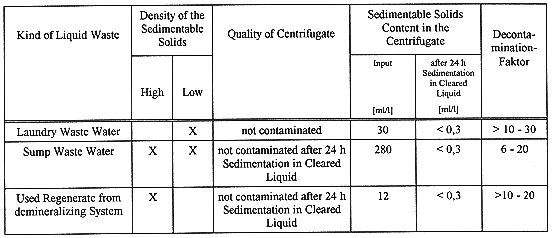
The data documented in Table I are collected during the test phase of the LWTS in the german NPP Philippsburg Unit 2.
Table I. Product Results of Liquid Waste Treatment (Centrifuge Type),
Carried Out in the NPP Philippsburg (GER)
CONCLUSION
The separation of undissolved solids from different waste water streams with a Liquid Waste Treatment System of the centrifuge type (LWTS) is a usual standard treatment step for the processing of contaminated waste water.
The described technology offers the following advantages:
REFERENCES
1. M. Szukala, "Laundry and Hot Shower Treatment System, Decanter/ Centrifuge" ABB Nuclear Services Radwaste Symposium, Seoul (June 1997)