LIQUID WASTE TREATMENT FROM SOURCE TO FINAL DISPOSAL
Dr. W. Hawickhorst, R. Finkbeiner, G. Gestermann
GNS Gesellschaft für Nuklear-Service mbH,
Hollestr. 7 A, D-45127 Essen
Germany
ABSTRACT
Since the closure of the so-called ASSE Saltmine, an experimental final repository for radioactive waste, by end of 1978, conditioned waste in Germany has to be accommodated in engineered surface interim storage facilities. As storage space in these facilities is limited, the application of volume reducing processes for waste treatment have gained major emphasis.
For treatment of liquid aqueous wastes, this led to replacement of embedding the waste into cement or bituminous matrices by processes which solidify the waste by elimination of its water content. In the early eighties, GNS has developed a process and treatment facilities known since then under the acronym FAVORIT.
This system allows the solidification of liquid wastes in suitable waste containers without the addition of any matrix material, by which considerable volume reductions can be achieved.
As this process is concentrating the waste and thus increasing the specific activities of the final waste product, these products in many cases must be accommodated in shielded casks for storage.
The FAVORIT facility is applying a vacuum drying process and is operating at low temperatures, by which undesirable chemical reactions can be avoided.
Although the process was originally developed for products to go to interim storage, its advantages remain as well for products to go to final repositories
Successful operating experience has been gained over more than 15 years.
INTRODUCTION
Embedding of liquid aqueous wastes in either cement or bituminous matrices is leading to a volume increase of the conditioned waste product by about a factor of 2, compared to the original volume of the raw waste.
After volume reduction of radioactive waste due to limited interim storage space availability became mandatory in Germany, GNS developed the FAVORIT process, a vacuum drying process operating at low temperatures, by which the liquid waste is solidified through elimination of its water content. By this, a volume reduction of the waste by a factor of 6 to 7 compared to the original raw waste volume can be achieved. This represents an improvement to the processes in use before by a factor of about 13. So, the goal of maximum volume reduction has been reached, the process has been accepted by the market in Germany, and has been in use for more than 15 years, having successfully treated the liquid aqueous waste from almost all of the nuclear power stations in Germany.
PROCESS TECHNOLOGY
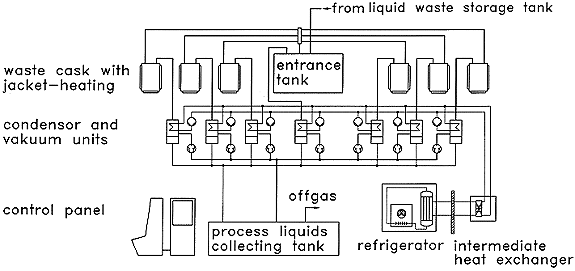
The liquid waste to be treated is stored in tanks, either on its place of origin - the nuclear power stations - or in an external processing facility to which it has been shipped by special transport equipment. The FAVORIT facility, a skid mounted modularised system - either operating as a mobile unit in the power station or as a stationary unit in the external processing facility - is taking over the waste by pumping or vacuum suction into an integrated shielded entrance tank. This tank can accommodate raw waste with all activity concentrations prevailing in the German power stations.
Fig. 1. FAVORIT Process - Simplified Flow Diagram
If necessary small amounts of anti-foam reactants can be added to the material in the dosage tank.
After filling of the entrance tank, the liquids are transferred to the waste containers by vacuum suction. These containers are designed according to the requirements of the specific waste. The processing of the waste is taking place in the waste containers. Vacuum suction ensures that leakage of liquids to outside the process equipment is avoided without additional protective devices, and overfilling of the waste containers will not occur. The vacuum system is integrated in the FAVORIT facility.
The GNS standard equipment contains six filling positions to the waste containers; thus processing can simultaneously take place in up to six waste containers. Special safety devices ensure that waste can not be transferred into a position not locked to a waste container.
After a waste container is filled with the liquid, the pressure in the waste container is reduced to about 30 mbar, and the waste container is heated from its external surface.
The vapour phase generated while the waste container is heated is led through a liquid cooled condensor, from where the condensate is fed into a process fluids collecting tank. This tank contains several chambers in which previously separated non-aqueous liquid phases (f. e. lubrication oil from the vacuum pump) can be collected separately.
From the process fluids collecting tank, the condensate is transferred to the waste water system of the nuclear power station or the waste processing facility.
After the first filling of the waste container has been dried out, the waste container is repeatedly refilled and evaporated till it is completely filled with solid substance from the liquid aqueous waste.
The advantages of using the vacuum drying process are twofold: first, any spilling from and overfilling of the system is not possible, and second, the process is operating at low temperature, by which the velocity of possible chemical reactions (in most cases exothermal) is reduced to such extent, that they can be easily controlled.
This is the reason, why the process is insensitive to the chemical composition of the waste, so waste with a broad variation of chemical compositions, in practice all occurring in the German nuclear power stations, can be processed.
With exception of taking over the waste from its original tank, and filling it into the waste containers, the process is automatically controlled, and presence of personnel is not required during operation.
Safety precautions are integrated in the control system, so that in case of incidents, the facility is automatically shut down to safe conditions, and long-term operational experience has proven the reliability and the safety of the system.
COOLING SYSTEM
The cooling system has special importance for the process, as condensing of the vapour phase has to be achieved safely. The coolant temperature conditions are independent of the cooling supply in the respective nuclear installation. A refrigeration system, cooled either by the water supply from the installation or by air, is adjusting the temperature conditions in the condensor.
By separation of the radioactivity carrying circuits from the cooling circuits, it is possible to install the refrigeration systems outside of controlled area in the open air, if air cooling is required.
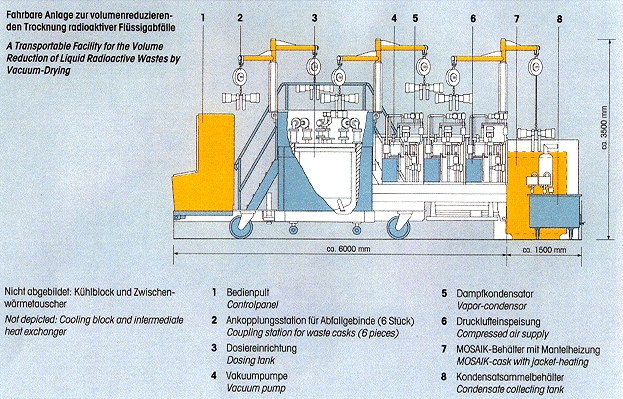
Fig. 2. FAVORIT Facility - Modular Setup

Fig. 3. FAVORIT Facility - View to Control Panel
HEATING, WASTE CONTAINERS
The heating system and the waste containers are interactive systems which determine the final waste product in terms of radiological requirements, mechanical properties, and product quality.
The requirements on the waste product are determined by the acceptance criteria of the interim store or the final repository, as well as by the criteria of safety for transport.
The safety properties (mechanical and shielding) required for transport, namely the qualification as IP-, Type A- or Type B-packages are provided by the waste cask itself or by a special overpack for transport.
The criteria for interim storage define permissible dose rate, mechanical properties in dependence of the activity content, and permissible leak rate.
The standard cask used for liquid waste to be stored in a German interim store is a cast iron cask which meets all the requirements including those for transport.
Since early 1994 ERAM, a final repository for low active waste, located at Morsleben (former Eastern Germany) is available and in operation.
For ERAM the waste packages have to meet dose rate and activity content criteria, as well as waste product qualities criteria like incinerability or non-incinerability and mechanical strength. Minor criteria are imposed on the waste package itself.
So, the standard waste containers in which liquid waste is treated by the FAVORIT process is a stainless steal 400- or 200-l-drum, and concrete shield may be added as required for ERAM.
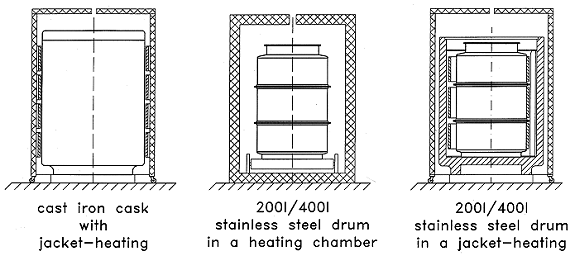
Fig. 4. FAVORIT Heating and Waste Cask Systems
The use of cast iron containers in ERAM is not possible due to weight limitations.
Heating of the waste containers is provided alternatively by
The use of shielded jacket heaters for drums is a recent development which assures optimised process performance together with low space requirements for the FAVORIT equipment. The latter is of special importance when mobile units are used in a nuclear power station.
OPERATION EXPERIENCE
During the past 15 years several thousands of m³ of liquid aqueous waste from the majority of the German nuclear power stations have been processed. All waste packages produced meet the stringent criteria for the interim stores or the final repository.
Raw waste processed by the FAVORIT facility includes evaporator concentrates from PWR and BWR, decontamination solutions including those with organic salt contents, sludges, siliceous filter aids, ion exchange resins, crud filters, or mixtures thereof.
The facilities are operating under the conditions imposed by the German Atomic Law, and are continuously supervised by authorities and their experts.
The FAVORIT system represents a flexible process, by which a broad variety of liquid aqueous waste can be treated, leading to products which meet the most stringent criteria.
Volume reduction by a drying process is mandatory if the conditioned waste products have to be delivered to an interim store, and its advantages remain if the waste products go to a final repository, as handling and transport requirements are considerably reduced.