 Campaign 97-0032B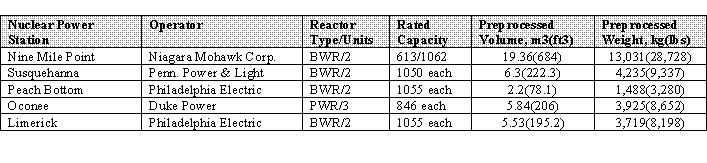
MINIMIZING OVERALL COSTS AND WASTE VOLUMES
UTILIZING ION EXCHANGE TECHNOLOGY AND SPENT
RESIN PROCESSING AT THE QUANTUM-CEP® FACILITY
Myron Kaczmarsky
Molten Metal Technology, Inc.
Jerry Hettinger
Pennsylvania Power & Light Co.
Jack Torbit, Jr.
Niagara Mohawk Power Corp.
Paul D. Saunders
Centec XXI
ABSTRACT
The combination of ion exchange technology for water treatment at nuclear power facilities and the use of Molten Metal Technology's Quantum-CEP7 (Q-CEP7) for the processing of spent ion exchange resin (IER), provides utilities with an overall process that meets operating requirements, reduces capital requirements, minimizes waste volumes, and is cost effective. The importance of water quality and its related impact on operating costs at nuclear power plants, combined with continued increases in low level radioactive waste (LLRW) disposal costs, have led to improvements in ion exchange technology and continued benefits from utilization of demonstrated technologies for volume reduction and stabilization.
Two (2) case studies are presented in this paper for nuclear power facilities where ion exchange technology has been effectively utilized, and where major spent IER processing campaigns using the Q-CEP® facility in Oak Ridge, TN have demonstrated significant reduction in waste management costs.
This paper presents the results of the Q-CEP® campaigns which included the processing of spent IER from Pennsylvania Power & Light's Susquehanna Nuclear Station, shipped in sixty (60) steel liners, and Niagara Mohawk Power's Nine Mile Point Nuclear Station, shipped in twenty (20) high integrity 9containers. Prior to the start of radioactive operations, key performance targets at Q-CEP® included the processing on average of six (6) 200 cubic foot high integrity containers per campaign and achieving a volume reduction of 30:1. Campaigns processing in excess of 40,000 pounds of dry spent IER, or the equivalent of approximately ten (10) high integrity containers, were achieved for Susquehanna and Nine Mile Point. The volume reduction for these campaigns were estimated to exceed 30:1.
To substantiate the overall cost savings, results of Q-CEP® campaigns processing spent IER from Susquehanna as well as the demineralization performance for this nuclear plant, were used in the EPRI wasteWORKS:Wet™ Code. Conclusions of the code calculations and savings are discussed in the paper.
INTRODUCTION
Catalytic Extraction Processing (CEP) is an innovative and proprietary technology that allows waste material of a wide range of composition (organic, organometallic, and inorganic) to be recycled as products of commercial value, such as industrial gases, metal alloys, and specialty ceramics. At the core of CEP is a liquid metal bath which acts as a catalyst and solvent in the dissociation and dissolution of the feed and the synthesis of products. Upon introduction to the bath, feeds dissociate and dissolve into their constituent elements. Addition of co-reactants enables product manufacturing and targeted partitioning of desired products. The catalytic and solvation effects of CEP, together with the thermodynamically controlled reaction pathways, allow the technology to achieve superior environmental and waste minimization performance. Quantum-CEP® is the application of the CEP technology to process radioactive and mixed waste (waste that is both hazardous and radioactive) streams. Targeted radionuclide partitioning leads to decontamination and reuse of a large portion of the waste components as commercial products (e.g., synthesis gas) with high resultant volume reduction through radionuclide concentration into a stable final form.
This paper presents results from processing spent IER at the Q-CEP® IER Facility in Oak Ridge, Tennessee. Forty three (43) processing campaigns were completed in 1997, and over 862,000 kg (1.9 million pounds) of spent IER were received at the Q-CEP facility from commercial nuclear utilities.
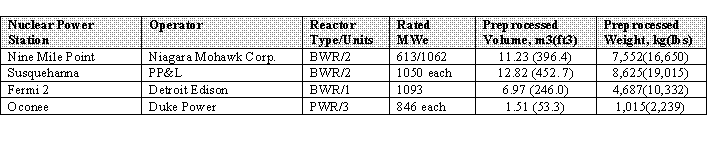
For campaigns 97-0031A and 97-0032B spent IER was actually processed from four and five different nuclear power stations, respectively. The amounts of spent IER processed in these two campaigns are listed below.
Campaign 97-0031A Campaign 97-0032B
THE EPRI WASTEWORKS PROJECT OBJECTIVES AND
METHODOLOGY FOR SUSQUEHANNA
As part of Susquehannaís continuing efforts to remain economically competitive, the Electric Power Research Institute (EPRI) was asked by Pennsylvania Power & Light to assist them in identifying opportunities for reducing the costs associated with its liquid waste processing program. The EPRI effort is part of an industry wide project targeting reductions in plant Operations and Maintenance costs. The purpose of this project was to evaluate the existing liquid waste processing techniques used at the station, and to assess the cost effectiveness of these processes.
Similar to the majority of boiling water reactors (BWRs), Susquehanna has determined that several processing techniques utilized in the past, may not be the most effective methods for treating liquid low level radioactive waste (LLRW). LLRW is processed using pre-coat filters configured in series. The LLRW is routed to a single deep bed demineralizer. This vessel is charged with 4.53 cubic meters (160 ft3) of IER (IRN 150). Spent IER is currently dewatered, shipped and processed in MMTs Q-CEP IER Facility in Oak Ridge.
During 1995 and 1996, EPRI under took the development of wasteWORKS:Wet™ (referred to as Wet) computer code. This was the second module to the wasteWorks radwaste management code. The Wet module is intended to assist nuclear utilities in evaluating the cost associated with managing liquid radwaste processing and the disposal of low level radioactive waste. The code can model an entire LLRW system, i.e., components, media descriptions and volume throughput, resulting solid waste generated, processing efficiency and disposal cost. The Wet module uses this information to provide the utility with a detailed economic analysis of the cost and performance of the LLRW processing activities. This analysis is based on a standardized methodology for calculating and comparing costs and system performance.
The Susquehanna project was designed to evaluate the economic viability of three specific processing scenarios utilizing the Wet code and/or data from similar economic analyses. The three scenarios included; 1) using the existing system of demineralization for release, 2) using a combination of evaporation and demineralization for LLRW, and 3) using membrane filtration for LLRW.
The first task involved data collection and performance of a detailed cost analysis of Susquehannaís current LLRW processing configuration. This analysis was performed using the Wet computer code modeling the existing radwaste system process. Based on plant input regarding typical performance, the following liquid waste processing data was gathered:
The second component of this evaluation consisted of an analysis of LLRW treatment options to compliment or replace existing processes. Information on the cost and performance characteristics for each option was analyzed, and radwaste processing and disposal estimates related to each option were developed. This cost and performance information was then used to input data and run the Wet code for the Susquehanna radwaste system for each processing scenario.
The data entered into the Wet code was used to generate the following program and system reports: 1) detailed cost reports for each processing component, 2) performance factors report for each processing component, 3) cost summary reports by component and system, and 4) program summary reports by system.
Q-CEP® IER FACILITY IN OAK RIDGE, TENNESSEE
The Q-CEP® IER facility has a design capacity of 3,681 m3 (130,000 ft3) per year of spent IER with contact readings of up to 10 R/hr. Located in Oak Ridge, Tennessee, this first-of-a-kind Q-CEP® facility processes low-level radioactive spent IER expended in water purification systems at U.S. commercial nuclear power plants. Molten Metal Technology owns and operates the Q-CEP® IER facility, and currently has contracts to process spent IER from over half of the U.S. commercial nuclear power plants. Through the acquisition of certain assets from Scientific Ecology Group (SEG) and VECTRA, Molten Metal Technology owns and operates the waste containers, shielded transport casks, and processing systems to ensure the safe transportation of spent IER to Q-CEP®. The facility was designed to operate while maintaining radiation exposure to the operations staff at levels that are "As Low As Reasonably Achievable" (ALARA). Through remotely controlled operations, the Q-CEP® IER facility follows a comprehensive ALARA program. The Q-CEP® control room is shown in Figure 1.
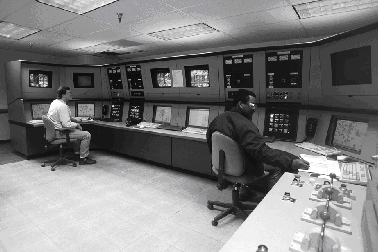
Figure 1. Q-CEP® Facility Control Room
Process Description: In this Q-CEP® facility, radioactively contaminated spent IER with up to 0.15 Ci/ft3 activity (10 R/hr dose rate) is ground, dried and fed to the Catalytic Processing Unit (CPU), which contains a molten metal bath, operating at 2400-3000°F and 10-150 psig. Organic constituents of the IER dissociate into their elemental intermediates, and through the addition of co-reactants, form syngas (i.e., CO and H2), and various trace inerts (e.g., N2). Non-volatile radioisotopes, such as 60Co, 54Mn, 55Fe, 63Ni and 51Cr remain in the metal bath. Volatile radioisotopes such as 134Cs and 137Cs are captured in the Gas Handling Train. After the metal bath reaches the maximum allowable volume or maximum concentration of radioactivity, the CPU is shut down and the metal bath cooled and solidified. The solidified bath is shielded and shipped to a disposal site.
The facility can be divided into four sections: feed preparation/injection, the CPU, the gas handling train, and final product packaging. Feed preparation can be operated separately from the remainder of the facility. Q-CEP® processing of resin is a batch process. The facility is designed to have two reaction systems with associated gas handling equipment (called Train A and Train B) which can be operated separately and at times simultaneously.
Spent IER is received from the customer in High Integrity Containers (HICs), or other approved waste containers, which are then transferred into separate holding tanks prior to batch processing. The resin is ground, dried and collected to allow injection of dried resin into the CPU. The system is fully enclosed allowing containment and recycle of any dust escaping from the feed. Incoming spent IER are routinely sampled and analyzed to ensure selection of the optimum operational CPU parameters.
Once a batch is completed, the CPU is depressurized and the crucible is allowed to cool. After cooling, the crucible and the attached bottom head assembly are lowered and placed onto a motorized cart (shown in Figure 2). The crucible assembly is then transferred to the capping area where it is remotely prepared for shielding and shipping. The volatile radionuclide trap, when expended, is removed from the GHT and placed into the crucible assembly. The final form crucible unit is prepared for shipment utilizing one of two overpack designs. The selection of the overpack design is based on the burial waste classification. In one overpack design, an approved HIC is lowered over the crucible assembly, mechanically secured, seal welded, and prepared for shipment. The CPU bottom crucible assembly and motorized cart are returned to the crucible preparation area.
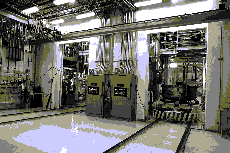
Figure 2 CPU Bottom Crucible Assembly and Motorized Carts;
Dual Trains are Shown
Q-CEP® CAMPAIGN RESULTS, 97-0031A AND 97-0032B
A wide variety of spent resins can be processed. The Waste Acceptance Criteria (WAC) for Ion Exchange Resins is broad:
The first campaign processing low level radioactive spent IER was successfully completed in December 1996. Key performance targets for the facility are to process an average of six HICs per campaign batch and achieve a volume reduction of 30:1. The average batch size and other performance parameters have steadily improved during the initial operating period with radioactive resin. The 97-0031A and 97-0032B campaigns in October of 1997 demonstrate this progress and that the facilityís design and technology are capable of achieving and even exceeding the key target performance parameters.
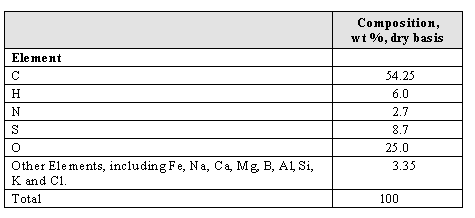
During these campaigns spent IER from four and five nuclear power stations were processed, respectively. The IER composition is a key input to the facilityís operating strategy to provide an integrated, cost effective, environmentally sound solution for spent IER. Analyses are performed on incoming resin to determine the composition. Ultimate and Inductively Coupled Plasma Emission Spectroscopy (ICP) analyses of representative resin are shown in Table I.
Table I. Analyses of Feed Resin
Campaign 97-0031A and 97-0032B Results for Susquehanna and Nine Mile
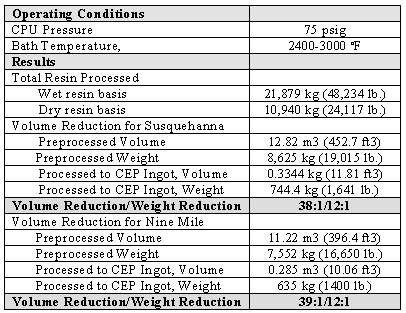
The operating conditions and results for Susquehanna and Nine Mile during Campaign 97-0031A are summarized in Table II.
Table II. Campaign 97-0031A Operating Conditions and Results
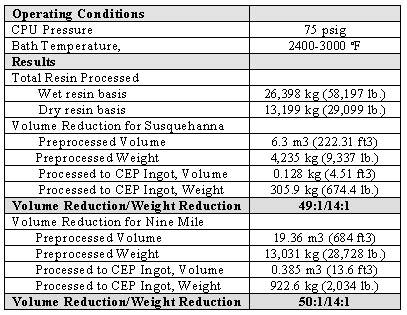
The operating conditions and results for Susquehanna and Nine Mile during Campaign 97-0032B are summarized in Table III.
Table III. Campaign 97-0032B Operating Conditions and Results
Volume Reduction for Disposal at Licensed LLRW Facility
The volume reduction ratios compare volumes for direct disposal at the LLRW management facility in Barnwell, South Carolina. The preprocessed volume of the waste is as received from the customer and is considered the volume that would have been buried had no volume reduction been performed.
CONCLUSIONS
The key benefit of the Q-CEP® IER facility is that it provides a commercially available, cost effective and environmentally sound alternative to the nuclear power industry for disposing of low level radioactive waste IER. The facility is designed to process all of the U.S. annual generation of IER with dose rates <10 R/hr. The process achieves significant volume reduction due to the recovery of organic material as decontaminated product gas. The process produces an environmentally improved final form that is safe and self-shielding, which reduces liability to the customers, reduces environmental risks to the public and is consistent with U.S. regulations. Key performance targets for the facility are to process an average of six HICs per campaign batch and achieve a volume reduction of 30:1. The average batch size and other performance parameters have steadily improved during the initial operating period with radioactive resin. The 97-0031A and 97-0032B campaigns in October 1997 demonstrate that the facilityís design and technology are capable of achieving and even exceeding the facilityís key target performance parameters.
The initial conclusions from the EPRI Wet code and associated analysis are that Susquehanna uses fundamental, proven technology for processing LLRW. Utilization of installed plant equipment and existing plant staff is cost effective. Currently, the combined use of demineralization for LLRW release and evaporation is the most cost effective of the three scenarios evaluated. Additional quantitative analysis of the Susquehanna LLRW operations is ongoing and will become available in 1998.