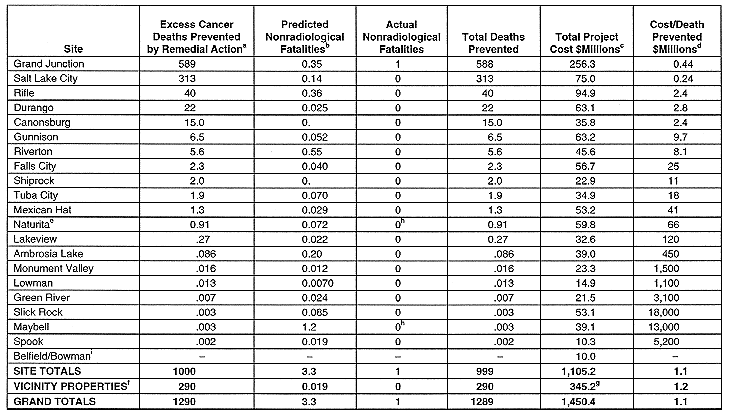
Table I Evaluation of 1996 Cost and Cancer Deaths Prevented by the
UMTRA Project Based on FY98 Federal UMTRA Budget
Robert E. Cornish
U.S. Department of Energy,
Environmental Restoration Division
P.O. Box 5400
Albuquerque, NM
87185-5400
Phone: 505-845-5654 Fax: 505-845-4023
Mark L. Miller
Roy F. Weston, Inc.
6501 Americas
Pkwy NE, #800
Albuquerque, NM 87110
C. Beth Pomatto
Jacobs Engineering Group Inc.
2155
Louisiana Blvd. NE, #10,000
Albuquerque, NM 87110
ABSTRACT
The Uranium Mill Tailings Remedial Action (UMTRA) Project, a 1.45 billion dollar project to stabilize uranium mill tailings and remediate structures built with them, is nearing completion. Several times during the project, the 24 UMTRA Project sites were ranked according to the health risks they presented to the public. There was an attempt to remediate the higher risk sites first, but it was not practical to remediate all of the sites in sequence strictly according to health risk. The most cost-effective remediations were at Salt Lake City, Utah, and Grand Junction, Colorado, where tailings piles were removed from the centers of cities. The remediation of structures built on tailings, or built of materials containing tailings, was more cost-effective than the remediation of the other tailings piles. The remediation of several of the UMTRA Project tailings piles was predicted on the basis of a priori calculations to yield negative benefits; remedial action was expected to kill more people through construction accidents than would be saved during the next 100 years through reduced radiation exposure following remedial action. The calculated public health benefits of remedial actions changed through the years as radiation risk factors shifted. As the project nears completion and the actual costs are known, more accurate cost-effectiveness calculations can be made.
INTRODUCTION TO THE UMTRA PROJECT
Congress created the UMTRA Project with the passage of the Uranium Mill Tailings Radiation Control Act (UMTRCA) of 1978 (1). This act gave the Department of Energy (DOE) the responsibility for remediating 24 uranium mill tailings piles, and associated Vicinity properties, in ten states. The Vicinity properties are structures built on or with tailings, or open land contaminated with tailings. More than four thousand vicinity properties have been remediated. The tailings piles are either stabilized in place or relocated and then stabilized. In either case, the tailings end up in large disposal cells with clay covers. The largest disposal cells contain more than five million tons of tailings. The disposal cells are designed to last for 200 to 1000 years.
Risk FactorsThe number of cancer deaths attributable to each remedial action alternative,including the no-action alternative, was estimated by calculating the annual population radiation dose (or population radiation dose over a limited period of time) and multiplying this dose by a radiological risk coefficient.
The Committee on the Biological Effects of Ionizing Radiations' (BEIR) has developed a risk factor of 3.5 x 10⁻⁴ cancer deaths per person-WLM (based on a 1980 United States reference population) (The "BEIR IV Report", (2). The National Council on Radiation Protection has recommended the use of 4.0 x 10⁻² cancer deaths per person- Sv for a worker population and 5.0 x 10⁻² cancer deaths per person-Sv for the general population (the working population is younger and presumably more sensitive to low level ionizing radiation) (3). The NCRP's recommendation is based on applying a DREF (dose rate effectiveness factor) to risk estimates associated with higher dose rates published in the BEIR V Report, "Health Effects of Exposure to Low Levels of Ionizing Radiation" (4). These values were used to calculate the number of cancer deaths averted by the remedial actions of the UMTRA Project.
The significance of radioactive airborne particles varied enormously among the UMTRA Project sites. The portion of the general population's dose due to airborne particles varied from 1% at Belfield and Bowman, North Dakota, to 78% at Lowman, Idaho. Belfield and Bowman were more typical of UMTRA Project sites. Lowman is an anomaly, because Lowman was only an ore concentration plant. The tailings at Lowman were not chemically processed to remove uranium, and radon emanation from the Lowman material was low. Most UMTRA Project sites contain chemically processed tailings from which radon emanation is significant.
METHOD OF CALCULATING THE NUMBER OF EXCESS CANCER DEATHS
Individual Sites
The number of cancer deaths associated with each remedial action alternative, including the no-action alternative, was estimated by calculating the annual population radiation dose (or population radiation dose over a limited period of time) and multiplying this dose by a radiological risk coefficient. The net number of cancer deaths averted over 100 years was determined by subtracting several terms from the projected general population cancer deaths due to radiation exposure resulting from no-action. The terms subtracted include the number of projected general population cancer deaths due to radiation exposure during remedial action, the projected worker population cancer deaths due to radiation exposures, the actual worker population deaths due to nonradiological causes during remedial action, and the general population cancer deaths due to radiation exposures following remediation.
The annual population radiation dose was previously estimated for each remedial action alternative considered in the Environmental Impact Statements (EIS) or Environmental Assessments (EA) prepared for each site. The dose was determined by simulating the radiological conditions at the processing sites, disposal cells, and vicinity properties using computer software such as MILDOS. Rather than reproduce these simulations, the estimated population radiation doses presented in the EAs and EISs were used for the purposes of evaluating the cost-benefit of the UMTRA Project. The doses provided in the Eas and EISs were multiplied by the updated risk factors to obtain the number of cancer deaths attributable to no remedial action, the chosen remedial action, and the period after remedial action. The number of projected cancer deaths associated with the no-action alternative was evaluated for a period of 100 years. From this value the number of cancer deaths incurred over a period of 100 years as a result of the chosen remedial action option (including radiological and non-radiological fatalities) was subtracted. The results of these calculations have been tabulated in Table I.A summary of the assumptions and methodsutilized in calculating the number of cancer deaths averted and the UMTRA cost-benefits for each site is listed in the following pages.
Vicinity Properties
The number of excess cancer deaths due to remedial action of vicinity properties that were averted over a period of 100 years was calculated by estimating the number of cancer deaths that would occur should no action take place. Due to the short remedial action periods associated with vicinity properties and the relatively low volumes of materials being handled, the hazard to remedial action workers and vicinity property owners during remedial action was assumed to be insignificant. The number of excess cancer deaths expected to result over a period of 100 years after remedial action as a result of placement of the cell has been accounted for in the individual site calculations is not considered as part of the vicinity property calculation.
A summary of the assumptions made in calculating the number of excess cancer deaths is listed in the following pages.
RESULTS
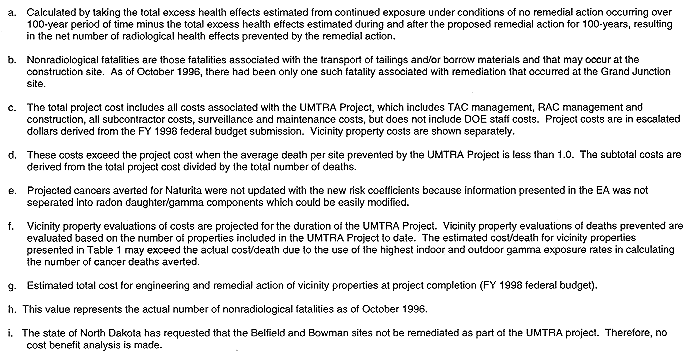
The estimated number of cancer deaths averted over a period of 100 years as a result of the implementation of the UMTRA Project is listed in Table I. Also shown in the table is the total project cost and the cost/death prevented, by site.
Table I Evaluation of 1996 Cost and Cancer Deaths Prevented by the
UMTRA Project Based on FY98 Federal UMTRA Budget
CONCLUSIONS
Approximately 1300 cancer deaths may have been prevented in the next 100 years by the UMTRA Project at a cost of 1.45 billion dollars to the Federal Government. The greatest cost-benefits are associated with the Salt Lake City and Grand Junction (higher risk) sites and the vicinity properties for which 0.2, 0.4, and 1.2 million dollars, respectively, are estimated to have been spent per death averted over 100 years. The medium to low risk sites were the least cost effective: the Slick Rock had a projected 18 billion dollars spent per cancer death averted. The lower cost-benefit ratio is due to its remote, rural location and sparse population. The number of cancers averted in 100 years at this site is only a fraction of a life and is the reason that the cost of preventing one death exceeds the total cost of remedial action.
SUMMARY OF THE ASSUMPTIONS AND METHODS INVOLVED IN CALCULATING THE NUMBER OF PREVENTED CANCER DEATHS AND UMTRA COST-BENEFIT FOR INDIVIDUAL SITES
ASSUMPTIONS USED IN CALCULATING THE NUMBER OF PREVENTED CANCER DEATHS AND THE UMTRA COST-BENEFITS ASSOCIATED WITH VICINITY PROPERTIES

ATTACHMENT
Calculation of the Excess Cancer Deaths Associated With Vicinity Properties Included in the UMTRA Program
Calculation of the Excess Cancer Deaths Attributable to Gamma Exposure
Excess Cancer Deaths Attributable to Gamma Exposure for the Vps with Interior Contamination:

Calculation of the Excess Cancer Deaths Attributable to Radon and Radon Daughters

Calculation of the Total Excess Cancer Deaths

REFERENCES