Fig. 1. Illinois LLRW disposal site
development responsibilities.
Paul Corpstein and Michael Henry
Chem-Nuclear Systems
Ralph Stein and Mark Brightman
Golder Associates, Inc.
ABSTRACT
The Illinois Low-Level Radioactive Waste Task Group has developed technical site selection criteria which address geographic, geologic, seismologic, hydrologic, and other scientific conditions best suited for a low-level disposal facility. The Illinois State Geological and Water Surveys will screen the entire state to identify 10 or more locations that appear likely to meet the Task Group Criteria based upon readily-available, pre-existing data. Chem-Nuclear will then evaluate these locations to select three sites that appear promising for development of a low-level waste disposal facility.
Chem-Nuclear will develop additional criteria that focus on those site features relevant to the design and operation of a safe disposal facility. The criteria will be placed in Safety/Licensing, Environmental and Operational categories and each criteria will be further identified as Mandatory, Avoidance, or Preference. Mandatory criteria define characteristics or conditions a site must possess in order to be selected. Avoidance and Preference criteria define conditions which are less or more desirable for the siting of a disposal facility. These are comparative in nature and can only be applied to areas which meet both the Task Group criteria and Chem-Nuclear mandatory criteria. Chem-Nuclear has developed a preliminary list of approximately 40 criteria and a more refined and comprehensive set will be developed in parallel with the Survey's statewide screening effort.
Criteria Application Statements will be developed which identify the technical evaluations and analyses which will be performed to demonstrate compliance with the Task Group and Chem-Nuclear criteria and the data needed to complete these analyses. The criteria will be applied in a logical sequence to ensure the efficient elimination of less favorable areas and selection of three sites likely to be suitable for the development of the ILLRWDF. Chem-Nuclear's process will apply Task Group and Chem-Nuclear criteria in a staged manner to disqualify clearly less promising lands, progressively bank lands for possible future consideration, and identify promising areas that have a higher likelihood of meeting all site selection criteria for further study. Preference will be given to volunteer locations that appear to meet applicable requirements, and are not less promising than other locations being considered.
Probabilistic performance assessment analyses will be used throughout site selection and characterization to help develop site selection criteria, focus data collection programs, identify sites more likely to meet the performance objectives and support the license application. A probabilistic approach is being used to address the inherent uncertainties associated with some of the properties and processes which affect the long term performance of a LLRWDF.
Probabilistic performance assessment examines the ILLRWDF performance as three components: the engineered barrier system (EBS), the geosphere, and the biosphere. Performance assessment models consisting of a conceptual EBS design located within several generic geosphere systems will be used to help identify favorable site features and these results used in the development of the Chem-Nuclear criteria. After initial screening, probabilistic performance assessment models will be developed for each specific area that shows significantly different site characteristics. The likelihood that an area will be able to meet the performance objectives will be a significant factor in deciding which areas should be retained. As more site specific data is collected the performance assessment models will be refined and the results used, in combination with technical data regarding compliance with criteria, to select the three sites to propose to the Task Group.
INTRODUCTION
Over the last ten years, various private and government groups have endeavored to develop and implement a site development process that results in a disposal facility that meets public, political, regulatory and industry acceptance for disposal of low-level radioactive waste (LLRW). These efforts have involved millions of dollars in expenditure and have resulted with little success for one reason or another. These reasons include:
Though the history of LLRW site development is less than fraught with successes, the process continues in many Interstate Compacts across the US. Sites in Nebraska, California, Texas, North Carolina, Pennsylvania, Ohio and certainly a site in Illinois, in the Central Midwest Compact, are all moving forward with their site development efforts. But the basic question of whether any of these siting efforts will succeed remains an issue clouding the efforts of the Compacts.
While this question is often discussed in meetings, conferences and literature, the mandate from the US Congress in the form of the Low-Level Radioactive Waste Policy Act of 1980 as amended and the mandate from the Illinois Legislature in the form of the Illinois Management Act of 1983 as amended have not changed. The commitment on the part of Illinois leadership, Illinois and Kentucky legislatures and the Illinois Department of Nuclear Safety (IDNS) to develop a facility has not changed. From January 1992 until late 1993, the IDNS along with Chem-Nuclear, and major waste generators reviewed siting processes being developed and underway in other host states nation-wide. Out of this review grew the newly reengineered and redefined process being implemented today in Illinois. (Klebe, 1996)
The new process began with the Illinois Management Act being revised to authorize a second site development process, establish the Illinois Low-Level Radioactive Waste Task Group (Task Group) and reassign decision authority and responsibility among the IDNS, the Illinois Scientific Surveys, the Task Group and the contractor, Chem-Nuclear. The role of Chem-Nuclear changed in the course of this process. Initially, Chem-Nuclear's role was to accept the characterized site from other IDNS contractors and perform facility design and performance assessments to result in the submission of a complete license application. In the reengineered and redefined process presently underway, Chem-Nuclear will develop the process to select a site from the 10 or more locations approved by the Task Group. Through application of various technical evaluation criteria and through the use of decision analysis based on probabilistic performance assessment modeling, Chem-Nuclear will select three sites for the Task Group's approval. Further activities in the new process assigned to Chem-Nuclear are to perform complete site characterization and licensing analysis, and to construct and operate a disposal facility that safely manages LLRW generated in Illinois and Kentucky.
TASK GROUP TECHNICAL CRITERIA
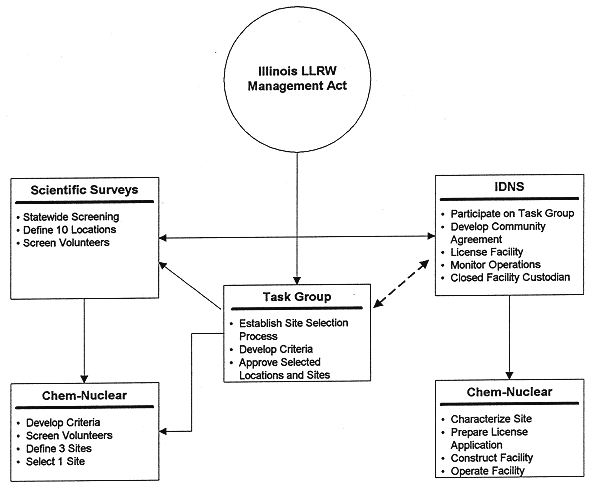
The 1993 amendments to the Illinois Management Act divided the Illinois process into two major parts: site selection and facility licensing, with the approval authority for each of these parts divided between the Illinois Task Group and the IDNS. In the Task Group's site selection part, the work is further divided into a Scientific Surveys statewide screening process and a Chem-Nuclear site selection process. The Task Group, in its report, "Site Selection Criteria for a Low-Level Radioactive Waste Disposal Facility", (December, 1996) assigns and describes its responsibilities and expectations for implementation of the various aspects of the statewide screening and site selection. Figure 1 shows these responsibilities and relationships. The Task Group's report also defines its site-selection criteria, which will be used by both the Scientific Surveys and Chem-Nuclear to determine location and site suitability.
Fig. 1. Illinois LLRW disposal site
development responsibilities.
The Scientific Surveys, in their implementation of the statewide screening process, will screen the state to define 10 or more locations of at least 640 acres that appear likely to satisfy the site-selection criteria. The Task Group's consideration of the "10 or more" locations proposed by the Scientific Surveys will not require that the locations explicitly meet all criteria; rather the location must "appear likely to satisfy" the criteria. In this part of the process, locations will not be evaluated against all criteria due to the size of the state and the reliance on non-intrusive investigations. However, if any locations are known to not meet any of the criteria, then that location is rejected.
Chem-Nuclear in the implementation of its site selection process will evaluate the 10 or more locations provided by the Scientific Surveys and must provide three sites which meet all of the criteria to the Task Group. These three sites will be intrusively tested and subjected to whatever analysis is needed to prove the site will pass the scrutiny of the Task Group. Any site found failing to pass a test against the Task Group criteria will be rejected.
Woven into the framework of both the Scientific Surveys statewide screening process and Chem-Nuclear's site selection process is a volunteer process. The volunteer process is dictated by the Management Act, which requires that preference be given to sites in locations volunteered by a landowner or a unit of local government. Sites are to be volunteered within a prescribed time frame which allows landowners and units of local government time to prepare required information describing the site's location. It will also allow the volunteer sites to be evaluated along with all other locations and sites. During the 60 days following publication of the Task Groups' criteria, landowners and units of local government can offer locations for evaluation by the Scientific Surveys during the statewide screening process. During the first 90 days following Chem-Nuclear's initiation of site selection from among the 10 or more locations, landowners and units of local government may volunteer sites as long as they lie within an approved location as described by the Scientific Surveys.
The Management Act directed the Illinois Task Group to develop criteria that would be used to discriminate between locations and sites in Illinois and that would emphasize the reliance on science above all other considerations. To complete its assigned responsibility under the Act, the Task Group formed and developed its goals and set about developing criteria. To provide a solid basis for the criteria, the Task Group reviewed federal and state regulatory and statutory requirements, heard expert testimony relating to the generation and characteristics of LLRW in Illinois and also heard about the facility which would be constructed and operated at the selected site. Throughout its three year site selection criteria development process, the Task Group called upon the knowledge of the Scientific Surveys, Chem-Nuclear, Illinois geologic and hydrologic experts, demographers, environmentalists and sociological consultants. These experts were the sounding board for thoughts and ideas that developed during the many hours of public deliberation, which was a key element in the success of the criteria.
After the issuance of the Task Group criteria to the Surveys, Chem-Nuclear will develop plans (Task Group Application Statements) which describe how the project will interpret each criterion, a demonstration of how a particular site does/does not meet the specific Task Group criteria, and the project strategy for criterion application during subsequent siting activities. The purpose is to demonstrate and document our interpretation of each criterion and ensure consistent application of each criteria throughout the site selection process.
The 25 criteria which resulted from this three year effort were divided into associative categories for ease of presentation. The categories are:
The form which the Task Group used to present the criteria is a clear and concise criteria statement, followed by a narrative. This narrative allows further understanding of the criteria statement and gave direction to the Scientific Surveys and Chem-Nuclear concerning how to apply each criteria and what evidence the Task Group would find useful in showing that a particular location or site met each criteria. A discussion of each criteria category follows:
Hydrology and Geology
Signifying the importance of the geologic and hydrologic characteristics at the site which will host the LLRW disposal facility, nearly half of the criteria are related to these sciences and the majority of these relate to ground water or surface water issues. The predominant mechanisms for radionuclides to be transported away from the disposal facility to the man-accessible environment are through the surface water and ground water regimes. Influencing and controlling these water movements are the site's surface drainage systems, the types of sediments beneath the site and the physical and geologic factors which affect their stability, order and arrangement. In order that the selected site may meet the regulatory requirements related to prevention of human exposure to radionuclides transported from the facility, the Task Group's goal in developing these criteria was to establish an environment at the site that would impede the movement of water, thus reducing the probability that radionuclides could reach off-site environments. Criteria topics in this category include :
Land Use
Two of the criteria relate to previous or existing use of the land upon which the site will be developed. One of the concerns of the Task Group based on their review of licensing requirements was that chemical or radiological contaminants at the site may mask the ability of the sites environmental monitoring program to recognize low levels of releases from the disposal facility. The criteria narrative suggests that if a site is brought forward for consideration by the Task Group and it has in the past been contaminated, Chem-Nuclear must also present a site remediation plan to reduce the levels of contamination such that there will be no interference with the site's monitoring programs. The second criteria in this category excludes a site intersected by an interstate highway or an active railroad system. The Task Group is precluding any site which contains these feature to assure the site operator is able to ameliorate any actions or incidents at the site without having to rely on right-of-way owners permissions.
Natural Resources
The state of Illinois has abundant natural resources which have been exploited for hundreds of years. The Task Group, for the purposes of developing its criteria, only considered mineral resources in this category of criteria, since other state resources such as water and land, endangered species and natural areas are covered by other specific criteria. Like the land use category, there are two criteria in the natural resources category. These criteria relate to the selection of a site which may overlie or be proximate to mine cavities or surface-mined lands. Also, the criteria in this category address the Task Group's concern for the site being impacted by operational surface mine operations or underground petroleum reservoirs.
Ecological and Recreational Areas
Since Illinois is fairly densely populated and the use of the remaining lands for production of agricultural crops is significantly important to its economy, the ability to establish, maintain and preserve ecological and recreational areas was strongly considered by the Task Group. There are seven criteria in this category and they are all related to the importance the State places on ecological and recreation area protection. Included in this set of criteria are 1000 foot set back restrictions for certain features such as conservation areas, sensitive stream habitats and public access lakes, and specific requirements for avoidance of any location or site which, if developed as a LLRW disposal facility would pose an adverse impact to any designated ecological area or recreational area.
Cultural and Paleontological Resources
Illinois has been occupied for many centuries, from prehistoric natives to early settlers to recent history immigrant cultures. All of these cultures left behind evidence of passing through Illinois or living on Illinois lands. The purpose of the two criteria in this category is to minimize the potential that the site, if developed on land containing these resources, would have an adverse impact upon them. The criteria specifically address cultural or historic properties and adverse impact to human skeletal remains.
CHEM-NUCLEAR TECHNICAL CRITERIA
Chem-Nuclear will develop additional criteria to use in the site section process. The purpose is to supplement the Task Group criteria, which are intended to serve as a reasonable and objective basis for identifying sites that appear promising for the development of a LLRW disposal facility. The Task Group criteria do not fully address all the applicable Federal, State, and local requirements that need to be met in order to license a site (although the Task Group did consider regulatory requirements during the development of their criteria). Since the Task Group do not have a role in facility design or operation, their criteria do not address specific siting issues related to these aspects of low-level radioactive waste disposal. For these reasons, Chem-Nuclear Systems will prepare criteria to be used during the twelve month process of reducing the ten or more locations under consideration to three sites. The Chem-Nuclear Criteria will focus on performance of the disposal system and safety-related issues, including those site features relevant to the design and operation of a safe facility. Criteria Application Statements will be developed which identify the technical evaluations and analyses which will be performed to demonstrate compliance with the criteria and the data needed to complete these analyses. The criteria will be applied in a logical sequence to ensure the efficient elimination of less favorable areas and selection of three sites likely to be suitable for the development of a LLRWDF.
Chem-Nuclear will develop criteria which will be placed under one of three categories intended to address the range of requirements to be considered in the selection of the three Sites. These categories include:
Each criteria category will be further identified as Mandatory, Avoidance, and Preference as described following:
Chem-Nuclear has developed a preliminary list of approximately 40 criteria. A comprehensive set of Chem-Nuclear criteria will be developed in parallel with the Survey's state-wide screening effort.
SITE SELECTION SEQUENCE
The site selection process has been developed to allow an efficient and defensible process for the selection of three sites that appear most promising for a disposal facility. The site selection process is divided into two distinct phases. The first phase is the state-wide screening conducted by the Surveys to identify the 10 or more locations. The second phase is conducted by Chem-Nuclear and involves more focused studies to narrow to three the number of sites that appear promising for development.
The sequence that the site selection process will follow can be divided into five steps, which include:
Step one of the site selection process is dedicated to the Survey's work to identify 10 or more locations that appear likely to meet the Task Group criteria, including an evaluation of volunteer locations. To do this work, the Surveys have developed an extensive statewide database of natural resource information which resides on their Geographic Information System (GIS). The GIS will be used to evaluate, analyze, and map data at various scales and in various configurations. The Surveys will issue a statewide screening report identifying the 10 or more locations relative to their ability to meet the Task Group Criteria. This entire process is expected to take 15 months to complete.
Planning for Chem-Nuclear's role in site selection involves the development of planning document (Activity Plan) for each area remaining under consideration. The Activity Plans will present available information resulting from data searches and preliminary conceptual models and performance assessment results, including an analysis of criteria and/or regulatory compliance. In addition, the Value of Information (VOI) analysis which prioritizes data collection and specific investigations and tests to be conducted will be included. Finally, information regarding quality assurance, reporting, and schedule requirements will be included in the plans as well.
The site selection process will be implemented in a similar fashion for both Task Group and Chem-Nuclear criteria. Each individual criterion and its narrative will be thoroughly reviewed to provide any necessary clarifications, to identify potential conflicts with any regulatory requirements, and to provide any practical limitations that may apply to the implementation of the criterion.
The types of analyses will be identified to show compliance to the specific criterion being considered. The types of analyses to be identified may be partially dependent upon the specific geographic regions of the State under consideration (i.e., dependent upon the natural settings in which an area may be located).
Chem-Nuclear will then determine the types of data collection techniques to be used at each location and area to secure the raw data needed for the technical analyses that will demonstrate compliance with site selection criteria. The location and extent of these data collection techniques will be planned in iterative steps as more information is gained about the locations and areas and the data collection activities focus on the remaining critical issues. This planning process will include the development of early conceptual facility layouts to optimize the location of the data collection points.
The technical analyses for each criterion will be developed in conjunction with the application of investigations and tests as defined within the Activity Plans for each area. The completed technical analyses will be provided in Chem-Nuclear's Site Selection Report to the Task Group that will demonstrate compliance of each selected site to Task Group criteria.
Steps two through four involve Chem-Nuclear activities over a twelve month period to identify three sites that appear promising for development. Chem-Nuclear's process will apply Task Group and Chem-Nuclear criteria to disqualify clearly less promising lands, progressively bank lands for possible future consideration, and progressively identify promising areas that have a higher likelihood of meeting all site selection criteria for further study. Throughout the process, Chem-Nuclear will give preference to volunteer locations that appear to meet applicable requirements, and are not less promising than other locations being considered.
In step two, an initial screening evaluation will be performed which will apply both Task Group and Chem-Nuclear Criteria. This exercise will rely upon data and information from the Surveys, existing literature, and a limited suite of initial field investigations. The intent is to further reduce the number of locations under consideration to around 10-12 smaller areas prior to initiation of detailed data collection programs.
Step three involves the further reduction of areas to four to five. Value-of-Information analysis will be used to guide surface investigations and limited subsurface investigations. Collection of this information will allow Chem-Nuclear to update and re-evaluate compliance with both Task Group and Chem-Nuclear criteria. In addition, area-specific performance assessment models will be developed during this step.
In step four, more detailed and extensive intrusive investigations will be used to select three sites for submittal to the Task Group. This step will also use the VOI analysis, and increased input from performance assessment evaluations. Significant amounts of data will be acquired to support the submittal of three sites for review and approval by the Task Group. Data collection will be governed by the specific characteristics of the locations/areas/sites being studied, and the types of analyses that must be carried out by Chem-Nuclear to demonstrate compliance of the three selected sites with the Task Group and Chem-Nuclear criteria, as well as applicable laws and regulations. Upon completion of this step, three sites that appear promising for development will be submitted to the Task Group for approval.
Step five is the Task Group review and approval process. This process includes notification and comment solicitation from State and local government, as well as the general public. If the Task Group finds that any of the three sites do not meet the Task Group Criteria, it is Chem-Nuclear's responsibility to identify a suitable replacement and the review and approval process is repeated. Once three sites have been approved, Chem-Nuclear is given approval to fully investigate one of the sites (with preference to volunteer locations). If at any point during the ensuing investigation information is yielded which renders the site no longer suitable for development, one of the remaining two sites will serve as a substitute for characterization.
PROBABILISTIC PA METHOD
Performance assessment is the systematic analysis of a LLRWDF and its surroundings to predict the potential radiological doses which an adjacent population might receive over the lifetime of the facility. Traditionally, radioactive waste disposal projects only use performance assessment towards the end of lengthy site characterization studies in order to demonstrate compliance with performance objectives specified in law or regulations. In contrast, probabilistic performance assessment analyses as practiced for the Illinois Low-Level Radioactive Waste Disposal Facility Project are to be used from the earliest stages of site selection planning through to the submission of a license application. As the site selection and site characterization program progresses, performance assessment will be used:
Performance assessment of the ILLRWDF requires the thorough analysis of the engineered barriers designed to isolate the waste, the eventual release of radionuclides, their transport through the geosphere, and ultimately their uptake by man. This system contains a range of man-made and natural barriers to the release and transport of radionuclides. Various processes act on different parts of the system at different rates and times during its evolution to determine the rate at which radionuclides are released and the speed at which they are transported towards man's environment.
Many of the properties and processes of this system are inherently uncertain. These uncertainties may be the result of a lack of knowledge, natural variability or randomness. Site characterization and careful design can increase the level of knowledge substantially, but it is likely that some long-term processes, such as degradation of the man-made engineered barrier system, can not be precisely quantified. Uncertainty due to the variability in a parameter, such as hydraulic conductivity or porosity, can be defined by measurements but not entirely eliminated. Similarly the likelihood of some events, such as earthquakes or floods, may be estimated but the uncertainty concerning the exact time of occurrence remains.
In order to evaluate all the system components and processes, including their uncertainty, a probabilistic performance assessment method has been adopted for the ILLRWDF. This approach builds a single integrated model of the entire system. Initially, simple, less detailed representations of some of the features and processes are used in the performance assessment model, consistent with the current state of knowledge. For example, during the initial screening stage little will be known regarding the specific groundwater flow pattern at a site, but generic features and properties may allow a number of possible flowpaths to be identified which have a wide range of properties (e.g. length, hydraulic conductivity etc.). As more information becomes available throughout the site selection process, the models can be refined, developed and made site specific. For groundwater flow this would include incorporation of results of site specific numerical groundwater flow and transport models.
The probabilistic performance assessment method allows for uncertainty explicitly by specifying input parameters as probability distributions. Uncertainty about the accuracy of particular process models can be included by specifying error bounds. If it is not certain which process model is the most applicable one of a range of possibilities, then probabilities can be assigned to the applicability of different process models and the sensitivity of the performance to the process model choice evaluated. Possible disruptive events (e.g. earthquakes, floods, etc.) can be included by specifying their probability of occurrence and the consequences when they occur.
The probabilistic PA approach adopted for Illinois calculates the influence of these uncertainties on model predictions by the Monte Carlo method. The Monte Carlo method is simply a process of generating a large number of "realizations" of the nature of the uncertain system and its future evolution. Thus the results of a probabilistic performance assessment are themselves presented as a probability distribution. Probabilistic performance assessment results for the ILLRWDF will be shown as cumulative distribution functions (CDFs) and complementary cumulative distribution functions (CCDFs). A CDF is simply the probability of the result being less than or equal to a given value, and a CCDF is the probability of exceeding a given value. By statistical analysis of the results, it will be possible to develop an understanding of the probability distributions for system performance, and the influence of different sources of uncertainty on the results. The statistical reliability of Monte Carlo results is independent of the complexity of the model, and in general is only a function of the number of realizations: the greater the number of realizations, the more accurate the calculated probabilities.
During the early stages, input parameters to the model tend to have wide, uncertain probability distribution and the uncertainty in the results is correspondingly large. As site specific information is collected, uncertainty will be reduced, and the input probability distribution will be more specifically defined. This, in combination with the use of more detailed models of the system, causes the results to become less uncertain.
COMBINING TECHNICAL RESULTS WITH PROBABILISTIC ANALYSIS TO SELECT, CHARACTERIZE, AND LICENSE A SITE
Probabilistic performance assessment examines the ILLRWDF performance as three components: the engineered barrier system (EBS), the geosphere, and the biosphere. Many aspects of the performance of the EBS component are independent of site-specific conditions and can be evaluated prior to site selection activities. The initial performance assessment model developed for the ILLRWDF program considers a preliminary conceptual design of the EBS placed on a series of generic sites having properties that are likely to satisfy the Task Group criteria.
With a conceptual EBS design identified and the overall system performance requirements known, the necessary geosphere performance can be identified prior to site selection activities. This will be accomplished through the comparison of overall disposal system performance (EBS and geosphere) for the various geosphere systems and by conducting sensitivity analyses to determine the specific geosphere properties that affect performance. The use of probabilistic performance assessment models consisting of a single conceptual EBS design located within several geosphere systems with a wide range of site conditions allows the identification of the types of sites which may be complementary to the EBS design. This also allows the identification of the types of sites which are unlikely to meet the performance requirements. These results will aid in the development of the Chem-Nuclear siting criteria.
The initial screening of the locations provided by the Scientific Surveys will use Chem-Nuclear siting criteria. This will involve collection of site-specific technical data by additional literature searches and initial field investigations. After initial screening, probabilistic performance assessment models will be developed for each specific area that shows significantly different site characteristics. These models will consist of refinements to the initial performance assessment model based on the acquired site-specific knowledge of the remaining areas. At this point, the models will have only limited field data which can be used for evaluation of these areas. However, these area-specific models will result in a better understanding of the likely performance of an area. The likelihood that an area will be able to meet the performance objectives will be a significant factor in deciding which areas should be retained during the further reduction of areas. As more site specific data is collected the performance assessment models will be refined and the results used, in combination with technical data regarding compliance with site selection criteria, to select the three sites to propose to the Task Group.
Analysis of intermediate results from the performance assessment model can be of great value in deciding what to do next. Because each Monte Carlo result is accompanied by the corresponding input values of the uncertain processes, there are numerous methods by which the most important uncertain processes can be identified. These include statistical techniques such as correlation, rank correlation and analysis of variance, and graphical techniques such as two-dimensional and three-dimensional scatter plots of input versus output values.
During site selection and characterization, iterative probabilistic performance assessments will help the decision maker choose what should be studied, when and in what level of detail. By evaluating system performance using currently available information and the anticipated level of knowledge that can be obtained following completion of a proposed site investigation activity, it will be possible to identify which activities will be most critical to the rapid and accurate determination that a site meets the performance objectives. This iterative approach is termed "Value of Information" analysis.
For a simple example, consider a site on a glacial till sequence in the early stages of being investigated. There might be some concern that an undetected buried channel might provide a short-circuit pathway for released radionuclides to reach the biosphere. An expensive program of drilling and geophysics has been proposed to locate the channel and measure its properties. The VOI approach would consider the consequence of such a channel existing by estimating the knowledge which might be gained from the field program. The estimate might be that groundwater flow through the till is increased by a factor of 2 to 5 times and the transit time to a nearby well is reduced by a factor of between 10 and 100. This new information is incorporated in the probabilistic performance assessment model and the sensitivity of the overall disposal system performance to these factors would be evaluated. Possible results might be :
Throughout site Selection and characterization, the growing detail of site specific technical information will be used to refine the probabilistic performance assessment model until it is determined that the disposal system meets the performance objectives. The final EBS design and site characterization information will provide input to a performance assessment to be included as part of the license application to demonstrate that the disposal system meets the performance objectives mandated by Illinois law. This performance assessment will explicitly include all processes expected to impact the performance of the facility over its life. A fully developed probabilistic performance assessment model may prove useful in the licensing phase to address any interrogatories which may arise regarding disposal system performance.