Fig. 1.
Guentcho Guentchev, Krassimira Ivanova
Governmental
Committee on the Use of Atomic Energy for Peaceful Purposes
69 Shipchenski
prokhod Blvd., 1574 Sofia
BULGARIA
Tihomir Guentchev
Institute for Nuclear Research and
Nuclear Energy, Bulgarian Academy of Sciences
72 Tzarigradsko shaussee
Blvd., 1784 Sofia
BULGARIA
ABSTRACT
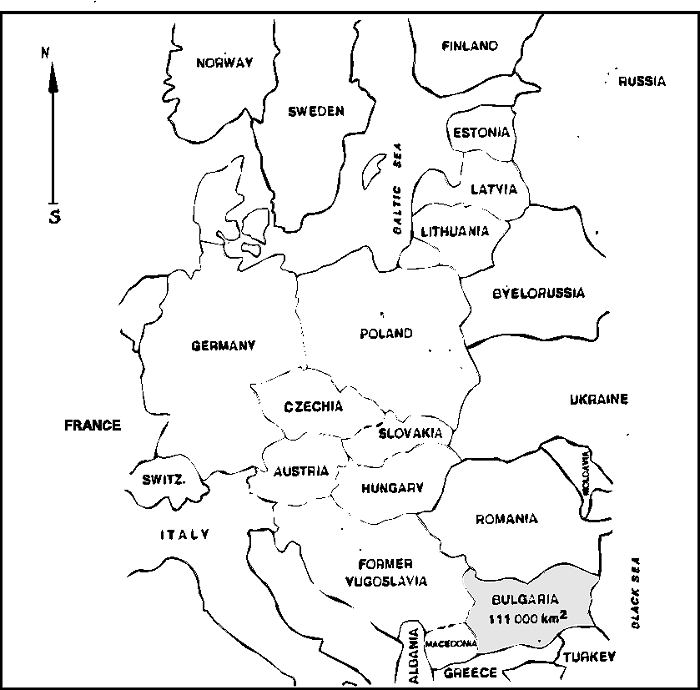
Republic of Bulgaria is situated in the south-eastern part of Europe - Fig.1. It is a little country with area of 111000 square kilometres and population about 9 millions. The capital of the country is Sofia with population of 1million. Bulgaria is an ancient country. It has been established in 681 A. D.
Fig. 1.
BULGARIAN NUCLEAR POWER PROGRAMME
Bulgarian nuclear power program started in the late sixties when an agreement was reached with the former Soviet Union to supply pressurized water reactors for electricity production with a thermal capacity of 1350 MW and electricity generation capacity of 440 MW(e). The first stage of the programme includes construction of 4 units in NPP Kozloduy well known presently as WWER-440. In fact nuclear energy development in Bulgaria began in 1970 with construction of first two units (1 and 2) for a period of 6 years.
The second stage includes next two units (3 and 4) which were completed in 1981 and 1982, respectively. They are the same type and they have the same parameters as units 1 and 2, but they are provided with improvement of safety systems.
The third stage is from 1987 to 1991 and it includes units 5 and 6. They are constructed according a completely different concept from WWER-440 reactors. Each of them is equipped with new generation reactor - WWER-1000 with 1000MW(e). The unit 5 started its operation in 1987 and unit 6 - in 1991.
NPP Kozloduy is situated on the right bank of Danube river.
The power plant total has installed 3760 MW(e) capacity and it is of a significant national and regional importance. The average annual electricity production is 12-14 billion kWh, which covers about 40% of the country's electricity demands.
The second foreseen NPP will be located on the right bank of Danube near town of Belene. The construction of first unit of Belene NPP began in 1985 with WWER-1000 Russian design type reactor again. In 1990-1991 the construction was stopped because of different reasons including financial ones.
NPP Kozloduy, NPP Belene and all electric plants in the country are state property and they are under the management of National Electric Company (NEC). NEC is subordinate to the Ministry of Energy.
Generalizing nuclear energy installations in the Republic of Bulgaria include:
Figure 2 shows you the locations of nuclear installations in the country.
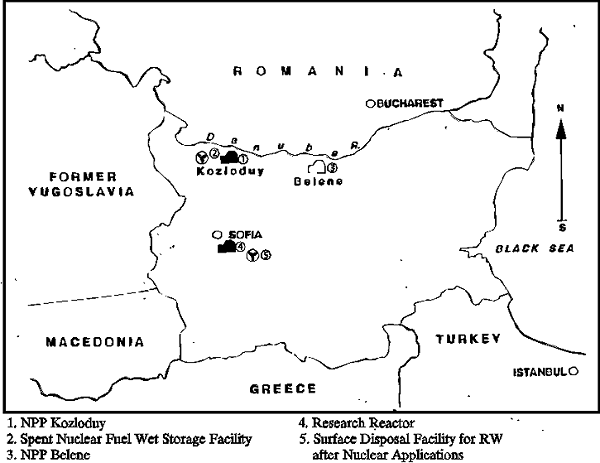
Fig. 2.
The governmental organizations that are responsible for the nuclear power programme are given in Fig. 3.

Fig. 3.
WASTE MANAGEMENT POLICY
The policy in the field of Nuclear Fuel Cycle and Waste Management is determined by the Law on the Use of Atomic Energy for Peaceful Purposes 1985, amended in 1995. It provides general rules and legal frames for nuclear activities in the country. The Law postulates the protection of life and health of people and environment should be of prime concern and should have priority before economic and other considerations. The responsibility for safety operation and liability for nuclear damage is born by the operator of a nuclear facility.
The state control in the field of nuclear power energy and atomic energy in Bulgaria is responsibility of Committee on the Use of Atomic Energy for Peaceful Purposes (CUAEPP) - the Regulatory body. The most important part of Committee is Inspectorate on the Safe Use of Atomic Energy (ISUAE). It is Bulgarian Nuclear Safety Authority. The organizational structure of the Committee is shown in Fig. 4.

Fig. 4.
By the Law the ISUAE has been determined as a state control body on nuclear and radiation safety. CUAEPP has judicial status and is financed via the state budget.
The financing of the activities connected with the Management of RW from NPP Kozloduy is responsibility of the Ministry of Energy as part of its economic activities, up to now.
The spent nuclear fuel of the NPP Kozloduy after 5 years of temporary storage at the NPP's spent fuel pools is returned to the supplier - Russia up to now. By the way we had to build intermediate wet storage facility on the site of NPP for nuclear fuel.
Financing of the activities connected with management of RW generates from the use of ionizing radiation sources in research, science, medical applications, industry and so on is a responsibility of the Government of the country.
Now two financial funds were created by the amended Law'1995:
All judicial and physical people that receive RW by their activities must give money in these two funds.
RADIOACTIVE WASTE INVENTORY
Radioactive Waste from NPPs
The main problem is the radioactive wastes from NPP Kozloduy because their quantity is big as a project decision and much more as a practice. There are three types of waste: liquid, solid and gaseous RW.
Liquid Wastes
The liquid wastes are classified according to their specific activities as follow:
| Low level | 3.7×10⁵ Bq/l |
| Medium level | 3.7×10⁵ ÷ 3.7×10¹⁰ Bq/l |
| High level | 3.7×10¹⁰ Bq/l |
The philosophy that defined the design of the NPP Kozloduy liquid waste processing systems was based on the following premises: 1)liquid releases into the Danube river must be kept at minimum; 2)solidification of the generated liquid waste will not be needed during the plant operation; and 3)solidification of the waste generated over the plant life-time will be performed during the plant decommissioning phase. To meet these very restrictive requirements plant was provided with the large capacity tanks intended to keep the majority of the plant generated and processed liquid wastes at the site.
Combination of various internal and external factors contributed to overall system miss-performance and the current problems. Some of them are very restrictive liquid water discharge limits, higher than anticipated liquid waste generation rate and worse equipment performance specified by the original design.
The liquid waste processing system at NPP Kozloduy is comprised of three subsystems: primary coolant clean-up subsystem, clean effluent collection subsystem and spent resin regeneration subsystem. All effluents collected by these subsystems share the same processing channel, i.e. all processed by an evaporator concentrator (two evaporators are provided in parallel to process incoming effluents).
The evaporator distillate is further processed by a series of cation and anion and cation-anion demineralizers and sent to one of four monitor tanks for radiochemical control. If the bath meets the discharge criteria it will be released into the Danube river. The distillate will be recycled back into the waste processing system if it does not meet the criteria. Each monitor tank has a capacity of 50m3.
There are two identical waste processing systems (described above) at Kozloduy NPP, each serving two units. Therefore, the combined storage capacity installed at the site in three auxiliary buildings (AB-1, AB-2 and AB-3) is 8600 m3.
Thanks to IAEA's technical assistance project for Bulgaria a team of Bulgarian experts from Sofia University, CUAEPP, NPP Kozloduy, Ministry of Environment have estimated the doses to the public from NPP's releases. The American expert, recommended by IAEA, took an essential participation in this project. As a consequence of this dose estimation the liquid release limit have been changed. This change lead to significantly decreasing of the waste amounts.
Kozloduy NPP has accumulated about 2390m3 at units 1 and 2, 2200m3 at units 3 and 4 of liquid waste and about 2500m3 at units 5 and 6 of liquid waste till 1995.
Solid Wastes
The solid wastes are classified according to one of the following parameters:

The SRW generated at NPP Kozloduy consist of filters, plastic (PVC), protective clothing, concrete and rubble, pieces of pipes and equipment, miscellaneous steel, paper and wood. The SRW is mostly generated during the plant outages and equipment maintenance.
The whole quantity of I÷II class SRW is about 7000m3 till 1995. Since 1995 there is used a supercompactor - 1000 tons for pressing of compressible RW in NPP.
The quantity of III class operating SRW is approximately 50m3.
There is not any information for total activity of all wastes. But it will be able to gain full information about that in approximately 2-3 years after treating the wastes and after obtaining a new "Canberra" measurement system.
Radioactive Waste from Research, Science, Medicine, Industry
The quantity of this kind of RW is not so big but it is a big problem, too, because these wastes are very different as a composition and as an activity.
In the repository named Novi Han, near the city of Sofia, are stored the following RW till the end of 1995:
The total activity of all wastes is assessed to be about 25000 Ci.
WASTE TREATMENT FACILITIES
For units 1-4 there is not any installation for the treatment of RW by the project.
For units 5-6 there was the following installation for the treatment of RW by the project:
To be realized the requirements of the law each unit has to have a radwaste treatment facility and the government of Bulgaria had to give an agreement to NPP Kozloduy to buy the missing installation from a Western Company. They are the following:
There will be a temporarily storage facility for storaging of treated RW by the building of RW treatment facilities for a period of 25-30 years. These two buildings have already been licensed and they are into construction by AB-3 now.
As a package form of treated RW there is a Bulgarian concrete container for packaging, storaging, transportation and final disposal of cemented RW. The container has a capacity of 5m3. This surepack container was tasted according to IAEA's recommendation and regulation as IP-3 packaging. It has already had a licence from the Regulatory body - CUAEPP. The container with RW may be transported by autotransport.
KOZLODUY RADIOACTIVE WASTE
STORAGE FACILITIES
Liquid Wastes
There are the following storage facilities for liquid RW:
There are 4 tanks with single capacity 150m3 in AB-1 and in AB-2, and one 100 m3 tank in AB-3 for temporally storage of spent ion exchange resins low level activity. For temporarily storage of spent ion exchange resins high level activity there are 2 tanks with single capacity 420 m3 in AB-1 and in AB-2, and one 100m3 tank in AB-3.
Quantity of these materials is 300m3 with low level activity and 100 m3 with high level activity.
Solid Wastes
These storage facilities comprised of a number of wells are located inside the auxiliary buildings. The wells were built as part of plant original design.
The new storage facility, outside the reactor buildings, is a stand alone above the ground concrete structure with the total volume of 4800m3.
Since the beginning of the operation of NPP in 1974 up to now the situation with the SRW is as follows: - store in AB-1 with capacity - 1000 m3 - it has already been full;
MEDICINE, RESEARCH, INDUSTRY RADIOACTIVE WASTE DISPOSAL FACILITY
There is a repository Novi Han for this kind of wastes, which is a property by Institute for Nuclear Research and Nuclear Energy of Bulgarian Academy of Science, near Sofia, in Losen mountain. It is Russian design and it is in operation since 1964.
It is a surface repository and has the following volumes:
FINAL DISPOSAL OF RADIOACTIVE WASTE
The first step was taken for final disposal of radioactive waste and spent nuclear fuel in Bulgaria. Within the development of "National Concept for Radioactive Management and Disposal in Republic of Bulgaria" a review of disposal principles and available disposal options was performed and the type and quantities of the wastes that have to be disposed of were estimated.
The development of the Concept for the construction of National Radwaste Repository has taken into consideration all IAEA recommendations, basic principles and criteria (1-5).
The Concept was created from 1991 to 1993 and contains 70 projects (6). By preliminary system analyses based on the criteria accepted by European Community, USA and IAEA Recommendations 20 sites were selected that have suitable conditions for locating a radioactive waste repository. A map of categorization of regions on the territory of Bulgaria is shown in Fig. 5. The regions and the areas are outlined on a map in scale M1:500000. Twenty sites are considered and will be subjected to investigations and preliminary studies for the second stage. It seems it will be accept a surface repository for final disposal of RW in Bulgaria because there are not any good underground geological structures in our country about that.
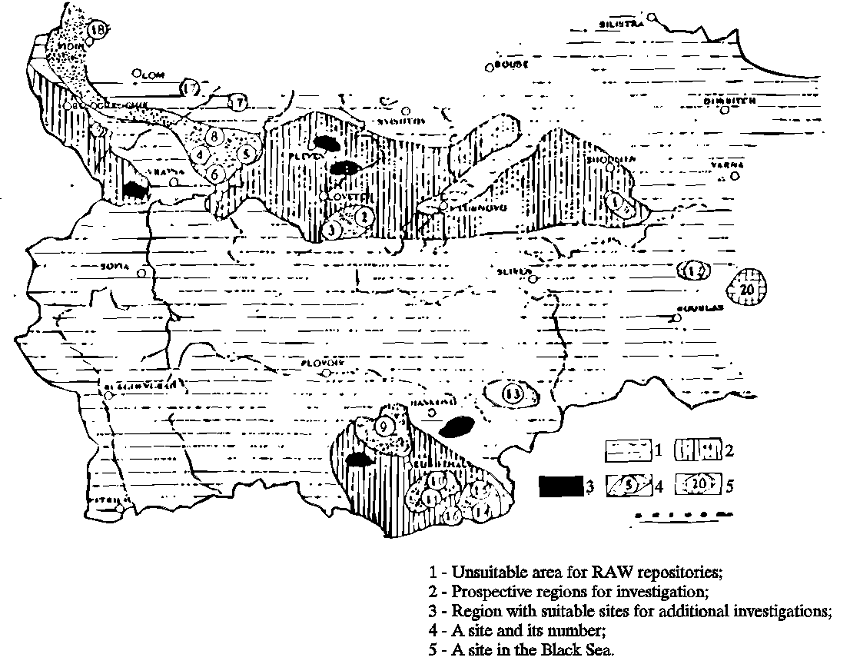
Fig. 5. (Click the picture to display the full size.)
INTERNATIONAL SUPPORT IN THE FIELD OF RADIOACTIVE WASTE MANAGEMENT.
From European Community
The present part of the support belongs to the EUROPEAN COMMUNITY PHARE PROGRAMME PROJECT - BG9107-02-04 "Radioactive Waste Management in Republic of Bulgaria".
The target of this project is Republic of Bulgaria to be acquainted with the opinions, advice and recommendations of the three consulting organizations - CASSIOPEE (a Consortium of European Union Radwaste Agencies), AEA Technology from the UK and SGN from France on the organizational aspects of radioactive waste management by comparing the current situation in the country with the foreign experience. The project covers the five basic topics:
According to the project the best estimation of the arising of LLRW and ILRW based on the assumptions of future operation is 29000m3 from the operation over the lifetime of the 6 units of Kozloduy NPP and of new one at Belene NPP. They will be reduced after treatment to about 23700m3.
Bulgaria has already received the results of the implementation of Phase 1 of the Project. They are a high quality documents of advice and proposals including for detailed procedures for a repository for final disposal of radwaste and so on.
The Project will be finished in February 1997, but there is a possibility the support to be continue in two or more directions. Two of them are:
From IAEA
As a present part of the support of the Agency there are two Regional Technical Assistance Projects of IAEA as follow:
The second part is a new Technical Assistance Project of the IAEA under Country TC Programme namely "Increasing the safety of the existing Novi Han Repository for RW from Nuclear Applications".
From Other Countries
In the last six years Bulgaria has been received some supports in the field of Radwaste Management from USA, UK, Japan, France, Germany, Russia and e.g. also.
CONCLUSIONS
There has already been a fact for establishing a national radioactive waste management fund "Safety management of RW" in Bulgaria. This is laid down in the Act on the Use of Atomic Energy for Peaceful Purposes, amended in 1995.
The purpose of this fund is to finance the future activities on RW Management in the country.
Next step will be the creation of the structure of the national fund for radioactive waste management and to establish the national organization that will be responsible for full aspect of RW Management in Bulgaria.
Main part of these activities is creating of normative documentation as a Law for Safety Management of RW including spent nuclear fuel if it is necessary and s.o.
The activities of all state organization that are responsible in the field of radioactive waste management have to continue for site selection, investigation and establishment of a national repository for final disposal of these dangerous materials.
REFERENCES