Table I Comparison of Basic Characteristics of Borosilicate Glass
and Synroc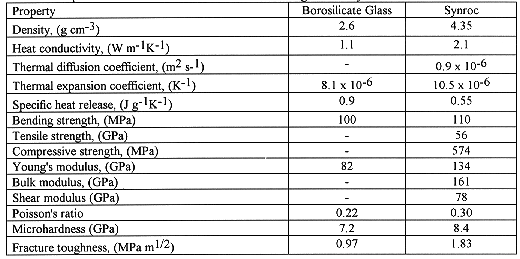
Nickolay S. Babaev
Ministry of Atomic Energy
Moscow, Russia
Andrew N. Sinev
IBR Corp.
Moscow, Russia
Igor A. Sobolev, Sergey A. Dmitriev, and Sergey V.
Stefanovsky
SIA "Radon"
Moscow, Russia)
ABSTRACT
A new concept of radioactive waste management in Russia based on incorporation of high-level waste (HLW) and any radioactive wastes (RW), containing long-lived radionuclides, mainly actinides, in rock-type materials is proposed and discussed. There are 9 Nuclear Power Plants (29 power units) in Russia whose spent fuel should be reprocessed. At the present time closed nuclear fuel cycle is realized for VVER and fast neutron reactors only. HLW formed at spent fuel reprocessing must be subjected to partitioning as first step. Short-lived fraction containing mainly fission and corrosion products should be vitrified or incorporated into mineral-type silicate or titanate-silicate materials. Long-lived actinide fraction may be subjected to transmutation or high temperature treatment, preferably, inductive melting in a cold crucible forming rock-type wasteforms like Synroc.
INTRODUCTION
Large-scale development of nuclear power engineering and other nuclear technologies has brought the attention of mankind to the most difficult problem - processing and ultimate disposal of a great amount of radioactive wastes.
Despite the fact that the problems of waste management are studied from the first days of nuclear technology emergence and a broad experience has been gained in this field, it is the problem that in the course of recent decades acquired a fresh force and is put in the forefront.
Largely it is related to two aspects: in the first place, in spite of significant experience gained in handling radioactive substances, the problem of their reliable isolation from the environment has not been solved as yet and, in the second place, the relevant accumulation of radioactive substances on the surface of the planet grows constantly.
Thus, proceeding from today's assessments of nuclear power development rate (430-450 GW of installed capacity in 2000), it should be expected that the total level of radioactivity of spent nuclear fuel (SNF) unloaded from power generating reactors, will amount to approximately 7.5 x 10⁵ MCi by the year of 2000.
In the case of SNP processing 99.9% of radioactivity transfers to high-level wastes (HEW). The isolation of the tremendous activity from the biosphere is one of the most complicated and crucial ecological problems of nuclear power, since only its reliable solution will permit development of the most ecologically clean power-generating trend, i.e. nuclear power, not only at the moment, but in future, as well.
Nowadays in the countries with advanced nuclear power program diverse concepts of radioactive waste (RW) management are developed and realized. The national programs of RW management depend essentially on the national strategy of nuclear power development and, the more so, on strategy of the finishing stage of fuel cycle (open or closed nuclear fuel cycle (NFC)) (1,2).
CURRENT SITUATION
Fuel cycle Policy in Russia
From all the stages of nuclear fuel cycle the following three ones are most characteristic from the viewpoint of radioactive waste formation: nuclear power plant, SNF processing plant and HLW transportation between enterprises of nuclear fuel cycle. The basic way of the personnel and population protection from radiation exposure consists in assurance of practically utter isolation of radioactive substance from the biosphere at all the stages of NFC. Irrespectively of specific features of RW management strategy, in all the countries mentioned a multibarrier system of protection is applied. When handling intermediate- and especially high-level wastes, the principle of three-barrier protection of the source from the environment is employed, envisaging at least three engineering or natural barriers restricting the waste dissemination in the course of storage or management of the wastes mentioned for their isolation from the environment. For instance: solid substance comprising radioactive wastes, a strong vessel for its storage and the wall of the storage site.
The first protective barrier being the most important is the matrix to be used for RW immobilization. When designing the multibarrier protective systems, the allowance is made for the fact that possible service life of the barriers is to be approximately equal to life time of the substances contained (the time in the course of which activity of solidified RW will decrease to the natural background level).
In the report offered to your attention the basic regulations of a new concept of RW management in Russia are presented.
Nowadays in Russia there are 9 NPP (29 power units) of total installed capacity exceeding 21 GW (el.). The NPP stock incorporates 11 power units with the RBMK-1000 type reactors; 6 power units with the VVER-440 type reactors; 7 - VVER-1000; 1 power unit with the BN-600 fast neutron reactor and 4 power units with the EGP-6 reactors.
Closed fuel cycle is realized now for the VVER-440 type reactors and fast neutron reactors (BN-350, BN-600) only. Spent fuel of the RBMK reactors due for the reasons of economy is not processed and kept in storages on NPP sites. Spent fuel from the VVER-1000 reactors sited both in Russia and Ukraine is transported to a temporal storage arranged at Krasnoyarsk mining and chemical combine, its capacity being 6000 t, which will be filled entirely by the year of 2000. In future realization of closed fuel cycle for the VVER-1000 type reactor is feasible.
Basic Principles of Radioactive Waste Management in Russia
LILW Management Policy
Liquid low- and medium-level RW involve the greatest hazard at NPP. Prior to their conditioning, they are subjected to processing to reduce their volume.
Liquid RW are collected and then evaporated reducing the volume by a factors of 50-100. As a result a high degree of the condensate purification from radionuclides is achieved. After additional purification from radionuclides using special filters the condensate is reused. Then concentrated radioactive wastes are transported for temporal storage in concrete containers lined with stainless steel, their capacity ranges between 200 and 5000 m3. The double protection, continuous monitoring of leak tightness and availability of reserve capacities rule out completely the possibility of radionuclide ingress to the environment.
Liquid radioactive wastes from NPP are not discharged to the environment. Only the purified, so-called off-balance waters, their limiting specific activity not exceeding the permissible concentration in drinking water, can be discharged.
Cementation (low temperature method) and bituminization (moderate temperature method) are used for liquid waste solidification, yielding solid wasteforms, which is to be stored in the near surface (shallow) repositories on the plant territory (3).
Up to date the advanced nuclear countries gave up the bituminization as the method of intermediate-level waste solidification due to a danger of fire for the bituminized waste storage. Intermediate-level wastes and slurries are mainly treated by the cementation method.
At Russian NPP the bituminization process was applied up to the mid-90-s, however, by the moment it has been given up, as well. At Balakovo NPP in cooperation with the NUKEM company (Germany) the construction of the Center of Radioactive Waste Management including combustion facilities (of 60 kg/h productivity) and RW cementation facilities (of 21 drum/day productivity in case of the work arranged in two shifts) is in progress. Commissioning of the facilities is planned for 1996/1997. By the end of 90-s the problem of liquid medium-level waste solidification based on cementation technology will be fully solved.
Burnable solid wastes from NPP are incinerated in special furnaces, non-burnable ones are pressed, packed and stored in special tanks. The method of combustion permits attaining a 20-80-fold waste volume reduction, pressing - a 3-4-fold one. On being processed, the solid wastes are placed in solid wastes repository located at NPP territory (3).
In the whole, the major strategic approach to low- and intermediate-level waste management in Russia is their maximum volume reduction to be solidified and transferred to regional repositories. The overwhelming part of high-level wastes formed as a result of the reactor operation remains in the unloaded fuel.
HLW Management Policy
Fuel elements extracted from the core are kept for a certain time period in special repositories at NPP and then they are transported to the radiochemical plant for processing or to a special centralized site for a long-term storage.
At the present time only one radiochemical plant (RT-1) is under operation in Russia, which is engaged in processing of SNF from power reactors. It operates at "Mayak" production association near Chelyabinsk and performs processing of all spent fuel from the VVER-440 reactors both from CIS countries and former socialist countries of Eastern Europe and Finland, where NPPs, previously constructed according to Soviet designs and now use the fuel manufactured at Russian plants, are under operation.
At the moment there are no regional burial sites for long-term storages of SNF and/or HLW on the territory of Russia. All radioactive wastes are kept on the sites of the manufacturers. Hence, all vitrified wastes of fuel processing from the VVER-440 reactors produced at "Mayak" PA are kept in a ground storage, specially constructed for this purpose, which will assure safe storage of vitrified HLW in the course of 20-30 years until the centralized storage will be built (4).
In 2000-2010 it is planned to realize the siting and start constructing a storage in geological formations for spent nuclear fuel not subject to further processing and vitrified high-level wastes. Zoning of Russian territory has been performed for the storage setup. At present a Coordination Board has been created engaged in substantiation and search of the sites fit for RW disposal. It is noteworthy that for the reasons of political and social character, the putting into operation of deep geological storages is not planned in any country of the world earlier than 2008-2010.
In the process of SNF regeneration alongside with low- and medium-level wastes processing of high-level wastes will be realized, as well. For high-level wastes their incorporation in a solid matrix featuring a high durability with subsequent disposal of the solidified wastes in deep (exceeding 1 km) stable geological formations is the only acceptable form of safe storage.
In certain countries, the Russian Federation inclusively, the technology of radionuclides incorporation into glass has been developed and put into industrial service. The technology complies with requirements of high chemical stability and low leaching rate of radionuclides in case of contact with water.
In France and Great Britain the French AVM-process (continuous two-stage process involving calcination of liquid HLW in a rotary furnace following by melting of the calcine and glass-forming additions in a melter with induction heating) is performed in industrial-scale facilities for HLW processing (4). In USA the LFCM-process of HLW processing (one-stage process of vitrification in a ceramic melter with HLW introduction in liquid and slurry-like form) is being developed and introduced for processing high-level wastes of military production (4). The works along this trend are under way in Japan and China (4).
Two trends in HLW vitrification involving phosphate and borosilicate glassy materials are developed in Russia: two- and one-stage processes. The process flowsheet envisaging dehydration, calcination and melting within one apparatus with continuous feeding of liquid wastes and fluxing additions directly to a Joule heated ceramic melter manufactured from refractory materials has been largely finished off. To obtain phosphate glass the liquid wastes are preliminarily mixed with orthophosphoric acid and in the form of a homogeneous product they are fed into the melter on the surface of the melt (4).
Alongside with phosphate materials a technology of borosilicate glass production in a ceramic melter using boron-containing mineral datolite and silica has been developed (5).
An industrial plant for HLW vitrification with 500 i/h productivity in terms of initial solution was put into operation at the RT-1 plant of "Mayak" PA in 1987. In 1991 a new unit for HLW vitrification was put into industrial operation at the same plant, which consisted of the following basic units: solution preparation unit, EP-500/1 electric furnace, off-gas cleaning system, unit of glass pouting into containers, unit for charging of filled containers into boxes, repository of vitrified wastes.
For three years of operation 6300m3 of HLW have been processed, and 460 m3 (1200 t) of phosphate glass have been produced. Total activity of radionuclides incorporated into the glass was up to 151 MCi.
CONCEPT
However, for long-lived radionuclides, the period of their potential hazard making up millions of years the use of glassy matrix for their reliable isolation is highly conjectural. It is considered advisable to realize partitioning of the liquid HLW into long-lived and short-lived fractions to optimize the flowsheet of handling liquid HLW formed in the SNF processing.
In Russia, adhering to the principles of a closed fuel cycle, the efforts aimed at partitioning and transmutation of long-lived radionuclides are considered as an integral part of the long-term program on radioactive waste management. The program comprises all crucial aspects starting from radioecological substantiation of the list of radionuclides, calculation of radiotoxicity indices, justification of the necessity of the extraction degree, elaboration of technological means of transmutation and ending with economic calculations of the cost of the programs, which are to envisage not only expenditures for their implementation, but also make allowance for avoided damage for the mankind and its future generations.
In Russia the arrangement of industrial production engaged in separation of long-lived radionuclide fractions during SNF processing to increase the reliability and safety of RW handling has been completed at "Mayak" PA in 1995.
Presently, in the framework of Russian_American program joint elaborations are made and Russian technologies are tested as applied to partitioning of high level liquid wastes stored at the radiochemical plant in Idaho. At V.G. Khlopin Radium institute reagents and technologies for solvent extraction for isolation of cesium and strontium, group of actinides, rare earths and technetium from acid solutions are developed. The technologies were tested in a dynamic (counterflow) mode in Radium institute hot cell using model wastes with addition of radionuclides. The tests in a periodic mode were carried out in a hot cell at Idaho national technical laboratory using actual radioactive waste specimens to check the results obtained at Radium Institute. A good coincidence of the results has been obtained. Joint works along this trend are continued.
For processing the fraction of short-lived radionuclides, whose period of potential hazard ranges between tens and hundreds of years, the vitrification technology described above with production of borosilicate glass can be applied. For processing the fraction of long-lived radionuclides, whose period of potential hazard ranges between tens of thousand and hundreds of millions years it seems advisable to use rock (mineral) - like matrices similar to natural mineral formations in their properties, which maintain their physical and chemical properties over the course of geological periods of the planet existence.
One of the rock-type matrices is titanate ceramics called "Synroc" has been suggested and developed in Australia using the hot pressing method (6). Synroc material comprises three basic mineral phases - hollandite BaA12Ti6016, perovskite CaTiO3 and zirconolite CaZrTi207. The technology of Synroc production consists of the following basic operations: HLW mixing with water suspension containing powdered TiO2, ZrO2, AI203, CaO and BaO, dehydration, drying, denitration and calcination of the mixture in a rotary calciner at a temperature of 750°C, addition of metallic titanium powder to the mineralized product in the amount up to 2 wt.%, and hot pressing of the product in special molds with subsequent annealing at 1200°C. The newest elaborations envisage preparation of a homogeneous charge, the so-called Synroc precursor, using sol-gel process (6,7).
Today's knowledge permits comparing basic characteristics of borosilicate glass and Synroc ceramic matrix (see Table I). It follows from the Table that Synroc features higher mechanical properties and, what is more important, it has a better chemical durability under hydrothermal conditions and elevated pressure inclusively, compared to borosilicate glass, which makes its use more attractive. The HLW content in the final Synroc product makes up 10-20 wt.%. Its higher strength, as compared to borosilicate glass at elevated temperatures, permits increasing HLW content in the matrix, while a higher fracture toughness and heat conductivity decrease the growth of the surface area at the expense of thermal fracture.
Table I Comparison of Basic Characteristics of Borosilicate Glass
and Synroc
Nevertheless, the technology of its production and implementation of the process have not been tested yet under industrial conditions using actual RW in contrast to vitrification. Up to the moment the process has been finished off in Australia using inactive materials and remote control facilities, which does not permit assessing the reliability and ecological safety of the process. Therefore, the technology mentioned has not find practical application anywhere in the world so far.
The research on the potentiality of Synroc material use for immobilization of actinides is continued in the framework of joint program of Japan Atomic Energy Research Institute (JAERI) and Australian Nuclear Science and Technology Organization (8). The research conducted by these organizations has revealed that the effect of alpha decay of actinides incorporated in the material is accompanied by a gradual decrease in its density by 2.7%, which is equivalent to the change in its density as a result of aging in the course of 45 thousand years.
The Nuclear Waste Management Co. and the Australian companies involved, on the one hand, and VNIIPIET (Russia) and VNIPIPT (Russia), on the other hand, from early 90-s are engaged in feasibility studies relating to creation of "Synroc" pilot facility for liquid HLW solidification and disposal at the territory of "Mayak" PA.
In Russia for the purposes of fixation of long-lived radionuclides an alternative method of production of rock-type materials on silicate basis by the method of inductive melting in the cold crucible is developed, which seems to be the most promising for Synroc production.
The use of Synroc material is a very interesting trend, since in case of success it is the rock-type matrices, which will permit a reliable isolation of long-lived radioactive substances from the environment for a long-term period, which can not be assured by the matrices developed on the basis of borosilicate and phosphate glasses.
Thus, in the context of a closed fuel cycle the suggested concept of RW management in Russia is to look as follows:
In this way a reliable isolation of the wastes from the environment will be assured.
REFERENCES