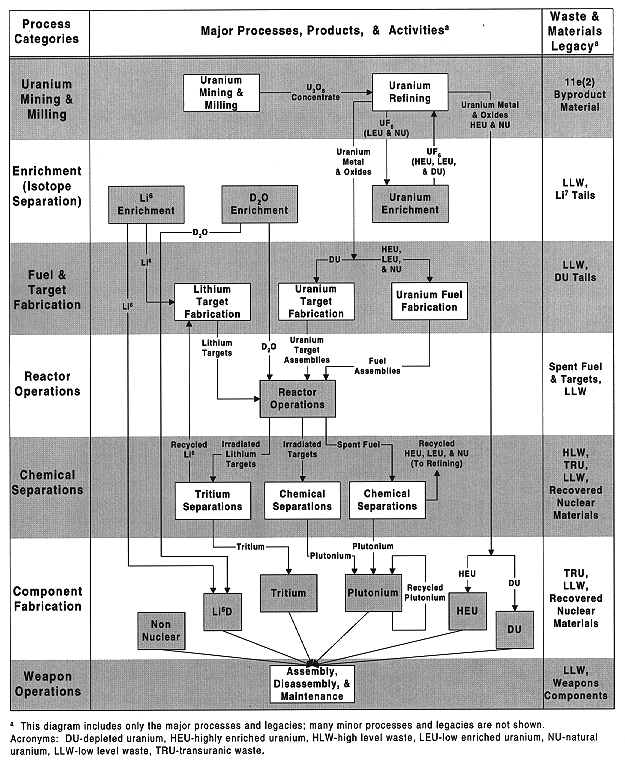
Fig. 1. Nuclear weapons production
process categories.
Donald C. Habib
Project Performance Corporation
Steven Taub
U.S. Department of Energy
Office of
Environmental Management
Office of Strategic Planning and Analysis
ABSTRACT
The National Defense Authorization Act of 1995 required the Department of Energy to submit a report to Congress describing all waste streams generated during each step of the complete cycle of nuclear weapons production in the United States, including estimates of the amount of waste generated and an analysis of the characteristics of each waste stream. To meet this requirement, the nuclear weapons production process was divided into eight general processes: mining, milling, and refining uranium; isotope production (enrichment); fuel and target fabrication; reactor operations; chemical separations; component fabrication; weapons operations (including assembly, disassembly, and maintenance); and research, development, and testing. In consultation with Congressional staff, DOE broadly interpreted "waste streams" to include four distinct elements: waste, contaminated environmental media, surplus facilities, and materials in inventory. Information was then compiled from existing sources in two areas: current and past activities at each site managed by DOE, and data on the environmental legacy present at each site. Using this information, the inventories of waste, media, facilities, and materials were categorized among the eight nuclear weapons production steps and nonweapons activities. The environmental legacy from nonweapons programs were grouped as either supporting the naval nuclear propulsion program or "other." Though other analyzes have described and quantified the Department of Energy's waste legacy, this is the first analysis of the origins of the environmental legacy of nuclear weapons production and includes waste, media, surplus facilities, and materials in inventory. The formal results of this analysis are to be released in a Report to Congress on the origins of the nuclear weapons environmental legacy.
BACKGROUND
As the nation moves forward after the Cold War era, it is faced with the challenging environmental legacy after five decades of nuclear weapons production. In 1942, America began to develop technology capable of producing nuclear weapons under the U.S. Army Corps of Engineers Manhattan Engineering District (known as the Manhattan Project). Its initial efforts resulted in the first atomic bombs used at the end of World War II.
With the enactment of the Atomic Energy Act of 1946, nuclear weapons development and production was transferred to the new civilian Atomic Energy Commission (AEC). The AEC developed and managed a network of research, manufacturing, and testing sites and focused the efforts of these sites on stockpiling an arsenal of nuclear weapons. Initially, the weapons production network was small and scattered, relying on many small, privately-owned facilities. However, in the late 1940s and early 1950s, during a period of great expansion of the weaponscomplex, most functions were consolidated into a complex of large, centralized, government-owned production facilities. Today, the primary mission of many sites is environmental restoration and waste management.
Stockpiling nuclear materials and weapons required an extensive manufacturing effort that generated large volumes of waste and resulted in considerable environmental contamination. Growing concerns about safety and environmental problems caused various parts of the weapons-producing complex to be shut down in the 1980s. These shutdowns, at first expected to be temporary, became permanent when the Soviet Union dissolved in 1991. Although the nation continues to maintain a reduced arsenal of nuclear weapons and limited production capability, the Department has largely suspended nuclear weapons production activities and begun to downsize the weapons complex. Production materials and facilities formerly considered vital are now excess to the Department's current mission needs.
The scope of the environmental legacy managed by DOE includes the following four major elements:
These four elements comprise the legacy managed by DOE. There are other aspects to the legacy resulting from nuclear weapons production that are excluded from this analysis because they either fall outside the scope of this report, are unidentifiable and unquantifiable, or are not under the purview of DOE:
PROCESSES THAT GENERATED THE LEGACY
A nuclear weapon is a complex device consisting of many parts, a number of which require special materials, assembled according to rigorous specifications. The essential ingredients of all nuclear weapons are fissile materials. Fissile materials are isotopes which are capable of being split (or "fissioned") by a low energy neutron, and thus by neutrons of all energies of the neutron energy spectrum which occur during a nuclear explosion. The "fissioning" of fissile isotopes releases additional neutrons and energy in the process. Some weapon-usable fissile materials do not occur in nature; others do but in forms that require separation or concentration. Uranium-235 (U-235) and plutonium-239 (Pu-239) are the primary fissile materials around which the United States nuclear weapons complex was built. A major portion of the nuclear weapons complex was devoted to producing these fissile and other nuclear materials.
U-235 occurs naturally in low concentrations. Uranium ore is mined, milled, and refined, and the U-235 is separated from the other uranium isotopes by physical techniques. Conversely, Pu-239 is produced artificially by exposing U-238 (the more abundant naturally occurring isotope of uranium) to neutron irradiation, typically in nuclear reactors. Plutonium is separated from uranium and other reactor fuel and target materials using chemical techniques.
Other materials enhance the power and efficiency of nuclear weapons. These materials include lithium enriched in the isotope lithium-6 (Li-6), and tritium and deuterium, which are heavy isotopes of hydrogen. Li-6 and deuterium are naturally occurring isotopes, while tritium must be produced by neutron irradiation.
This analysis attributes the wastes, contaminated media, surplus facilities, and materials in inventory resulting from nuclear weapons production to eight process categories that depict the general flow and sequence of steps that went into the nuclear weapons production process. The eight steps are:
In general, these steps occur sequentially, except for research, development, and testing, which takes place concurrently with the other steps. Research and development is mostly complete before component fabrication begins, but testing of a particular nuclear weapon system may continue until a weapon is retired from the stockpile.
Nuclear materials were produced by starting with mined and milled uranium, refining it for enrichment to high U-235 levels for use in weapons or to lower levels for use as reactor fuel and targets. Reactor fuel and targets were irradiated in nuclear reactors and then dissolved in acid and chemically processed to extract the plutonium and recover the unused uranium. Tritium was produced in a similar fashion by separating lithium isotopes, manufacturing lithium targets which were irradiated in reactors, and then chemically processing the targets to recover the tritium. Plutonium and highly enriched uranium (HEU) were shaped into "pits" to be used in the nuclear explosive package. Additional nuclear materials were used to make the "secondaries" that produce additional fission and sustain thermonuclear reactions. These nuclear components were assembled with explosives; arming, fusing, and firing systems; neutron generators; tritium storage and transfer systems; parachutes; batteries; and structural components to form complete nuclear weapons. Figure 1 illustrates a simplified flow of materials between these processes.
Fig. 1. Nuclear weapons production
process categories.
The numerous activities that went into making nuclear materials and weapons, and storing or disposing of the wastes, were conducted at hundreds of sites across the country. Some of the sites were owned by DOE and its predecessor agencies and operated by contractors; others were privately owned, but worked under contract with DOE; still others provided DOE and its operations contractors with needed services and supplies. Table I lists the major sites associated with the process categories, and Table II presents a summary of the results of the analysis.
Table I Functional Process Missions of the Major Sites and
Facilities
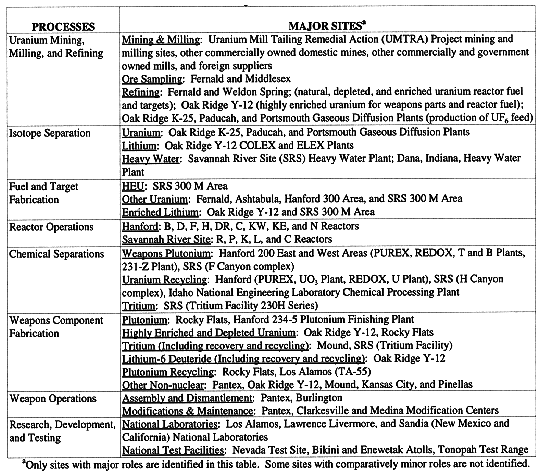
Table II Summary of the Environmental Legacy of Nuclear Weapons
Production

Non-weapons activities also took place at the nuclear weapons complex sites, and some even used weapons-complex facilities. May of these activities generated wastes and contaminated media similar to those resulting from nuclear weapons production. These nonweapons activities are grouped into the following two categories:
Production of materials and services for the Naval Nuclear Propulsion Program, a joint DOE and U.S. Navy program, responsible for the design, testing, construction, and operation of nuclear propulsion systems for surface warships and submarines. The Department has produced and processed highly-enriched uranium for the Navy at various weapons complex facilities. DOE also accepted spent nuclear fuel from Naval nuclear reactors to recover enriched uranium for reuse in the weapons programs.
A variety of non-defense programs administered by DOE and its predecessor agencies. Since the beginning of the "Atoms for Peace" program in 1954, federal agencies have sponsored research and development of civilian uses of nuclear energy. The agencies have led the effort to develop nuclear power plants, supplied enriched uranium to civilian reactors, constructed and operated prototypes and demonstration plants, and accepted some wastes for storage and disposal. The Department and its predecessor agencies have also managed many research programs addressing energy supply and basic and applied science and technology.
Figure 2 presents the scope of this analysis in the context of these other related programs.
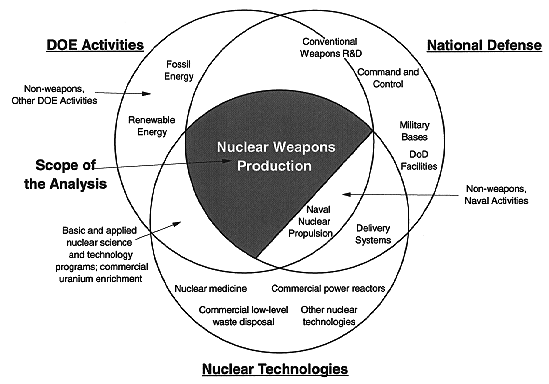
Fig. 2. Scope of this analysis.
WASTE
Virtually all nuclear weapons production activities generated waste. As used in this report, the term "waste" refers to solid and containerized liquid materials that are either radioactive, hazardous, or both, and have been disposed of in or on the land or water or are being accumulated in storage pending a decision on disposal. Waste has been disposed of by shallow-land burial, underground injection (known as hydrofracture), and sea burial, and is stored in containers, tanks, silos, buildings, and other structures (DOE discontinued radioactive waste disposal by underground injection in 1983 and sea burial in 1969). Some disposed waste has been retrieved in site cleanups and is currently in storage. Some waste contains both radioactive and hazardous components, and other waste is solely either radioactive or hazardous.
Waste is measured in terms of its volume (cubic meters) and its radioactivity content (curies). DOE manages a waste legacy of 36 million cubic meters containing about one billion Curies. (By contrast, spent nuclear fuel from domestic commercial power reactors includes 32,000 metric tons of material containing an estimated 30 billion Curies.) Approximately two-thirds of the DOE waste volume and 90 percent of the radioactivity resulted from nuclear weapons production.
The waste legacy includes the following seven major categories of waste:
The origins and characteristics of this waste are summarized as follows:
DOE manages a legacy of 36 million cubic meters containing about one billion Curies. Approximately two-thirds of the waste volume and 90 percent of the radioactivity resulted from weapons production.
Uranium mining, milling, and refining generated the largest volume of weapons waste. Weapon operations generated the smallest volume. By volume, the vast majority of the 36 million cubic meters of DOE waste is disposed 11e(2) byproduct material. States with the largest volumes of waste from weapons production are Colorado, Utah, New Mexico, and Texas.
Most radioactivity in the waste legacy is present in high-level waste, attributed primarily to chemical separations. All high-level waste remains in storage today (except for some which has leaked from storage tanks at Hanford). Most of the high-level waste is located at the three DOE sites performing chemical separation for weapons production located in Idaho, South Carolina, and Washington. About 99.7 percent of the radioactivity in high-level waste comes from radionuclides with half-lives less than 50 years.
Most transuranic waste resulted from nuclear weapon component fabrication and chemical separation for the production of weapons-grade plutonium. Nonweapons activities produced about a tenth of the transuranic waste volume and about half of the radioactivity. Nearly 90% of the radioactivity in stored transuranic waste comes from radionuclides with half-lives less than 500 years.
Radioactivity in waste from uranium mining, milling, and refining, enrichment, and fuel and target fabrication is due generally to naturally occurring radionuclides (e.g., uranium, thorium, radium, and radon). Radioactivity in waste from the other process categories is due primarily to reactor-generated fission products (e.g., cesium-137 and strontium-90) and transuranic isotopes (e.g.,plutonium)
Most of the DOE waste volume has been disposed of, but most of the radioactivity remains in storage. Except for high-level waste, portions of all other waste categories have been disposed of. However, much of this waste was originally disposed of under conditions considered inadequate by today's standards.
Only a small amount of hazardous waste generated from weapons production activities remains in storage. Hazardous waste disposed of onsite appears in this analysis as contaminated media. Hazardous waste disposed of at commercial sites is not included.
The legacy of 32 million cubic meters of 11e(2) byproduct material being managed by DOE is only a fraction of the total amount originally produced by companies supplying uranium to the AEC. Of the 325,000 tons of uranium oxide (U3O8) purchased by the AEC between 1942 and 1971, only about 20 percent came from mill sites now being remediated by DOE. About 46 percent of the AEC uranium purchases were imported uranium.
CONTAMINATED MEDIA
Environmental media (including soil, sediment, groundwater, and surface water) on and around most DOE sites have been contaminated by both hazardous and radioactive substances released from a variety of nuclear weapons research, development, production, and testing activities and from other DOE nuclear and non-nuclear programs. This contamination has resulted from a number of causes. Some waste streams were discharged to the environment with or without prior treatment. These include relatively small, localized releases that may have resulted from accidents; larger planned releases of process effluents; and releases on a much larger scale, such as atmospheric fallout from nuclear weapons tests. In other cases, containment systems such as tanks, drums, or landfills placed in or on the land failed to perform their intended function and some or all of the waste leaked into adjacent soil and water. Other contaminated media resulted from spills and other inadvertent releases during process or maintenance operations. Together, the effects of these releases to media comprise this element of the legacy of nuclear weapons production.
Contaminated media include water and other media, primarily solids and sludges. In total, nuclear weapons production activities have resulted in a legacy of 270 million cubic meters of contaminated water media and 58 million cubic meters of contaminated solid media. Other Department nonweapons activities have contaminated an additional 54 million cubic meters of water media and 5.8 million cubic meters of solid media. In some cases, a single activity that was performed for both the nuclear weapons and nonweapons programs contaminated environmental media. For example, uranium for nuclear weapons, the Naval Nuclear Propulsion Program (NNPP), and commercial nuclear power reactors were enriched simultaneously in the same facilities. The amounts of contaminated environmental media resulting from these activities were apportioned in this analysis to determine the volumes attributable to nuclear weapons and non-weapons activities.
The Department is now actively remediating contaminated media through treatment, removal, and containment-oriented actions. Treatment may immobilize contaminants within the media or remove contaminants from it. In some cases, the media themselves are removed from the environment and treated or stored before final disposal. Given current resources, technology, and priorities, however, the treated media often cannot be returned to original conditions. If contaminant concentrations and risks are low and the regulators concur, DOE often decides not to treat contaminated media but rather to monitor contaminant movement through the media and take steps to reduce or prevent human exposure through containment or institutional controls.
The origins and characteristics of the contaminated media legacy are summarized as follows:
SURPLUS FACILITIES
During the course of nuclear weapons production and other activities, the Department of Energy built and used more than 20,000 buildings, facilities, and structures ("facilities"). Facilities include buildings, limited areas within buildings, tanks, impoundments, pipelines, electric equipment yards, and a variety of other structures. Many of these facilities became contaminated with radionuclides and hazardous constituents as a result of the activities that occurred in or around them. The change in DOE's mission and an aging infrastructure has led DOE to evaluate the status and long-term plans of many of its facilities and to plan the management of this part of its environmental legacy. The legacy of facilities discussed in this report only includes those that DOE has identified as "surplus" to its mission. In the future, additional facilities will become surplus as they become obsolete or are no longer needed.
Surplus facilities are managed by several DOE program offices. Within the Office of Environmental Management, the Office of Nuclear Material and Facility Stabilization is responsible for stabilizing and storing nuclear materials and deactivating surplus facilities and the Office of Environmental Restoration manages the decommissioning of surplus facilities.
The origin and characteristics of DOE's surplus facilities are summarized as follows:
MATERIALS IN INVENTORY
The production of nuclear weapons requires a wide variety of both nuclear and non-nuclear materials. During the Cold War era, DOE and its predecessor agencies continually acquired materials to produce weapons and conduct other Department missions. Many of these materials were routinely consumed or disposed of; however, others accumulated in significant quantities. When weapons production was suspended in the early 1990's, DOE had significant inventories of various materials associated with weapons production and other missions on hand. Although DOE still maintains a limited weapons production capability, the vast majority of these materials are no longer being used to meet current missions. Because of their quantity, characteristics, and the management and disposition challenges they pose, materials in inventory constitute a significant element of the legacy of nuclear weapons production.
In February 1995, DOE launched the Materials in Inventory (MIN) Initiative, a DOE-wide effort to improve management, reduce inventories, and reduce costs for materials that no longer have clearly defined or immediate uses. The purpose of this initiative was to assess DOE's inventory, analyze its current management practices, identify its disposition plans, consolidate information on its environmental and safety vulnerabilities, and identify barriers to disposition. DOE compiled most of the data used to quantify this element as part of the MIN Initiative.
In the MIN Initiative, DOE focused on ten specific categories of nuclear and non-nuclear materials. The ten categories of materials were chosen because the they exist in significant quantities, have been the subject of management concerns in the past, or are likely to be of future concern, or are not under a specific DOE program to ensure their comprehensive management. This report used quantitative data on eight of the ten MIN Initiative categories: depleted uranium, natural and enriched uranium, plutonium and other nuclear materials, spent nuclear fuel, lithium, scrap metal, lead, and sodium. (The two other categories, chemicals and weapons components, have been quantified in units that cannot be readily coverted to mass.)
The total amount of materials in inventory is relatively small in comparison with other legacy elements. Some materials in inventory are valuable commercial products, others pose unique risks to human health and the environment or have limited disposition pathways. Portions of DOE's inventories of some materials, such as lead, lithium, and scrap metal, have been sold or reused and recycled, but other materials, such as plutonium, must remain in long-term storage.
The origin and characteristics of DOE's materials in inventory are summarized as follows:
METHODOLOGY
Data used in this analysis came primarily from previously compiled sources which were analyzed to categorize each part of the legacy according to the weapons process or non-weapons activity from which it resulted. This methodology required assumptions and expert judgment where specific data were not available. A summary of the methodology used to attribute the legacy to each process step is shown in Fig. 3.
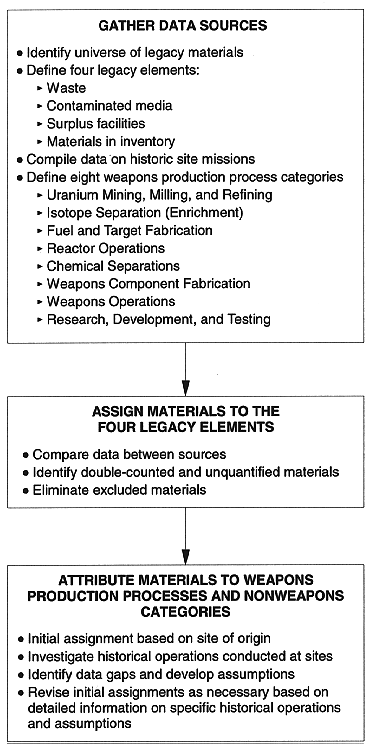
Fig. 3. Methodology.
Most of the data sources used for this analysis (Table III) contain information compiled for reasons different from those underlying this analysis. As a result, the data were incomplete, and judgments and assumptions were necessary in interpreting and adapting the existing information to allow its use in this analysis. More detailed historical and quantitative data is present at DOE sites, but it has not been compiled on a nationwide basis. Additional data and analysis would have only a limited effect on the results presented here.
Table III Major Data Sources

The quantities of waste, contaminated media, surplus facilities, and materials in inventory attributed to the weapons programs and to particular processes are not precise, but they represent the best judgements made based on available data. The quality of data and level of detail varies for different elements. Compiled inventory data for waste and materials in inventory is more detailed, complete, and precise that it is for contaminated media and surplus facilities.
CONCLUSIONS
The data in this report suggest several general conclusions about the legacy of nuclear weapons production: