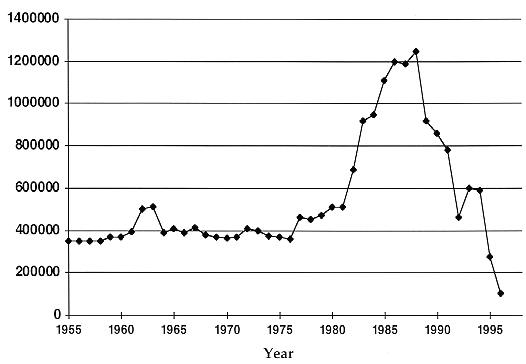
Fig. 1. Annual LLW Disposal at SRS.
David A. Zigelman
Westinghouse Savannah River Company
Savannah River Site
Aiken, South Carolina 29808
ABSTRACT
The Savannah River Site (SRS) Solid Waste Division (SWD) has partnered with a number of commercial nuclear power plants in order to directly implement utility best practices as a means of improved treatment, storage and disposal of low-level radioactive waste. Initial focus of this effort has been on the implementation of an aggressive waste minimization program.
Through a series of bench marking visits and technical exchanges, SRS has implemented changes to work practices and material/product specifications that have resulted in substantial cost savings and extension in the life of on site disposal facilities. Although these work practices have proven highly successful at commercial nuclear plants over the past several years, their direct large scale application at Savannah River was unique to the Department of Energy (DOE) Nuclear Complex.
In Fiscal Year 1996 (FY 96), Savannah River has realized a storage/disposal space savings and cost avoidance of 175,000 cubic feet and $17.7 million, respectively for its low-level radioactive, transuranic, mixed and hazardous waste streams. The SRS has won a 1996 White House "Closing the Circle Award" for these pollution prevention program accomplishments. This award is the pre-eminent Federal Government recognition in the pollution prevention/waste minimization arena.
The accomplishments of the Savannah River pollution prevention/waste minimization program clearly demonstrate the direct applicability of commercial power plant initiatives to cost reduction efforts at DOE facilities.
INTRODUCTION
The SRS is a key DOE facility focusing on national security missions, environmental and waste management activities, and economic development and technology transfer initiatives. Owned by the DOE and operated under contract by WSRC, the complex covers 310 square miles near Aiken, South Carolina.
From its construction and initial operation in the 1950s until the early 1990s, SRS operated in a manner consistent with its national defense mission. There was minimal contact with the commercial world, with all process-related research and development performed on site. Production goals and employee and public health and safety were paramount. Cost effectiveness was a secondary consideration. The situation was similar at the other sites in the DOE Nuclear Complex.
With the fall of the Soviet Union, the need for a large robust operating DOE Nuclear Complex ended. Missions of the DOE facilities changed from production to environmental management, several formerly critical facilities were shut down and decommissioned and virtually unlimited operating budgets quickly became a thing of the past. As DOE and its contractors recognized that a basic change in operating culture was required, the need for cost effectiveness became a major consideration both for basic survival and to complete remaining missions within available budgets. This change in operating culture involved, among others:
The cost effectiveness/savings initiatives undertaken by DOE and its contractors mirror the efforts of commercial nuclear power plants over the past 20 years. Specifically in the area of low-level radioactive waste management, the commercial power plants were faced with spiraling costs for waste disposal. Burial costs were increasing steadily from a few dollars per cubic foot in the late 1970s to several hundred dollars per cubic foot today. This problem was compounded by the formation of regional compacts which presented the possibility that the majority of generators would be denied access to available disposal capacity.
As the cost of disposal of low-level radioactive waste became an increasing part of the nuclear plant's operating budget, this portion of the operation came under increased scrutiny as the utility endeavored to reduce costs and improve its situation in what was quickly becoming a highly competitive electrical generation and distribution industry. Strategies were developed and implemented to:
IMPLEMENTING A COST REDUCTION
CULTURE AT SRS
As part of its program to reduce SRS's costs for treatment, storage and disposal of solid waste, the SRS SWD has pursued some of the more traditional approaches including:
In addition to these initiatives it was recognized that there was a significant source of proven, world-class practices within easy grasp of SRS; the 100 or so commercial nuclear plants. These plants readily share their best practices among themselves without regard to utility ownership. Discussions with several of these plants found them willing and eager to share their best practices with SRS as well.
In partnering with several of these commercial nuclear plants in order to identify and directly incorporate the most cost effective best practices, several classical paradigms had to be overcome at SRS:
Although the cost of low-level radioactive waste disposal at SRS does not provide the same overwhelming economic driver as exists in the commercial nuclear industry, radiological performance requirements for low-level radioactive waste disposal facilities have resulted in an almost doubling of unit disposal costs. This results from a 1995 change from shallow land burial to disposal in engineered vaults. The need for a new focus on pollution prevention/waste minimization at SRS resulted in this area becoming the initial focus of the partnership with commercial nuclear power plants. Waste minimization was viewed as a means of continuing to drive down waste volumes requiring disposal. (See Fig. 1.)
Fig. 1. Annual LLW Disposal at SRS.
SRS bench marking teams visited several commercial nuclear plants in the eastern United States with demonstrated track records in waste minimization pollution prevention. During the bench marking visits, plant personnel openly discussed their programs, what had worked (and what hadn't worked), the need for senior management commitment and support, employee education and motivation, and opportunity identification and assessment. Plant walk downs were key ingredients of the visits as most of the members of the bench marking teams were representatives of SRS's larger waste generators.
1996 - A YEAR OF WASTE MINIMIZATION
SUCCESS AT SRS
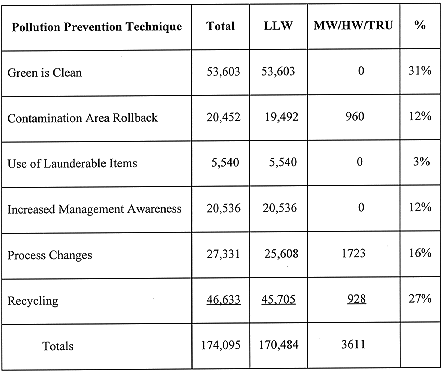
The key to successfully "jump starting" the SRS waste minimization program was the development of a process for identification and implementation of commercial waste minimization opportunities (the Pollution Prevention Activity Form) and senior management support and commitment to achieving the desired results. As a result, the application of commercial best practices was a significant contributor to a documented (and DOE approved) waste source reduction of approximately 175,000 cubic feet in FY 96. This source reduction equates to an avoidance of approximately $17.7 million in disposal costs. The breakdown of this waste source reduction by waste stream and general technique is shown in Table I.
Table I Savannah River Site Waste Volume Source Reduction for FY 96 (Cubic Feet)
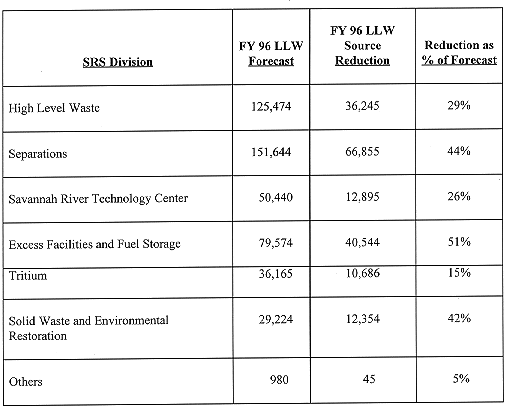
The commercially proven pollution prevention/waste minimization initiatives implemented at SRS in FY 96 are calculated to result in a 250,000 cubic foot source reduction on an annualized basis. The application of commercially proven techniques is expected to result in an additional 25% source reduction in FY 97. The breakdown of low level radwaste source reduction by SRS division is shown in Table II.
Table II Savannah River Site LLW Source Reduction by Division for FY 96 (Cubic Feet)
The most successful source reduction techniques are summarized in Table I. A summary of the Pollution Prevention Activity Forms are available from the author. The individual Pollution Prevention Activity forms are available to other nuclear facilities via the Internet.
As a result of its pollution prevention/waste minimization accomplishments in FY 96, the SRS has won a prestigious White House "Closing the Circle Award". This award is the pre-eminent Federal Government recognition in the pollution prevention/waste minimization arena.
CONCLUSION
Yes, Virginia, DOE facilities can learn from commercial power plants. Once the NIH (not invented here) factor is overcome, partnering between DOE facilities and commercial nuclear plants provides a powerful vehicle for exchanging best practices as both cultures strive for improved cost competitiveness. The use of long-standing commercial nuclear plant waste minimization techniques, learned by bench marking several commercial plants, has resulted in immediate benefits to the Savannah River Site. The application of these techniques has resulted in a waste volume source reduction of 175,000 cubic feet and a disposal cost savings of $17.7 million in FY 96.
ACKNOWLEDGMENT
This work was sponsored by the DOE Office of Environmental Restoration and Waste Management under DOE Savannah River Operations Office Contract No. DE-AC09-96SR18500.