Fig. 1. Volume of RA Liquid Effluent.
George Wall
Hunting Brae
ABSTRACT
The paper briefly describes the Atomic Weapons Establishment (AWE), its recent contractorisation and the new arrangements for funding its work. It then outlines the United Kingdom national and thence the company Waste Management strategy and the key role that Waste Minimisation plays in them both. It highlights the main elements of the company Waste Minimisation Program with particular emphasis on those techniques that worked and those that did not. Finally it shows the results achieved to date and our targets for the future.
INTRODUCTION
The purpose of this paper is firstly to briefly describe the Atomic Weapons Establishment (AWE), its recent contractorisation and the new arrangements for funding its work. It then outlines the United Kingdom national and thence the company Waste Management strategy and the key role that Waste Minimisation plays in them both. It highlights the main elements of the company Waste Minimisation Program with particular emphasis on those techniques that worked and those that did not. Finally it shows the results achieved to date and our targets for the future.
CONTRACTORISATION
Aldermaston is situated about 40 miles west of London in the Thames valley in the Royal County of Berkshire. It is a beautiful yet well populated area so environmental issues are particularly sensitive. It was built in the early 1950's and until the early 1990's was managed by various government departments from the Ministry of Supply through the Atomic Energy Authority to the Ministry of Defence. As a government establishment it had Crown Immunity from certain legislation which combined with its very high security status meant that it was not subject to the same rigorous external inspection regime as most civil nuclear sites.
In the early 1990's following competitive tender a management contractor was appointed, Hunting- BRAE, who now run the establishment on behalf of the Ministry of Defence. The vast majority of the work is carried out on incentivised contracts which enable the company to share in any savings they make such as minimising waste. The establishment is unusual in that all aspects of nuclear weapons work are undertaken - research, development, design, manufacture, assembly, maintenance, disassembly and material recovery - so there is a unique opportunity to introduce waste minimisation techniques throughout the entire process.
STRATEGY AND POLICY
United Kingdom national strategy is to have sustainable development which has been defined as 'development that meets the needs of the present without compromising the ability of future generations to meet their own needs'. In particular the government wants to protect and if possible enhance the environment and have identified a waste hierarchy:
The aim is to be as near the top as possible and the government has set national targets for reductions in landfill waste and plans to set overall waste reduction during 1997. Money is available for research and waste minimisation is incentivised by a new landfill tax supported by powers to levy fines and ultimately stop production.
AWE strategy and policy within this national framework is:
KEY ELEMENTS OF PROGRAM
The key elements of the Hunting-BRAE waste minimisation program have been to:
The information required sounds very basic and simple to obtain but in reality is often either not gathered in quite the right way or lacks definition:
Creating awareness requires time, effort and persistence and needs to involve all of the following ideas:
Identifying responsibilities is vitally important if any real progress is going to be made towards the top of the waste hierarchy:
It is important that any targets that are set are challenging yet achievable and make sure you allow for and separately identify any known growth areas. For example at AWE there is an accelerating decommissioning program producing increasing amounts of both solid low level and intermediate level radioactive waste. Accordingly we set waste minimisation targets for operational wastes - a 15% reduction per annum - and covered decommissioning wastes by including waste minimisation incentives in the contract specifications.
Everybody likes to be praised for their efforts particularly if they believe they are saving the company a bit of money. In the early days be generous and even if an idea cannot be followed through at least thank people for the time and effort they have put in and explain why it is not being adopted. A special pen or a mug or a badge at least shows people you are genuinely looking to reward people for ideas. And for those ideas that really do work and make savings make sure you have a system to assess their value and a mechanism to share some of those savings with the employees.
Giving someone or a group of people two or three hundred pounds each will not only encourage them but word will soon spread and more ideas will start to come in. Publicize their success in the company magazine or newsletter and if possible arrange for the people to demonstrate their idea to other groups or facilities that might benefit.
PROBLEMS
There are many problems or difficulties that can frustrate the success of a Waste Minimisation Program. It will be very difficult to really get it off the ground until you have sufficient detailed information to be able to quantify the current situation and demonstrate improvements. Legacy or historical wastes will tend to cloud the issue and dilute any improvements unless accounted for separately. Clearly any significant changes in workload can affect the volumes and types of waste produced. At AWE for example weapon production and disassembly work is relatively steady at the moment, however, the decommissioning of redundant facilities is starting to accelerate rapidly and within two years is likely to be the dominant waste producing activity on site.
Many of the ideas will require some money to be spent up front either to buy new equipment or to develop good ideas into working solutions. Start with a few simple ideas that are relatively cheap to implement and quickly demonstrate savings. After a few well publicized successes you are more likely to be able to persuade fund holders to invest big sums which may take longer to recover but will actually make bigger savings in the long term.
One of the problems at AWE has been that Waste Management is a 'free' service to facilities. At least one other nuclear establishment in the UK achieved a significant reduction in wastes coming forward for disposal by starting to charge by the unit volume. AWE has not chosen to follow this route so far because of concerns that it might encourage facilities either to accumulate wastes or to dispose of them by inappropriate means.
Finally you are certain to encounter a degree of apathy towards waste minimisation particularly in those people who have worked in the industry a long time. In the early days achieving the end goal of a new better weapon was always more interesting and important than minimising wastes or in some cases even knowing how the waste could be disposed of. However, we are all becoming more environmentally aware and certainly in the UK a waste producing process should not start until an agreed disposal route or long term storage regime has been established.
RESULTS
Since 1991 the company has achieved nearly a 50% reduction in the volume of radioactive liquid effluent being treated and discharged into the river Thames (Fig. 1).
Fig. 1. Volume of RA Liquid Effluent.
This has been achieved by a systematic review of all radioactive liquid effluent producing processes in all facilities. As a result it was possible either to completely eliminate some wet processes, to make some 'damp' rather than wet and in some cases to divert probably non-active liquids to hold and monitor tanks where subject to satisfactory analysis they are diverted to our Trade Waste or non-active plant. Not only does this reduce the volume discharged directly into the river Thames, always a very sensitive environmental issue, it also reduces the volume of active sludge we have to store at AWE for treatment and eventual disposal.
Volumes of solid low level waste have not shown such a dramatic reduction (Fig. 2) and apart from 1993 which showed a 40% increase have stayed fairly static. In practice we had a very effective clean up campaign during both 1993 and 1994 which alone generated some 800 cubic metres of low level waste. Also during 1994 and 1995 at least two new major facilities started active commissioning and one of the main elements of our low level waste volume is the protective clothing worn by staff in the active areas. Work has been carried out to identify techniques and equipment which can enable this clothing to be checked and classified as free release material, however, there is some nervousness about pursuing this option for public relations reasons. In the meantime equipment has been purchased which combined with a vacuum packing process developed by some of our own staff has improved the packing density of some of our low level waste by over 100%.
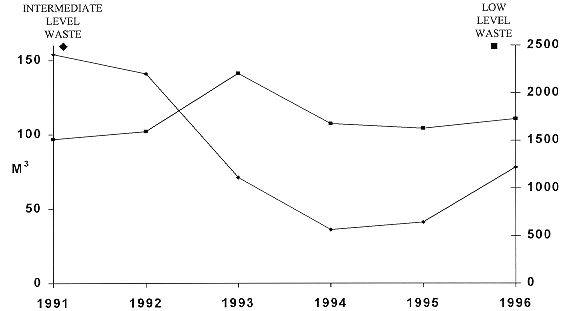
Fig. 2. Volume of Solid RA Waste.
Volumes of solid intermediate level waste, mostly plutonium contaminated material, have reduced dramatically since 1991 (Fig. 2) principally due to improved housekeeping techniques, better segregation of wastes and a number of measures which have not only reduced the amount of material being introduced to gloveboxes but also improved the waste efficiency of processes within gloveboxes. This work has been co-ordinated by our Manufacturing Division Waste Reduction Committee and demonstrates what can be achieved by an enthusiastically led group of like minded and committed individuals. However, this particular waste stream will be particularly affected by our accelerating decommissioning program and in 1996 one relatively small decommissioning project generated as much waste again as our normal operations.
The volumes of non-active or Trade Waste effluents have also with one exception shown a steady decline since 1991 (Fig. 3) and whilst the results have been less dramatic than those for radioactive effluent the company has just started on a program of works to reduce the ingress of rainwater to this system which has long been recognized as its principal weakness.
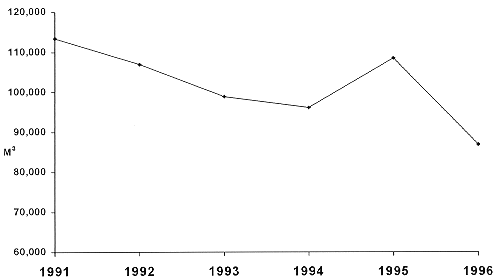
Fig. 3. Volume of Trade Waste Effluent.
Finally Toxic and Hazardous non-active wastes, sometimes called special wastes, have apparently not responded to waste minimisation techniques (Fig. 4). In practice I believe our work is just starting to pay dividends but until now it has been swamped by the effects of a facility rationalization program which has seen many old buildings, including several analytical laboratories, closed down, emptied of their contents and demolished. People in general, and apparently chemists in particular, are great horders and only dispose of material when really forced to. Another driver to increase volumes has been the introduction of 'use by dates' and improved quality assurance regimes which ensure that only in date chemicals are used. At first this produced significant quantities of unused but out of date materials from both our stores and individual laboratories. However, improved stock control systems and smaller local holdings are now starting to reduce this waste.
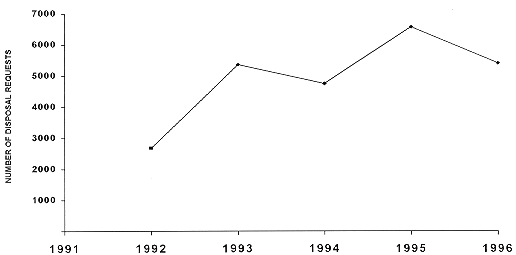
Fig. 4. Volume of Toxic and Hazardous Waste.
FUTURE PLANS
In the future we intend to :
In particular we are concentrating on trying to reduce our volumes of radioactive liquid effluent to the level that by using a further treatment stage we will no longer need to discharge direct into the river Thames.
CONCLUSIONS
I hope I have demonstrated that a large organization with many different and often conflicting priorities can unite behind a Waste Minimisation banner. You do need to appoint a company champion but he cannot be expected to do it on his own. He needs to have champions within each facility and they need to try and involve people at all levels within the organization. You must have enough information to be able to set realistic but challenging targets and to provide feedback and encouragement. Try to get a few quick results but do not be disappointed if it takes longer than anticipated or you meet resistance and apathy.
All people and especially the younger generations are becoming more environmentally aware and sooner or later everyone realizes that waste management and waste minimisation can have a profound effect on the bottom line.