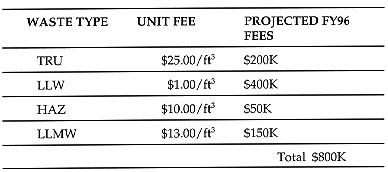
Table I SRS Set-aside Fee Rate Structure and Projected FY 1996 Fees
Sherri Johnson
U.S. Department of Energy
Savannah
River Operations Office
P.O. Box 616
Aiken, South Carolina 29802
Keith Stone
Westinghouse Savannah River Co.
P.O.
Box 616
Aiken, South Carolina 29802
ABSTRACT
The Savannah River Site (SRS) is one of three Department of Energy (DOE) Operations Offices demonstrating the feasibility of a unique and innovative waste generator financial chargeback system. During 1996, the SRS Generator Set-aside Fee initiative provided funding and a mechanism to implement 14 waste minimization projects that will result in a reduction of 1,900 cubic meters of hazardous and radioactive waste and a annual cost savings of $4M. The SRS Generator Set-aside Fee concept has relevancy, and is directly transferable, across the federal government and the commercial sector.
Unlike traditional DOE chargeback systems which are based on waste generators bearing all or a portion of waste management treatment, storage and disposal costs, the Set-aside Fee is a generator surcharge that is pooled and used to fund fast payback waste minimization projects. Generators are "taxed" a small percentage of actual waste management costs for each type of hazardous and radioactive solid waste they generate. The collected fees are combined into a reserve account and reallocated to the generators who propose waste minimization projects offering the largest waste and cost reduction benefit to the SRS.
The Generator Set-aside Fee has passed the litmus test at SRS, will be expanded to additional DOE facilities in 1997, and most notably, can be directly incorporated in any larger industrial operation - government or commercial! This paper will detail the Set-aside Fee process, necessary support functions, and lessons learned from implementation at SRS.
BACKGROUND
The Savannah River Site (SRS) is a key DOE facility focusing on national security work; environmental and waste management activities; and economic development and technology transfer initiatives. Owned by the Department of Energy (DOE) and operated under contract by Westinghouse Savannah River Company (WSRC), the complex covers 310 square miles near Aiken, South Carolina, bordering the Savannah River.
There are over 70 facilities within 6 operating divisions at SRS that "manifest" radioactive and hazardous solid waste to onsite Treatment, Storage and Disposal (TSD) operations. Typical annual waste generation volumes are 8,000-10,000 cubic meters of solid low level radioactive waste, 150-300 cubic meters of transuranic waste, 780-900 cubic meters of RCRA hazardous waste, and 5-10 cubic meters of solid low level radioactively mixed waste.
The DOE is in a transition from an era of national defense missions, production focus, big budgets, to clean-up and shutdown focus, and dramatic budget cuts. The primary product of the DOE weapons complex has shifted from bombs to waste. A fundamental barrier to reducing waste generation exists within the DOE; waste is managed as a product or asset, not a cost of production as in commercial industry. The waste management function within the DOE is a direct funded budget line item rather than a production cost to the program that produced the waste. The resulting paradox is that waste minimization can only be achieved by the waste generator, yet the DOE generator is not responsible, nor does he receive positive or negative feedback, regarding the quantity of waste produces. The result has been a lack of investment, by waste generators, in projects that will reduce waste. To illustrate, DOE expenditures for waste minimization implementation typically represent less than 2-3% of departmental waste management expenditures.
The DOE Pollution Prevention Executive Board, chaired by the Deputy Secretary, is initiating a broad range of incentive programs to encourage waste generators to fund Waste Minimization and Pollution Prevention (WMin/PP) implementation activities. These initiatives are aimed at achieving real waste reductions and corresponding cost reductions for the Department. One of the options, initiated by the Executive Board, for encouraging generator accountability and market driven performance is a Generator Set-aside Fee system whereby waste generating organizations are assessed a small fee based on the type and quantity of their waste. These funds are pooled and made available on a competitive basis, for implementation of WMin/PP projects.
SRS SET-ASIDE FEE GOALS & OBJECTIVES
This Generator Set-aside Fee concept was piloted during FY 1996 at the Los Alamos National Laboratory, Sandia National Laboratories (New Mexico), Oak Ridge National Laboratory, Oak Ridge K-25, Y-12, Paducah and Portsmouth sites, and the Savannah River Site.
The Generator Set-aside Fee is intended to inform managers of facilities that generate waste of the costs to DOE for managing the waste. This initiative will allow sites to pinpoint major sources of waste generation and/or avoidable expense.
In general, the objectives of the Set-aside Fee program are to:
The goal of the SRS Set-aside Fee pilot demonstration was to evaluate the following:
Specific performance goals for the SRS FY 1996 pilot were to:
SRS SET-ASIDE FEE SCOPE AND STRUCTURE
The SRS Set-aside Fee is imposed on all on-site waste generators who ship solid radioactive and hazardous waste to SRS waste management facilities for treatment, storage, and disposal. Liquid effluents and sanitary waste are not subject to fees. The specific waste types generated at the SRS and assessed a fee are:
The Set-aside Fee for each waste type is based on a small percentage (3-5%) of the appropriate average per-unit cost that the DOE will incur to manage the waste. In addition, waste generation projections and the total FY1996 set-aside fee objective of $800,000 were factored into the determination of the rate structure. Refer to Table I.
Table I SRS Set-aside Fee Rate Structure and Projected FY 1996 Fees
Funds captured through the set-aside fee are made available exclusively for implementation of projects that reduce waste and provide a rapid payback. Waste generators compete for accrued set-aside funds by submitting WMin/PP project proposals on a specified frequency (quarterly at SRS). Guidelines were developed for waste generator project proposals. To be considered for funding through he set-aside account, projects must meet minimum requirements. Following are specific criteria SRS uses for project proposal preparation and evaluation.
Projects shall:
Projects cannot:
A key element of the SRS set-aside fee program is waste generator participation in selection of projects to be funded. A committee was formed with representatives from each of the major SRS waste generating organizations. The committee administers a variety of waste minimization initiatives with set-aside fee project selection one of their duties. Projects are presented to the committee on a quarterly basis. Committee members, each carrying an equal vote, prioritize projects based on previously discussed criteria and overall value to the SRS. Projects are approved based on available set-aside funds.
The process by which dollars are debited from generator accounts and credited to the central set-aside account starts with SRS waste tracking systems. Waste generation is tracked and reported on a monthly basis for over 70 discrete facilities. Set-aside fee invoices were easily incorporated as a extension of the waste tracking system. The invoice includes the facility I.D. number, the facility charge code, the waste type and quantity generated, and the corresponding fees to be debited. Invoices are prepared monthly and issued to finance, facility managers, facility waste management staff, and other interested staff. Recall that one of the objectives of the set-aside fee is to heighten management awareness of waste generation and the costs associated with managing waste; visible and widely distributed waste generation and billing statements help accomplish this.
One of the accounting constraints that had to be overcome within the DOE to "legally" implement the set-aside fee was maintaining the segregation and integrity of Defense and Civilian appropriations. The solution was the establishment of two separate set-aside accounts, one for Defense and one for non-Defense appropriations. SRS Finance performs a manual voucher transfer of funds from the generator account (charge code on invoice) into the appropriate set-aside account. The new accounts provide maximum flexibility by allowing year end balances to be carried forward into the next year, and the moneys can be used for either capital or expensed projects.
RESULTS
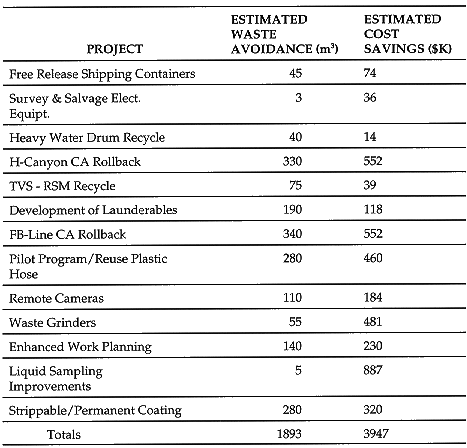
During FY 1996, the SRS Set-aside Fee system collected over $400K in fees, disbursed $250K back to waste generators to fund 7 projects with proposed combined savings of $1M. Progress towards completion of these projects has resulted in a avoidance of over 680 cubic meters of radioactive waste and a waste disposal cost savings of $1M. During the first quarter of FY 1997, 7 additional projects were funded that propose to save in excess of $3M in life cycle waste disposal costs! Table II summarizes these projects:
Table II SRS Set-aside Fee Waste Minimization Projects
Although we did not meet the pilot project objective to collect $800K in fees, it can hardly be considered a failure. Due to a re-energized waste minimization program backed by strong senior management support and deployment of commercial nuclear industry best practices, waste generation rates were reduced by nearly 40% of what was initially projected.
The set-aside fee has also resulted in some qualitative benefits:
CONCLUSIONS AND RECOMMENDATIONS
The set-aside fee concept is sound and can be incorporated into almost any industrial environment where there is a desire to stimulate investment in projects that will reduce waste generation and waste management costs. Following are some ingredients that ensured successful implementation at SRS:
In conclusion, the SRS Set-aside fee met and exceeded all expectations, and clearly is "not just another chargeback scheme."
This paper was prepared in connection with work done under Contract No. DE-AC09-96SR18500 with the U.S. department of Energy. By acceptance of this paper, the publisher and/or recipient acknowledges the U.S. Governments right to retain a non- exclusive, royalty free-license in and to any copyright covering this paper, along with the right to reproduce and to authorize others to reproduce all or part of the copyrighted paper.