Table I
James Melillo
USDOE
Gregory Evans
Coleman Research
ABSTRACT
The January 1992 announcement by the Department of Energy creating the Environmental Restoration and Waste Management Advisory Committee (EMAC) made it the first Federal agency with "landlord" responsibilities to establish a Department level, external advisory body to assist it in meeting its environmental cleanup responsibilities at the various weapons complex facilities around the Country.
What precipitated this action? What was the Department trying to accomplish by creating the EMAC? How successful has the effort been? How has it evolved? These are the questions this paper will endeavor to answer. It will do so, by first examining the circumstances at the Department of Energy (DOE) that created the need for a high-level citizens' advisory board. Next, it will report on the process by which the first committee members were selected, the relationship of the Committee to DOE, and some of the early successes and shortcomings of the EMAC/DOE partnership.
With this as a base, the evolution of the EMAC to its present configuration as the EM Advisory Board or "EMAB" and DOE's experience in managing with the EMAB as an integral part of the policy setting process will be examined. The paper will conclude with a look at the effectiveness of the EMAB as a catalyst in helping the DOE Environmental Management Office succeed in its mission.
CIRCUMSTANCES THAT CREATED THE
NEED FOR EMAC
One of the primary historical missions of the DOE and its predecessor agencies has been the development and construction of nuclear weapons for national security purposes. Early in the nuclear era, questions were raised by scientists involved in the weapons program concerning waste management practices. However, the imperatives of the nuclear arms race demanded that weapons production, rather than waste management and control of environmental contamination, be given precedence. A quote from a 1948 report of the Safety and Health Advisory Board reflected the problems that were to come:
"The present contaminated waste in present quantities and by present methods (in tanks or burial grounds or at sea), if continued for decades presents the gravest dangers..."
At its peak, the DOE nuclear weapons complex consisted of 16 major facilities. Today, the Department still owns 2.1 million acres of land and 85 million square feet of buildings, substantial portions of which are contaminated to some degree (1). Many of the problems are related to radiation hazards, enormous volumes of contaminated water and soil, and numerous contaminated structures.
The ending of the Cold War focused the public's attention on the enormous health and environmental consequences associated with winning that war and the demand for cleanup became very powerful. DOE's challenge was twofold: First, it had to deal with all the problems associated with cleaning up such massive amounts of contamination; and secondly, it had to deal with all the publics surrounding the sites and those with national interests who were very distrustful of the Department for creating the problem in the first place and not telling anyone about it. Responsibility for managing this challenge fell to a newly created Office of Environmental Restoration and Waste Management (the name was later shortened to the Office of Environmental Management or EM) (2).
The Department of Defense at the time, was facing similar, albeit more manageable challenges, as was the Department of Interior. The U.S. Environmental Protection Agency, in an effort to reduce the polarization that existed among the Federal Government, states, Indian tribes and other stakeholders began sponsoring a series of informal roundtable discussions among interested parties designed to raise the trust levels among the participants so issues could be discussed and resolved. This initiative was eventually formalized as a Federal Advisory Committee called the Federal Facilities Environmental Restoration Dialogue Committee but was more commonly known as the "Keystone" Committee, named after the organization that hosted and facilitated the effort for the EPA (3). Its objective was to improve Federal facilities environmental restoration decision-making and priority setting processes.
DOE was a member of the "Keystone Committee" and was committed to implementing the Committee's eventual recommendations concerning stakeholder involvement in decision-making. However, its environmental restoration and waste management mission required that the Department move more quickly to reestablish trust with its stakeholders so decisions on cleanup could move forward. As such, EM began instituting reforms proposed by stakeholders for more open communications independently of the "Keystone" dialogue. One early forum, still in existence, is the State/Tribal Government Working Group, or STGWG. This group meets regularly with EM and other DOE representatives, but as the name suggests, its membership is limited to state and tribal government officials.
DOE still had no formal means to obtain feedback from impacted communities, industry, labor, the environmental community, the scientific community or others that could contribute their expertise to helping EM succeed with its mission. The problem became acute when the Department sought to meet its regulatory requirements for site cleanup with a programmatic environmental impact statement (PEIS) covering all its sites. The implementation plan for such a PEIS had to be very comprehensive and would require public endorsement to be successful. EM ran a series of public workshop scoping sessions around the Country to obtain suggestions on how to prepare a PEIS but it quickly became apparent that a more regularized means of consultation would be required.
Thus, the Department decided to reach out to individuals NOT consulted through existing regulatory/legal requirements. EMAC was established to provide formal two-way communication channels among DOE and interested parties, including the public industry, labor and the scientific community.
EMAC: THE EARLY YEARS -
COMMITTEE SELECTION
For the new EMAC to be even reasonably effective as a consensus builder, it was absolutely imperative that the selection process for its members be viewed as fair and equitable both to the external world and internally, within EM. The decision to go forward with an EMAC came shortly after the Department's extensive PEIS public workshop scoping sessions. The main theme heard repeatedly from those sessions was the need for interaction and credibility. The building blocks of trust being created were still very fragile and could be easily destroyed if the Department reverted to a Decide - Announce - Defend (DAD) strategy characteristic of its pre-EM days.
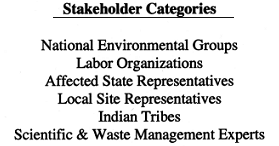
The Department determined that for the Committee to be most effective, its membership should represent a wide range of interests and types of expertise. It first sought balance of membership by stakeholder group. Within those groups, EM looked for (1) people whose degree of expertise in areas of concern to DOE would qualify them as national or international rank in their particular field; and (2) people who would be willing to devote the time necessary to work within a committee structure so as to develop consensus recommendations for consideration by the Department (4) Table I shows the group categories used:
Table I
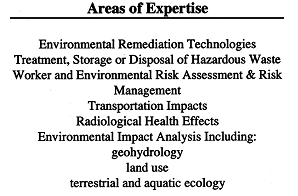
The Scientific & Waste Management Experts category drew from academia, public policy groups, companies and other Federal agencies. The areas of concern in which EM sought to obtain expertise are listed in Table II.
Table II
To avoid any appearance of pre-selection, the Department canvassed broadly for candidates: soliciting representative organizations from the stakeholder categories, advertising publicly, and consulting with persons and groups already working with DOE. Nominations were reviewed and scored by senior EM program managers and recommendations were made to the EM Assistant Secretary who made the final decision (5). Because of this comprehensive solicitation, evaluation and nomination process, there were few public objections to the selectees when the Department made its announcement in July 1992.
EMAC: THE EARLY YEARS -
SUCCESSES AND FAILURES
Under the EMAC's charter, which governed the Committee's activities for its first two years according to the Federal Advisory Committee Act, the EMAC's primary responsibility was to advise the EM Assistant Secretary on both the substance and the process of the Programmatic Environmental Impact Statement from the perspective of affected groups and state/local governments. In addition, the EMAC was to provide counsel to the Assistant Secretary on any other EM projects which were assigned to the Committee for review (6). Several events and circumstances made successful implementation of the charter difficult.
First, EM as an Office was relatively young and growing very rapidly. Conflicts and disagreement over program thrust existed throughout the organization. Business units were still learning how to work with each other, and had little experience working with an external body. As a result, EM and the EMAC did not really know how to respond to each other initially.
Secondly, the EMAC being a precedent setting body itself, lacked models from which to draw lessons on roles. By coincidence, many of the first EMAC members were also participants in other public involvement initiatives such as the informal "Keystone" group and the STGWG. In those endeavors, the focus was somewhat different, their roles were as stewards for specific interest groups, reaching consensus was not necessarily the objective. EMAC, as a Federal Advisory Committee, required consensus building so as to come up with recommendations that could be made as a group. Its members were not selected to make recommendations as individuals.
Third, the EMAC had met only three times before the Administration changed, and with that change, came shifts in policy direction and priorities, including reconsideration of the desirability of pursuing a single PEIS strategy to cover all DOE sites. This latter point was significant since providing counsel on the PEIS was the principal reason EMAC was created.
During the first year of its existence, the EMAC met five times at various DOE sites around the Country. It focused much of its attention on stakeholder communication issues as a component of the PEIS and also dealt with land use, health and safety issues. While the site visits helped educate EMAC members on DOE issues, the meetings away from DOE headquarters prevented the EMAC from developing familiar working relationships with DOE line policy managers at a time when most management directives were coming from headquarters. Relations between the Committee and DOE became increasingly strained. To some, it began to appear that the EMAC was failing in the role of consensus builder for which it was chartered (7).
Despite these problems, the EMAC did make a number of contributions to the EM program. Its land use subcommittee (1) produced a paper recommending the incorporation of future land use policies into the implementation plan for the PEIS as they pertained to deciding cleanup strategies; and (2) suggested modifications to the Department's risk assessment process that provided stakeholder input into the selection and improvement of environmental fate and transport models used in the PEIS. At the DOE Hanford site, the EMAC evaluated the effectiveness of the tri-party agreement among the DOE, EPA and Washington State that governs site cleanup and waste management decisions at Hanford. At DOE's Oak Ridge, Tennessee site, the EMAC listened to public concerns and considered health and safety issues for subcontractors and technology development needs required to meet environmental restoration problems at the site. At DOE's Rocky Flats site in Colorado, the EMAC, after evaluating the waste issues at the site, agreed with DOE that radioactive waste should be concentrated in one or two buildings to reduce the number of contaminated buildings (8).
Overall however, EMAC's value to the EM program was beginning to be questioned publicly. The Committee was criticized for costing too much, accomplishing little and spendingmore time promoting individual agendas than working as a cohesive team that could help the EM clean up program move forward (9).
EMAC members and DOE managers were not insensitive to these concerns and efforts were made to correct problems. An independent facilitator was brought in to help the Department and the EMAC sort out their difficulties and come to consensus on a future course of action but external pressures were building that would render these actions too little, too late.
FROM EMAC TO EMAB: EM'S "OUTSIDE"
BOARD
OF DIRECTORS
By July 1994, budget realities were weighing heavily on the EM program. The slowness with which actual cleanup was being accomplished and the ever spiraling price tag for that cleanup was having an adverse impact on Congressional resolve to continue funding the EM program at levels required to meet regulatory compliance agreements DOE had signed with various states. The EM Assistant Secretary at the time, Thomas Grumbly determined that he needed a more powerful committee to assist him; one that was capable of serving as an unofficial "Board of Directors" (10) who could provide him broader technical advice, be comfortable dealing within the Washington political environment and whose members could serve as advocates for environmental management.
The change sought by Mr. Grumbly was really a refinement of the Department's original objective in creating the EMAC. The concept had proved valuable to both DOE and Committee members. However, under a Board structure, the members were being asked, as much as possible, to "leav[e] interest group affiliations at home" (11) and operate as part of the EM management team. The primary change was to focus the Board's attention on providing advise and recommendations on matters of policy affecting the conduct of the EM program and away from its previous concentration on oversight activities at the local site levels.
Mr. Grumbly moved swiftly to make his vision a reality. Looking to the EPA's Science Advisory Board as a model, he restructured the EMAC into an executive level, limited member EM Advisory Board or EMAB and established a committee structure reporting to the EMAB, to provide counsel on major EM issues. The Committees were to be composed of non-EMAB member specialists in various fields with EMAB members as chairs (12). He also further broadened the EMAB by naming 11 new members, including two new Co-chairs.
Initial EMAC member reaction was not universally positive. Several persons were upset about the absence of consultation with the Committee over the planned reorganization and the naming of new members (13). However, adverse public reaction generally, was fairly minimal and this can be viewed as an important measure of how far EM had progressed in building its credibility with the public.
The pendulum was now swinging back. When the EMAC was first created, the level of confidence the Department enjoyed with the general public was extremely low. DOE first had to demonstrate that it could be trusted before the public would be willing to accept again as valid, its technical expertise or its recommendations of other technical experts.
The EM of late 1994 had moved a long way toward rebuilding public confidence as compared to the EM of early 1992. EM senior managers at headquarters and in the field now had an almost three year track record interacting with stakeholders through a variety of mediums: the EMAC, STGWG, Site-Specific Advisory Boards (SSABs), the Federal Advisory Committee to Develop On-Site Innovative Technologies (DOIT Committee), focus area work groups and other informal initiatives. EM was demonstrating effectively that it could listen, learn and also teach.
The proposal to restructure the EMAC into a stronger independent "Board of Directors" for the EM program represented a maturation of EM's relationship with external stakeholders and amounted to an institutionalization of outside citizen input as a key component of EM's policy and management review process. It was logical that as the EMAB's scope increased, additional participants with relevant expertise would be needed to do the work. The significant difference was that EM could now propose members on its own and those candidates were accepted without suspicion by the public for their expertise and ability to contribute.
The creation of the SSABs at various DOE locations to deal with site-specific issues also freed up the EMAB and its committees to focus on broader, complex-wide policy issues. In addition, the committee structure created a mechanism that made expert counsel available as well to the individual EM program office managers. The stage was now set to begin a real partnership.
MANAGING WITH EMAB
The revised charter of the EMAB illustrated its new broader role in providing counsel on management issues facing EM. The Board's Mission Statement /14 outlines the following as the Board's duties:
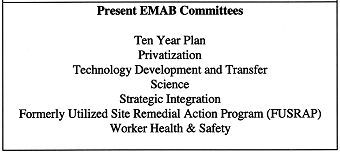
The Committees are established on an ad-hoc basis and sunset as their work is completed. Because of the interrelated nature of the Committee work, the Committee structure and process is designed to operate in a matrix management fashion with the work of one Committee building on and/or reinforcing work done by another with the goal being that the sum of the parts will begreater than the whole. Members too, are encouraged to lend their expertise where needed across the spectrum of Committee activities and are encouraged to participate on more than one Committee.Table III shows the current EMAB Committees:
Table III
All EMAB work is done within the context of meeting the goals and principles of the Assistant Secretary of Environmental Management. But is it working? Is all this collaborative management worthwhile? Is the EMAB helping EM to do its job better? The early returns suggest the answer is - yes. The relationship between the DOE and its various publics has matured. The participatory management partnership approach exemplified by the EMAB/DOE relationship has resulted in recommendations that have contributed significantly to the manner in which EM conducts its business. Innovations have been instituted that are helping the Department with its cleanup mission. The EMAB "Board of Directors" concept has raised DOE's dialogue with its stakeholders above simply two-way communication with interested parties. This type of communication is still critical and is carried out effectively at the site level through the SSEB's; but the EMAB partnership provides a framework for consideration of broader, national concepts which can be integrated with site activities.
EMAB AS CATALYST: HELPING EM SUCCEED
Although the original focus of EMAC was to assist DOE in the preparation of the PEIS, in the evolution of EMAC to EMAB, the PEIS became one of the many issues on which the Board advises the Assistant Secretary of Environmental Management.
In May 1996, the Board issued its final recommendations on the PEIS. These recommendations represented four years effort by the members of the PEIS Committee (of both EMAC and EMAB). EMAC had earlier offered recommendations that enhanced the January and May 1992 drafts of the Implementation Plan for the then Environmental Restoration and Waste Management (ERWM) PEIS. The Board's final recommendations focused on the need for additional public involvement in the Department's decision making for the Final WasteManagement (WM) PEIS and recognized the "key challenge for DOE is to develop and communicate a coherent sense of how discrete activities fit within a larger whole" (15). The Department adopted almost all the recommendations in July 1996.
EM under the present Assistant Secretary Al Alm, is focusing on a ten year plan designed to address the Program's most urgent safety and health risks and complete cleanup at most sites by 2006 recognizing that at some larger sites, the complexity of problems will require additional time. Mr. Alm, in initiating the Ten Year planning process, promised that the Ten Year Vision would be implemented in collaboration with all interested parties and he met with numerous stakeholders in Washington and at the DOE sites between July and December 1996 to obtain their counsel. As the planning process is refined and implemented through 1997, provisions have been made to obtain stakeholder input all along the process (16).
Mr. Alm requested that EMAB, through its Ten Year Plan Committee, address the measures for evaluating site-specific plans; recommend ways to integrate the site plans into the overall Plan; identify issues that are common to multiple sites; and advise on methods for involving the public in the planning process. The EMAB also recommended that the Ten Year Plan be evaluated and updated annually if necessary and DOE adopted that recommendation (17).
Congress has required that DOE quantify the health and safety risks that must be addressed in DOE's cleanup and waste management program and the level of urgency associated with those risks by determining the financial and time costs associated with their resolution (18). EMAB played a major role in the development of a draft report entitled Risks and the Risk Debate: Searching for Common Ground, "The First Step". The Board, through its then Risk Committee working in conjunction with EM managers, provided a series of recommendations which allowed the draft report to be completed and sent to Congress. This in turn, affected the structure of the FY 1998 budget for the Environmental Management program.
Another EMAB success story is in the technology development area. EM has long considered the development and commercialization of promising environmental technologies that can do the job better, faster, safer and cheaper as critical to meeting the requirements of the EM program. Many artificial regulatory and market barriers exist however, which have impeded growth of such technologies. The DOIT Committee and its successor, the Interstate Regulatory Cooperation Initiative (ITRC) were making real progress addressing regulatory barriers but no one was addressing market barriers. The principal one, according to technology companies, being restrictive Federal procurement practices (19). The EMAB working through its Technology Development and Transfer Committee and DOE managers helped facilitate:
Other Committees have also been making contributions The EMAB Strategic Integration Committee is currently reviewing EM's implementation of five major recommendations made by the National Academy of Sciences in its report: Improving the Environment; 1995. In the spring of 1997, the Committee is expected to review how well EM has integrated these recommendations into its' Ten Year Plan process. Working closely with the Ten Year Plan Committee, the Strategic Integration Committee plays a pivotal role in reviewing and commenting on the Ten Year Plan procedural guidance to EM's field offices, the fiscal year 1999 budget process, and the Ten Year Plan Integrated Strategic Planning, Budgeting and Management System.
The EMAB Worker Health and Safety Committee provided recommendations on the implementation plan for the EM Safety and Health Integrated Program and is working with the EM Office of Health and Safety on issues concerning the elimination of urgent risks, improving conduct of operations across the DOE complex, and the impacts of health and safety measures on former DOE workers. The EMAB Privatization Committee is looking at longer range ways of expanding lessons learned from in-place privatization efforts such as the Tank Waste Remediation system at DOE's Hanford site, and low-level advanced mixed waste efforts in Idaho. The objective is to institutionalize throughout EM, a culture which will pursue privatization when and where it makes sense as a long-term opportunity to leverage capital resources. Under such a culture the Department would, to the extent possible, divest itself of ownership of non-mission functions and facilities.
The EMAB Science Committee is working with EM's Office of Science and Technology to identify serious near and long-term problems for which no present adequate solution exists. The goal of this initiative is to get the EM program managers as problem holders, to work more closely with the scientific community responsible for the conduct of basic research, and to link these efforts to the various phases of the Ten Year planning process so priorities can be addressed first.
But where does EMAB go from here? What role could it or should it play in the many options that may define EM's future?
WHAT'S NEXT FOR EMAB?
Another pendulum is once again moving. EMAC concentrated its efforts in the field at a time when most policy decisions were made at EM headquarters. EMAB has dealt primarily with EM headquarters and now the decision-making is shifting back to the field. Whether EMAB remains valuable to EM will depend in large measure on the success the Department has in adjusting to a management structure that contemplates implementation decisions being madeat the field level while reserving policy decisions for headquarters. EMAB's matrix committee structure provides the flexibility that should allow it to work both with headquarters and field personnel as required but there will exist many opportunities for confusion.
With regard to some of the longer term issues facing EM arising out of the Ten Year Plan such as privatization and what the focus of scientific research and development should be, the expertise available to the Department through the EMAB and the generally cooperative working relationships that have been fostered between EM and the Board suggest that these are areas where EMAB can continue to contribute heavily.
At one time, EM contemplated employing the EMAC as an umbrella organization for the site-specific advisory boards (SSABs). The general focus of the EMAB on total complex issues rather than site-specific issues precludes that. However, the shifting of more and more decision-making to the field may create circumstances where some linkage between the two bodies might be desirable.
These examples illustrate that the EMAB experiment is not yet over. Both the public and the Department have learned a lot from each other by the association. The marriage, while not always smooth has grown and matured and like "glasnost" there is no going back. EMAB may not last forever, but the changes it and other participatory management efforts like it have instituted in the Department of Energy and their impact, are likely to remain.
REFERENCES