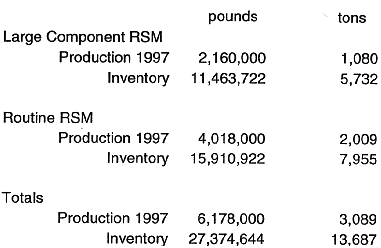
Table I RSM from the US Nuclear Industry.
Steve Lorenz, Manager - Radwaste
ComEd
Frederick Gardner, CHP
National Waste Management
Corporation
ABSTRACT
The development of recycling techniques for radioactive metals has led to the availability of products for use by commercial companies and utilities. These products include shielding blocks, boxes and drums for radioactive materials and components for specialized applications. RSM is also recycled into non-nuclear applications for general recycling as scrap, particularly for high value metals like nickel, copper, aluminum and stainless steel.
The paper describes the commercial experience of nuclear utilities in the generation and management of RSM, based on a 1997 survey of roughly half of the industry. Recommendations for future uses and potential applications of recycled metals will be discussed. The results of this study indicate that the industry has been recycling RSM to the scrap market for decades and that development of a commercial RSM products industry will be largely based on the cost of RSM products.
COMMERCIAL GENERATORS SURVEY
A industry survey was conducted between December 1996 and January 1997 to assess the generation and management of radioactive scrap metal (RSM) from nuclear utilities. The results of this survey are presented for the responses received and extrapolated to the nuclear power industry as a whole.
Of the 115 reactor units in the US, responses to the survey were received from 45. Of the 38 BWR reactors, 19 were surveyed or 59%. The 74 PWR reactors are represented by 26 survey responses or 35%. The responses were tabulated and summarized as follows.
Large components identified in this study are defined as steam generators and turbine rotors and associated equipment. The current storage of these item s at reactor sites is over 5,000 tons. The generation of large components in 1997 is estimated to be zero from BWRs and over 1,000 tons due to the replacement of steam generators at McGuire and Salem. Table I - RSM from the us nuclear industry, shows the contribution of these items to the us RSM inventory.
Routine generation of RSM from reactor operations is estimated to be over 2,000 tons during 1997. This represents about 4 years of stored RSM already produced.
Table I RSM from the US Nuclear Industry.
COMMERCIAL RSM - TYPES AND ACTIVITY
RSM is produced from the removal and modification of in-plant structures and facilities. The typical constituents of commercial RSM are listed in Table II - Commercial RSM Characteristics.
Table II - Commercial RSM Characteristics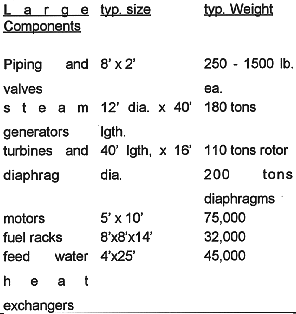

CHARACTERISTICS OF COMMERCIALLY GENERATED RSM
RSM from commercial nuclear power plants is contaminated with beta-gamma emitters almost without exception. The predominant radionuclides are C0-60, Cs-137, Fe-55, H-3, Sr-90. Contamination levels result in dose rates generally in the few tens of millirem per hour at one foot, up to a few hundred millirem pre hour. Removable contamination is rarely over a few hundred thousand dpm per 100 cm2.
Activation of RSM is limited to components that are proximate to the core during operations. Very little RSM is activated. The most frequent activated metals encountered are in-core instrumentation, fuel assembly hardware and control rods and associated equipment. Due to the very high curie content and dose rates from these components, this RSM is packaged underwater in spent fuel type casks and buried as LLRW. Extremely high curie content wastes are over the upper limit for Class C LLRW and await disposal as "Greater that Class C" material - possibly at Yucca Mountain.
ON-SITE MANAGEMENT OF RSM
Commercial Generators of RSM frequently manage the decontamination and scrap disposition of metal using on-site facilities and resources. Of the facilities responding to the survey, virtually all have operated decontamination facilities in the past. Today, over half of the facilities routinely decontaminate and release low dose rate metals and other materials for unrestricted release. Usually, the released material is recycled to a scrap processor. High dose rate and difficult to clean items are sent to commercial processors.
The operation of on-site decontamination facilities is based on the cost of operations. The operations of on-site facilities was viewed as more cost competitive than off-site processing by the utilities who operate such facilities.
The on-site facilities usually are set up in confined, shop areas and suited only to the decontamination of parts and pieces with low activity and dose rates. All facilities with operating decontamination facilities also have active contracts with off site vendors for decontamination of large or high dose rate materials.
RELEASE CRITERIA
Surface Contamination
The facility criteria for free release range from no detectable activity to USNRC Reg Guide 1.86, which applies to the release of surface contaminated items, without volumetric contamination. This was expressed as a direct beta-gamma frisk measurement to less than 100 cpm per probeusing a thin window GM detector. Most facilities use a fraction of the 1.86 limits as an operating limit for release. Many use not detectable activity as an action guideline.
Volumetric Contamination
Half of the plants responding employ environmental LLD concentration limits for the release of potentially volumetrically contaminated items, including metals. The derivation of volumetric standards from 1.86 surface limits to has been evaluated by numerous other studies.(1) The results of these studies result in a range of possible concentration limits in RSM around the 20 to 50 pCi per gram at levels currently released for unrestricted use.
SEG has received a license amendment for the release of metals with volumetric contamination in the few pCi per gram range, the only such license amendment issued to date to a processor.
U S Ecology has developed a release program that applies surface contamination limits to bulk materials in a fashion to justify release of materials that are, in essence, volumetrically contaminated. The application of this approach makes complex items, like motors and cracks in castings releasable, even though the surfaces are in some cases inaccessible.
The development of volumetric standards is supported by the Association of Radioactive Metal Recyclers (ARMR) and in process at EPA and NRC. IAEA has released a new guidance document for solid material clearance(for comment) in January 1996.(2) These efforts will aid the industry by preventing otherwise "clean" material from becoming LLRW or RSM and hopefully, simplifying the process for release of materials with little activity.
COMMERCIAL FACILITY RECYCLING POLICIES AND PRACTICES
None of the facilities reported any formal or informal recycling policy for RSM. While many facilities recycle paper, plastic and glass, the recycling of RSM was not noted as a program. The only recycling done was limited to pilot scale projects and demonstrations discussed below.
The processing methods employed range from decontamination and release at the point of generation to melting and fabrication by processors. The more unique processing methodologies are discussed below.
STORAGE POLICIES AND PRACTICES
The storage of RSM is limited to the routine accumulation of RSM in vans, drums or boxes during accumulation prior to shipment.
The storage of large components such as PWR steam generators and rotors from BWRs and PWRs is prevalent and routine. Domestically, we estimate that there are over 28 PWR steam generators and 35 turbine rotors in storage. The rotors weigh around 220,000 pounds each have very low levels of contamination. Steam generators, conversely, contain over 100 curies of activity on the average after a few years of decay in storage.
METHODS AND EXPERIENCE FOR PACKAGING AND TRANSPORTATION
The methods for removal, packaging and transportation do not vary from generator to generator. For large, low activity components, the element is segmented into the most convenient size for transportation. Wrapping or fabricated packaging is placed around the element to meet the D.O.T. requirements for contamination and dose rate control during transport. The largest components, such as PWR steam generators and reactor vessels are moved via multi-axle schnabel cars and/or barges.
Since 1980, over 35 steam generators have been removed and replaced from PWR reactor plants. Of these, 12 have been disposed of as low-level radioactive waste, with the rest in storage mausoleums at the reactor facility.
Large components RSM includes turbines - both the rotors and diaphragm elements - which in total weigh over 300 tons. Since 1980, over 40 low pressure turbines have been replaced from both BWR and PWR reactor plants. A typical turbine rotor is 42 feet long, 18 feet wide and weighs over 110 tons. The associated diaphragms, weigh over 200 tons.
RSM RECYCLING CAPACITY - HISTORICAL DEVELOPMENT OF TODAY'S FACILITIES
Commercial generators reported that an the average, 90% of the routine metal produced was deconned and free released with 10% packaged and disposed as LLRW. Of the large components produced, most is still in storage at the site of generation. Since the 1980's, the predominant commercial practice for disposition of RSM has been to decontaminate and recycle the clean metal into the commercial scrap metal industry. The material that is not released is sent to processors. Most of the metal sent to processors has been melted into shield blocks. The following described the development of the commercial processing industry.
U S Ecology
The first metals recycling facility was opened in Oak Ridge in 1982. The Hydride Chemical Company started by chemically decontaminating fuel racks. The facility was later acquired by Quadrex and subsequently, U S Ecology and expanded to include abrasive blasting and cleaning of all types of RSM. The U S Ecology facility pioneered the development and application of 1.86 surface limits to bulk materials and, in effect, implemented a volumetric release limit under their license.
U S Ecology has successfully demonstrated to the US Nuclear Regulatory Commission, the Illinois Department of Nuclear Safety, the State of Tennessee and their clients that the implementation of their release program is consistent with current regulatory practice and public health and safety. Today, the metals released are sold as scrap. U S Ecology has a capacity of over 5,000 tons per year.
Alaron
The Alaron facility in Wampum, Pennsylvania opened in 1986. This facility specialized in repackaging and later free release of RSM for scrap recycle. Today the company has the capability to free release and recycle RSM into products. The combined capacity for decon and release is over 3,500 tons per year. The chemical decontamination technology - employing fluoroboric acid - can recycle the acid while providing an aggressive cleaning of all metals and concrete. For structural steel, Alaron has a continuous flow descaler.
Alaron developed the RAM-LOC™ shielding blocks in 1996. These chevron shaped blocks are in commercial use at over four client sites. In 1997, Alaron announced development of the new RAM-LOC™ shielded family of containers. These Type 7A qualified containers are sized to contain 55 gallon drum, provide 2 inches of steel shielding equivalent and three inches on the lid. Made of RSM, the containers as the shield blocks will exhibit a surface dose rate less than 1 mR per hour at 12 inches.
Allied Technology Group, Inc.
The Allied Technology Group (ATG) facility in Richland, WA began decontamination operations in 1989. The ATG facility has a RSM decontamination capacity of over 1,000 tons per year.
Chem-Nuclear Systems, Inc.
In 1988, Chem-Nuclear built the Defense Consolidation Facility(DCF) in Barnwell, SC for dedicated processing of the wastes from the military. The facility currently decontaminates and recycles metal to the scrap industry. The large size and handling capacity of the facility makes it ideal for heavy items and large components. The capacity is over 2,000 tons per year.
F.W. Hake Associates
In 1990, the F.W. Hake Associates (HAKE) facility in Memphis was expanded beyond the SAFESTOR/SAFESHOP services to include SAFECON, a metal component, decontamination and recycling service. In late 1996, one NE utility recovered over 45,000 pounds of metal tooling and equipment for use in their next outage through the decontamination and reuse of the equipment vice processing as LLRW.
Today, HAKE is known for their expertise as a processor of large components like turbine rotors as well as other waste management services. The HAKE facility capacity is over 3,000 tons per year plus large components.
Scientific Ecology Group, Inc.(SEG)
In 1990, SEG began construction of the Metal Melting plant in Oak Ridge. This facility became operational in 1992 and currently operates to produce 10 ton shield blocks under a number of government contracts for the supply of shielding. SEG has expanded their facilities to provide chemical decontamination and abrasive cleaning of metals.
With a design production basis of 12,000 tons per year, the facility has routinely operated at a rate of 8,000 tons per year. The current order backlog for shield blocks will last at least another 2.5 years for 1/97. New orders are expected that will total 10 years of capacity.
The commercial RSM contribution to the SEG metal melt feed has historically been less than 20% with government clients - primarily the DoD - contributing 80%. SEG decontaminates the metals with low contamination prior to melting. About 60% of the commercial metals are released with 40% fed to metal melt.
Manufacturing Sciences Corporation
The latest RSM facility is the 1995 Manufacturing Sciences Corporation (MSC) plant in Oak Ridge, TN. This $ 25 million dollar facility is a new addition to the original MSC melting shops and rolling mill, dedicated to recycling and fabrication of RSM from government and commercial clients. The design capacity of the facility is over 20,000 tons per year. MSC has fabricated boxes and drums from RSM and currently offers a family of products for sale, all manufactured from RSM.
PRODUCT MANUFACTURING AND REUSE - SHIELD BLOCKS
The production of high energy accelerator shield blocks began in 1991. The plant constructed by SEG in Oak Ridge has delivered over 50,000 tons of shielding to over 6 clients throughout the U. S. for shielding high energy radiation and gammas for atom smashers.
Looking back over the last 5 years, the SEG shield block program has consumed over 30,000 tons of RSM from commercial generators and 60% of all RSM produced from the commercial market.
One of the early recycling projects was the production and utilization of contaminated lead as shielding blocks. The contamination remained in the lead matrix. Lead was re-cast into interlocking blocks with weights of 30 - 40 pounds. Theses were leased or sold to the generating site or new customers. Approximately 5 tons of lead was processed using this method in 1990. Lead bricks were returned to the manufacturer, F.W. Hake Associates, for recycling and reuse. Since the original project was done industry emphasis has been on the decon and free release of lead to eliminate the mixed waste problems from contaminated lead.
Another shield block program was begun in 1996 to utilize steel as shielding blocks that can be hand held. The RAM-LOC™ shielding block program, implemented by Alaron, is in production today at a rate of 5 tons of steel per year. These blocks employ a unique chevron-like design that enhances shielding effectiveness and construction. The expansion of this program to a rate of 20 tons per year is possible based on production capability.
Product development - Containers and Components
The development of the container product market began in 1992 with the construction of the Manufacturing Sciences Corporation (MSC) facility in Oak Ridge. This facility was specifically designed to decontaminate, smelt, roll and fabricate radioactive metal into products for use by the nuclear industry - commercial and government.
To date MSC has created over 8 container designs and manufactured over 300 containers with RSM content. The total mass of RSM that has been recycled totals over 50 tons since commercial operations began in 1995. MSC has fabricated steel boxes for a utility.
Production of containers from RSM was started by Alaron in 1995. The development of a family of RSM containers was announces in February 1997.
COMMERCIAL USE OF RSM PRODUCTS
Commercial generators noted in the survey that the purchase of RSM containers would only be attractive if the cost of the containers was competitive with the cost of clean items. The opportunity to re-utilize the RSM did not seem attractive unless the following three factors could be favorably evaluated for the use of RSM products;
RSM PRODUCTS NEEDED BY INDUSTRY
Commercial RSM generators consume metal items throughout the operating life of the facility and into the decommissioning phase. During operations, shielding blocks sized to be placed in and around small areas are used during maintenance outages and during routine operations. Drums and boxes made of metal are consumed on a recurring basis. The ratio of containers needed to RSM generated is about 0.25 to 1 - with four times the mass of metal produced as needed. Commercial reactors are buying spent fuel casks with a mass of 100 tons each. The use of RSM for the fabrication of these storage casks in Europe has been done for over a decade. The use of RSM in the USA has yet to be implemented.
Commercial utilities would gladly use RSM for appropriate products, but will not pay more the competitive market price for the consumable item.
Product Ideas the could be consumed by commercial industry include:
CONCLUSION
The commercial nuclear power industry has generated over 50 million pounds of surface contaminated RSM over the last decade ad continues to generate RSM at a rate of over 10 million pounds per year. Over eight years worth of large components are in storage and the inventory is increasing by over 1,200 tons in 1997 form the generation of steam generators and turbine rotors alone.
The non- large component RSM is planned to be decontaminated and recycled to the commercial scrap steel industry under existing regulations imposed by the USNRC. 90% of this RSM is expected to meet release criteria for unrestricted release after decontamination.
The recycling of the large components in storage provides the industry with a large inventory of RSM. The high costs of eventual burial or disposition may make the reuse of these components attractive.
Commercial generators are potential clients of the RSM manufacturing industry if the costs for the RSM products can be less than the cost of current practice.
Bibliography
Survey Results and Personal Communications
Special Thanks to the Contributors Below
ComEd
Vaught, Mary Duke Power Co.
Miller, Clint Pacific Gas and Electric Co. Diablo Canyon
Fryer, John American Electric Power Co. D.C. Cook
Weber, Brian Detroit Edison Co. Fermi 2
Hobbs, Donnie Georgia Power Company E.I. Hatch
Kay, Doug Texas Utilities Commanche Peak
Castagnacci, Al Duquesne Light Beaver Valley
Scoggins, Frank Georgia Power Co. Vogle
Gatslick, Mary Boston Edison Pilgrim
Lubasewski, Steve PECO Nuclear Peach Bottom
Barrett, John Illinois Power Clinton Power Station
Chalifoux, Ray Illinois Power Clinton Power Station
Kalinowski, Tom Pennsylvania Power and Lt. Susquehanna
Allen, John R. WPPSS WNP-2
Wilson, Roy Entergy
Smith, Andy SEG Carder, Bill SEG
Grayewski, Dave U S Ecology
Taylor, James ALARON
Byrne, Mike Manufacturing Sciences Corp.
Smith, Alvin U S Ecology
Large, Dewey MMT