Table I Activity Objective: Remove Stainless Steel Fuel Baskets
from Bays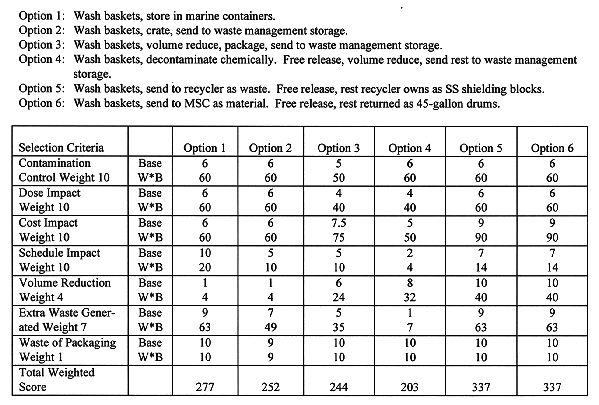
Pauline Hartwig
Decommissioning Services
Wayde Gutzman
Decommissioning Radiation Protection
Supervisor
Waste Management and Decommissioning Operations
AECL, Chalk
River Laboratories
Chalk River, Ontario, Canada K0J 1J0
Michael Byrne
Product Manager, Decontamination and
Recycling Services
Charles D. Nichols
Manager Survey, Transportation,
and Waste Processing
Manufacturing Sciences Corporation, Oak Ridge,
Tennessee 37830
ABSTRACT
The decommissioning of the NRX research reactor at AECL Chalk River Laboratories (CRL) included the removal of 200 stainless steel fuel transfer baskets from the spent fuel bays in late 1995. The baskets, which weighed approximately 8000 kg, were surface contaminated with both alpha- and beta/gamma-emitting radionuclides, but had not been activated or volumetrically contaminated.
A decision matrix was used to evaluate the options for the storage and disposal of these baskets, including two proposals for the recycling of the baskets. The evaluation was based primarily upon potential for future cost avoidance, contamination, dose, cost, volume reduction, and generation of secondary wastes. Recycling at Manufacturing Sciences Corporation (MSC) was chosen as the preferred method for the disposition of the baskets.
A radiological analysis of the baskets was conducted, and the inventory of radionuclides estimated. The baskets were shipped to MSC in Oak Ridge, Tennessee, in March of 1996. The shipment was classified as Radioactive Materials, Class 7 Dangerous Goods, Surface Contaminated Objects (SCO-II). The shipment required two 72.5 m3 marine shipping containers. Based on external gamma dose rate, the shipment was classified as Radioactive Yellow. Regulatory approval for the shipment, including an export permit, was obtained from the Atomic Energy Control Board (AECB).
After acceptance at MSC, the baskets were given an initial treatment in the chemical decontamination bath, and then sectioned using plasma cutting in the receiving area for special shipments. The sectioned baskets were then sent for chemical decontamination, and monitored to identify material that met the applicable criteria for free release to the open metals market. About 4% of the material was free released. The remaining contaminated stainless steel will be melted in MSC's vacuum induction furnace and formed into ingots. The ingots will be rolled and used to manufacture stainless steel drums. The volumetric contamination level of radionuclides in the manufactured drums will be determined. The containers will be returned to AECL prior to June of 1997.
THE DECISION MATRIX
A summary of the decision matrix used to document the selection of recycling as the method of disposition of the stainless steel is located in Table I as follows.
Table I Activity Objective: Remove Stainless Steel Fuel Baskets
from Bays
The criteria with the greatest weights were cost, dose and contamination control. It is noteworthy that they had equal weights, and that cost alone was not the dominant criterion. The other criterion with significant weight was the likelihood of the generation of additional or secondary wastes. Canada does not have a facility for radioactive waste disposal, so the recycling options were compared to the waste storage options available at the time of the development of the matrix. The options with the two highest scores both involved recycling of the material in the United States. However, the option of sending the material to the United States as waste required written confirmation from the Canadian nuclear regulator (the Atomic Energy Control Board) that the material would be accepted back into Canada should it not meet the waste acceptance criteria of the recycler. Obtaining this confirmation may have added considerable delays to the schedule for the project. As well, the recycler for this option proposed that they keep the stainless steel and use it to fabricate shielding blocks, which the recycler would own. AECL determined that the fabrication of stainless steel containers for radioactive waste storage was a preferred use for the material. For these reasons, Option 6, recycling at MSC, was chosen as the preferred method for disposition of the material.
PRE-SHIPMENT ASSESSMENT OF THE METAL
The metal used in this project was 304 stainless steel plate and solid tubing that had comprised 200 stainless steel fuel transfer baskets. The baskets were used to transfer fuel rods in the spent fuel bays of the NRX reactor at AECL Chalk River Laboratories, and to transfer fuel bundles at the NPD CANDU power reactor at Rolphton, Ontario. During the shutdown of the NPD reactor in the 1980s, the NPD fuel baskets were transferred to the NRX reactor bays at CRL. Design drawings of the baskets were available. Most of the baskets were used and stored in the bays for over 30 years. Experimental studies in the NRX reactor involving spent fuel resulted in both alpha and beta/gamma contamination of the bay system.
In order to identify the radionuclides present on the baskets as surface contamination, a total of ten coupons were cut from ten randomly-selected baskets. The coupons were cut in the area of each basket that had the highest contamination level according to a beta/gamma count rate instrument. The coupons were sent for detailed radiological analysis, including chemical separation and alpha-, beta- and gamma spectrometry. During this analysis, the loose contamination was removed from the stainless steel. After the analysis, a final gamma spectrometry analysis confirmed that little or no activation had occurred in the metal. Mean scaling factors for each radionuclide, based on the gamma spectrum analysis of 137 Cs and 60Co from the coupons at the analysis lab, were calculated.
A detailed procedure for the removal of each basket from the bays, including detailed radiological assessment, was written. Each basket was washed underwater in the bays with high-pressure water, and wiped as it was removed. A unique identifier was attached to each basket, and the radiological data associated with each basket was recorded. An example, consisting of one day's removal of baskets, can be seen in Table II.
Table II Survey Data for 1996 Feb. 20.

A maximum allowable gamma dose rate of 0.6 mSv/hr on a given basket, measured on contact with the basket as it was removed from the bays, was derived based on comparison between gamma doserate and level of radioactive contamination from detailed analyses of the sample coupons. This ensured that a basket exceeding MSC waste acceptance criteria or the contamination levels indicated in Transport of Dangerous Goods (TDG) regulations was not shipped. The baskets with gamma dose rates greater than 0.6 mSv/hr were sent for steam decontamination until the gamma dose rate fell below the dose rate criterion. Loose contamination levels were also assessed, and used to determine whether each basket required steam decontamination and reassessment prior to shipping.
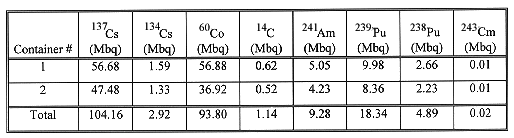
A portable gamma spectrometer was used to measure the gamma dose rate contributed by 137Cs and 60Co for each fuel basket as it was removed from the bays. This measurement was used, along with the scaling factors, to estimate the radionuclide inventory for the each of the two marine shipping containers used to ship the baskets to MSC. The results of the radionuclide inventory analysis are as follows.
Table III Radionuclide Inventory of Stainless Steel Fuel Baskets by
Shipping Container
SHIPMENT OF THE MATERIALS
The level of surface contamination on the baskets, and the external gamma dose rate on the marine shipping containers, resulted in the classification of the shipment as Radioactive Materials, Class 7 Dangerous Goods, Surface Contaminated Objects (SCO-II). Based on external gamma dose rate, the shipment Radioactive Yellow. A representative of Manufacturing Sciences Corporation traveled to Chalk River Laboratories to broker the shipment to Oak Ridge. The MSC representative reviewed the shipping documentation and inspected the marine containers before they were closed and locked. An export permit was required from External Affairs and International Trade Canada in order for the shipment to proceed. Shipment of the materials occurred according to the regulations described in IAEA Safety Series No. 6, 1985 Edition (as amended 1990).
RECEIPT AT MSC
The containers were received at MSC on March 27th, 1996. They were bar coded and placed in indoor storage to await the completion of MSC's new chemical decontamination line.
UNLOADING AND STAGING
In August the packages were opened for the first time by MSC and the baskets were unloaded and placed in a lay down area for staging. During the unloading process, individual baskets were monitored. Contact gamma dose rates ranged between 0.1 - 0.7 mSv/h and 0.02 - 0.07 Gy/h (beta). In addition, smears were taken that indicated removable contamination levels between 2 - 3 mGy/h. The contact readings and smear results indicated a significant increase compared with the outgoing data provided by AECL, which was later determined to be due to leaching of radioactive contamination from the stainless steel during transport and storage.
PREPARATION & PRE-DIP
Due to the higher than expected contamination levels, MSC determined that the baskets would be dipped while intact to reduce employee exposure and the spread of contamination during later steps to segment the baskets. The baskets were processed through a series of degreasing and acid solutions for a total of 90 minutes each, which reduced the gamma contact dose rates by a factor of 50 (to < 0.02 mSv/hr), and removable contamination levels by a factor of 3000 (to 33 - 1667 Bq/100 cm2).
SEGMENTATION
Survey results after the pre-dip indicated that welds on the baskets were the most contaminated areas. Additional chemical processing/testing concluded that the welds were too porous to decontaminate, and should be removed from the baskets during the segmentation process.
Each basket was segmented such that every surface was accessible for processing and survey; and each weld was removed. A combination of thermal and mechanical cutting techniques were used during the segmentation. The baskets were reduced to flat stock, wire mesh, and tubes of approximately 2.5 cm diameter.
DECONTAMINATION
To decontaminate the material MSC used the same solutions that were used for the pre-dip, but this time concentrations were adjusted and stay times were increased to approximately 120 minutes per 227 kg batch. After one pass, the smearable contamination levels were acceptable under MSC's free release criteria of 16.7 Bq/100 cm2, but the fixed levels remained above MSC's free release criteria. A second pass through the entire decontamination and survey process yielded very little additional release.
SURVEY RESULTS
Although the majority of the material (>96%) had been rejected in survey due to failure to meet free release criteria, 1430 kg met the criteria, and were recycled through the secondary metals market.
MELTING
At this point in the project AECL and MSC decided that the remaining 6661 kg of material would be melted in MSC's vacuum induction furnace. The material was already sized to fit into the crucible, and all of the material could be included in one melt cycle. The melt will occur in March of 1997. The material will be cast into six (6) ingots measuring approximately 1.23 m long x 1 m wide x 0.15 m high, and metallurgical sampling will confirm that the ingots are within ASTM ranges for 304 stainless steel. A subsample of the melt will be sent for characterization to determine the content of gamma-emitting radionuclides in the molten metal.
PRODUCTS
The ingots will be rolled into sheet steel in March of 1997. AECL has requested that MSC fabricate 208 l stainless steel drums from the rolled steel. About 80 drums will be fabricated, and all of the manufactured drums will be Type A Packages which will comply to UN A2/X 440/S/96 for solids and UN A1/Y 1.2/100/96 for liquids.
CONCLUSIONS
The recycling of the AECL stainless steel fuel transfer baskets at MSC provided the most desirable solution to their final disposition, and provided an opportunity for beneficial reuse of surface-contaminated stainless steel which otherwise would have been stored as radioactive waste.