
Fig. 1. Low-level radioactive waste
policy amendments act milestones.
Richard Paton
Vice President
American Ecology
Corporation
ABSTRACT
It has been sixteen years since the passage of the National Low-Level Radioactive Waste Policy Act and the available licensed disposal capacity has decreased. Yet millions of dollars are still being expended to implement the Act. Has the Act failed? Did the Nation make a mistake in assigning the development of new disposal capacity to the States in 1980? The Act provides a reasonable frame work for developing a long-term, national waste disposal system. So why don't we have one?
INTRODUCTION
With the passage of the Low-Level Radioactive Waste Policy Act in 1980, (the Act) Congress sought to create a stable national system for low-level radioactive waste by January 1, 1986. With the support of the National Governor's Association, the National Conference of State Legislators, industry and national environmental groups, implementation of this national policy was assigned to the states. There was a general expectation that within six years the nation would have three to four new disposal sites dispersed regionally. These new sites would insure adequate and economical disposal for years to come.
EARLY PROGRESS
By 1983 two states - California and Texas - initiated state-wide screening efforts to identify suitable low-level radioactive waste disposal sites. The remaining states were working together with their respective legislators to form regional associations called Interstate Compacts for the purpose of insuring that future regional disposal needs would be met. It wasn't long (1983) until forty states had formed seven interstate compacts for low-level radioactive waste disposal Identifying a host state and selecting potential sites within these compacts would take longer than the time frame allotted by the Act.
1985 AMENDMENTS ACT
With over forty states moving to implement the Act, there was general encouragement that a framework for regional disposal options was evolving. To maintain the momentum, Congress enacted the Low-Level Radioactive Waste Policy Amendments Act of 1985 (the Amendment Act). By this action Congress extended the date for implementation of a national system to January, 1993.
The Amendments Act also established a series of development milestones and penalties designed to help insure the 1993 implementation goal. (See Fig. 1). The states worked to meet their obligations and by 1990 only New Hampshire, Vermont, Rhode Island, Puerto Rico, and District of Columbia were out of compliance with the milestone provisions of the Amendments Act.
Fig. 1. Low-level radioactive waste
policy amendments act milestones.
As further progress was made and efforts to actually identify new sites unfolded, local and statewide political opposition intensified. People most directly affected by the Acts felt disenfranchised from setting the original policy. By 1993, only fourteen states were even close to being in general compliance with the Amendments Act's provisions. Eight screening programs had been initiated but only one state - California - had actually issued a license for a new disposal facility. Texas had selected a site, prepared a Central Interstate Compact (Nebraska host state) and the Southeast Compact (North Carolina host state). The Rocky Mountain Compact met its obligation by entering into an interregional agreement with the Northwest Compact for long-term access to the Richland disposal facility.
In terms of the original expectations held in 1980 and the national bureaucratic framework for disposal established by the Compact system, the acts were relatively successful. At least three new disposal appeared to be in reach and there was regional focus by the states on their disposal needs.
FLAW IN THE SYSTEM?
Here we are in 1997 having expended as a nation well over half a billion dollars and no new facilities are in operation. In fact, one facility (Beatty, Nevada) has closed and Richland, Washington has limited its service to the Northwest and Rocky Mountain Compacts. Barnwell, South Carolina still provides access for most of the nation's waste generators but at substantially higher costs. Further, Barnwell's continued long-term open access is far from being assured. Each year the South Carolina legislature introduces bills to close or limit Barnwell's access. From today's perspective, the national low-level waste disposal system is less stable than before the passage of the Acts. The objectives of the Acts have not been achieved.
It would be easy to say that the Low-Level Radioactive Waste Acts are a failure and that its time to embark on a new direction. But the Acts and the Compact System it established are not to blame. The ability to achieve a stable, national low-level waste policy is not due to any fundamental flaws of the Act or the compact systems, but rather the time it has taken to implement the Acts and events that have occurred outside the basic framework of the Act.
As with any public policy decision, new stakeholders and new perceptions of the problem develop when there is long time delay between the setting of the policy and its ultimate implementation. When there are specific actions to be taken and deadlines for those actions the problem is even more pronounced if the ramifications of those actions are felt by individuals or groups that have had little or not direct involvement or stake in the establishment of the policy in the first place.
PERCEPTION OF THE PROBLEM
In the case of the Amendments Act, the milestones and penalties established seemed reasonable, rational and most of all, desirable in 1985. The real impact of the decisions necessary to achieve these milestones were far enough in the future so as to warrant minimal attention or concern. As the milestones and attendant actions were approached, and as actions were undertaken that made the Acts implementation more of a reality, what appeared a desirable goal in 1985, became politically painful and undesirable when viewed close up. This becomes most apparent if actions that denote progress and actions that denote setbacks and charted against milestone dates. (See Fig. 2).
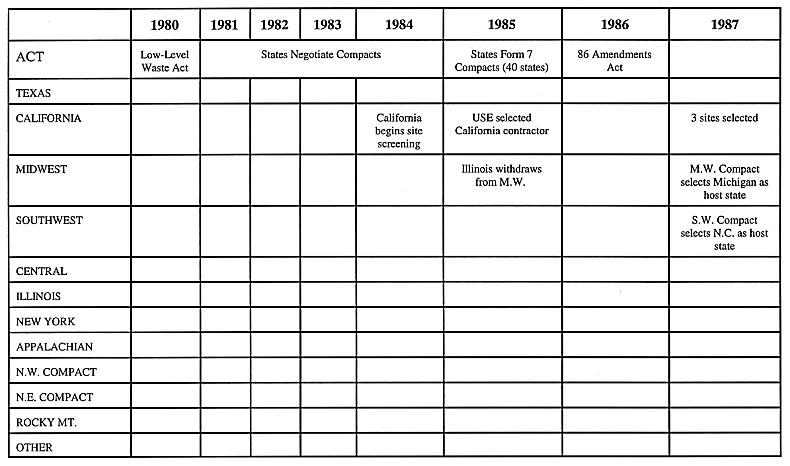
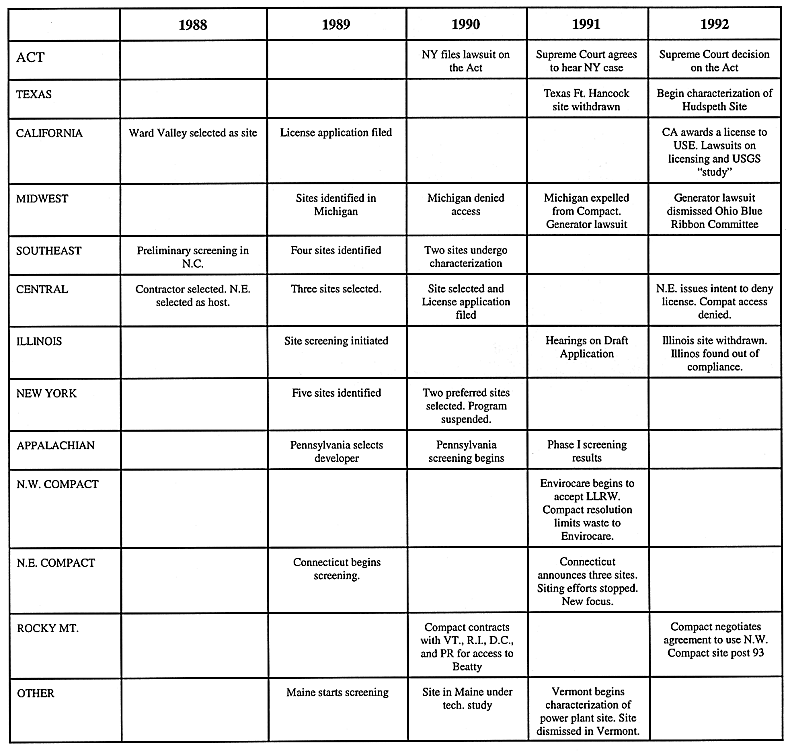
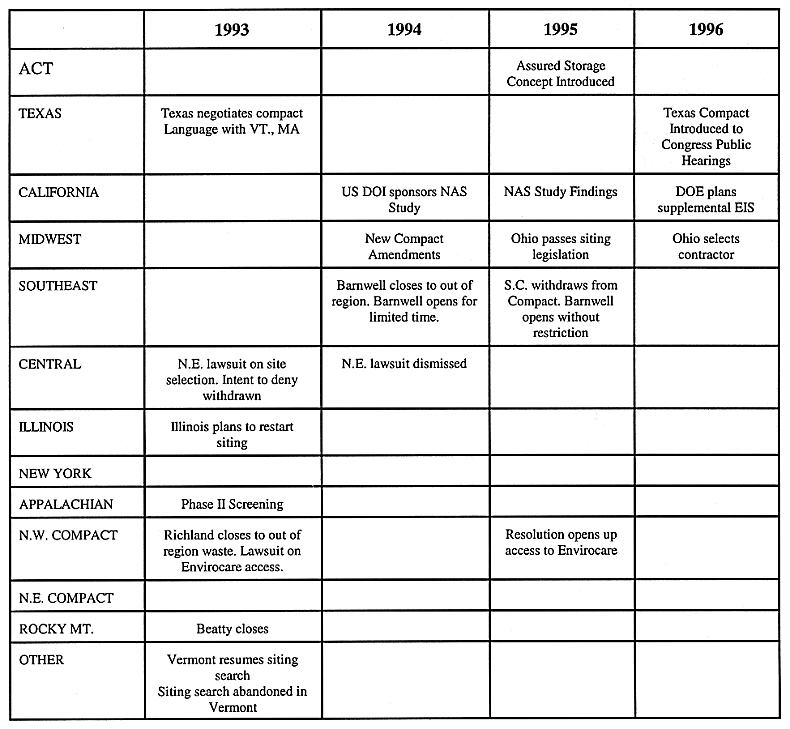
Fig. 2. Key events in the implementation of
the low-level radioactive waste act.
During the early years (1980 - 1987) significant progress was made in establishing a national system with minimal disruptions that could be classified as threatening to the Acts. As states and regions began to identify potential host states and sites, the political reality of building a new facility started to sink in. In those regions were there were strong political figures willing to support the Acts objectives and/or effective generator groups were active in maintaining sufficient pressure to counterbalance local siting opposition, the efforts to implement the acts succeeded (California, Nebraska, and Texas).
In at least two cases - Nebraska and North Carolina - where strong opposition within the state was sufficient to stimulate actions to slow the rate of progress, external pressures brought by other states and regions was sufficient to counter the internal political pressure and put these state programs back on track. In the case of Nebraska it was the Southeast Compact's decision to withhold access to Barnwell as a result of Nebraska's 1992 "Intent to Deny" decision. In the case of North Carolina it was legislative action in South Carolina to keep Barnwell open to Southeast generators based upon progress milestones in North Carolina.
In other states and regions where challenges within were not effectively met with outer pressures the siting efforts stalled or died. In general, the common factors present were progress had been made to implement the objectives of acts were:
CHANGING CONDITIONS
In the sixteen years from the initial passage of the Low-Level Radioactive Waste Policy Act, a number of actions and changes in conditions have transpired that have altered the perceived need and resolve to continue active implementation of the Act's objectives. Key among these are: The New York U.S. Supreme Court decision; South Carolina's withdrawal from the Southeast Compact; the expansion of Envirocare of Utah; and the Clinton Administration.
NEW YORK SUPREME COURT DECISION
In 1990 the State of New York filed suite against the Federal Government over the Constitutionality of the Amendments Act. In a 6 to 3 decision, the high court upheld the overall constitutionality of the Act but struck down the "take-title" provision that would have made states that failed to implement the Act responsible for waste ownership and liability. The impact of the Supreme Court's decision has been interpreted both as a declaration of support for the national system for low-level waste and the death of the Amendments Act. The "Take-title" provision was seen as a minor disincentive for a state's failure to act. The court's removal of this disincentive served to lessen the pressure for compliance. The Court, in their opinion, suggested that there was a sufficient incentive to fulfill the objectives of the ct through the internal political pressure that could be brought should a non-compliant state cease having access to a sited states facility.
"A state whose radioactive waste generators are unable to gain access to disposal sites in other States may encounter considerable internal pressure to provide for the disposal of waste, even without the prospect of taking title . . . The purpose of the Acts is not defeated by the invalidation of the take title provision . . ."
The ability of compact regions to restrict access and impose conditions tied to milestones of progress was sustained. When exercised, the conditions for access did serve as an incentive for states and regions to continue progress.
SOUTH CAROLINA'S WITHDRAWAL FROM THE SOUTHEAST COMPACT
In 1995, South Carolina withdrew from the Southeast Compact and announced it would begin receiving waste from generators nationwide. The only condition for access was payment of state imposed surcharges. Access waste not tied to progress in implementing the Act's objectives as had been the case in the past. As a result, the internal pressure of lost access for non-compliance states as suggested by the Supreme Court suddenly became non-existent. This action created a false expectation that the national low-level waste problem had been solved and that the immediate political pain for continued siting and licensing decisions far out-weighed the long-term benefit of providing for future disposal needs.
ENVIROCARE
In the early 1990's, Envirocare of Utah received a license amendment that enabled their Clive, Utah facility to receive limited amounts of low-level radioactive waste. Prior to that time, Envirocare provided service for a unique niche of waste - namely large volume/low activity material generated from major remediation projects. In 1991 the Northwest Compact passed a resolution permitting large volume/low activity waste to be imported into the Compact region. The resolution was designed to limit the imported waste to the major remediation type of projects.
Since 1991, Envirocare has received additional license amendments that permit the facility to receive a broader range of water products. In 1995 the Northwest Compact amended their resolution. This action opened the Envirocare facility to some waste that were routinely generated and would ultimately have gone to new compact sites. This action has created another false assumption that the national low-level radioactive waste problem and been solved. It provided another "safety-valve" that political lenders could use to avoid the build-up of internal pressure to construct new regional sites.
THE CLINTON ADMINISTRATION
The development of a national system for low-level radioactive waste requires the support of the federal government. It was Congress that established the framework through the passage of the Acts and the US Nuclear Regulatory Commission and US Department of Energy that have provided technical assistance to the states and regions as the sought to implement the Acts. It is disappointing that in the only region to actually license a new facility - California - it is the federal government itself that is hindering success.
In 1992, the State of California issued a license to US Ecology to operate a low-level radioactive waste facility in Ward Valley. This was the first license issued under the Low-Level Radioactive Waste Acts and the first new license in over 20 years. Early in 1993, the Secretary of Interior under the Bush Administration set in motion the transfer of federal lands in Ward Valley to the State of California for the construction of the facility. This action was halted when the Clinton Administration assumed power. Interior Secretary, Bruce Babbitt, announced that the Department would request the National Academy of Science (NAS) to review the license application. Babbitt indicated that the land would transfer upon a finding by the Academy that the site would accommodate a low-level waste facility. In 1995, the NAS issued their opinion in general support of California's licensing decision.
In February 1996, the Department of Interior indicated additional testing of the site would be needed prior to a land transfer decision. This decision was made in spite of the fact that the NAS felt such studies could be undertaken while the site was operating.
In December 1996, the Department of Interior issued a request to prepare a Supplemental Environmental Impact Statement (SEIS). The third such study for the Ward Valley Project. The range of topics to be covered by the SEIS far exceeds any reasonable needs for a land transfer decision and covers topics well documented in the original EIS and subsequent SEIS.
One can only conclude by these actions that the Administration is more interested in political hand-ringing than support of a national policy. Interiors' delaying actions in Ward Valley have had a chilling effect on the will to actively pursue the objectives of the Acts.
THE LOW-LEVEL RADIOACTIVE WASTE ACT - WHAT LIES AHEAD?
During the years when sited compact regions and states imposed conditions for access progress in the implementation of the Low-Level Radioactive Waste Policy Acts was being made. The opening of Barnwell and Envirocare for national access without restrictions tied to a state of region's progress to meet their obligations under the acts has removed the political pressure to move forward. In addition, the Clinton Administration's actions in California have raised serious doubts about the commitment to the federal government to a national low-level waste policy as envisioned under the Acts. The structure and framework still remains to create national system.