Fig. 1. Radioactive waste generated
from dismantling of JPDR.
Kazuo FUJIKI & Hisashi NAKAMURA
Japan Atomic Energy
Research Institute
Tokai-mura, Ibaraki-ken, 319-11 JAPAN
ABSTRACT
Dismantling of the Japan Power Demonstration Reactor(JPDR) generated about 3,770 tons of low level radioactive solid waste. After the completion of the JPDR decommissioning, future possibility of the recycling of a part of LLW generated is being discussed, in conjunction with JAERIs recent activities on melting tests, feasibility study of the recycling system, and the development of new volume reduction facilities in Tokai site. Controlled recycling within the nuclear facility will be favored as a first step of realization of slightly contaminated materials, for demonstration of waste volume minimization and safe management of the waste. Equipment for waste management such as containers will be primary candidates for recycling of radioactive metallic materials to be used in JAERI.
INTRODUCTION
Dismantling of the Japan Power Demonstration Reactor (JPDR) of the Japan Atomic Energy Research Institute (JAERI), the first full scope decommissioning of nuclear power reactor in Japan, was completed in March 1996, as reported elsewhere (1). It generated about 3,770 tons of low level radioactive solid waste, including 1,190 tons of metal waste as dismantled components and equipment, and 2,140 tons of concrete waste as rubbles and blocks. Application of the exemption principle and the recycling of such LLW decommissioning materials are already realized in some European countries and the United States. In Japan, however, development of the exemption criteria for the LLW is just become a term for the discussion in reflecting the realization of decommissioning of commercial power reactors in near future.
According to such situation (lack of clearance criteria), all radioactive solid waste generated in JPDR decommissioning, had to be stored. They were segregated, packed into the containers and stored according to the pre-determined management plan in which relatively fine classification and categorization were adapted with a concern on the future recycling and/or clearance of the low level waste. Among the total amount of radioactive wastes, significant portions are considered to be eligible for the clearance, if an similar clearance criteria to the one in the European countries will be applied. For example, 60% of metal wastes are considered to have activities less than 0.4 Bq/g of beta/gamma nuclides.
Recently JAERI started to construct new waste treatment facilities in order to reduce the storage volume of the solid LLW. It will process the solid LLW which have been accumulated in Tokai site since the beginning of research activities and are being temporally stored. In these facilities, both metallic and non-combustible materials will be melted and solidified into stabilized form. JAERI already conducted melting tests of radioactive ferrous metal (2) using 500 kg induction furnace and its experience will be effectively utilized to develop melting procedures in new facilities. Also JAERI have been studied probable scenarios, necessary technology and the costs for controlled recycling of radioactive metal wastes within nuclear facilities (3).
Based on these experiences, following stepwise approach is proposed for future recycling of LLW in JAERI:
Among the stepwise approach listed above, some aspects of the controlled recycling option are discussed in the following.
CHARACTERISTICS OF THE JPDR DECOMMISSIONING WASTE
Wastes generated from decommissioning of the JPDR were managed according to the plan defined in advance. This considered the nature of the waste and the ease on handling and storage. Decommissioning wastes were segregated according to material, size and shape, and were packed into suitable containers. In addition, relatively detailed classification was applied about the radioactivity level with the consideration of a possibility of future release/recycling, even though the criteria for such release are not defined in current regulation.
Metal waste generated from dismantling of JPDR includes i) activated components (mostly with surface contamination) such as core internals and reactor vessel, ii) equipment and components with only surface contamination, and iii) secondary waste other than dismantled components such as parts of devices used in dismantling works.
The surface radioactivity level of the activated components was about 2 Sv/h for core shroud and higher for other small pieces removed from the center region of the core, lower for components in the peripheral region. These are stored in 24 shielding containers (made of ductile cast iron).
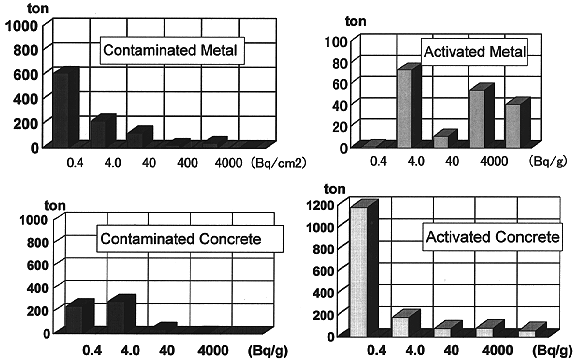
The waste of second category (surface contamination only) were with the activity of typically from 40 Bq/cm2 to below 0.4 Bq/cm2 as shown in Fig. 1. These are mostly stored in the 1 m3 cubic steel containers or in 200 liter drums.
Fig. 1. Radioactive waste generated
from dismantling of JPDR.
Radioactive concrete waste were generated from dismantling of structures inside of the buildings, namely from demolition of the biological shield concrete around the reactor, and removal of concrete surfaces inside of the buildings for decontamination. Among these, 1,670 tons of very low level concrete were buried in a near surface disposal facility in Tokai site, as a demonstration of the safety of such disposal. The rest of the concrete (with slightly higher radioactivity) were packed into the cubic steel containers or 200 liter drums, and are stored in the storage building.
In summary, a total of 3,770 tons of radioactive wastes were generated from dismantling of JPDR, among which 2,100 tons of wastes (1,190 tons of dismantled metal waste, 480 tons of concrete, and 430 tons of secondary waste) are being kept in the storage buildings. In addition to these radioactive waste, a large amount of concrete rubble without artificial radioactivity (therefore it could be treated as conventional waste) was generated from demolition of the buildings which had been decontaminated and released from radiation control. Total amount of these concrete was about 18,000 tons, and some amount were crushed and used to fill back the places where formerly the buildings of JPDR existed.
Results of sorting about the radioactivity level are shown in Fig. 1. It reveals a significant portion of these waste belongs to the category of very low level waste, as typical for decommissioning waste from reactors. These waste are eligible for the clearance, if criteria similar to the one in the European countries will be applied. For example, about 60 % of metal waste and 70 % of the concrete waste are considered to have activities less than 0.4 Bq/g of beta/gamma nuclides in average.
WASTE MANAGEMENT IN TOKAI SITE
Radioactive waste generated in the Tokai research establishment of JAERI are all processed on site. Concerning low level radioactive solid waste, combustible materials are incinerated, but all other solid wastes have been packed in the containers and stored in storage facilities. This includes JPDR decommissioning waste, as described above, and total volume of waste packages accumulated since the beginning of research activities of JAERI is now approaching to current storage capacity limit . Implementation of volume reduction measure is urgent task for JAERI due to a lack of space for expansion of the storage and indefinite disposal strategy about the waste generated from nuclear research activities. There is a significant amount of very low level waste among these stored waste. Therefore volume reduction and the recycling of the waste should be conducted in parallel manner for rational waste management strategy.
In newly established plan of the processing facilities for low level solid waste, melting will be employed as a primary measure for volume reduction, not only for metallic waste but for non-combustible waste. Radioactive metal will be transformed into ingots by melting and stored again. Measurement of residual radioactivity of the ingots will be performed easily and more accurately than in the current estimates because of homogenization effect of melting. This will result in easier segregation of ingots with very low activity, i.e., which are though to be eligible for future clearance or for recycling within the nuclear facility, from the rest which will be disposed of as radioactive waste.
Minimization of waste volume will be achieved further by promoting recycling of material. Though implementation of the exemption and the clearance of the low level radioactive material is not discussed yet in detail in Japan, use of slightly contaminated material under certain radiological safety consideration within nuclear facility should be considered prior to general recycling with unconditional clearance. Such controlled recycling option may demonstrate the safety of the recycling of very low level radioactive material, and may enhance public view for the recycling. In the recycling of the metallic material, melting is a key technology and melting capability in the volume reduction process in JAERI will be able to link a possibility of controlled recycling.
OPTIONS ON CONTROLLED RECYCLING OF RADIOACTIVE METAL
Though the absence of consistent and internationally accepted release criteria, clearance of decommissioning material and their recycling and reuse are being practiced in many countries, especially in EU. As mentioned in recently published OECD/NEA report (4), over three hundred thousands tons of material had been released from the decommissioning projects in Europe and United States since 1979 under varying criteria. Currently proposed clearance levels focus almost entirely on unconditional clearance or unrestricted release of the material. However a variety of alternatives to the unconditional clearance are available still within the context of recycling and reuse. OECD/NEA report suggested several optional scenarios including melting processing within the nuclear (controlled) facility as Tiered system for safety evaluation.
In the study at JAERI, controlled recycling of the low level radioactive material have been considered, as well as unconditional clearance, from a view point on minimizing or optimizing volume of wastes from decommissioning. In this recycling option, it is assumed that all processes (melting, casting, etc. for ferrous materials) for recycling of contaminated materials are performed within the nuclear site and resulting products are also used in the nuclear facility. This is a variation of conditional or restricted recycling and is mostly equivalent with Tier D option described in the NEA report. Under this assumption all practices relating to recycling of the material will be done under appropriate radiation control. This enables more restrictive control of radiological effect to human due to recycled material and, in turn, material with (slightly) higher residual radioactivity than unconditional clearance criteria may be used. This provides additional volume reduction of the low level waste, even when clearance of the material is not realized by some institutional or other reasons.
In such controlled recycling the radiological safety should be considered, in effect, only for the workers engaged in processing of recycled materials and site personnel who use the products. The use of slightly contaminated material, however, may require general consideration on the selection of end uses, such as:
Also balance of supply/demand relation should be a primary concern for establishing effective volume reduction and the safe management of the waste. For recycling of radioactive metal, waste containers by casting and steel structure bars by a combination of casting and milling, are the candidate products to be used in nuclear facilities.
JAERIs waste processing facility for volume reduction will have melting furnaces in its central part, at least one for the metal waste and another for non-metal solid waste. Metal ingots will be stored temporally, and partially be used to produce items described above after the measurement of radioactivity.
Static casting is rather simple and well-proven method to produce items, and further, it is cost-effective even small amount of the metal is processed. So it is attractive to use static casting for the production process in the controlled recycling of the radioactive metal. However in producing large items such as containers, most casting processes use sand molding. The sand will be contaminated by the process of casting in which melted radioactive material may contact with mold. Separation of the surface layer of the mold from the rest is very difficult because the mold is broken after casting. Therefore used sand should be all handled as secondary waste, if clearance criteria is not defined. Alternative method not utilizing molding sand and still maintaining the merit of casting will be preferred, if available.
A most simple alternative is use of metal molding case, but it is not suitable for casting of large products due to rapid cooling rate. Another example of such method is special casting procedure reported by CEA (5), in which casting case constructed by steel plates is embedded in the pile of small steel balls. The pile of steel balls plays a role of not only supports for the case but conductor to release the heat from molten metal. Though detail of the method and the results are not explicitly reported, it is thought to be ambitious method in controlled recycling of radioactive metal.
Within the framework of waste management in JAERI, one candidate of the recycling of radioactive metal is to produce waste containers to be used as disposable ingot case for melted non-metal non-combustible radioactive waste. Another possibility is to make thick wall containers to substitute the shielding containers currently being used to store activated components of JPDR. When using these containers, further utilization of radioactive material and volume reduction of the waste will be achieved if vacant space are filled melted low level metal for enhancing shielding effect, as already tried to produce such package in Germany. This type of waste package, so called onion casting block, will be made by using JPDR low level metal waste. A case study shows the utilization of radioactive metal to produce such waste packages will result in reduction of about 30 % of storage volume of JPDR metal waste, as material balance shown in Fig. 2 (weight of metallic wastes are shown only for carbon steel and stainless steel).
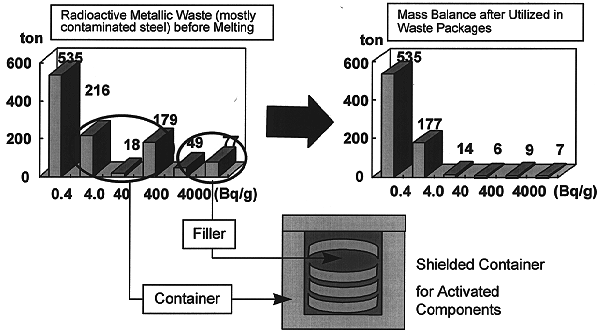
Fig. 2. Case study to recycle
radioactive ferrous waste from JPDR dismantling to fablicate containers and to
produce onion casting.
Our previous study on the recycling (3) reveals that the production of the items using casting process costs relatively cheaper compared with other process such as milling. Though more detailed cost-benefit analysis based on realistic plan of processing should be made, recycling of low level radioactive metal stored in JAERI will have much benefit on the future waste management.
RECYCLING OF CONCRETE FROM NUCLEAR FACILITIES
Decommissioning of nuclear facility usually generates large amount of concrete rubbles and blocks from decontamination and dismantling of buildings and structures. Though total amount is large, most of the concrete is non-contaminated (without artificial radioactivity), i.e., rubbles and blocks generated by demolition of the body of structures and/or buildings. Radioactive concrete waste are generated from decontamination of the building (usually a removal of surface layer) and demolition of activated structures around the reactor, namely from biological shield. Amount of radioactive concrete waste, however, is generally small compared to non-radioactive one. They are usually stored or disposed as low level waste, even some alternative use of low level radioactive concrete may be considered.
Non-radioactive concrete, i.e., rubbles and blocks generated by demolition of structures and/or buildings, can be recycled or reused in general along the same strategy for the conventional concrete waste. However, amount of dismantled concrete is huge in some case (assumed to be several hundreds of thousand tons for dismantling of a nuclear power plant), and many site of the decommissioning locates at inconvenient place. For these reasons and other considerations, such as public acceptance, recycling or reuse in or near the site of decommissioning may be preferred. Development of on-site use and cost-effective processing method are desired because of large amount of concrete rubble.
In the JPDR case, dismantling of the buildings generated about 18,000 tons of concrete rubbles without artificial radioactivity. Among which 6,900 tons were crushed and used to fill back remained basements of demolished buildings and for the road bed in the site. Rest of these concrete rubbles are temporarily piled in the storage area, but in future it will be also crushed and used as bases of the new buildings and the road bed constructed in the site.
Besides decommissioning waste, several hundreds tons of concrete waste were generated from steam generator exchanges of PWRs of some utilities in Japan. In these cases non-radioactive concrete are kept in their site (buried as conventional waste except small pieces used as monument).
CONCLUSION
Realization of the recycling of low level radioactive material is a key issue for future full scope decommissioning of nuclear facilities. Recycling will be cost effective even the case of controlled recycling of the material within the nuclear facilities. Step-wise approach is being proposed for realization of recycling of low level radioactive material in JAERI.
REFERENCES