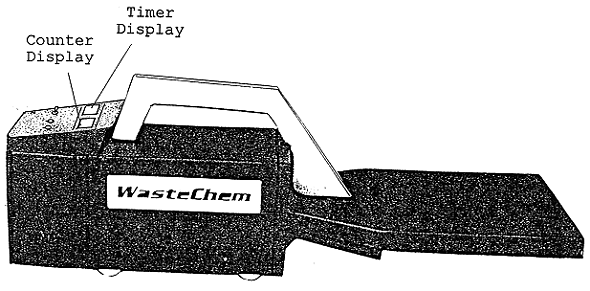
Fig. 1. The LAPS (Large Area Plastic
Scintillator)
F. J. Coleman and K. F. Collett
WasteChem Limited
Kelburn Court
Daten Park, Risley, Warrington WA3 6TW
Tel: 00 44 1925
858226
Fax: 00 44 1925 811867
ABSTRACT
The factory site of one of the main UK suppliers of radium luminised dials to the public, aerospace and defense industries, covers an area of 6.7 hectares. It contained laboratory and factory buildings which had been in use since the factory site was first established for this purpose in 1937. Luminising of dials ceased in the early 1980s. Part of the site formed the company's sports field which had been built on infill waste materials.
The company owning the site had been given planning permission for development and a certain amount of decontamination work had been carried out in the 1980s. WasteChem contracted to remove, segregate, package and transport the remaining radium radioactivity, which was spread throughout the site on land to a depth of 3 metres, and in buildings to the foundations.
On-site analysis of soil and rubble samples was normally carried out by sodium iodide gamma spectrometry, an occasional sample being sent to a NAMAS Approved Laboratory for measurement on a GeLi gamma spectrometer for calibration quality assurance purposes.
To speed up the process, reduce waiting time and the high cost of off-site analysis, a novel instrument was developed by WasteChem. The original prototype instrument consisted of a large area plastic scintillator (LAPS) attached to a commercially available portable counter-timer-EHT unit. The combined LAPS and associated counter instrument formed a portable laboratory-type analytical system that could be used anywhere on site in four operational modes. The calibration and readout method has been designed so that immediate in-the-field specific activity levels in Bq.g-1 can be obtained to an acceptable accuracy by non technical staff. Experience with the prototype on this project has led to a robust improved design that incorporates within the body of the LAPS its own miniature counter-timer-EHT unit.
DECOMMISSIONING OF THE CONTAMINATED SITE
It was necessary to first ascertain the distribution of soil radioactivity in the open land area and sports field, and follow this with a radiation survey of the laboratories and buildings.
The land was divided into square metre grids using tapes staked to the ground. Using the LAPS (Fig. 1) in operational Mode 2, each square metre of ground area was checked with the scintillator suspended about 10 cm above the surface. It was possible to carry out the land surface scan at slow walking pace by observing the rate-meter on the counter unit. Within a few seconds it was clear whether the soil within the square metre area to a depth of 30 cm was above a set "background" level. If the rate-meter reading was found to be above background the scan was stopped and the LAPS was placed on the ground in the center of the square metre under inspection and a one minute count was taken.
Fig. 1. The LAPS (Large Area Plastic
Scintillator)
The counts per minute obtained very approximately corresponded to the specific activity in Bq.g-1 of one square metre of soil to a depth of 30 cm. This was established by a special calibration procedure. The operator obtained the specific activity value by inspection of a simple graph of cpm above background against apparent specific activity in Bq.g-1.
Using this rapid ground scanning method, the open land contamination of the site which covered between 4 to 5 hectares was completed and mapped over three days. Not only did the survey quickly demonstrate where the highest radium contamination was situated, but, it also gave a good indication of the position and local specific activities over the site and the total site activity involved. These two very important pieces of information allowing the planning of the excavation and disposal of relatively large quantities of radioactive soil to proceed without delay at an early stage of the contract.
The buildings covering the rest of the site area were more difficult to survey and the preliminary measurements using standard alpha and gamma surface contamination hand monitors indicated low levels of radium contamination throughout the structures. Much higher levels were detected below the ground floors in the foundations, the result of which led to an early decision to remove all buildings and excavate the foundations.
Consequently, all buildings on the site were knocked down and a large amount of soil and rubble waste had to be analyzed and segregated. Normally, this would be an expensive and time consuming exercise. The on-site sodium iodide gamma spectrometer could only analyze small 250 g samples and had to be transported to the on-site cabin laboratory where the detector was housed in a very heavy lead castle. If the activities were low, (<1 Bq.g-1), then the gamma spectrometer measurement count time would be at least 30 minutes. If the activities were high, (>1000 Bq.g-1), the gamma spectrometer would be saturated and unable to take a measurement without sub-dividing the samples into a few grams which would mean even more samples requiring expensive analysis.
This problem was avoided by using the LAPS in Mode 1, in which 2 kg samples of soil and rubble were placed under the scintillator in its relatively small lead shield, in positions close to the active areas of interest and measured for a one minute count time. The cpm obtained were then compared to a simple graph of cpm against Bq.g-1. Fig. 2. To maintain quality assurance and accuracy of the LAPS results, every thirtieth or so sample was measured and verified on the local gamma spectrometer. This instrument, in turn, was verified by measuring every thirtieth or so gamma spectrometer sample on a GeLi gamma spectrometer at an off-site NAMAS approved Laboratory.
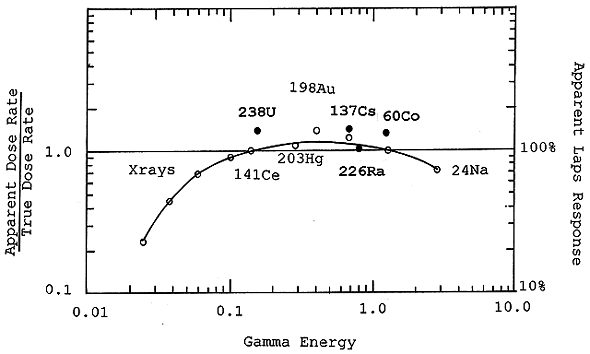
Fig. 2. The LAPS calibration graph
(mode 1 operation).
To obtain activities at a depth of up to 3 metres in the ground, the LAPS was used in Mode 3 in which 10 cm long core samples, 2.5 cm in diameter were measured.
Finally, all the waste being disposed to Drigg had to be packed into half iso-containers which contained about 20 tonnes of soil and rubble. The disposal authorities require fairly precise activity information and failure to produce reasonably accurate figures could involve significantly increased disposal costs. It is virtually impossible to produce data directly from the 20 tonnes container once it is full, so the waste was initially packed into 200 litre drums and a measurement was taken by the LAPS situated 100 cm from the side of the drum surface. The waste was then transferred to the iso-container which was suitably marked with the total activity inventory.
Some sixty cubic metres of soil and rubble graded Low Level Waste of total activity 2.49 GBq were disposed of to BNFL, at Drigg, and 2460 cubic metres of exempt (<4.0 Bq.g-1) contaminated material to a special site. Some 4000 cubic metres of sifted, analyzed material were allowed to remain on site, the radium activity being below regulatory concern (<0.4 Bq.g-1). Altogether, over 6520 tonnes of material were processed and graded according to specific activity.
This decontamination exercise proved to apply to the largest site in the UK to be decontaminated of radium arising from the luminising industry. It was carried out in less than 6 months at a relatively low cost. An independent survey by the National Radiological Protection Board confirmed that WasteChem had met the necessary criteria for clearance of the site as required by the UK pollution control regulatory bodies. The owners of the site have commenced redevelopment.
THE LAPS INSTRUMENT
The LAPS consists of a Type NE102a plastic scintillator 225 cm2 by 0.5 cm thick. This configuration allows considerable advantages over standard scintillator analytical equipment. The thin scintillation detector can be easily placed between two small flat sheets of lead shielding, thus dispensing with the usual stationary large heavy lead castle normally required for a 3" dia. cylindrical sodium iodide gamma spectrometer. The large detector contact surface area can analyze much larger samples than the usual gamma spectrometer which is typically only 250 g, and will not saturate at high cpm. The LAPS sample at 2 kg is eight times greater and can be considered as much more representative of the specific activity when large volumes are involved. The shape of the scintillator, the small amount of lead shielding and the large sample ensures a low background count and a high sample count, so specific activities down to less than 0.4 Bq.g-1 can be measured to an overall error of ±15% over a period of less than 2 minutes. Furthermore, the LAPS is fully portable and can be used anywhere on the site.
There are four operational modes:
These four operational modes are shown in Fig. 3.
THE SPECIAL SYSTEM CALIBRATION METHODS
Mode 1 is empirically calibrated using four specially made sealed sources 21 cm x 21 cm by 3 cm thickness. Except for the background source, each source consists of 2 kg of silver sand spiked with a known amount of 226Ra (in solution) with nominal specific activities of 0.4, 2.0 and 4.0 Bq.g-1, The precise specific activity of each source was ascertained by GeLi gamma spectrometry to ± 3% at an off-site NAMAS Approved Laboratory. A daily check using these sources establishes the calibration factor on the graph used by the operators, with an overall probable error of ± 15%
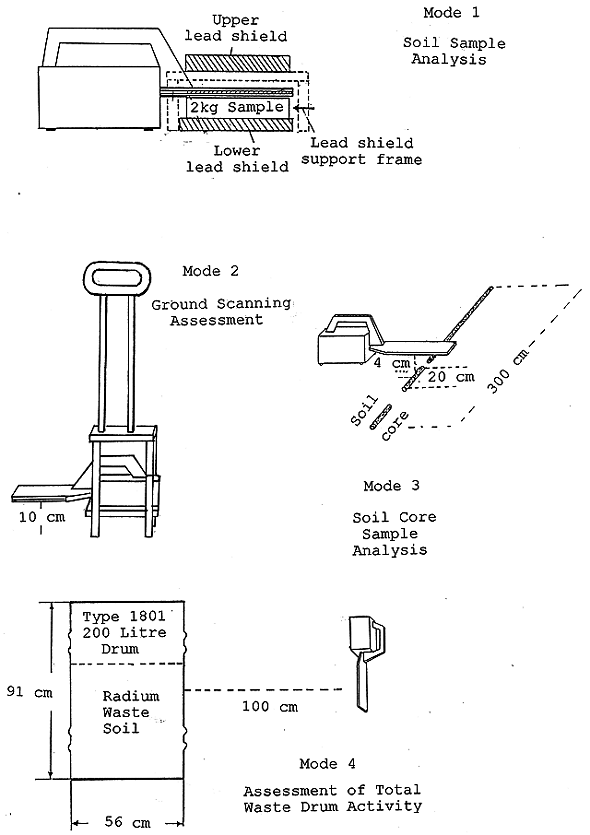
Fig. 3. The four operational modes of
the LAPS.
Mode 2 was calibrated by making a "source", 100 cm x 100 cm by 30 cm deep, of clean soil and placing a calibrated 60Co source in the soil at various depths in a 10 x 10 x 10 cm matrix. The results were later verified by replacing the clean sand with homogeneous radium contaminated site soil which had been assessed from five samples measured on a GeLi gamma spectrometer at a NAMAS Approved Laboratory. This operational mode is not meant to be an accurate measurement method, but a simple quick indicator of the very approximate specific activities over large areas of land and detector of hot spots. When samples were analyzed by local gamma spectrometer the results showed that the ground scan results, using the LAPS, were within a factor of two.
Mode 3 was calibrated using a special tubular sealed source, 10 cm long by 2.5 cm in diameter, the actual size of a typical soil core sample. The source consisted of radium contaminated soil obtained from the site and analyzed on a GeLi gamma spectrometer at a NAMAS Approved Laboratory as having a specific activity of 17.8 Bq.g-1 to an overall probable error of ± 15%.
Mode 4 was calibrated using a computer program that calculated the dose equivalent rate in uSv.h-1 at 100 cm from the side of a 200 litre drum filled with radium contaminated soil to within 10 cm of the top of the drum at a density of 1.6 g.cm-3. The overall probable error on the calculations is ± 10%. The results were checked by actually filling a 200 litre drum with the radium contaminated soil used to calibrate the LAPS in Mode 2. The results were found to be in reasonable agreement.
In practice, the drums of waste vary in weight and density, departing considerably from the standard soil density of 1.6 g.cm-3, so, seven calibration graphs were made corresponding to the actual soil and rubble waste packed in the drums. This included waste densities from 0.8 g.cm-3 to 1.4 g.cm-3 and respective drum weights 143 kg to 250 kg. The main error arises in the method used in obtaining the DE rate at 100 cm. For a one minute count time on the LAPS the overall probable error is ±17% and for a 10 minute count time the error is ±11%. These errors can be further reduced by taking four polar measurements at 100 cm around the drum.
QUALITY ASSURANCE CALIBRATION METHODS
All the samples used to calibrate the LAPS were analyzed at a NAMAS Approved Laboratory on a GeLi Gamma spectrometer to ±3%. Each sample result was given in unit of Bq.g-1 obtained directly from the 226Ra gamma peak at 186 keV. Measurement of the counts in this low intensity gamma peak is relatively easy using a high resolution GeLi detector. Direct measurement of 226Ra parent avoids the gamma daughter equilibrium problems which would clearly be evident in the LAPS results which operates on the principle of detecting all the gamma daughters, notably 214Bi and 214Pb. To produce a gamma parent-daughter relationship, the NAMAS Laboratory were also requested to produce specific activity values for 214Bi and 214Pb following sealing of the 226Ra sample for a period of 30 days, which is about 8 half-lives of the 222Rn (radon gas) precursor.
The local sodium iodide gamma spectrometer having an inferior resolution was unable to accurately measure the 226Ra peak and analysis was achieved by measuring the much higher intensity 214Bi peak at 609 keV and then multiplying the 214Bi activity by an appropriate parent-daughter factor given by the NAMAS calibration 226Ra-214Bi ratio assuming equilibrium. This method relies on the samples removed from the ground also being in equilibrium, which of course they are not, due to the fact that the radon gas precursor continuously escapes from the ground, depositing the radionuclides from subsequent reactions down the decay chain elsewhere. To avoid having to wait 30 days for the radon to build up to the required 214Bi equilibrium value for 226Ra assessment for a QA verification, each 214Bi result was multiplied by a correction factor obtained experimentally from numerous sample measurements obtained by repeatedly measuring the 214Bi peak on sealed samples, on a daily, basis over a 30 day period.
This effect can be seen in the LAPS calibration graph given in Fig. 2. Gamma ray measurements were taken on the LAPS for a period of 30 days commencing from the day the calibration sources were prepared and sealed. A gradual increase in the dose rate was observed until 30 days when the increase was no longer discernible. The graph line marked non-equilibrium was obtained on day one, and that marked equilibrium was recorded on day 30. It is interesting to note that when one of the calibration sources was deliberately punctured the release of radon gas was detected on an alpha probe placed at the puncture hole, but although the gamma dose rate dropped, it did not return to its original non-equilibrium condition. The gamma dose rate was only further decreased by forcing air through the source container. This same effect was noticed when contaminated waste soil was placed in the 200 litre drums. It would appear that radon does not freely leak from the ground. It probably requires a rising water table to supply pressure to push it out of the ground and, even then, a considerable amount of radon stays put, perhaps because it attaches to ground water and other molecules.
Following careful experiments it appeared that the difference in gamma dose rate between soil freshly dug out of the ground compared to the same soil sealed in a container for 30 days, was on average, only about 15%.
SPECIAL DISPOSAL REQUIREMENTS
For large amounts the UK disposal authorities require not only the total activity of radioactive waste, but also the total activity arising from alpha emitters and the total from beta emitters, including daughters with half- lives greater than 3 months. Regarding radium, the only alpha emitting daughter is 210Po which has a half-life of 138 days. Consequently, this alpha activity must be added to the alpha activity of 226Ra. The only beta emitter is 210Pb with a half-life of 21 years and this activity must be stated in the disposal documentation.
Radium has only been in use by the luminising industry in this century and, therefore, the history of the radon precursor is unknown and it cannot be assumed that 210Pb is in equilibrium with 226Ra as it would take at least 130 years for near equilibrium conditions. To obtain a reasonably practical estimate The NAMAS Laboratory was asked to reassess a number of calibrated samples by reviewing each spectrum and measuring the 47 keV peak of 210Pb. The activity was found on average to be about 20% of the 226Ra activity. The 210Pb "worst case" activity could be calculated by assuming that this radionuclide had been "operative" for three half-lives ie 63 years, it can be shown that this would produce a 210Po activity of 86.2% of 210Pb activity. Activity of 210Po can therefore be obtained by calculating 17.24% of the 226Ra activity.
CONCLUSIONS
Commercially available radiological protection instruments are primarily designed for the measurement of alpha, beta and gamma surface contamination on hands, feet, clothing, work tops and floors. They are not entirely suitable for surveying large areas of contaminated land. A typical method of surveying land masses is to obtain numerous small samples of soil and dispatch them to a scientific establishment for expensive and time consuming analysis on complex laboratory equipment.
Following a number of decommissioning contracts where use of commercial instruments and outside laboratory facilities proved unsatisfactory in incurring both high costs and lengthy delays, WasteChem decided on a policy of designing and manufacturing their own equipment specifically for the purpose of decommissioning large land areas contaminated with radium. Several prototype instruments have been designed and produced and the LAPS is the first of these instruments to have been developed and fully tested in the field. While it was primarily designed for the detection of radium arising from the luminising industry, the instrument has also been successfully tested on land contaminated with 137Cs, 60Co and 235U produced by the nuclear industry. The 226Ra, 60Co, 137Cs and 238U response of the LAPS is shown in Fig. 4.
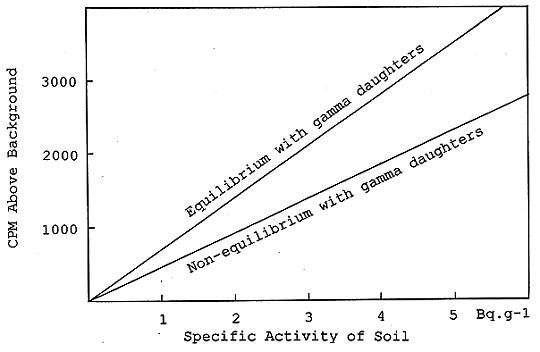
Fig. 4. The energy response of NE102a
plastic scintillation sheet 1 cm thick (1) (LAPS response superimposed in BOLD).
The exceptionally good results from using the LAPS technique on this and a subsequent contract has reduced costs, decreased time delays and consequently reduced the dose to the Company's Classified Workers and members of the public. The Company's policy has been fully justified and this has been endorsed by the Institute of Chemical Engineers which chose the use of the LAPS by WasteChem as a significant advance and nominated WasteChem for the Gold Medal, an Excellence in Safety and Environment Award 1996.
REFERENCES
1. Unpublished energy response curve of NE102a plastic scintillation material from measurements by UKAEA.