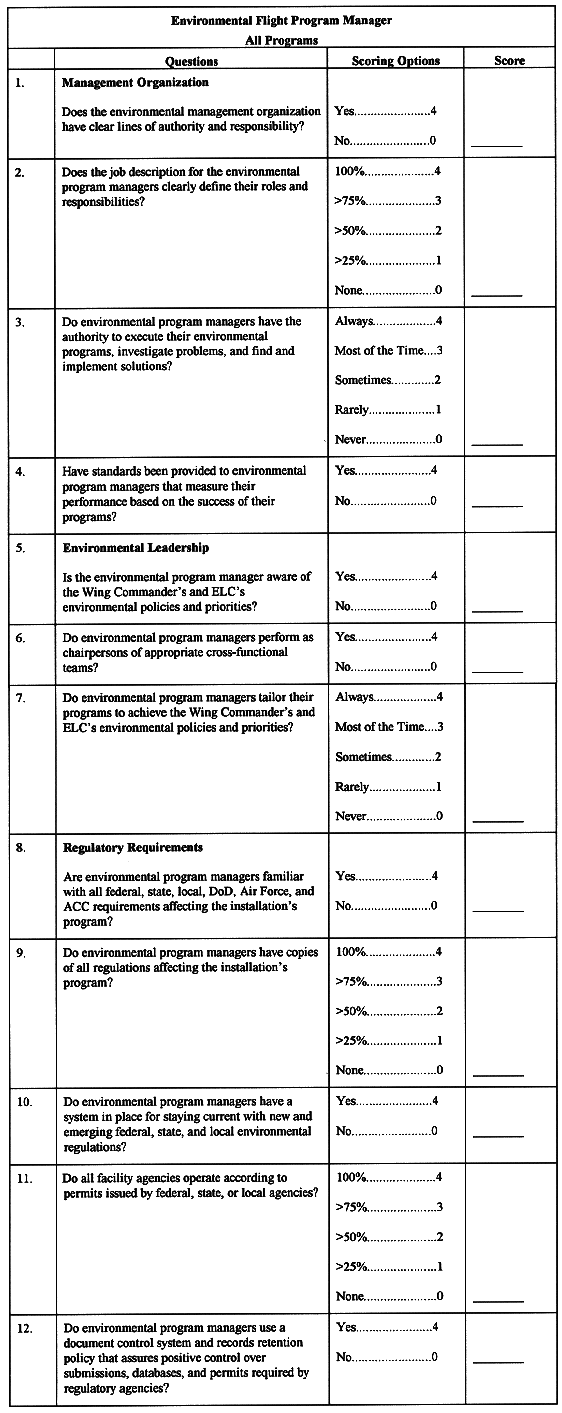
Fig. 1. Environmental flight program
manager.
Gary Kaszynski
CH2M-Hill
ABSTRACT
A new and innovative approach has been developed for conducting a management self-assessment of the functional components of facilities' environmental programs. The management self assessment approach is complementary to the analysis of root causes of environmental noncompliance. Although root cause analysis routinely is confused with management self assessments, it is quite different. Root-cause analysis focuses on why specific compliance deficiencies occur. Examples include equipment failure, poor maintenance, lack of training, lack of budgets, or a breakdown in an existing management system. Management self-assessments focus on systems and procedure that need to be in place to address root causes. Both assessment techniques share the goal of converging the management assessment with a root cause analysis, resulting in improved environmental performance.
In this context, management self assessment checklists have been developed to answer the following types of questions:
To address the need for a method to review environmental management systems, a series of Environmental Management Self-Assessment checklists have been developed for a major Air Force Command that will allow environmental managers to perform a self evaluation of their environmental management functions. The checklists were designed to allow the users to quantify their responses to a series of questions, identify areas of strength and weakness, and measure performance over time to document improvement. The checklists are included in a Microsoft ACCESS database that allows the users to complete the checklists electronically, customize the checklists, develop management action items to implement, conduct trend analysis and produce reports.
INTRODUCTION
In the past several years, federal facilities have made substantial progress identifying and fixing thousands of environmental non-compliance issues through environmental compliance auditing. In many instances audit findings have been analyzed to identify root causes systemic to the non-compliance issues so that senior management can assign budgets and direct efforts to correct the source problems, not just the resulting symptoms. Environmental compliance audit programs have been successful in identifying specific conditions of non-compliance and producing management action plans to correct deficiencies for specific environmental media.
PURPOSE
This paper presents an additional approach for achieving environmental excellence--by conducting a management self-assessment of the functional components of a facility's environmental program. Management self-assessment results produce findings and recommendations that are intended to be used in developing more efficient and productive environmental management systems, which in turn, will improve environmental performance.
In this context, 38 management self-assessment checklists have been developed to address the following types of questions:
DESIGNING THE SELF-ASSESSMENT CHECKLISTS
In order to review a facility's environmental management systems, a series of 38 Environmental Management Self-Assessment checklists have been developed. These checklists can be used by all levels of professionals to assess management of their programs and the overall facility effort. The checklists were designed to allow the users to quantify their responses to a series of questions, identify strengths and weaknesses, and measure performance over time to document improvement.
Figure 1 presents a sample checklist. The checklists were designed for a particular Air Force Major Command and are intended to be used by the individuals assigned to specific positions. The checklists are designed to be stand-alone self-assessment tools. Each checklist is organized into several subsections that define the particular Management Standards applicable to the position. The individual performing the self assessment is provided with a range of responses (criteria) with associated scores ranging from 0 to 4. Scores are entered in the rightmost column and can be added to determine the total score. A calculation can then be performed of the total achieved score divided by the total possible score to obtain a percentage. Certain questions may not apply specifically to the individual's responsibilities and should not be included in the tally.
Fig. 1. Environmental flight program
manager.
MANAGEMENT STANDARDS
The checklists measure the effectiveness of systems, programs, and tools used to manage environmental issues, not just the compliance issues themselves. In general, each checklist is organized into subsections selectively chosen from a master set of management standards commonly utilized by industry and government professionals alike. The standards are as follows:
The management standards for each checklist were customized based on the responsibilities of the checklist users. Therefore, every management standard is not included in every checklist. Whereas management standards represent a common thread throughout the checklists, the questions under each management standard were adapted to the particular user. This approach promotes continuity between checklists, yet presents an opportunity for users to compare effectiveness of their management programs.
A review of the responses to similar questions may reveal whether management is cohesive or inconsistent. For example, the Environmental Flight Chief may believe that the Environmental Program Managers are aware of environmental mission statements, goals, and policy. This belief is demonstrated in the response to a particular question posed in the Flight Chief's checklist. The response to a similarly posed question in the Environmental Program Manager's checklist provides feedback to the Flight Chief indicating that not all Environmental Program Managers have been fully informed of fundamental management policies. Thus, the review checklists provide an opportunity to identify miscommunications and to implement simple and effective solutions.
THE CHECKLIST QUESTIONS
For each management standard presented in the checklists, a series of questions have been developed that address particular elements related to the management standard. The questions are designed to invoke a response to the following:
It is also important to understand that particular management standards and associated questions may not carry the same weight as others. In the self-evaluation process, weighting of particular management standards or questions is certainly appropriate and encouraged.
THE CHECKLIST SCORING OPTIONS - PERFORMANCE MEASUREMENTS
Scoring Options have been established that allow the individual to quantify their response to a checklist question. The scoring options and associated values (ranging from 0-4) have been simplified into 3 criteria types:
Yes/No Many of the questions require a simple affirmative or negative response with no allowance for "maybe". The response should be a "No" unless the individual has no hesitation that all aspects of the question are being implemented. The intent is for the individual to fully evaluate the implications of the question and answer objectively.
% (Complete) Certain questions are posed such that the response requires an indication of the percentage of particular actions that have been completed. These percentages are correlated to a numerical score.
Frequency Responses to certain questions require an indication of the frequency in which a particular action is required to fulfill the requirements of the management action. The criteria are referenced as "Always", "Most of the Time," etc. and present more of a subjective approach to responding to the question.
CHECKLIST SCORING
The individual should simply enter the value in the "Score" column that most represents the condition that exists in response to the question. The individual scores should be summed and expressed as a percentage of the value of the total possible score. Scores of those questions that are not applicable are not to be entered.
ENVIRONMENTAL PROGRAM ANALYSIS
It is important to conduct a "Baseline" self-assessment with any necessary notations on the checklist. This baseline will then be used during subsequent self-assessments for comparison purposes. The continual and recurring application of the checklist will show where improvements are being accomplished, where strengths and weaknesses exist, and provide the individual with an opportunity to monitor the "health" of the environmental programs.
SUMMARY
Environmental management systems in the United States have evolved in sophistication since the early days of environmental activism in the 1970's. The two major drivers for improvements include a rapid increase in environmental regulatory activity and societal mandates to practice conscientious environmental stewardship. While facilities have made great progress addressing these challenges, repeat deficiencies continued to plague some programs.
Environmental compliance can be viewed as a continuum, ranging from meeting minimum standards of performance to environmental excellence. The continuum of environmental performance can be organized into 4 phases:
Organizations with effective environmental programs now focus on anticipating future regulatory trends and reflecting them in their current environmental management systems. As the environmental assessment process matures and organizations become more confident that they are in compliance with regulations, the assessment emphasis shifts to environmental management systems. These management reviews focus on whether systems are in place and operating properly to manage future environmental risks. Development of a system to evaluate and measure environmental management systems combined with a goal to continuously improve, provides the foundation for facilities to move into the advanced stages of environmental management -- the proactive and preventative stages.