Table I Example Policy Statement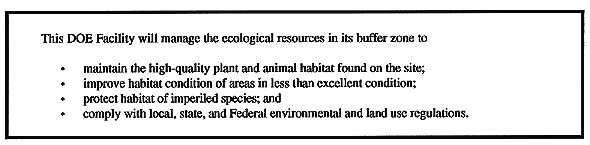
Daniel Michael and Mark Hooten
Neptune and Company, Inc.
Elizabeth Kelly
Los Alamos National Laboratory
William Roy-Harrison
US Department of Energy
ABSTRACT
Recent interest in defining the appropriate content of an Environmental Management System (EMS), as specified by ISO 14001, prompted this study to determine how ecological concerns should be incorporated into an EMS and subsequently implemented. In this paper, we present both a conceptual approach and an example based on an actual application.
The approach described in this paper involves developing management goals and measurement endpoints based on a facility-specific ecological resource policy statement, and a management and monitoring plan based on the specified goals and endpoints. We believe that this approach should be employed at Department of Energy (DOE) facilities where an ecological resource management approach that goes beyond simple regulatory compliance is warranted. This approach, based on EMS principles, is comprehensive and integrated. It culminates in an integrated data collection and management plan, which will be useful for ecological risk assessments, NEPA environmental assessments, NRDA damage assessments; and protection of threatened and endangered species, migratory birds, and wetlands.
We believe that there is a growing need at DOE facilities to move toward such a comprehensive, integrated systems approach so that these facilities can proactively address ecological concerns, rather than being forced to respond retroactively to damage claims, restoration requirements, and/or bad publicity. Data generated from a proactively conceived, integrated ecological monitoring plan will also greatly improve the ability of the DOE facility to evaluate the impact of proposed projects and assess the impacts of past environmental problems. In addition, integrated environmental monitoring, data management, data interpretation, and reporting that incorporate the needs of multiple environmental regulations, across media, could result in enormous savings and increase the defensibility of DOE environmental decision making.
INTRODUCTION
Recent interest in defining the appropriate content of an Environmental Management System (EMS) as specified by ISO 14001 prompted a study to determine how ecological concerns should be integrated into an EMS and subsequently implemented. Proponents of ISO 14001 have stated:
This paper describes an approach for developing objectives, targets, and processes for ecological resource management at those Department of Energy (DOE) facilities where an ecological resource management approach that goes beyond simple regulatory compliance is warranted. A major goal of this approach is to position DOE facilities so that they can proactively address ecological concerns, rather than being forced to respond retroactively to damage claims, restoration requirements, and/or bad publicity.
Although DOE is not requiring ISO 14001 implementation at its facilities, it is recommending ISO 14001 as a voluntary approach to encourage good environmental practices, such as pollution prevention and sustainable development, by adopting an integrated systems approach. The DOE position is that existing DOE orders and policy statements are consistent with, and have elements of, the ISO 14001 EMS approach. For example, the Secretary of Energy has issued a land- and facility-use policy for the DOE that makes the following statement.
"It is Department of Energy policy to manage all of its land and facilities as valuable national resources. Our stewardship will be based on the principles of ecosystem management and sustainable development. We will integrate mission, economic, ecological, social, and cultural factors in a comprehensive plan for each site that will guide land and facility use decisions. Each comprehensive plan will consider the sites larger regional context and be developed with stakeholder participation. This policy will result in land and facility uses which support the Departments critical missions, stimulate the economy, and protect the environment" (OLeary 1994).
Although never finalized, DOE Draft Order 4310 defines ecosystem management as
"the integration of ecological principles and economic and social factors to manage ecosystems to safeguard ecological sustainability, biodiversity, and productivity. It is a proactive, goal-driven approach to sustaining ecosystems and their values. It needs a cooperatively defined vision of desired future ecosystem conditions that integrate ecological, economic, and social factors affecting a management unit defined by ecological, not political, boundaries."
DOE Order 430.1, Life Cycle Asset Management, calls for managing DOE assets as "valuable national resources" and calls for asset management performance measures. These performance measures are to include a comprehensive land-use planning process with stakeholder involvement. The development of asset management performance measures is consistent with ISO 14001s requirements for establishing metrics for use in assessing progress and monitoring continuous improvement.
APPROACH
Embodied in the approach described in this paper is the desire to consider all major aspects of ecological data collection and decision making within a well-defined framework so that these activities can be integrated to the maximum extent possible. This desire is consistent with ISO 14001 but was actually motivated by the authors previous investigation of the effectiveness and efficiencies of current DOE ecological impact assessment approaches. See Kelly et al. (1996) for further discussion of this study. This research showed that current DOE approaches generally involve separate consideration of ecological issues during CERCLA/RCRA ecological risk assessments, NEPA environmental assessments and impact statements, NRDA damage assessments, environmental surveillance monitoring, body/tissue-burden monitoring for radionuclides, and the myriad of other regulatory drivers (e.g., threatened and endangered species, wetlands, and migratory birds).
The authors interviewed over 40 environmental managers and staff at three DOE facilities. During those interviews, many environmental managers revealed that they believed that important ecological concerns were not being addressed by the current media- and program-specific ecological assessment activities. As reported by Kelly et al. (1996), one major concern of these managers is that the spatial and temporal resolutions of existing programs are inadequate to assess ecosystem-level impacts and that opportunities for cost-saving integration of different programs were not maximized. One conclusion of the previous study is that without early, high-level integration, facilities can expend a great deal of time and money without providing the information needed to adequately support regulatory and environmental management decision making. Another conclusion is that without adequate programmatic integration, important policy decisions are often made again and again by parallel managers, resulting in different standards for different decisions. For example, what is considered significant by the ecological risk assessment program may not be important to the habitat surveillance program. Inefficiencies result because standards for data quality and data management also vary from program to program, making it difficult for the various programs to use each others data.
To avoid these problems and to increase consistency and reasonableness in ecological resource decision making, we propose the following, deceptively simple, framework, which includes development of
The facility-specific ecological resource policy statement should identify the important concerns of the landlord and trustees with respect to the facilitys valued ecological resources. This policy statement should clearly establish the intent of the facility to take a proactive approach to environmental management--one that goes beyond regulatory compliance. Such a statement should also establish the intent of the facility landlords (e.g., DOE/DP, DOE/EM, DOE/ER) to protect, maintain, or enhance specific valued resources. This ecological resource policy statement should be incorporated into the overall policy statement that guides the EMS and should be consistent with the intent of the Secretary of Energys policy and DOE Order 430.1.
When a policy statement has been developed, managers and technical staff have an unambiguous framework for integrating the entire ecological management and monitoring approach. The next logical step is the development of management goals that translate the policy statement into measurable endpoints. For the development of an integrated management and monitoring plan to be possible, top level management at a facility (representing both DOE facility management and corresponding M&O contractor management) may have to mandate that the many different organizations responsible for the various regulations and other requirements work together. A lead organization should be identified, and top-level management may need to get directly involved to ensure success. To make certain that the management goals address all of the core issues, including regulatory requirements and stakeholder concerns, it is recommended that a facilitated process involving DOE, contractors, regulators and stakeholders be used. It is also recommended that a structured process, such as the Data Quality Objectives (DQO) process (EPA 1994), be used to guide the planning.
To start the DQO-facilitated planning process, a site conceptual model that describes the juxtaposition of significant environmental aspects, including potential release sites (e.g., solid waste management units; CERCLA sites; treatment, storage, and disposal units; and spatial and temporal descriptions of ecological resources) is needed. Geographic Information Systems are useful tools for assembling and viewing existing ecological information and can be used to develop the model, plot the spatial extent of various vegetative communities and wildlife populations, and track the status of environmental aspects(focusing on ecological stressors) and resources.
In developing management goals and related endpoints, emphasis should be placed on identifying endpoints that can be measured practically and that are good indicators of the health (sustainability) of the systems of interest while also providing good resolution between impacted and unimpacted areas. To the extent possible, these endpoints should be developed so that they can serve multiple uses. For example, they should be able to serve as asset management performance measures as required by the DOE life cycle facility management order (430.1), while also serving as assessment and measurement endpoints for ecological risk assessment and providing useful metrics against which progress can be measured. Such metrics are required by the ISO 14001 EMS approach. Equally important, the goals should provide the basis for planning an integrated ecological monitoring program using the DQO process.
Both management and monitoring plans should be developed when management goals are in place. The management plan should specify the facilitys approach to meet the goals (e.g., measures to limit access to sensitive habitats, weed management, controlled burning programs, water management, restoration of impacted areas with native vegetation). The monitoring plan should specify the focused set of data collection requirements for tracking the effectiveness of management actions to achieve the management goals.
The DQO process is an effective tool for developing monitoring specifications consistent with the understanding of the problem, the site conceptual model, and the regulatory framework. In facilitated planning meetings with the appropriate mix of management, technical experts, and stakeholders, the DQO process is used to formulate decisions based on the management goals, to specify data collection requirements in terms of the technical defensibility of those decisions, and to establish the spatial and temporal boundaries for the decisions. This decision focus is important for efficient and effective data collection and for implementation of action-oriented ecological monitoring activities.
The final products of the DQO process include quantitative statements of how data will be used to support decision making (decision rules) and the associated acceptable limits on possible decision errors. The decision rules are derived from the management goals. Specification of decision errors requires the decision makers, usually a small group of internal DOE and contractor managers and regulators (preferably, but not necessarily, a subset of the planning group), to establish limits based on a consideration of the consequences of incorrect decisions. The full set of specifications generated through the application of the DQO process (i.e., the DQOs) form the basis for the development of designs for data collection, and provide measurable criteria against which to assess data adequacy later on.
The data collection designs should identify the core integrated monitoring requirements and indicate where these data may need to be augmented to support specific program decisions. For example, if the CERCLA- or RCRA-driven ecological risk assessment requires monitoring of a reference area in addition to impacted areas, this requirement should be noted. Another example might be the need for project-specific data to address specific NEPA evaluations. In both cases, what is usually needed is to apply the design at different scales (e.g., the scale of the proposed project impact area) or to a different population [a reference area unimpacted by the stressors (environmental aspects) of concern].
RESULTS OF CASE STUDY
The proposed approach was pilot tested at one DOE facility, and the results are being considered in recommending revisions to its existing ecological programs. This facility includes a highly developed industrial compound surrounded by a relatively unimpacted buffer zone. The following discussion summarizes some of the lessons learned from this ongoing effort.
Facility-Specific Ecological Resource Policy Statement
The DOE, acting as resource custodian, developed a draft policy statement for ecological monitoring and management of the buffer zone on the site (Table I). This policy statement was developed to serve as the basis for planning an integrated ecological monitoring program. It will also be used by the DOE facility managers in discussions with stakeholders about the final disposition of the site and related land-use decisions.
Table I Example Policy Statement
Measurable Management Goals
In the pilot project, the DQO process was used to develop measurable management goals. These goals evolved out of a series of facilitated meetings involving representatives from DOE, contractors to the site, state and Federal (EPA) regulators, and neighboring communities. The need for stakeholder involvement was clear from the outset. Important and previously unrecognized perspectives were provided by the DQO participants. These perspectives helped shape the development of the ecologically and socially relevant management goals and related measurable endpoints. The stakeholder involvement also added credibility to the final plan and met the requirements of EPA regulations and DOE orders, as well as the intent of ISO 14001.
The first step in developing the management goals and monitoring needs was to identify and map each of the major vegetative communities comprising the buffer zone. Important species of plants and animals comprising each of the community types were identified from historical data. A set of management goals, consistent with the DOE policy statement, then was developed for each of the vegetative communities. The development of these management goals was based on a population approach to the integrity of the site at large. This was done by first recognizing the geography of the major plant communities on the site and identifying the plant and animal associations. The recognition of what plants principally described each vegetative community gave the first indication of what to use for measurable management endpoints. Identification of species of special concern, followed by a recognized need to monitor species richness of plants and animals on the site at large, provided additional ideas for measurement endpoints. Finally, there was a recognition that weed encroachment was an important measurable management endpoint. Table II gives an example of the management goals and associated measurable management endpoints.
Table II Example Management Goals
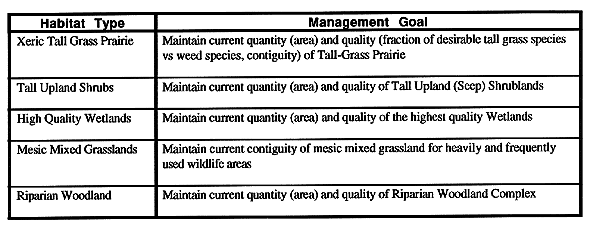
Monitoring Plan
The DQO process focused the diverse planning group on defining a set of specifications for monitoring to assess progress in terms of meeting the management goals. Monitoring requirements had to support diverse decision making, including the assessment of 1) impacts associated with allowing access to the buffer zone by various technicians, scientists, and other groups and 2) habitat, community, weed, and water management activities. In addition, monitoring requirements had to support regulatory requirements such as wetlands protection, migratory bird and threatened and endangered species management. Integrated decision rules were developed from management goals to evaluate whether the diverse management goals were being met. Table III shows the types of decision rules that were developed for one habitat type. These decision rules formed the basis for the subsequent design of the monitoring program. Similar decision rules were developed for each of the other habitat types in Table II.
Table III Example Decision Rule Related to the Management Goals
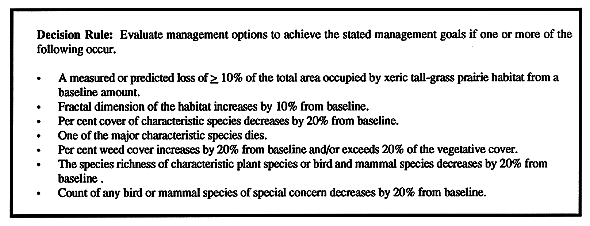
The primary purpose of the decision rules was to provide a basis for the design of the management program and an indication of how data would be used to support decision making. The decision rules and related acceptable decision errors were used as targets for the development of a monitoring plan. This monitoring plan was designed to have long-term ramifications but with short-term results. Therefore, the design was not constructed as time dependent, rather it was constructed as time implicit. For example, thresholds of reasonable annual natural population variation were identified for the area and the species therein, and these were used to govern the degree of fluctuation in measured populations that would trigger a management concern. Therefore, time was considered implicitly, and the degree of variation that was identified as a concern for any given measure was stated independently of time of measurement.
Native vegetation monitoring requirements were considered independently of those for noxious weeds. This was done primarily so that weeds could be considered with respect to vegetative community as well as the site at large to maximize the potential for detecting an increase in weed density. Measurements on native vegetation were implicit to habitat type with the intent of examining observed changes of habitat-specific vegetation simultaneously to maximize the ability to detect changes. Translated into a statistical design, both the weed monitoring program and the native vegetation monitoring program were considered multifactorial, multivariate ANOVA designs with equal sampling effort among community types. An equal sampling effort implies that habitats that comprise a greater proportion of the total buffer zone area are allocated a proportionally greater number of samples, with smaller areas receiving the minimum number of samples needed to observe changes of interest with adequate confidence. The importance of the multivariate design was to minimize the over-inflation of decision errors and to maximize the ability to detect changes when evaluating multiple populations concomitantly.
CONCLUSIONS AND RECOMMENDATIONS
We believe there is a growing need at DOE facilities to take an approach similar to the one described in this paper, whether or not ISO 14000 is formally implemented. The proposed approach is consistent with ISO 14001 EMS and represents a major shift from the current emphasis on compliance with individual regulations and DOE orders. We believe that taking this integrated approach will provide data that will be useful for ecological risk assessments, NEPA, NRDA, and other regulatory drivers such as T&E, migratory bird and wetland protection. In addition, the data generated from an integrated ecological monitoring plan will greatly improve the ability of the DOE facility to evaluate the impact of proposed projects and assess the impacts of past environmental problems. If called on to develop a site-wide environmental impact statement (SWEIS) or other such assessment, the site will be well served by having implemented this approach.
By implementing a quantitative ecological resource monitoring plan, the facility will be able to defensibly document the effect of actions both under DOE control and out of its control (e.g., off-site decisions affecting onsite ecosystems). This information will be especially useful in assessing NRDA damages and demonstrating areas where DOE was, and was not, responsible for observed impacts to ecological resources. Such an approach could reduce DOE's liability to less rigorous, politically driven, assessments of damages.
A recognized problem with ISO 14000 performance assessments and auditing, as well as DOE management assessments, is determining if data are adequate to make definitive evaluations. The quantitative DQO approach surmounts this problem by providing technically defensible data collection designs specifically developed to assess the effectiveness of the management plan and to support management decisions. The authors recognize the difficulty of getting statistical approaches accepted by resource managers. This reluctance to adopt statistical designs is often based on the fear that using purely statistical approaches will eliminate the role of expert judgment and result in nonsensical sampling plans. To avoid this pitfall, it is important to incorporate, rather than replace, professional judgment in the statistical plan.
The need within the DOE Complex to shift to an integrated approach to environmental management and monitoring is supported by the work of Kelly et al. (1996), DOEs Draft "Policy Framework and Implementation Plan for Using Ecological Risk Assessment at DOE Facilities" (DOE 1993), and the underlying premise of ISO 14000. DOE's ecological programs are often wrought with inefficiencies and redundancies, and are not able to provide a comprehensive picture of the status of the ecological resources under their stewardship. SWEISs are developed based on this incomplete picture and, in many cases, have led to requirements for additional work, such as the development of threatened and endangered species management plans and biological resource management plans.
Ecological risk assessments conducted to support CERCLA and RCRA corrective action programs have begun to move away from an individual release site evaluation to an evaluation conducted at a watershed level, ecological exposure unit level, or other larger area. This area-based evaluation is much more consistent with the scale at which ecological monitoring programs should be implemented and is consistent with the habitat type approach presented in the example above. Therefore, we believe the time is right to begin the move toward a comprehensive integrated approach to ecological management and monitoring. Ecological risk assessments should have the benefit of data gathered at a scale that is appropriate for assessing risk, and DOE managers should likewise have the benefit of these data to determine the effectiveness of their ecological management efforts. In addition, by consolidating activities that individually cannot afford to generate all of the data that are needed, we believe that the probability of meeting all parties needs can be increased. Further integration of reporting activities, data management, standard operating procedures development, and data assessment can yield additional savings that can be better invested in an integrated set of monitoring requirements.
In this paper, we have focused on ecological monitoring. In practice, we believe that integration should be targeted for all environmental media using a similar approach. Integrated environmental monitoring, data management, data interpretation, and reporting that incorporate the needs of all environmental regulations affecting each media could result in enormous savings and increase the defensibility of DOE environmental decision making. With the US EPA sponsoring such initiatives as "Project Common Sense" and "Project XL" and with ISO 14000 implementation beginning at many large industries, the time is ripe for reexamining DOE environmental data collection efforts with integration and defensible decision making as worthy goals.
REFERENCES
CEEM Information Services 1995. "International Environmental Systems Update," Volume 2, Number 11 (November 1995).
DOE 1993. ABRAMS, C.W., G.R., BILYARD, R.E. LEWIS, M.D. MCKINNEY, L.R. POND, B.K. WISE, J.A. WISE, "Policy Framework and Implementation Plan for Using Ecological Risk Assessment at DOE Facilities (Draft)", DOE/RL/01830-H16, USDOE Office of Environmental Guidance (June 1993).
OLEARY 1994. "Land and Facility Use Policy," US Department of Energy unnumbered memorandum to Secretarial Officers and Operations Office Managers (December 21, 1994).
KELLY 1996. E. KELLY, R. CUNNINGHAM, D. MICHAEL, and F. VERTUCCI, "Integrated, Comprehensive Ecological Impact Assessments in Support of Department of Energy Decision Making," Los Alamos National Laboratory document LA-UR-96-2594 (1996).
EPA 1994. "Guidance for the Data Quality Objectives Process," Environmental Protection Agency report EPA QA/G-4 (September 1994).