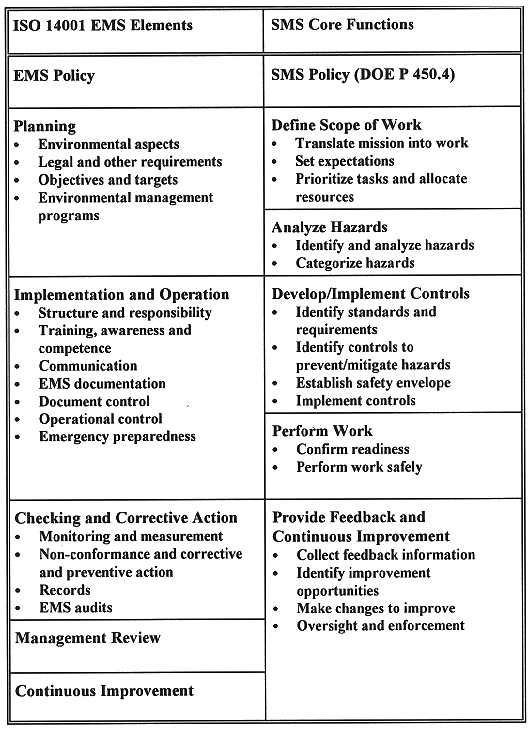
Table I Comparison of ISO 14001 Environmental Management System
(EMS) with DOE Safety Management System (SMS)
Diane Meier
Lawrence Livermore National Laboratory
Fission Energy Safety and Systems Safety Program
Washington Operations
Office
William Roy-Harrison
Department of Energy
Office of
Defense Programs
Germantown, Maryland*
ABSTRACT
ISO 14001, the new international standard, is a tool that public and private organizations can use to improve environment, safety, and health (ES&H) protection and pollution prevention. The standard's specifications for environmental management systems (EMS) are intended to assure integration of ES&H considerations into the mainstream of operations. There is no overall federal policy, nor is there any Department of Energy (DOE) policy, specifically on the use of ISO 14001 for federal facilities. However, DOE has clearly indicated its support for the use of standards developed by voluntary, private sector, consensus bodies, as is evident in numerous policies and requirements. In addition, DOE's quality assurance program requires implementation of management systems. What is new for DOE is the application of the management system approach to ES&H programs. The Department issued a new integrated safety management systems (SMS) policy in October 1996. While the SMS policy does not reference ISO 14000, there are many parallels between the SMS and the EMS. Both are based on the management system approach that is often referred to as "plan, do, check, act." The SMS and EMS have the same fundamental elements, although there are some differences in terminology and categorization of elements. Both involve work planning, analysis of hazards and impacts, operational controls, feedback, and improvement. DOE already has in place many of the elements of the EMS and the SMS. However, linkages between existing ES&H programs and integration with operations could be improved. Whether it is called an EMS or an SMS, the management system approach would enable DOE sites to improve ES&H integration. Work planning and execution would proceed with full consideration of ES&H objectives and targets. The adverse impacts and costs of violations, occurrences, and accidents would be avoided and/or mitigated more effectively, and continual improvement would be assured.
INTRODUCTION
Public and private sector organizations continue to be challenged by the need to improve the integration of facility operations with environmental, safety, and health (ES&H) protection and pollution prevention. ES&H programs tend to be isolated from the mainstream of site operations and too focused on regulatory compliance. Work planning and execution often proceed without sufficient consideration of how to protect the environment and public and worker health and safety or how to prevent pollution. When ES&H is an add-on or an afterthought, there is more potential for adverse consequences and increased costs that could have been avoided.
This paper examines the opportunity for DOE to improve ES&H integration with operations by implementing ISO 14001, the new international standard for environmental management systems (EMS). In addition, the paper addresses the possibilities for implementing ISO 14001 in conjunction with the Department's new policy for integrated safety management.
ISO 14001 ENVIRONMENTAL MANAGEMENT SYSTEMS
ISO 14001 is the international specification standard for environmental management systems that was issued by the International Organization for Standardization (ISO) in September 1996 (ISO, 1996). It is the first of a series of voluntary environmental standards and guideline documents being developed by ISO, which is a nongovernmental organization composed of the national standards bodies for 120 member countries, including the United States through the American National Standards Institute. U.S. participants in the development of the ISO 14000 standards include government agencies, major corporations, such as IBM, Exxon, and Alcoa, and trade associations, such as the Chemical Manufacturers Association and the American Petroleum Institute.
There is not yet an overall federal policy or DOE policy on the use of ISO 14001. However, there are many existing DOE requirements that would seem to support DOE adoption of ISO 14001. DOE is committed to the use of standards developed by voluntary, private sector, consensus bodies, as is evident in numerous policies and requirements. In addition, DOE's quality assurance rule (10 CFR 830.120) and quality assurance order (5700.6c) require implementation of management systems. Another driver for ISO 14001 at federal facilities is the National Technology Transfer and Advancement Act of 1995 (Public Law 104-113) signed by the President in March 1996. This new law requires federal agencies to use applicable technical standards developed by voluntary, private sector, consensus bodies or explain to the Office of Management and Budget why the use of the standard is impractical or inconsistent with applicable law.
Several DOE sites are already proceeding with implementation of ISO 14001. For example, DOE's Savannah River Site in South Carolina and Kansas City Plant in Missouri are actively implementing ISO 14001 environmental management systems, and other sites are considering it. An ISO 14001 Working Group was established in August 1996 by the Energy Facilities Contractors Group (EFCOG), an organization of the prime contractors responsible for managing and operating DOE sites. EFCOG members include Allied-Signal, Lockheed Martin, Bechtel, Kaiser-Hill, and the University of California. The interest in ISO 14001 is consistent with the EFCOG mission, which is "to promote excellence in all aspects of the operation and management of DOE facilities in a safe, environmentally sound, more efficient and cost-effective manner through the ongoing exchange of information" (EFCOG, 1996).
DOE INTEGRATED SAFETY MANAGEMENT
As ISO 14001 was being finalized in September 1996, the Department was completing a new policy for integrated safety management systems. One of the drivers for this initiative was the Defense Nuclear Facilities Safety Board's Recommendation 95-2, which includes the following subpart:
The Department accepted this recommendation not only for major defense nuclear activities, but for all activities at DOE facilities. DOE issued the Implementation Plan for Integrated Safety Management (DOE, April 1996) to define the objective, guiding principles, and core functions of safety management systems (SMS). The Safety Management System Policy, DOE P 450.4, officially establishes the Departmental policy on SMS components (DOE, October 15, 1996). In addition, DOE is developing SMS guidance. Initial drafts of the guidance do not address the possibilities of implementing the SMS in conjunction with the ISO 14001 EMS. The relation between the SMS and the EMS may evolve through implementation at the individual DOE sites. For example, the Savannah River Site is working to implement its EMS in conjunction with its SMS.
USING MANAGEMENT SYSTEMS FOR ES&H INTEGRATION
DOE sites already have in place many of the EMS and SMS elements. To determine what improvements are needed, a "gap analysis" should be conducted for each DOE site's operations. This is recommended as the first step toward conformance with ISO 14001, and it also makes sense for SMS implementation.
Table I lists the elements of an EMS next to the SMS core safety functions, showing that, while there are some differences in terminology and categorization of the elements, there are many similarities between the two systems. Both involve planning, analysis of potential impacts or hazards, operational controls, and feedback to assure continual improvement, illustrating a systematic approach often referred to as "plan, do, check, act." It is important to note that both the EMS and the SMS could be designed to encompass all ES&H activities, regardless of the fact that one uses the term environmental while the other uses the term safety.
Table I Comparison of ISO 14001 Environmental Management System
(EMS) with DOE Safety Management System (SMS)
The SMS Policy and Implementation Plan state that the term safety is used "synonymously with environment, safety and health (ES&H) to encompass protection of the public, the workers, and the environment." However, the Policy and Plan are very heavily focused on safety and health, and there is no explicit discussion of environment protection or pollution prevention. Unless more attention is given to environment, it may be difficult for the SMS to achieve real ES&H integration. One possibility is to implement the SMS in conjunction with ISO 14001 in order to assure that environment is considered as well as safety and health.
ISO 14001 defines environment as including the surroundings in which an organization operates, including people, as well as flora and fauna. Thus, the standard requires that the EMS cover public health and safety and the environment. As for workers, ISO 14001 states that:
For DOE sites, occupational health and safety would be needed in an EMS, just as it would be in the SMS, in order to assure full ES&H integration.
The management system approach has real potential for improving the integration of ES&H with operations. However, that potential may go unrealized unless there is a concerted effort to assure that integration really occurs. To understand the possibilities, it is useful to walk through the elements of a management system for ES&H.
POLICY
The EMS environmental policy is defined in ISO 14001 as a statement by the organization of its intentions and principles in relation to its overall environmental performance. The EMS policy is intended to provide a framework for action and for the setting of environmental objectives and targets. ISO 14001 requires that the EMS policy include a commitment to continual improvement and prevention of pollution.
The Department's policy for integrated safety management, stated in DOE P 450.4, could be a good starting point for an SMS/EMS:
This SMS policy would need a specific commitment to prevention of pollution in order to conform to ISO 14001 requirements. Also, it is likely that each DOE site would need to develop its own policy that would address its particular mission and environmental conditions and that would be responsive to the community and State where the site is located and to other stakeholders.
PLANNING
The EMS planning process is intended to assure that the organization fulfills its environmental policy. As shown in Table I, EMS planning corresponds with the SMS functions of defining the scope of work and analyzing hazards. The EMS planning process involves consideration of"environmental aspects," which are the organization's activities, products, and services, in order to determine whether they could cause significant impacts on the environment. This is comparable to the SMS functions of translating mission into work and identifying, analyzing, and categorizing hazards related to the work.
DOE operations that could affect the environment or the health and safety of workers are analyzed in the process mandated by the National Environmental Policy Act of 1969, as amended (NEPA), and also in the safety analysis process. NEPA requires that the impacts of proposed "major federal actions significantly affecting the human environment" be analyzed in environmental impact statements (NEPA, 1969). Federal agencies have been conducting NEPA impact analysis on proposed projects and programs for about 27 years. ISO 14001 does not require organizations to involve stakeholders in the impact analysis process or disclose the results. NEPA, however, requires an open process with extensive opportunities for public participation and full disclosure of the results of the environmental impact analyses. Thus, ISO 14001 requires less than federal facilities are already doing through the NEPA process.
In addition to the NEPA process, DOE conducts safety analysis to assess the hazards of its operations. The integrated safety management system approach recognizes the need for flexibility in safety systems. The nuclear safety approach for highest hazards may not be appropriate for all types of work. For example, environmental restoration and research and development activities may need different approaches to safety management than assembly or disassembly of weapons. Safety systems should be tailored to the actual work being performed. There is increasing emphasis on enhanced work planning as a means to tailor the safety systems.
Enhanced work planning is a recent DOE initiative that focuses on prevention of accidents through early identification and mitigation of hazards. Multidisciplinary teams, which include line managers, ES&H professionals, and the workers involved in the operation, plan how the hazards associated with a task can be controlled or prevented. There have been numerous demonstrations of this approach (DOE, October 1996), but so far there is no guidance as to when to undertake this kind of enhanced work planning effort. An EMS/SMS could determine the types of activities that need enhanced work planning. In addition, the EMS/SMS could assure that after enhanced work planning is completed, work objectives are established, responsibility is assigned, resources are allocated, and performance is measured and evaluated.
It is a continuing challenge at DOE sites to develop linkages between the existing ES&H programs, such as NEPA, pollution prevention, and safety analysis. These programs have tended to be implemented independently, and only minimal efforts are made to establish linkages between them. An EMS/SMS could set up mechanisms to assure that people in the different ES&H programs communicate and coordinate with each other, as well as with line managers and workers, in order to more effectively mitigate and avoid impacts. It will be important for the ES&H professionals to work closely with each other to identify potential significant impacts from a particular project or operation, and assure that resources are applied to mitigate those impacts and that progress is measured and evaluated.
For example, when a NEPA document identifies significant impacts related to routine releases to the air or surrounding water bodies, the EMS/SMS could assure that options for pollution prevention are assessed and that action is taken. The assessment would determine if it is feasible to reduce emissions by adjusting operations or installing technology. Ideally, the analysis of pollution prevention options would be considered in the NEPA process. The Environmental Protection Agency (EPA) has issued guidance on the integration of NEPA and pollution prevention activities (EPA, 1993). However, NEPA is all too often a paper exercise without any follow-up activities focused on pollution prevention. An EMS could set objectives and allocate responsibility and resources to assure that NEPA and pollution prevention activities actually result in operational changes that reduce routine emissions.
An EMS/SMS could assure that potential impacts and hazards identified during the NEPA or safety analysis processes or through enhanced work planning are carefully considered in setting objectives and targets for operations. ISO 14001 requires that environmental objectives and targets reflect consideration of operational aspects that could have significant environmental impacts. While this might seem to be the obvious way to develop ES&H performance measures, one can envision organizations taking different approaches. For example, an organization might decide to "pick the low-hanging fruit," that is, focus its performance measures on operational aspects with relatively insignificant impacts in order to demonstrate improvement. That kind of strategy would not be consistent with the ISO 14001 requirement to consider significant impacts in setting objectives and targets.
ES&H performance measurement is also required in the SMS. The proposed revision to the DOE Acquisition Regulation for management and operation contracts requires that the SMS "establish, document, and implement safety performance objectives, performance measures and commitments in response to DOE program and budget execution guidance..." (DOE, October 10, 1996). This connection between performance objectives and resources in the DOE Acquisition Regulation is also made in ISO 14001. EMS planning includes development of an "environmental management program" that designates responsibilities and the means and time-frame for achieving objectives and targets. This is similar to the SMS functions of prioritizing tasks and allocating resources.
Finally, the EMS identification of legal and other requirements is equivalent to the SMS identification of standards and requirements. ISO 14001 designates this as a planning activity, while the SMS Implementation Plan includes it as part of developing and implementing controls. This element of the EMS/SMS should build on the progress already made with recent DOE efforts to clarify and consolidate the definition of requirements for operations. In particular, the DOE "work smart" standard process could be used to yield a set of requirements tailored to the work activities and associated hazards.
IMPLEMENTATION AND OPERATION
Both the EMS and the SMS emphasize the importance of operational controls in the system. ISO 14001 requires an organization to establish specific conditions to control operations that could have significant impacts. The EMS documents the operational procedures for normal operations and for accident and emergency situations. The EMS also assures that roles, responsibilities, and authorities for operations are defined, documented, and communicated.
Operational controls, procedures, and accountability are also key elements of SMS implementation. One of the guiding principles in SMS Policy 450.4 is that "administrative and engineering controls to prevent and mitigate hazards shall be tailored to the work being performed and associated hazards." There is clear recognition that safety management mechanisms could differ from facility to facility and activity to activity, based on the hazards and work performed. The SMS Policy also provides guiding principles on line management responsibility for safety, clear roles/responsibilities, and competence commensurate with responsibility. Designating roles and responsibilities is especially important for DOE because of the complexities involved in contracts for operating the sites.
CHECKING AND CORRECTIVE ACTION
ISO 14001 requires that the EMS measure and monitor performance against objectives and targets. This checking of the system can be done through internal reviews and/or third party audits. Other standards in the ISO 14000 series provide guidelines for environmental auditing. The ISO 14000 auditors will be registered through a process being developed by the American National Standards Institute (ANSI) and the Registrar Accreditation Board (RAB). ISO 14001 audits will focus on maintenance and improvement of the EMS, which is quite different from the traditional environmental compliance inspections conducted by regulators. There are many outstanding questions about how the ISO 14001 audits might be used in the regulatory system. The answers are likely to evolve over time as ISO 14001 is implemented in different states and EPA regions. The results of EMS audits are to be provided to management and used to improve the EMS. If nonconformances are found by means of internal review or audit, the EMS has procedures for defining responsibility and authority for mitigating any impacts caused and for undertaking corrective and preventive action.
The SMS also requires collection of feedback information, oversight and enforcement and identification of improvement opportunities. As part of the DOE contract reform initiative, performance measures are being added to all new contracts. The DOE Acquisition Regulation specifies that the SMS must document and implement safety performance objectives and performance measures. Thus, all DOE sites will need to assure that their performance measures conform to those requirements. Some DOE sites are already implementing performance measurement systems with ES&H objectives and measures. For example, the University of California contract with DOE contains ES&H performance measures for Lawrence Livermore, Lawrence-Berkeley, and Los Alamos National Laboratories.
CONCLUSION
The EMS and the SMS both focus on the management system as a means of assuring continual improvement in ES&H protection. Different approaches to the EMS and SMS are likely to be taken at the various sites, due to the differences in missions and stakeholders. The EMS and SMS could essentially be one integrated system - an EMS/SMS. Or an EMS could be a subsystem within the SMS. While it is too early to know exactly how ISO 14001 or integrated safety management will be implemented at DOE sites, it is important to start considering the possibilities.
By taking the management systems approach, the Department would be more systematically integrating ES&H with site operations. Work planning and execution would proceed with full consideration of ES&H objectives and targets. The adverse impacts and costs of violations, occurrences, and accidents would be avoided and/or mitigated more effectively, and continual improvement would be assured.
REFERENCES
* This work was performed under the auspices of the U.S. Department of Energy and the Lawrence Livermore National Laboratory under Contract W-7405-Eng-48.