Fig.
1. SRS ISO 14001 EMS Impementation
Ronald L. Peterson
Department of Energy
Savannah
River Operations Office (DOE-SR)
H. Steve Etheridge
Westinghouse Savannah River Company
(WSRC)
ABSTRACT
DOE's Savannah River Site (SRS) covers 310 square miles and employs approximately 16,000 people. The primary mission for the site has undergone a significant change from the production of nuclear materials for the nation's strategic weapons program to the protection and restoration of the environment at SRS. Our goal is to become a leader in restoring, stabilizing, protecting, and enhancing the environment. To achieve this goal, SRS has begun implementation of an environmental management system complying with the ISO 14001 Standard. SRS will fully integrate the system into the management structure and obtain recognition that our EMS complies with the standard. It is SRS's intention to be in a position to obtain registration to the ISO 14001 standard should the DOE decide to do so. This paper describes SRS's decision to implement the environmental management system, the action plan for implementation, and challenges in their ongoing implementation process.
DECISION TO IMPLEMENT ISO 14001
SRS has an established culture of quality as a result of years of emphasis on quality management systems through NQA-1, DOE Order 5700.6, and ANSI/ASQC E4. Many of these systems are directly transferable to ISO 14001; for example, collection and evaluation of environmental data, records management, and corrective and preventive action systems. In early 1995, Westinghouse Savannah River Company (WSRC), the management and operating contractor for the SRS, began studying ISO 14001 and the potential benefits that implementation of the standard could provide to the environmental management of the SRS. WSRC decided that SRS could enhance its environmental management capability and performance and its credibility in the eyes of its stakeholders and regulatory authorities. Consistent with this decision, a 2-day workshop was held in August 1995 to introduce ISO 14001 to key personnel from WSRC, DOE-SR, other government agencies and subcontractors with a presence at SRS, and DOE personnel from other sites and national laboratories. At the workshop, it was concluded that many of the components, i.e., organization structure and practices and procedures, required to implement the standard were already established. However, gaps existed and moderate effort would be required to develop, implement, and document the environmental management system prescribed by ISO 14001.
Action Plan For ISO Implementation
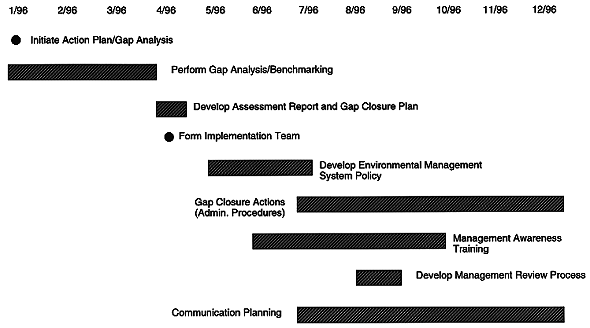
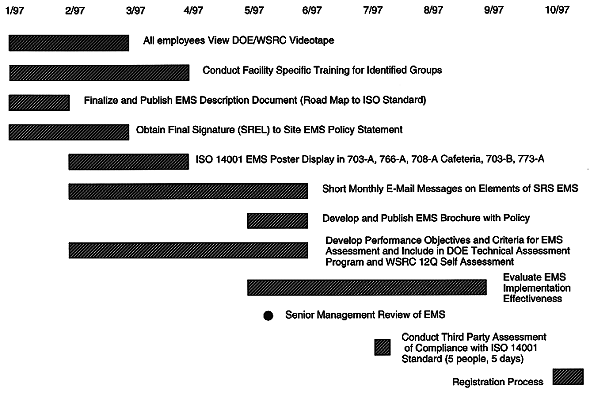
The activities/schedule for modification to or development of the EMS is shown in the attached chart (see Fig. 1).
Fig.
1. SRS ISO 14001 EMS Impementation
Subsequent to the August, 1995, ISO 14001 workshop, the Environmental Protection Department of Environmental, Safety, and Health Division took responsibility for pursuing implementation. The Department of Energy Environmental Compliance Division quickly partnered with WSRC in the endeavor. September, October, and November were spent reviewing workshop results and comments and attending training. The team leader, along with others in various site organizations, attended off- site seminars for training. Also, during this period, a series of meetings were held to discuss the value of ISO 14001 to site organizations. One feature of environmental programs at SRS which has proven useful is the Central Environmental Committee (CEC). The committee, composed mainly of environmental coordinators from each department/group (some 40 from around the site) provided an excellent forum to kick off the effort. After consideration of CEC input, a plan to perform a "gap analysis" was developed. A benchmarking team was formed in early January, 1996. Team membership was comprised primarily of selected environmental coordinators. Other functional group representatives were added, including quality assurance.
The first order of business for the team was to formulate the "how-to" of the analysis. The team went to work to develop "lines of inquiry" (LOI) for each of the ISO elements/sub-elements. These LOI's were intended to assist the team analyze from an SRS business perspective. The LOI's, however, are multi-functional such that other sites could adopt them. Some other Westinghouse managed DOE sites have, in fact, used them.
It is important to point out that the team adopted a "top down" approach to the gap analysis. This was emphasized throughout the process. Due to the very complex nature of the site, to analyze each company and agency at all levels initially would have bogged down the process very quickly. The intent from the beginning was to analyze from a site-wide, but truly integrated, perspective. Focusing on the "top" levels first without excruciating details proved to be a challenge! Determining gaps at the very highest level initially is important. Lower tier gaps tend to be more visible and identifiable as the process matures.
A second important part of our analysis methodology was to match existing environmental policy, planning, and program activities with the EMS elements. The best example of this is in the area of planning. Because SRS is a federal facility, it falls under the regulatory purview of the National Environmental Policy Act(NEPA). In short, NEPA is intended to ensure that federal facilities/agencies assess the environmental impact of project-type activities. Due to the exemplary NEPA program in place at SRS, much of the letter and intent of the standard is already being met. Some NEPA experts would say that the process brings total conformance with ISO 14001 planning. This is a subject for another time (and paper). The benchmark team has concluded that the NEPA strategy at SRS fulfills a significant part, but not all, of the ISO 14001 requirements for planning. One identified "gap" is a description process at the senior management level for determining "aspects". The process can be simple or complex depending upon the business. The bottom line for SRS senior management, however, was to reach consensus on activities that should receive the most scrutiny.
The gap analysis took four months to complete. The team met weekly to review and status findings and discuss matters needing attention. A technique that was used to expedite the process was to organize into subgroups. The initial analysis of each element, e.g., policy, was assigned to a group of 3 or 4. Total team composition was 16. Once the 3-4 person group did its initial assessment, conclusions were presented to the entire team. Consensus was reached, though certainly after much discussion and deliberation. The team determined early in the process that to have total value, "gap closure" actions would be defined as part of the results. These actions were included in the ISO 14001 Environmental Management System Assessment Report and Closure Plan issued in May, 1996. This report to senior management, including the WSRC President, included the benchmark form with LOI's and assessor signatures. Gap closure actions were assigned completion dates and responsible organizations should the decision be made to proceed with actions necessary to come into conformance.
On May 30, 1996, the Vice President and General Manager of Environmental, Safety, and Health issued a formal memorandum to all senior management stating plans to proceed to conformance. The Benchmark Team leader then assumed the role of Implementation Team Lead. Within the next month, the Implementation Team was formed. For obvious reasons, this team included several members of the Benchmarking Team.
Just as with the Benchmarking Team, the Implementation Team was organized into subgroups. Several factors influenced this including: activities requiring the greatest change, organizational relationship, and personal preferences of team members. The primary subgroups were 1) Policy 2) Facility Specific Training 3) Communication/Awareness 4) Management Review.
By September 30, 1996 actions required for gap closure had been completed or implemented as appropriate. Obviously, the EMS is a dynamic, living process which causes ongoing activities. The cause and effect, or continuous improvement properties of the EMS can only be judged over time. The thrust of our effort now is to continue emphasis on communication and training. A plan for each of these ongoing efforts has been developed and implemented. A significant part of the communication plan is a video production describing management commitment and some basics of the EMS. Featured in the 12 minute video are Dr. Tara O'Toole (DOE) and Mary McKiel (EPA). These strong advocates of environmental management system participated at the request of Westinghouse's Jim Gallagher. Mr. Gallagher is President, Westinghouse Government and Environmental Services Company. Mr. Gallagher is also featured in the video as his corporate level emphasis is a key driver in the success of the EMS at Savannah River.
The next immediate challenge to implementation is the monitoring of progress especially in training and awareness. The development of an environmental program self-assessment, already part of WSRC business policy, will greatly aid this effort. This formal site-level process meets and even exceeds ISO 14001 EMS audit requirements. Also, experience with the management review process is essential to determine just how functional and beneficial it is. SRS has had many methodologies and techniques for management review. Bringing these together into focus will take SRS full cycle in the improvement process.
A decision to seek third party registration is yet to be made. Several factors will weigh in this decision, of course. As a federal facility with mainly a non-commercial purpose, the financial payback is not as significant as perhaps for outside companies. Credibility with stakeholders, including the regulatory agencies, is important, but not tied directly to a monetary benefit. This, at present, is the driver for implementing ISO 14001.
CONCLUSION
Savannah River Site's program to develop and implement ISO 14001 is well down the track. Ultimate success will be determined by near term audits (self-assessments and DOE/Westinghouse). One such implementation assessment was conducted in August of last year. SRS management expects that its EMS will result in performance improvement as told by various indices measured and monitored at the site. These are real, objective-related improvements, not performance control mechanisms. The desired outcome of ISO 14001 at SRS is an environmental culture enhancement - positive impacts on the environment through our value for change and continuous improvement.