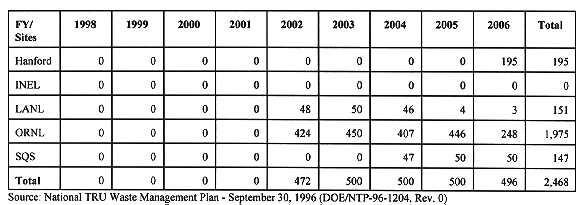
Table I Number of Annual RH-TRU Waste Shipments
Michael R. Brown
U.S. Department of Energy-Carlsbad Area
Office
Carlsbad, NM
J. Carlos Lopez, P.E.
Rogers & Associates Engineering Co.
Salt
Lake City, UT
Joe P. Harvill
Advanced Sciences Inc.
Albuquerque, NM
ABSTRACT
The U.S. Department of Energy (DOE) plans to dispose of over 2,200 m3 of remote- handled transuranic (RH-TRU) waste by the end of fiscal year 2006. In support of this goal, efforts are ongoing for the Waste Isolation Pilot Plant (WIPP) to begin receiving RH-TRU waste in October 2001 from Los Alamos National Laboratory (LANL) and Oak Ridge National Laboratory (ORNL). An RH-TRU System Assessment that identifies the technical and programmatic challenges associated with RH-TRU waste disposal at WIPP was issued in November 1995. This paper discusses preparation, transportation, and disposal of RH-TRU waste in light of recently published goals in the National Transuranic Waste Management Plan. The Waste Management Plan calls for the certification of RH-TRU waste at LANL and ORNL in 2001.
The RH-TRU System Assessment has identified necessary measures for characterizing and repackaging waste, certifying the RH-72B transportation cask, and preparing the WIPP facility to receive RH-TRU waste. This paper finds that although the current status of activities in these areas can support initial disposal in 2001, sustained, long-term throughput will require greater financial commitment at RH-TRU waste storage sites.
INTRODUCTION
On September 30, 1996 the U.S. Department of Energy-Carlsbad Area Office (CAO) issued the National TRU Waste Management Plan (NTWMP) (1) as part of an aggressive initiative to manage and prepare eligible TRU waste for disposal at the WIPP, a deep geological repository near Carlsbad, New Mexico. For the purpose of the WIPP mission, TRU waste has been defined in the WIPP Land Withdrawal Act (2) as waste containing more than 100 nanocuries of alpha- emitting transuranic isotopes per gram of waste, with half-lives greater than 20 years, except for:
TRU waste is divided into two types, contact-handled (CH) and remote-handled (RH). RH-TRU waste is waste that, when packaged, exceeds a container surface dose rate of 200 mrem/hr. RH-TRU waste typically results from the decontamination of hot cells or from test specimens of fissionable material containing transuranics, which in turn results in higher radiation fields.
Before publication of the NTWMP, the CAO had issued the Remote-Handled Transuranic System Assessment (3). This assessment identifies the technical and programmatic issues related to the disposal of RH-TRU at WIPP and serves as a reference point for the implementation of activities to meet the October 2001 milestone. It also serves as a central reference for many of the requirements and limitations associated with RH-TRU disposal, most importantly those contained in the WIPP Land Withdrawal Act (LWA) of 1992 (2). The LWA established the total volume capacity for WIPP at 6.2 million cubic feet but did not specify the specific breakdown of each waste type (RH-TRU and CH-TRU) that can be disposed of within this limit. It also identified the following important limits concerning the disposal of RH-TRU waste at WIPP:
The NTWMP sets forth objectives for disposal of RH-TRU waste at WIPP beginning in October 2001. It also calls for the certification and development of a transportation system to support the disposal of 433 m3 of RH-TRU waste from LANL and ORNL in fiscal year 2002 according to the limits set forth in the LWA.
Although the NTWMP presents viable objectives, it is clear that efforts to dispose of RH-TRU waste at WIPP will need to be intensified, especially in the area of characterization. Much of the eligible RH-TRU waste from ORNL, Hanford, and other sites remains to be characterized and packaged in final form suitable for disposal at WIPP.
DEVELOPMENTS IN THE CERTIFICATION PROCESS
The WIPP Waste Acceptance Criteria (WAC) (4) define the preliminary acceptance criteria, requirements, and compliance methods to certify RH-TRU waste for disposal at WIPP. The criteria are divided into five properties:
| Container and Physical Properties | (WAC section 3.7) |
| Nuclear Properties | (WAC section 3.8) |
| Chemical Properties | (WAC section 3.9) |
| Gas Generation | (WAC section 3.10) |
| Data Management | (WAC section 3.11) |
The WAC provides descriptions, specifications, and limits associated with the waste that can be disposed of at WIPP. Thus, although the WAC is not intended to be a "how to" document, it establishes a framework for RH-TRU certification.
The TRU Waste Characterization Quality Assurance Program Plan (QAPP) (5) is also an essential element of the certification framework for WIPP-eligible RH-TRU waste. The QAPP establishes a performance-based program where quality assurance objectives are defined for analytes associated with WIPP-eligible TRU waste in the areas of measurement, sampling, analysis, and data management. The TRU Waste Characterization Sampling and Analysis Methods Manual (6) identifies testing, sampling, and analytical methods accepted by the DOE to meet the requirements of the QAPP and the Waste Analysis Plan (7) for all WIPP-eligible TRU waste.
CHARACTERIZATION CONSIDERATIONS
Recent developments in various technologies for nonintrusive measurement of radionuclide and waste material content could make it possible to effectively characterize the majority of the RH-TRU waste in the DOE complex. These technologies, however, remain in the demonstration phase and will require additional development for RH-TRU characterization.
The need for hot cells at the current waste sites is also an issue of some concern. The handling, characterization, and repackaging of RH-TRU waste are expected to require a significant amount of hot cell time because of the waste's activity level. The availability of hot cells at the waste sites is limited because other high-priority programs use them extensively. RH-TRU waste sites might be able to use hot cells in facilities that have been deactivated and are not in use. The use of deactivated facilities, however, will most likely require the renewal of safety analysis documentation. This process is often lengthy and can be quite involved depending on the condition of the intended facility. It is anticipated that the October 2001 milestone will require that the near-term eligible waste sites use existing active hot cells to accomplish the necessary characterization and packaging of their RH-TRU waste. Those sites will thus need to adjust their priorities that govern hot cell use.
In fiscal year 1996, the CAO initiated a comprehensive evaluation of mobile systems for characterizing WIPP-eligible TRU waste. The results were published in the Mobile Systems Capability Plan (8). The research conducted in support of this plan indicated that, although mobile system technology has advanced significantly in recent years, it is more directly applicable to CH-TRU waste characterization than RH-TRU waste characterization. Mobile systems are typically designed to handle lower-level radioactive wastes such as CH-TRU waste, whose low activity does not require the use of robotics or extensive shielding. Thus, while mobile systems may have application for characterizing RH-TRU waste, they require a substantial amount of design, engineering, and testing before they will be operational.
TRANSPORTATION OF RH-TRU
Development of the RH-72B cask is an essential milestone toward fulfilling the DOE's 2001 goal. The RH-72B cask and RH canister constitute the packaging baseline of the WIPP RH-TRU disposal program. The safety analysis report for packaging has been submitted to the Nuclear Regulatory Commission (NRC) for review. This unit is very similar in design to the NuPac 125B cask certified by the NRC and could be transported over road or rail. The RH-72B cask will be an NRC Type B approved package. The cask is expected to fall within the limits allowed for tractor trailer transport without an oversize permit. Progress on the certification of the RH-72B cask is on schedule to support the October 2001 milestone. It is scheduled for completion in 2000, assuming that qualification tests are not required for its certification. This assumption is made on the basis of the performance and certification of its predecessor, the NuPac 125B cask. The DOE plans on 2,468 shipments of RH-TRU waste to WIPP between 2002 and 2006. The breakdown of this plan is contained in Table I.
Table I Number of Annual RH-TRU Waste Shipments
Under the current disposal baseline each shipment of RH-TRU waste will consist of a single RH canister inside an RH-72B cask. The RH canister is a DOT-Type A cylindrical carbon steel receptacle and is designed to be vented using conventional carbon filters. It weighs approximately 998 kg (2,200 lbs) and has a maximum payload of approximately 2,631 kg (5,788 lbs) and has an available internal volume of about 0.89 m3 (31 ft3), with a corresponding external volume of about 1.0 m3. Its nominal dimensions are approximately 3.1 meters long (10 feet) and 0.66 meters (2.25 feet) in diameter. The RH canister can accommodate direct loading of waste articles or prepackaged drums of waste and can hold up to three 55-gallon drums of RH-TRU waste.
Although manufacturing capabilities for this canister are readily available, use of the RH canister is not sufficiently standardized in industry to make its fabrication costs low. In addition to its cost ($6,000 to $10,000), the canister has a welded closure which must be tested to demonstrate a correct seal. The specialized equipment required for this closure system is expected to increase handling costs.
NECESSARY PREPARATIONS AT WIPP FOR DISPOSAL OF RH-TRU WASTE
The WIPP disposal system involves both surface and underground operations. WIPP is to receive RH-72B casks in the RH-TRU waste handling bay, where the canisters will be safely extracted and transferred underground. RH canisters will be emplaced along the ribs of the storage rooms using a special underground emplacement device. The process was demonstrated in 1988 using non-nuclear materials; the exercise showed that a single canister could take up to 8 hours to unload, handle, and emplace.
There are also scenarios relevant to the disposal rates for RH-TRU and CH-TRU waste that have undergone additional consideration in support of the NTWMP. The current WIPP disposal baseline calls for RH-TRU waste to be emplaced in the ribs of the WIPP underground storage rooms and, once closed, CH-TRU waste to be emplaced in the rooms. Since disposal of CH-TRU waste is to begin in November 1997, significantly before receipt of RH-TRU waste, additional consideration has been given to the mining and emplacement strategy to ensure that the planned throughput for CH-TRU waste (see Table I) does not affect the ability to sustain RH-TRU disposal as necessary.
The WIPP relies on one waste-handling shaft which must be shared by both CH-TRU and RH-TRU operations. To ensure the availability of this shaft without delays after the October 2001 period, plans are to adjust operational shifts so that RH-TRU canisters are handled during travel times when there is less demand for CH-TRU emplacement. A demonstration exercise conducted in 1988 raised concerns about the reliability and continuous operation of the RH-TRU equipment; in cases where equipment was susceptible to single-point failures, planned waste handling practices have been modified to exclude the use of such equipment. Unloading operations for RH-TRU and CH-TRU waste will occur as soon as possible after delivery of the shipments; however, emplacement activities are not expected to create significant conflicts or delays. In support of surface operations, mining practices and waste-handling methods in the WIPP underground continue to be refined to ensure the desired throughput for both CH-TRU and RH-TRU waste.
ANNUAL VOLUME OF WASTE TO BE PROCESSED
The DOE plans to dispose of 2,209 m3 of RH-TRU waste at WIPP by the end of fiscal year 2006. The breakdown of this plan is contained in Table II.
Table II Volume of RH-TRU Waste Processed Annually (m3)
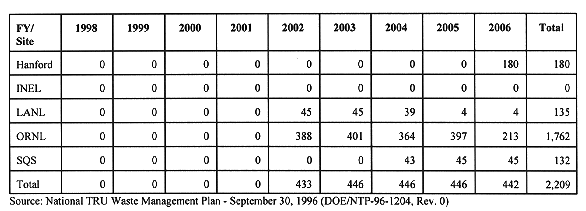
According to the NTWMP, most of the RH-TRU waste to be disposed of at WIPP between 2001 and 2006 will originate at ORNL (see Table II). However, LANL has eligible RH-TRU waste that could also come to WIPP in support of the October 2001 milestone. LANL has taken proactive steps to certify approximately 17 RH-TRU waste canisters according to the WAC Revision 3 in order to have waste available as soon as WIPP is able to receive it. While there have been some changes in acceptance requirements, what is known about the LANL waste is anticipated to be sufficient to meet the current acceptance requirements (WAC Revision 5) and allow this waste to come to WIPP soon after October 2001.
CONCLUSION
The NTWMP affirms the need to intensify efforts to prepare for disposal of RH-TRU waste at WIPP. The October 2001 milestone is an essential element in ensuring that the RH-TRU waste sites fulfill commitments to their host States as well as alleviate the growing need for on-site storage capacity at the waste sites. While the fiscal year 2002 objective remains viable, it is important to note that significant steps in the area of program integration and characterization are necessary.
REFERENCES