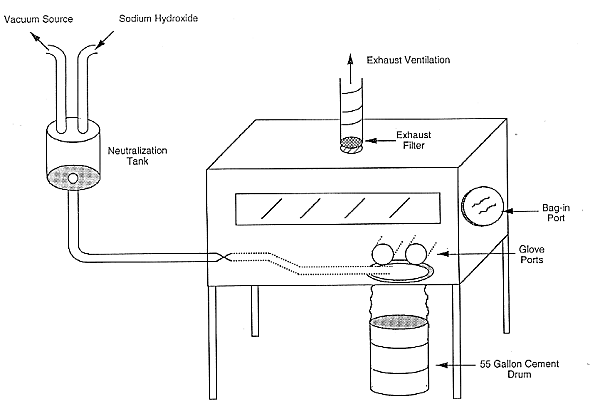
Fig. 1. Bldg. 774
bottle box.
Richard P. Dunn and Ricky A. Wagner
Rocky Mountain
Remediation Services (RMRS)
ABSTRACT
In support of the historic weapons production mission at the Rocky Flats Environmental Technology Site (RFETS), several liquid waste treatment processes were designed, built and operated for treatment of plutonium-contaminated aqueous waste. Most of these processes ultimately resulted in the production of a cemented wasteform. One of these treatment processes was the Miscellaneous Aqueous Waste Handling and Solidification Process, commonly referred to as the Bottlebox process. Due to a lack of processing demand, Bottlebox operations were curtailed in late 1989. Starting in 1992, a treatment capability for stabilization of miscellaneous, Resource Conservation and Recovery Act (RCRA) hazardous, plutonium-nitrate solutions was identified. This treatment was required to address potentially unsafe storage conditions for these liquids. The treatment would produce a TRU wasteform. It thus became necessary to restart the Bottlebox process, but under vastly different conditions and constraints than existed prior to its curtailment.
This paper provides a description of the historical Bottlebox process and process controls; and then describes, in detail, all of the process and process control changes that were implemented to convert the treatment system such that a Waste Isolation Pilot Plant (WIPP) and a Land Disposal Requirements (LDR) compliant wasteform would be produced. The rationale for imposition of LDRs on a TRU wasteform is discussed. In addition, this paper discusses the program changes implemented to meet modern criticality safety, Conduct of Operations, and Department of Energy Nuclear Facility restart requirements.
INTRODUCTION
The Rocky Flats Environmental Technology Site (RFETS), located 15 miles northwest of Denver, Colorado, is a government-owned, contractor-operated facility that was part of the nationwide Department of Energy (DOE) nuclear weapons production complex. Prior to 1992, the sites mission was to produce components for nuclear weapons. In support of this mission, several liquid waste treatment processes were designed, built and operated for treatment of plutonium-contaminated aqueous waste. The Liquid Waste Operations organization received aqueous waste from across the site for final treatment. Various unit processes were used, resulting in the production of cemented waste products.
One of these treatment processes was the Miscellaneous Aqueous Waste Handling and Solidification Process, commonly referred to as the Bottlebox process. Due to a lack of processing demand, Bottlebox operations were curtailed in late 1989. Starting in 1992, a treatment capability for stabilization of miscellaneous, RCRA hazardous, plutonium-nitrate solutions was identified. It thus became necessary to restart the Bottlebox process, but under vastly different conditions and constraints than existed prior to its curtailment. This paper describes in detail the process that led to the successful restart of the Bottlebox.
PROCESS DESCRIPTION
To assist in understanding this description of the process, refer to the Fig. 1 schematic. The term "bottlebox" refers to a negative-pressure glovebox used for the treatment of solutions transferred into the glovebox in plastic bottles. In todays application, these are miscellaneous waste solutions known to be incompatible with standard chemical-precipitation, decontamination processes (e.g. analytical laboratory waste) or solutions that contain concentrations of radionuclides unacceptable in alternative treatment systems.
Grouting powders are pre-mixed in accordance with a specified formula and placed in a 55-gallon drum that is then attached to the bottom of the glovebox using a plastic liner-bag. A pre-determined number of 4-liter plastic bottles with waste solutions are transferred into the glovebox through the bag-in port. The liquids are vacuum transferred from the bottles into the neutralization tank, where sodium hydroxide is added, as necessary, to adjust the pH into the basic range. The liquid is then gravity drained from the neutralization tank back into the glovebox where it is poured into the grouting drum. The liquids are mixed into the grouting powders by an operator manipulating a rodding stick through gloveports on the side of the glovebox. If sampling of the wasteform is required, a sample of the wetted cement is obtained and packaged for shipment to the analytical laboratory. After a specified preliminary curing period, the cement waste drum is removed from the glovebox and moved to a storage area for final curing of the cement.
HISTORICAL PROCESS INFORMATION
The Bottlebox was designed and constructed in the early 1960s for processing of miscellaneous wastes not compatible with other waste treatment systems. Interviews with operators and management from this early period revealed that an informal Research & Development effort had been carried out to establish the grouting formula. The operating procedure from this early period contained the formula, but no record of the R&D effort could be located.
Fig. 1. Bldg. 774
bottle box.
While the operation was proceduralized (1), significant operator judgment was used regarding the amount of cement and sodium hydroxide utilized, and the volume of aqueous waste used per batch. The cemented waste drums underwent radiography to detect free-liquids and were ultimately shipped to the Idaho National Engineering Laboratory (INEL), which had few Waste Acceptance Criteria. There were no RCRA or Land Disposal regulations at the time. Successful solidification of the waste was the major treatment goal.
There was a Nuclear Material Safety Limit established to allow a maximum 200 grams of fissile material in the glovebox at any time. Fissile content of the waste solutions typically ranged from 0.001 to 0.500 grams/liter. The only characterization performed on the waste liquids prior to treatment were for fissile material content and pH measurement.
In 1985, after introduction of RCRA regulations, the Bottlebox was permitted under Interim Status as a hazardous waste treatment unit. It was permitted for treatment of several characteristic and listed waste codes. There were no significant process controls or process changes implemented as a result of these new hazardous waste regulations. The process operated under this regimen until operations were curtailed in December of 1989.
THE RESTART PROCESS
When weapons production operations were terminated sitewide in December of 1989 due to safety concerns, there were over 1000 4-liter bottles of plutonium contaminated aqueous waste being stored in gloveboxes and drums within various production buildings. After mission program decisions were made in 1992 to not restart plutonium recovery production operations, a method for processing these bottled solutions became necessary. It was recognized that hydrogen generation and plastic embrittlement posed a significant safety hazard for these bottled solutions, and that stabilization of the liquids was required. The Bottlebox process was selected for this effort.
Recognizing that the process would have to be operated under significantly more restrictive conditions due to imposition of new regulatory, criticality safety and conduct of operations requirements, the restart effort was projectized to manage for the following end products:
Wasteform Acceptance Criteria
Given that stabilization of solutions up to 6 grams/liter fissile content would be required, the resulting cemented wasteform would be classified as TRU waste. It would, therefore, have to meet the Waste Isolation Pilot Plant Waste Acceptance Criteria (WIPP-WAC) (2). Acceptance criteria of major concern for the Bottlebox wasteform were the requirements for no free-liquids, particulates < 1% by weight (no longer a requirement), and thermal power.
Based on historical radiography examinations and the results of a TRU Waste Sampling Program study performed on actual cemented Bottlebox waste, it was established that the historical (in this case, pre-1985) wasteform produced excellent results for lack of free-liquids and particulates. To further support these results, large-scale process studies were performed where a full-scale mock-up of the Bottlebox glovebox, a waste solution simulant, and the historical grout powder formula were utilized. This study established that the free-liquid and particulate requirements could be met, and determined the process bounds for liquid-to-cement ratio. The TRU Waste Sampling Program and the large-scale process study results were documented in a Bottlebox Process Qualification Report (PQR) (3).
Hazardous Waste Requirements
The majority of the solutions requiring processing were RCRA hazardous based on their corrosivity (E.P.A. waste code D002). A significant percentage of the solutions were also hazardous for toxic metal concentrations (D004 - D043). Based on the "no-migration" variance (4) petition for WIPP, the only WIPP required treatment for these hazardous wastes would be for removal of the corrosive characteristic through solidification. In other words, the Land Disposal Requirements (LDR) under RCRA for removal of the toxic characteristic and treatment of "underlying constituents" (5) would normally not apply for a wasteform being disposed of at a facility granted the no-migration variance. Due to the uncertainty associated with WIPPs variance request, and the fact that the Bottlebox cemented waste drums would likely be stored on the RFETS for several years, the decision was made to make every attempt to produce a waste form that would also meet applicable LDR. This was a decision reached jointly by EG&G (the operating contractor), DOE, and the Colorado Department of Public Health & the Environment (CDPH&E).
Demonstrating compliance with the LDRs would first require complete characterization of the waste solutions for toxic and underlying constituent concentrations. To formalize this process, a detailed Sampling and Analysis Plan (S&AP) (6) was issued and the waste solutions were properly characterized.
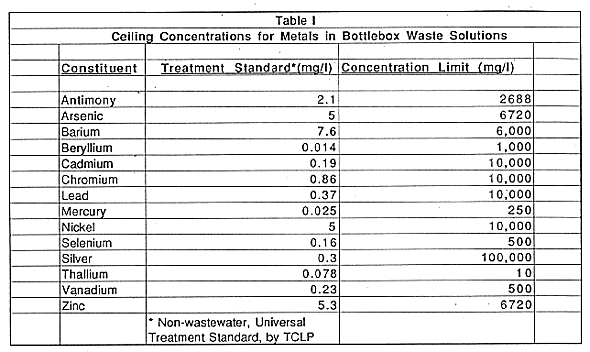
Next, the project would have to demonstrate the treatment process was capable of meeting the LDR for the identified toxic metals and underlying constituents. To accomplish this, a series of Surrogate Waste Studies was performed, with results documented in the PQR. Using simulated waste solutions spiked with known concentrations of the identified metals, bench-scale cementation runs were made utilizing the grouting mixture and mixing method from the Bottlebox process. Once cured, the cement samples were submitted for Toxic Characteristic Leaching Procedure (TCLP) (7) analyses to determine compliance with the LDR. Through this process, ceiling concentration limits for each metal in waste solutions were established. These ceiling concentrations are shown in Table I, and were incorporated into a formal Process Control Plan (PCP) (8), along with other important process parameters (e.g. grout formulas). The S&AP was written to require that all candidate solutions for the Bottlebox meet these established limits.
Table I Ceiling Concentrations for Metals in Bottlebox Waste
Solutions
Due to the Bottlebox having historically processed both characteristic and listed wastes, any liquids subsequently introduced into the neutralization tank (see Fig. 1) would "pick-up" the listed waste codes (e.g. F001) under the RCRA mixture rule (9). Under this condition, future cemented waste forms would all have to be assigned the listed F-codes of any waste previously treated in the tank. To avoid this, the tank would normally have to undergo "closure" (10) (i.e. cleanout) to remove the listed codes. This generally involves expensive closure plans and physical tank cleanout. Recognizing that the neutralization tank was lined with a deposition resistant liner and that several flushes of the tank had been performed since last treating a listed waste, an agreement was reached with the CDPH&E that as long as no additional listed wastes were processed, the F-codes would not have to be applied to any future cemented waste forms.
As a result of the treatment that would accomplish removal of the hazardous characteristics (i.e. the toxic characteristic), and the non-applicability of the listed waste codes, the resultant cemented waste form would no longer be considered a RCRA hazardous waste. As a result, the waste would no longer require management as a hazardous waste under RCRA (e.g. would not have to be stored in a hazardous waste storage unit). It would, obviously, still need to be managed as a TRU waste form, pending disposal at WIPP.
Criticality Safety Requirements
While the historical process operated under a formal Nuclear Material Safety Limit (NMSL) for criticality protection, the limit was not as rigorously derived or documented as demanded by present-day standards (11). To bring the NMSL up to standard, the process was completely reevaluated for double-contingency protection, and a new limit was issued. The first contingency credited for the process was the requirement for sampling and destructive analysis of candidate waste solutions to determine total fissile material content. A limit of 6 grams/liter of fissile material was established. This limit would allow the processing of a wider population of bottled solutions and thus allow the site to maximize improvement in its safety posture.
As the second contingency, a requirement was added for non-destructive assay (NDA) of each bottle, prior to being introduced into the Bottlebox. Using test solutions, the Safeguards Measurement group at the site developed a technique for assaying the fissile material content of a 4-liter bottle using a Bismuth-Germanate, gamma-ray detector. The assay process was fully proceduralized (12) and is utilized for every Bottlebox evolution. The physical controls taken credit for in the NMSL were all fully integrated into the Bottlebox procedure (13), which was fully updated as part of the restart effort.
Conduct of Operations (Con Ops) Requirements
In accordance with DOE Order 5480.19, Conduct of Operations, the Bottlebox and associated facility operations were fully evaluated for implementation of the order. A Con Ops Implementation Plan was generated and fully executed prior to restart. Several key operational improvements were implemented as a result. The Bottlebox procedure was completely updated and rewritten, a formal Bottlebox Training and Qualification Plan was written and executed, a formal drill program was implemented, key operator-aides were developed and posted (e.g. tank level-to-volume conversion charts), and a strict formality-of operations culture was instituted. All of these improvements proved to be important for "passing" the operational Readiness Assessment (discussed below).
In addition to the procedures already discussed, a Batching Methodology procedure was developed that contained strict requirements for assembling "batches" of liquid bottles such that process control volume and thermal power limits were observed, and that nuclear material control limits were not exceeded. The process volume controls ensured that the combination of waste volume, sodium hydroxide neutralization additions, and neutralization tank flushing liquid would not exceed the allowable volume-per-batch established by the PCP. Also developed was a detailed processing status report that recorded the history of every bottle processed; including fissile material concentration, batch number, and cemented waste drum number.
All of the aforementioned procedures were written and approved in accordance with strict site procedures, including the requirement to gain concurrence from the site Operations Review Committee (ORC).
Systems Operating Test
Once all of the procedures and training were in place, a systems test was performed to ensure the processing equipment would work as designed and to "prove" the operational procedures. Process water (raw water), placed in 4-liter bottles, was used in place of actual waste solutions and the entire procedure was executed, resulting in the production of one cemented drum. Even the best, most carefully developed procedures often have flaws that do not become apparent until they are used for the first time. This test run proved to be extremely valuable in that it identified several procedural "deficiencies" (mostly human factors type deficiencies), and some mechanical deficiencies, all of which could be corrected prior to treating an actual batch of waste solutions.
Readiness Review Requirements
In accordance with DOE Order 425.1, Startup and Restart of Nuclear Facilities, a formal Readiness Assessment for Bottlebox operations was performed. All facets of the operation were evaluated by DOE and contractor management and authorization for restart was given.
OPERATIONAL SUCCESSES
As a result of all the above mentioned preparations, the restart of the Bottlebox process was a tremendous success. Since restart, the site has stabilized more than 3300 liters (74 batches) of plutonium solutions. The Bottlebox process has allowed the RFETS to significantly improve its safety posture relative to both worker and public safety, and has done so in an environmentally responsible manner.
FUTURE PLANS
More recently, the Bottlebox process being operated by Rocky Mountain Remediation Services (RMRS), has been successfully utilized in the stabilization of plutonium contaminated Ion Exchange resins. Other applications are constantly under review, and if determined to be appropriate, the Bottlebox mission will be expanded accordingly.
CONCLUSIONS
As was demonstrated with the Bottlebox process, historic waste treatment processes can be proven capable of producing waste forms that comply with regulations that were implemented long after the process was designed. As was detailed above, there were no required upgrades to the process equipment (e.g. no mechanical mixing). Development of formal process control parameters and improvement in administrative, safety, and formality of operations areas, although formidable challenges in themselves, were all that was necessary for successful restart of the process.
REFERENCES