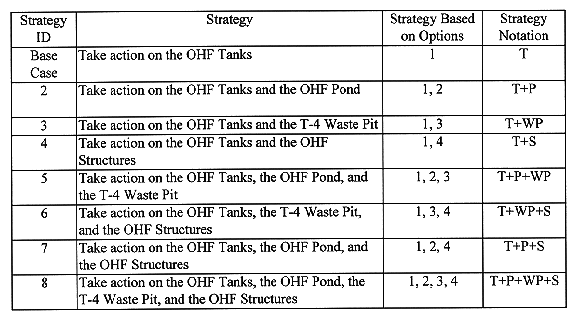
Table I. Identification of OHF Strategies
Kenneth S. Redus
MACTEC
189 Lafayette Drive, Suite
C
Oak Ridge, TN 37830
(423) 483-2715 Fax (423) 483-2717
Clay Bednarz
Lockheed Martin Energy Systems
Bldg
7078, MS-6402, ORNL PO Box 2008
Oak Ridge, TN 37831
(423) 241-3926 Fax
(423) 241-5049
ABSTRACT
An effectiveness-cost (EC) analysis was performed on several strategies that combined tank, surface impoundment, or waste pit Comprehensive Environmental Restoration and Compensation Liability Act (CERCLA) remedial actions with a structural decontamination and decommissioning action at the Old Hydrofracture Facility (OHF) in Waste Area Group 4 at the Oak Ridge National Laboratory (ORNL). Results of were obtained and subsequently approved by Department of Energy Oak Ridge Office program manager in less than three weeks.
It is a fact that DOE is rapidly moving to a project-based approach of dealing with environmental challenges in the areas of waste management, environmental restoration, nuclear material and facility stabilization, science and technology development, landlord activities, and national program planning and management.
This means that Maintenance and Integration (M&I) contractors at DOE sites will be required to support and justify strategy planning and decisions in these project areas. This paper demonstrates that EC analysis can be accomplished in a timely manner to support such decisions.
INTRODUCTION
The Old Hydrofracture Facility (OHF) project required key decisions to be made regarding the selection of remedial actions or decontamination and decommissioning (D&D) actions in FY96.
Several independent options were identified:
The challenge, however, meant integrating the OHF options to create strategies which would realize life cycle cost savings. The selection of one, or more of the options, was therefore required.
Seven strategies were identified based on combining the options, Table I. The Base Case strategy is Strategy 1, Sluice and Grout the OHF Tanks. For ease in description of strategies, each strategy is defined as "take action on" a specific set of components. The end point for all strategies is restricted industrial use.
Table I. Identification of OHF Strategies
SUMMARY OF EFFECTIVENESS-COST ANALYSIS RESULTS
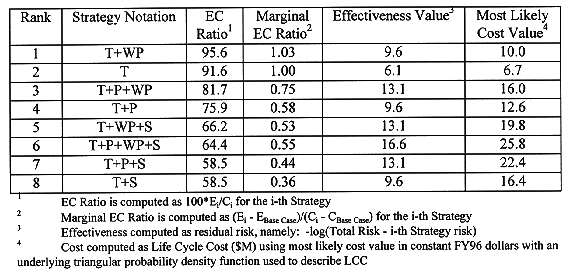
The optimal strategy, based upon the maximum EC ratio, is Strategy 3, composed of Option 1 (sluice and grout the Tanks), and Option 3 (Grout the T-4 Waste Pit).
The Base Case conditions are: 1) Effectiveness computed as residual risk, 2) Cost computed as Life Cycle Cost using most likely cost value and estimated as a Net Present Value with a 10% discount rate, and 3) all strategies include the "sluice and grout the tanks" option.
The relative ranking of all strategies is illustrated in Table II. The LCC of the optimal strategy cannot increase by more than 4% in order for this strategy to strategy to remain optimal. The effectiveness of the optimal strategy cannot decrease by slightly more than 4% in order for this strategy to strategy to remain optimal. This small difference between T+WP and T indicates that either is preferable.
Table II Rank Ordering of Strategies Based on EC Ratios
Examining the ranked Marginal EC Ratio values provides insight into the marginal differences of the strategies, Table III.
Table III Summary of Rank Ordered Strategies.
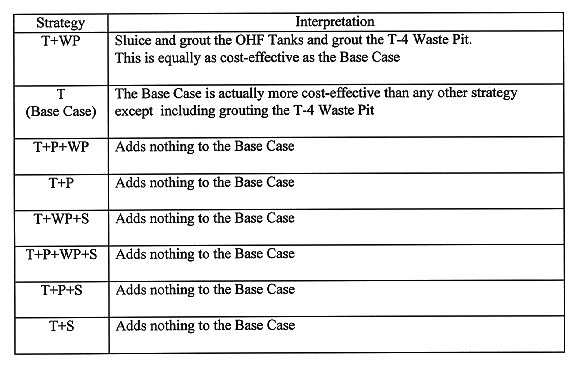
Based upon the EC analysis and ground rules, it was recommended that OHF program management initiate the Base Case strategy "sluice and grout Tanks T-1, T-2, T-3, T-4, and T-9." Under the Base Case strategy, total human health residual risk due to contaminants in the OHF tanks can be reduced by no more than 35% at an expected cost of $8.2 million.
The integrated strategy 1) sluice and grout Tanks T-1, T-2, T-3, T-4, and T-9 and 2) grout the T-4 Waste Pit was considered sufficiently risky from other programmatic perspectives, including availability of technology, funding, schedule impacts, and political will. However, the EC analysis indicated that when both the OHF tanks and the T-4 waste pit are remediated, the total human health residual risk can be reduced by up to 55% of the total OHF risk at an expected cost of $12.4 million.
Thus, when the tanks and the waste pit are attacked as an integrated strategy, an additional $4.2 million buys an extra 20% residual risk reduction. The maximum expected life cycle cost for this integrated strategy is $16.9 million. The period of performance for this integrated strategy is 28 months.
Finally, from a human health risk perspective, if this risk is 15% to 20%, or less, of the total risk for all components of the OHF, there is minimal difference between the integrated strategy and the strategy is to sluice and grout the tanks only.
DETAILS OF TECHNICAL APPROACH FOR STRATEGY EVALUATION
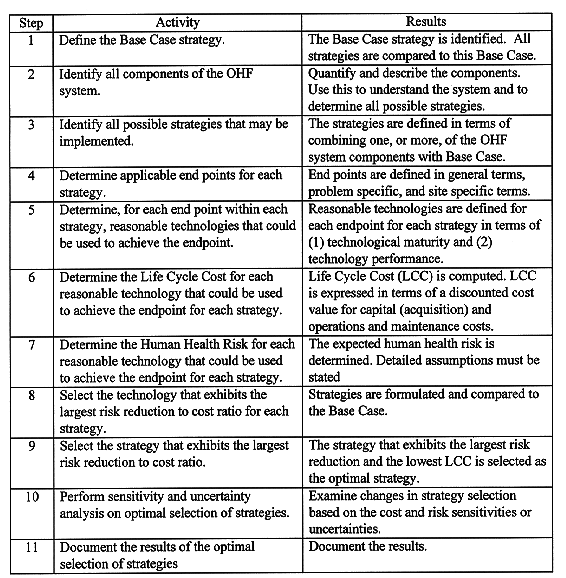
The technical approach activities and expected results used to evaluate strategies for Old Hydrofracture Facility (OHF) remedial actions or decontamination and decommissioning actions is summarized in Table IV.
CONSTRAINTS AND LIMITATIONS OF EVALUATION
There are several major limitations to the results:
Table IV. Technical Approach
CONCLUSIONS
An EC analysis was performed on several integrated strategies for the OHF project at ORNL. Results of were obtained and subsequently approved by Department of Energy Oak Ridge Office program manager in less than three weeks.
The EC approach was straightforward and understandable to all stakeholders. Such an approach is easily transferable to waste management, environmental restoration, nuclear material and facility stabilization, science and technology development, landlord activities projects. It is recommended that when the integrated strategies have been selected, an optimal project selection approach be applied to 1) minimize total LCC, 2) meet annual budget constraints, technical risk requirements, human health and environmental risk reduction requirements, and 3) accommodate multiple project combinations (Redus, 1996; Redus and Sharp, 1996; and Redus and State, 1997).
BIBLIOGRAPHY
KEATING, B. and J. H. WILSON. 1986. Managerial Economics, Academic Press, Hartcourt Brace Jovanovich, New York, New York.
REDUS, K. S., "Optimal Project Selection To Minimize Life Cycle Costs," MACTEC TR-96-03-045, March 1996.
REDUS, K. S. and G. SHARP, "Recent Advances in Optimal Project Selection Using Risk Management and Cost Minimization," ANS/ENS Joint Meeting, November, 1996.
REDUS, K. S. and S. E. STATE, "Optimal Project Selection Using Risk Management And Cost Minimization To Support The Department Of Energy Base Case Environmental Management Report," Proceedings of Waste Management 97, 1997.