NONDESTRUCTIVE ASSAY AND NONDESTRUCTIVE EXAMINATION
SYSTEMS AND ACTIVITIES AT THE INEL RADIOACTIVE WASTE MANAGEMENT COMPLEX*
Clifford J. Stanley
Idaho National Engineering and
Environmental Laboratory
Lockheed Martin Idaho Technologies Company
P.
O. Box 1625 Idaho Falls, ID 83415-4201
(208) 526-5637 / Internet:
stancj@inel.gov
ABSTRACT
The Radioactive Waste Management Complex (RWMC) located within the Idaho
National Engineering and Environmental Laboratory (INEEL) contains facilities
and equipment to manage low-level, mixed, and transuranic (TRU) solid
radioactive waste generated by the INEEL and other Department of Energy (DOE)
laboratories and operations. The primary mission of the RWMC is safe disposal of
INEEL-generated low-level waste (LLW) and temporary storage of mixed and TRU
waste. Much of this waste will be retrieved, nondestructively examined, and
shipped to a centralized DOE disposal facility, such as the proposed Waste
Isolation Pilot Plant (WIPP) facility in New Mexico.
The Transuranic Storage Area (TSA) within the RWMC is used for examination,
segregation, certification, and interim storage of TRU waste. Within the TSA, a
facility referred to as the Stored Waste Examination Pilot Plant (SWEPP)
provides space for the nondestructive assay and examination systems that
characterize and certify the various waste forms for shipping and disposal to
WIPP. The process through SWEPP includes waste container warmup, radiological
survey and weighing activity, radiographic examination, fissile material assay,
container integrity visual inspection, container overpacking, and gamma-ray
spectrometer evaluation. This paper will provide an overview of the current and
planned NDA/NDE waste characterization activities associated with SWEPP. The
SWEPP efforts are getting a lot of attention as the result of the Settlement
Agreement between the governor of Idaho and the DOE requiring that we start
shipping TRU waste to WIPP by 1998.
INTRODUCTION
The purpose of this paper is to provide an overview of the current and
future nondestructive assay (NDA) and nondestructive examination (NDE) waste
characterization activities associated with the Stored Waste Examination Pilot
Plant (SWEPP) in the Radioactive Waste Management Complex (RWMC) located at the
Idaho National Engineering and Environmental Laboratory (INEEL). Included in
this paper is a description of each of the SWEPP NDA/NDE systems and associated
activities.
The RWMC located within the INEEL contains facilities and equipment to
manage low-level, mixed, and transuranic (TRU) solid radioactive waste generated
by the INEEL and other Department of Energy (DOE) laboratories and operations.
The primary mission of the RWMC is safe disposal of INEEL-generated low-level
waste (LLW) and temporary storage of mixed and TRU waste. Much of this waste
will be retrieved, nondestructively examined, and shipped to a centralized DOE
disposal facility such as the proposed Waste Isolation Pilot Plant (WIPP)
facility in New Mexico. Figure 1 shows an aerial view of the INEEL Radioactive
Waste Management Complex.
The Transuranic Storage Area (TSA) within the RWMC is used for examination,
segregation, certification, and interim storage of TRU waste. Within the TSA, a
facility referred to as the Stored Waste Examination Pilot Plant (SWEPP)
provides space for the nondestructive assay and examination systems that
characterize and certify the various waste forms for shipping and disposal to
WIPP. The process through SWEPP includes waste container warmup, drum venting
and head space gas sampling, radiological survey and weighing activity,
radiographic examination, fissile material assay, container integrity visual
inspection, container overpacking, and gamma-ray spectrometer evaluation. In
addition a limited number of drums are evaluated in the Gas Generation Testing
Facility for hydrogen and volatile organic gas generation due to decomposition
of the materials inside the container.
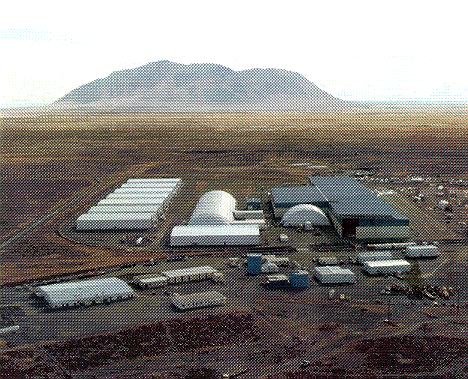
Fig. 1. Aerial Photo of the INEEL
Radioactive Waste Management Complex (RWMC). The white structures on the left
are the newly constructed RCRA certified storage facilities, the white
air-filled structure in the center is the present drum/box storage facility with
the attached SWEPP facility. The large structure on the right is the Retrieval
Enclosure which covers the buried waste. (95-942-4-16).
BACKGROUND
Since 1970, the Radioactive Waste Management Complex (RWMC) at the Idaho
National Engineering Laboratory (INEEL) has served as the major U.S. Department
of Energy storage site for defense-generated, contact handled transuranic
(CH-TRU) waste. Approximately 65,000 cubic meters (2.3 million cubic feet) of
CH-TRU waste is stored at the RWMC on above-ground concrete or asphalt pads, or
underground covered with an earth berm. Most of this TRU waste is currently
stored inside air support buildings, or in hard-walled storage buildings that
are approved by the State in accordance with the Resource Conservation and
Recovery Act (RCRA). The waste is contained in approximately 132,000 drums and
11,400 boxes.
Before TRU waste shipments from the INEEL to WIPP can begin, the TRU waste
must be characterized and certified to meet the WIPP Waste Acceptance Criteria
(WAC). The SWEPP facility was initially developed to evaluate the capability of
various technologies to examine the waste forms and to certify the contents of
waste containers for shipment to WIPP. Over the years, the mission of the
facility has changed from technology demonstration to production. SWEPP performs
the non-destructive examination (NDE) and non-destructive assay (NDA) of TRU
waste contained in drums for shipment to WIPP.
WIPP Non-Destructive Assay/Evaluation (NDA/E) Requirements
DOE's TRU waste characterization criteria is specified in the Waste
Acceptance Criteria for the Waste Isolation Pilot Plant (WIPP-WAC) and the
Quality Assurance Program Plan (QAPP). The QAPP identifies the quality of data
and techniques required to ensure that the specific objectives associated with
the TRU Waste Characterization Program are met. It describes the activities that
are required to characterize TRU waste for disposal at the WIPP facility,
including both the managerial and technical aspects of program management and
the data quality requirements that facilities must meet. The WIPP-WAC identifies
criteria and requirements that regulate the safe handling, preparation,
transportation, and emplacement of TRU waste packages in the WIPP repository.
CURRENT SWEPP SYSTEMS
The SWEPP facility currently performs non-destructive assay and examinations
of waste primarily contained in 55-gallon drums. The primary techniques being
used in SWEPP to examine waste packages include visual examination for container
integrity, and non-destructive radiographic and radioassay examinations for
container contents. These examinations are performed using the real-time
radiography (RTR) system, the passive/active neutron (PAN) assay, and gamma-ray
spectrometer (GRS) system. The interior of the SWEPP facility is shown in Fig.
2. Surveys for contamination, radiation levels, and drum weight are also made at
a container weigh station within the facility. Supporting and associated systems
include the Drum Vent Facility and the TRU Package Transporter (TRUPACT) Loading
Facility.
Neutron Assay System
The Stored Waste Examination Pilot Plant (SWEPP) contains two high
sensitivity, non-destructive assay (NDA) units based on PAN analysis techniques
that evaluate transuranic (TRU) waste packages. Both units were designed and
constructed by Los Alamos National Laboratory (LANL). The initial NDA unit was
installed in 1984 and accommodates standard 55-gallon (208-liter) drums. The
second unit was installed in 1987 and accommodates metal or wood crates as large
as 84x54x54 inches. Both units operate on the combined passive-active neutron
(PAN) measurement principle. The PAN drum assay unit is shown in Fig. 3.
In the PAN system, the passive neutron unit detects the number of
time-correlated neutrons being emitted spontaneously from the waste package.
Passive neutron measurements are then used to quantify the spontaneous fission
neutron yield of the source material. The passive portion of the measurement
records neutrons being emitted spontaneously, using an electronic processing
that separates neutrons detected in clusters of two, three, or more at a time
from neutrons that are detected singly. The cluster events can be related to
spontaneous fission of Pu-240. Since most of the TRU waste processed at SWEPP
has a constant Pu-240 isotopic fraction, the Pu-240 measurement can be used to
estimate the total Pu mass in a waste package. The single events are related to
alpha-neutron reactions in the waste matrix, which for most of the SWEPP wastes
are produced by Americium (Am)-241.
Active neutrons are measured by inducing fission in fissile material via an
interrogation neutron source and then quantifying the resulting induced fission
neutron signal. The interrogation neutrons are provided by a Zetatron neutron
generator which produces bursts of 14 MeV neutrons. These neutrons are
thermalized and used to interrogate the waste packages and to produce fissions
in Pu-239 and other fissile TRU isotopes. The prompt fast fission neutrons that
result are counted and can be related to the mass of Pu-239 present. The PAN
system is currently configured for a sensitivity sufficient to measure 100 nCi/g
quantities of Plutonium (Pu) for most drum categories. Wastes originating from
the Rocky Flats Plant (RFP) constitute most of the SWEPP inventory. These wastes
have a constant ratio of Pu-239 and Pu-240, and thus both the active and passive
assay measurements can be used to estimate total Pu mass. This allows a
considerable amount of cross-checking to be done. Since the active measurement
is more sensitive, it is used generally to determine Pu contents below 20g, and
especially to determine if a package is below the 100nCi/g "non-TRU"
limit.
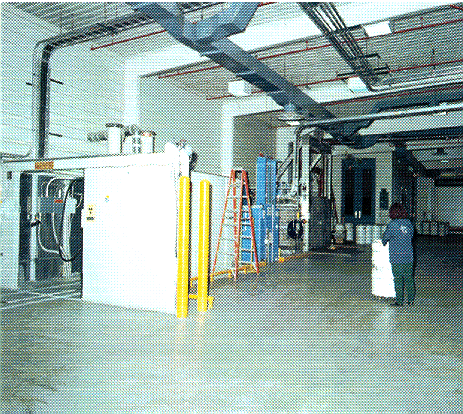
Fig. 2. Interior view of the SWEPP
facility showing the RTR system (on the left), the PAN drum assay system
(middle), and the PAN box assay system (just to the right of the drum assay).
The Container Integrity Inspection system is just to the right of the PAN box
assay . The Gamma-Ray Spectrometer system is at the far end of the building out
of sight on the right. (94-179-2-8)
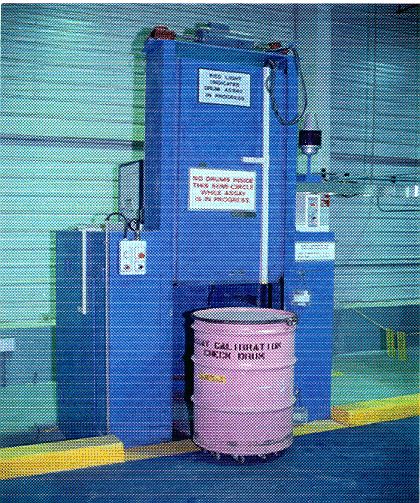
Fig. 3. SWEPP Passive-Active Neutron
(PAN) Assay System for Waste Drums. The Pink drum is used for system
calibration. (95-838-2-19)
Since the RFP wastes are segregated by matrix type, experience obtained in
assaying thousands of packages of the same type matrix has led to specialized
analysis algorithms for many specific matrices. Both specialized and generic
algorithms reside in the operating system software packages which are upgraded
as the algorithms are refined.
The drum and crate NDA units operate independently; however, they share some
electronic equipment and use a common data acquisition system and operating
system software. The drum PAN unit data generation system consists of the assay
chamber and its associated polyethylene and graphite moderating materials,
structural aluminum, and steel; drum rotator; vertical door opening and closing
mechanism; Zetatron pulsed neutron source; active, passive, and interrogation
flux neutron detector packages (both shielded and unshielded); mechanical,
electrical, and nuclear safety interlock hardware; and various assay chamber
electronics. The crate PAN (also known as the Box Assay system) unit is similar
to the drum system. It consists of an assay chamber with associated polyethylene
walls (no graphite), structural aluminum and steel; a vertical door opening and
closing mechanism; a Zetatron pulsed neutron source; active and passive signal
neutron detector packages; mechanical, electrical, and nuclear safety interlock
hardware; and various assay chamber electronics.
Gamma-Ray Spectrometer
The SWEPP gamma-ray spectrometer (SGRS) system uses passive gamma-rays to
analyze radioactive waste packaged in 55-gallon drums. The SGRS is a modified
Canberra, quantitative and qualitative (Q2) low-level waste assay system that
includes a shielding enclosure, drum turntable, turntable motor, motor controls,
high-resolution high-purity germanium (HPGe) detectors, associated amplifiers,
high-voltage power supplies, analog-to-digital converters, acquisition and
interface modules, the calibration pulsers, the Ethernet communication link, and
a VAXStation computer. Also included is the liquid nitrogen support system
required for operation of the HPGe detectors and a drum containing 152Eu
sources for energy calibration of the system. The SGRS system is shown in Fig.
4.
During radioactive decay, a given radionuclide emits a number of gamma-rays
with specific energies. This gamma ray distribution is known as the gamma-ray
energy spectrum for the isotope of concern. Measuring the gamma-ray energy
emitted by an unknown sample (analyzing the spectrum) identifies the
radionuclides in the sample. The SGRS is capable of identifying gamma-ray
emitters at very low activity levels packaged in a wide variety of matrix
materials. The system records gamma-rays emitted from the waste, generates a
gamma-ray spectrum, and processes the resulting information in a specific energy
region to arrive at calculated ratios of the mass of selected isotopes to the
mass of Pu-239 and/or to the mass of U-235. The reported isotopic mass ratios
assume that the ratios are constant throughout the entire contents of the drum.
The isotopic mass ratio data is used to verify or adjust the quantitative
results from the passive-active neutron (PAN) waste assay system. Without these
measured isotopic mass ratios from the SGRS, the PAN assay system assumes the
radioactive material to be weapons-grade plutonium which consists of Pu-238,
Pu-239, Pu-240, Pu-240, and Am-241 (a decay product of Pu-241) in nominal
weapons-grade proportions. Because of the variety of chemical separation
processes used by the waste generator, the material in a drum may not be
weapons-grade plutonium: the contents could be enriched in Am-241 and/or U-235,
which could compromise isotopic mass values from the PAN assay system.
The standard Q2 shield chamber was modified to accept four HPGe detectors.
The chamber is constructed of low radiation background steel. Circular
penetrations were cut into the back wall of the chamber for insertion of the
snouts of the four detectors which are positioned at different elevations in the
shield. The detectors are nominally 10% efficient and have energy resolution of
better than 800 electron volts (eV) at 122keV. Each of the detectors has been
fitted with an INEEL-designed calibration pulser. Information from the pulser
pulses is used for real-time validation of the data collected by each detector.
The pulser data are stored as a permanent part of the spectral record and are
used in analyzing the spectral data for energy calibration, dead time
correction, pile-up loss correction, and data quality verification. Each
spectrum is individually validated using the stored pulser information.
The VAXStation computer controls the SGRS and the drum turntable, and
analyses the spectral data. The spectral data are analyzed using VAXGAP, a
gamma-ray spectral analysis code developed at the INEEL, along with the method
for calculating isotopic mass ratios. Reduced data is then sent to the SWEPP
Data Management System which is linked to the PAN measurement data.
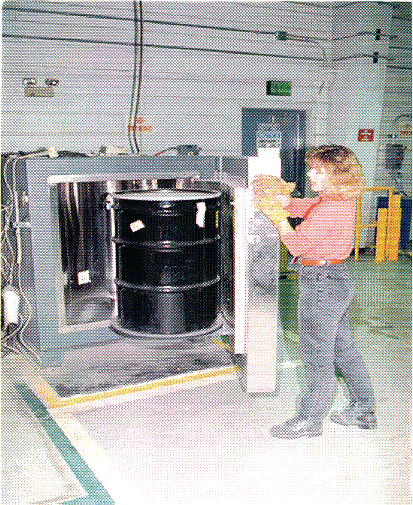
Fig. 4. SWEPP Gamma-Ray Spectrometer
(SGRS) System. A calibration drum is shown loaded on the turntable.
(95-838-3-27)
Real-Time Radiography System
The Real Time Radiography (RTR) waste NDE System combines X-ray radiography
and fluoroscopy, which allows the image of the object under examination to be
displayed at the same time the examination is taking place (i.e., in "real"
time). The RTR system is shown in Fig. 2. This is especially desirable in the
identification and characterization of radioactive or hazardous waste because
container contents can be examined without breaching the container. The system
also provides data-recording capabilities.
The real-time x-ray radiography system is used to determine or verify the
proper waste Item Description Code (IDC) and visually examines the contents of
the waste containers to determine if the contents meet certain waste form
requirements. Information on the presence of liquids, gas cylinders (e.g.,
aerosol cans or other potentially pressurized containers), small particulates
(fines), layers of confinement, and drum liners is provided using the RTR
system.
A cart mounted on rails transports drums or boxes into a lead-shielded
enclosure. The cart is removable and has an attachment designed to carry up to
three drums. The attachment has three pedestals on which individual drums may be
placed. All pedestals turn at the same time from a common drive and will rotate
the drums at a speed selected by setting a console potentiometer. Direction of
rotation can be switched at the console. A removable box attachment allows
rotation of a box or crate to view both sides. Boxes cannot be rotated during
RTR inspection but are first inspected from one side and then removed from the
RTR cave and rotated 180 degrees, reinserted and inspected from the opposite
side.
The x-ray tube head is a constant potential, oil-cooled, hooded anode
Philips Model MCN 421. The maximum operating voltage of the tube is 420kVp dc.
The output of the X-ray head is 11,000R/min at 20cm when operating at 420kVp. A
beam focus selector for the tube head may be set on wide or narrow focus. The
head is a vacuum tube with an anode and a cathode supplied by high voltage DC
(+/-210kV). When high voltage is applied, the electrons produced at the tungsten
filament are accelerated into the face of the tungsten anode target. The
reaction between electrons and the tungsten target produces X-rays.
The imaging system consists of a fluoroscopic screen and a low-light-level
Isocon camera. The fluorescent screen is coated with a thin layer of gadolinium
oxysulfide, a rare-earth phosphor, which when acted upon by X-rays will emit
light. The degree of image brightness is proportional to the intensity of the
X-rays striking the screen phosphor. Since the X-rays must first pass through
the item being examined before striking the screen, the degree of screen
brightness transmitted to the control console is inversely proportional to the
density of the material being examined. The camera is mounted inside a shielded,
light-tight enclosure to protect the lenses and electronic components from
radiation damage. The camera has five lenses in a turret arrangement, permitting
remote selection of image size. The lenses point at a first-surface mirror,
mounted at a 45-degree angle, which in turn views the fluoroscopic screen. The
X-ray tube head and camera are equipped with drive motors to provide vertical
scanning of containers being examined. This ensures simultaneous motion of both
the x-ray tube head and the camera system. The output from the imaging system is
supplied to monitors at the operator's station. The processing can consist of
videotaping, adding printed data on the videotape via a character generator, and
verbally describing the results of the RTR examination with the audio recorded
on a track of the videotape.
The advantage of viewing the examination in real time is that the X-ray
device can be adjusted on the spot to obtain optimum imaging conditions, or the
system can be stopped to focus on one object. The RTR works extremely well in
verifying the presence of free liquids by jogging the container or handling
system and then watching for the resulting wave motion.
SWEPP UPGRADE ACTIVITIES
The SWEPP facility at the INEEL continues to support the DOE Transuranic
Waste Characterization Program (TWCP) and provide needed waste characterization
data in accordance with DOE and WIPP characterization and reporting
requirements. Modifications to the existing SWEPP NDA/E systems, therefore, are
constrained to activities that allow the SWEPP facility to remain operational to
support the TWCP.
The WIPP-WAC is currently in the process of being finalized and the WIPP
facility is scheduled to open in the fall of 1997 and begin to accept waste
shipments for long-term storage. With the opening of the WIPP facility, the
INEEL will begin shipping the available inventory that complies with the
WIPP-WAC and can be shipped without repackaging or treatment. In order to
provide this inventory for shipment to WIPP, the current and future
methodologies used at SWEPP for waste evaluation and certification are being
reviewed for ways to increase the through put and efficiency of the operation.
Radioassay System (PAN and SGRS) Upgrade
The current PAN control software was rewritten to meet Quality Level-II
requirements and includes modifications designed to integrate the results of the
SGRS with those from the PAN. This integration will also provide necessary
algorithm modifications for assaying waste contaminated with uranium. The
software upgrade includes developing algorithms and other software improvements
necessary to integrate the SGRS and PAN systems into an overall waste assay
instrument and adjust the PAN measurement results, if needed, by using isotopic
mass ratios inferred from the SWEPP gamma-ray system. The SGRS software is being
modified to perform spectral summing of the gamma-ray spectra from each detector
to improve system performance and reduce the required counting time.
Plans also include improved quality of the neutron assays by incorporating
shift register coincidence counting technology in the PAN system and completing
improvements currently in progress in the individual PAN and SGRS software.
Evaluation results indicate that quality of the assays can be improved by
incorporating this technique, especially the assays on waste forms producing
high neutron emission rates.
Both the PAN and the SGRS currently require extensive physics oversight to
ensure that the systems are properly assaying the waste configuration and that
the data reductions are properly performed for the specific waste configuration.
One of the goals of this system and software integration is to reduce the amount
of oversight required and to automate some of this oversight and data
validation.
Hardware upgrades are also planned for both the PAN and SGRS systems with
respect to the electronics and signal processing equipment. We have also ordered
higher efficiency HPGe detectors for use in the SGRS and a new neutron generator
for use in the PAN system.
Real-Time Radiography
Current activities to improve the SWEPP RTR system for production operations
include evaluation of an imaging system upgrade (to replace the fluoroscopic
screen and low-light level Isocon camera) and digital signal enhancement tools.
The evaluation of the image intensifier concluded that it improved image quality
of the waste drums being examined; necessary modifications to the RTR cave are
currently being evaluated.
Digital real-time radiography is being evaluated in terms of techniques to
digitize RTR images, process images in real-time, provide averaging
capabilities, and provide image analysis and quantification tools. The image
analysis tools would provide the operator with tools to help quantify items
within the waste (e.g., liquid volumes) and remove the subjectivity of estimates
now required of the operator. Digital data storage techniques using CD
technology are also being evaluated to improve the reliability and
retrievability of the data in accordance with the WIPP requirements.
SUMMARY
Research and development into waste characterization technologies continues,
and the integration of upgrades and new technology to this facility planned by
SWEPP operations, engineering, and TRU Waste Programs are being evaluated.
Continuing waste characterization research and implementation of identified
upgrades and technology developments is expected to increase the percentage of
waste that can be certified for shipping to WIPP. We are currently working on
upgrades to the facility and relocating equipment to improve the process flow
and through-put of waste drums. To date we have passed both the Cycle 1 and
Cycle 2 WIPP waste characterization PDP testing for the PAN/SGRS systems. We are
continuing to process waste drums in the facility in preparation for intrusive
characterization The RWMC and SWEPP are also currently participating in the
commercial Mobil NDA/E technology demonstration programs for the DOE. The SWEPP
facility is continuing to support the needs of the INEEL, the DOE complex, and
the private sector with respect to NDA/E characterization of the various forms
of radioactive waste in support of the Environmental Management cleanup and
disposal initiatives.
REFERENCES
- Safety Analysis Report for the Radioactive Waste Management Complex at the
Idaho National Engineering Laboratory. Idaho National Engineering Laboratory,
Idaho Falls Idaho. INEL-94/0226 (February 1995).
- Transuranic Waste Characterization Quality Assurance Program Plan. U.S.
Department of Energy Carlsbad Area Office, Carlsbad, New Mexico. CAO-94-1010,
Revision 0 (April 30, 1995).
- Waste Acceptance Criteria for the Waste Isolation Pilot Plant. U.S.
Department of Energy Carlsbad Area Office, Carlsbad, New Mexico. WIPP-DOE-069,
Revision 4 (1991).
- Performance Demonstration Program Plan for Nondestructive Assay for the TRU
Waste Characterization Program. U.S. Department of Energy Carlsbad Area Office,
Carlsbad, New Mexico. CAO-94-1045 (1994).
- Real-Time Radiography Examination System Description, TPR-1522, Radioactive
Waste Management Complex, INEL.
- Gamma-Ray Spectrometer Assay System Description, TPR-1534, Radioactive
Waste Management Complex, INEL.
- Passive/Active Neutron Drum Assay System Description, TPR-1523, Radioactive
Waste Management Complex, INEL.
*This work was supported by the U. S. Department of
Energy Assistant Secretary for Environmental Management under DOE Idaho
Operations Office Contract DE AC07 94ID13223.