Table I Characteristics of the Residues from Cogema (La Hague,
France)

J.P. Boyazis and M. Demarche
ONDRAF
Belgium
ABSTRACT
A new facility for the receipt and storage of radioactive waste, known as Building 36, was built on the Belgoprocess site in Belgium. This facility is intended to receive and store intermediate and high radioactive waste originating from the reprocessing by COGEMA of spent fuel from Belgian nuclear power plants.
The facility consists of :
- a storage cell for packages with very highly radiating and heat producing vitrified waste. This cell consists of 2 x 30 stainless steel pits which can each receive 10 primary packages.
- a storage bunker with a capacity of 1.000 cubic meters for the medium and highly radiating primary packages.
- a common receiving station (receiving hall, lock, unloading cell), which serves the storage areas.
Storage modules can be added in the future, without interfering with the operational area of Building 36. The storage capacity can thus be extended eight to ten fold.
Building 36 is designed to withstand earthquakes, external explosions and airplane crashes.
The duration of storage depends on the development of final disposal facilities. The design life is planned for a period of 75 years, although 100 years or more are possible.
INTRODUCTION
The seven nuclear reactors in Belgium will have consumed, until their closure, an approximative total quantity of 4000 tons of uranium. In order to recover the recyclable elements (uranium and plutonium), agreements have been entered into between Synatom and the French reprocessing company Cogema. The existing contracts provide for the reconditioning of 670 tons of uranium and the return of the waste products to Belgium. This waste consists of economically uninteresting, but highly radioactive elements. The spent fuel elements are reprocessed by Cogema in La Hague, France. The waste products will be conditioned in this facility into an inert matrix and packaged in standard containers. The return of the waste to Belgium will commence in 1997 and the last shipment is expected to arrive ten years later.
The Belgian National Agency for Radioactive Waste and Enriched Fissile Materials, NIRAS (ONDRAF), has built a new storage facility for the receipt and storage of the above-mentioned waste products. It is located on the Belgoprocess site close to Mol in the northeast of Belgium and is referred to as "Building 36". Belgoprocess is a subsidiary of NIRAS and is in charge of storing radioactive waste products taken over by NIRAS. The storage facility can, if necessary, also handle or store radioactive waste products from other origins.
The duration of the storage will depend on the development of final disposal facilities. The design life of Building 36 is 75 years, although 100 years or more are possible.
RADIOACTIVE WASTE
Radioactive waste from the reprocessing of spent fuel elements at Cogema, La Hague is classified in the following five categories :
The first three categories and the intermediate alpha radiating waste of category 4 will be stored in Building 36. Low alpha radiating waste and waste of category 5 will be stored in another building, Building 51, on the Belgoprocess site.
The characteristics of the above-mentioned waste categories and of the standard containers that will be stored in Building 36 are presented in Table I.
Table I Characteristics of the Residues from Cogema (La Hague,
France)
WASTE STORAGE AND RECEIPT
Building 36 is designed for the storage of waste from the categories 1, 2 and 3 and for part of the category 4 waste (intermediate radiating alpha waste). Once the waste has reached a sufficiently low level of radiation and heat production, it can be transferred to a final disposal facility.
Building 36 can also serve as a receiving and loading station for road transport containers, including those with a weight of 112 ton, in the following cases :
LAYOUT CONSIDERATIONS
Building 36 consists of storage modules (cells and bunkers) for the different categories of waste. These modules are positioned around a common receiving station. This station consists of a receiving hall, a lock, an unloading cell and a transfer corridor.
Due to the important heat production, category 1 waste will be stored in special storage cells. The waste from categories 2, 3 and 4 will be stored in a storage bunker.
The building is designed in such a way that it can easily be extended in order to meet the storage requirements of the total national reprocessing program (approximately 4000 tons of uranium). Construction work for additional cells or bunkers can be executed without interfering with the operational use of the existing facilities. The storage capacity of Building 36 can easily be extended to 8 to 10 times its original capacity.
The total cost of the building in its actual configuration (two storage cells of each thirty pits and one storage bunker) is of the order of eighty-five million US Dollars.
GENERAL LAYOUT
The general layout of Building 36 is shown on Figs. 1, 2 and 3 and consists of the following areas. The numbers and letters in brackets indicate the reference of the area or the equipment as shown on the figures.
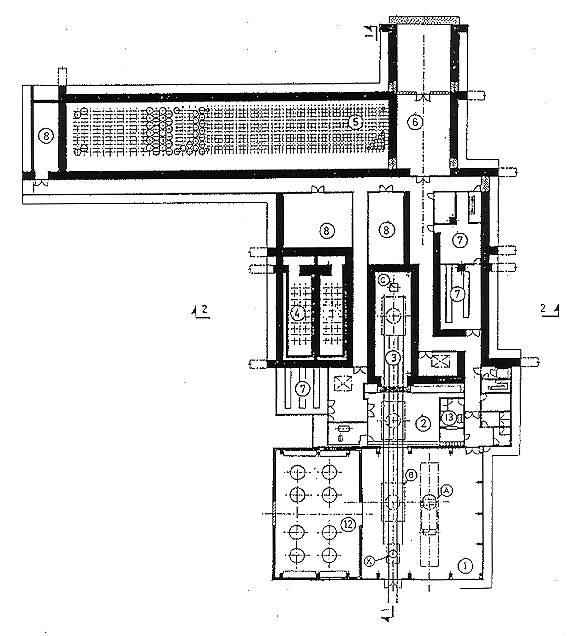
Fig. 1. Level 0.00 m.
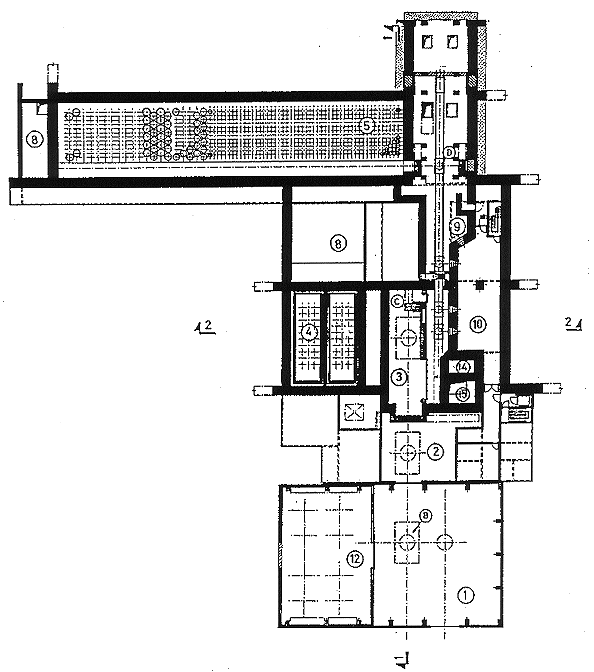
Fig. 2. Level 4.50 m.
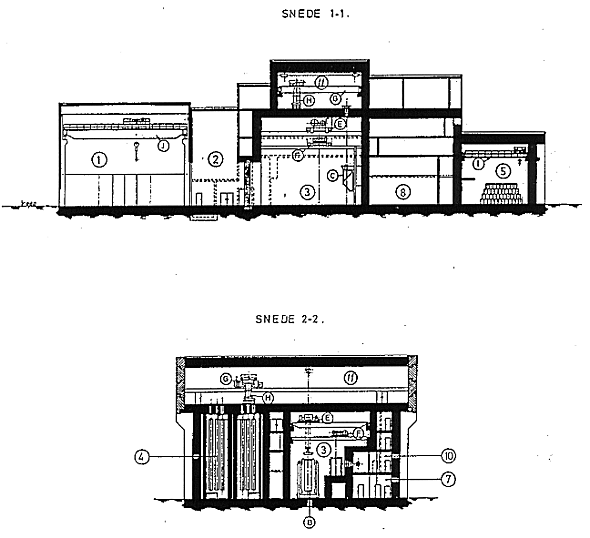
Fig. 3. View 1-1 and 2-2.
VENTILATION INSTALLATION
The ventilation comprises five independent circuits (storage cells, storage bunker, transfer hall, unloading cell and lock, building). It serves the following purposes :
Under normal operational conditions there is no danger of internal airborne contamination. Even so, the air discharged through the chimney is filtered. Back-up extraction fans are provided.
The ventilation installation is connected to both normal and emergency supply. It is also connected to the ultimate electricity supply system. In case of complete failure of these systems, cooling is ensured through the principle of natural convection. A 37 m high chimney will provide the temperature gradient needed for cooling of the storage cells.
ELECTRICAL INSTALLATION
The electrical installation consists of three separate power supply systems :
A No Break serves continuously the PLC's and the radiation monitoring systems.
Fire detection systems and telephones have their own autonomous systems.
STRUCTURAL SAFETY
Building 36 is designed to resist the following exceptional events :
RADIATION PROTECTION
Radiological safety is achieved by certain design specifications, which resulted in 1.50 to 1.70 m thick concrete wall and roof slabs. A special concrete composition was used in order to limit hydration heat production, shrinkage and formation of fissures in the concrete structure. Characteristics of this composition are : a low water content and the use of special cement, pulverized fuel ash and super plasticizer.
A radiation monitoring installation is installed to measure the following :
In accordance to the general rules applicable on the Belgoprocess site, the dose rate at the contact of the external walls is limited to 20 micro Sv/h.
The estimated dose rate for the population living in the immediate surroundings of the Belgoprocess site, is calculated to be lower than 10 micro Sv/year assuming the storage areas are completely filled.
The danger of contamination under normal circumstances is negligible. Nevertheless decontamination of primary packages and transport containers is possible at different locations in the building.
The possibility of criticality in the storage cells for vitrified waste has been analyzed and found to be zero.
FIRE PROTECTION AND ALARM
The construction materials are incombustible and the building is divided into fire containing areas. Around the building a 15 m wide area has been cleared of trees and bushes.
The fire fighting equipment consists of portable fire extinguishers and a static halon system in the building. Fire hydrants are installed on the periphery of the building. Fire and smoke detection systems are installed with visual and audible alarms.
All alarms are relayed to the Belgoprocess central control room.
MANIPULATIONS
All manipulations of primary packages will be remote controlled from the control room, except for the loading machine which will be served locally. Due to the high reliability of the handling systems, the primary packages can be moved without risk of incidents.
The altitude at which the packages will be transferred by the traveling cranes will be limited to avoid damage to the packages in case of fall.
The electrical power supply and the motorization of the essential handling functions are redundant to make sure that the load can be brought back to a safe position in any circumstance, even after an earthquake.
Furthermore most of the handling systems (traveling cranes, grippers, mobile platform,...) are equipped with mechanical emergency systems, which make it possible to move the loads even in case of failure of the redundant electrical system.
RELEASE TO THE ENVIRONMENT