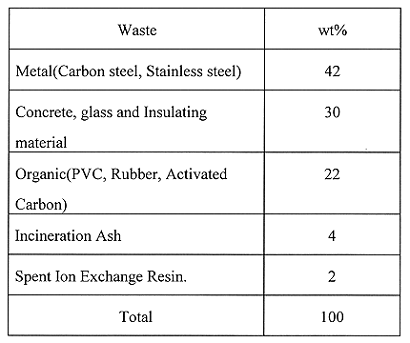
Table I Component of Waste for Test
Katsuo Yamazaki, Satoshi Karigome, Yoshihiro Akagawa
The
Japan Atomic Power Company
Yasuo Dougaki, Yoshihisa Nakayama, Keishi Obara, Akio
Tsuchiya, Yukito Tsuji
Toyo Engineering Corporation
ABSTRACT
The Japan Atomic Power Company (JAPC) and Toyo Engineering Corporation (TEC) have developed an incinerating/melting process using the Plasma Arc Centrifugal Treatment process (PACT) for Low Level Dry Active (Miscellaneous Solid) Waste (DAW). We had supported tests of melting incombustible waste, tests treating organics which have high chlorine/sulfur content with controlling, together with incombustible waste, and tests of certifying the proper characteristics of solidified slag and metal.
JAPC placed an order with TEC for constructing an incinerating/melting facility using Plasma Arc Centrifugal Treatment process ( PACT developed by Retech ,USA ) in Tsuruga Nuclear Power Station because of it's advantage in progress of development and the highest treatment efficiency at the result of comparison with other plasma technologies in 1995. This paper shows the results of incineration/melting tests and explains the concept of our Plasma Arc Waste Volume Reduction Facility, for which engineering is on-going.
INTRODUCTION
In Japan, Nuclear Power Stations have begun to transport for a shallow land disposal to Low Level Radioactive Waste Disposal Center (Rokkasyo, Aomori) since December, 1992. In the first phase operation of the Center, the target waste is the solidified liquid waste, but they are planning to start the disposal of DAW consist of concrete, insulation materials, filters and metal wastes in the second phase from around 2000.
Japan is evaluating some specified ways in DAW treatment for final disposal. One is the mortar filling solidification process which pours mortar into 55gal drum containing pre-placed wastes. This process needs to sort the wastes according to the shape and the strength and to remove Aluminum, Combustible Materials etc. from wastes in advance of solidification for the purpose of the stable waste form. Another is an incineration /melting process which has the advantage of reducing the pretreatment work removing them.
JAPC selected the latter one: incineration/melting and chose a Plasma Arc Melting technology as the treatment process to minimize the overall cost of treatment and disposal, to reduce those volume and to convert wastes to a stable waste form. In addition, the Plasma Arc Melting technology has a large treatment capacity and has a capability of processing a variety of wastes including organics in a single step.
Plasma Arc Melting technology , however, was not established as a treatment process for DAW in Japan except municipal waste incineration ash melting. Then JAPC planned to carry out some certification tests to show whether plasma technology is suitable for radioactive waste treatment or not.
CERTIFICATION TEST
Purpose of Test
We performed the test according to the waste component of Table I.
Table I Component of Waste for Test
Tsuruga Station wastes include PVC and Rubbers and we want to treat those organics in mixture with other inorganic and metal wastes. Some plasma scientist believed that when treating organic waste, plasma arc may be cut off because decomposed organic gas would disturb normal arc operation. If we can not treat organic waste in plasma furnace, we must prepare the other treatment technology for organics in addition to inorganic/ metal plasma melting furnace.
The behavior of the radioactive nuclides is very important for the high
temperature treatment of radioactive waste because it affects the method of
measurement/evaluation of radioactive nuclides for final disposal. Especially
Cesium is the key nuclide in the evaluation of
 emitters and it is
required to remain in the slag layer.
emitters and it is
required to remain in the slag layer.
Test Procedure
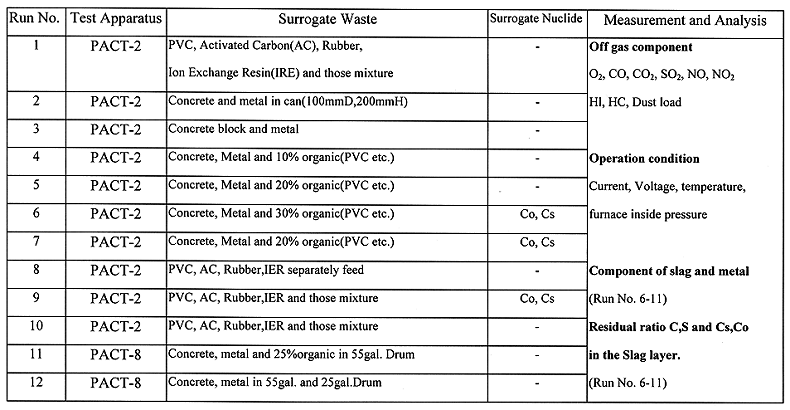
We performed the test with PACT-2 and PACT-8 of MGC-Plasma, Muttenz, Switzerland. The PACT-2 has 2 feet I.D. furnace and 150kW torch and the PCAT-8 has 8 feet I.D. furnace and 1,200kW torch. We used the PACT-2 as bench scale test apparatus and the PACT-8 as performance test apparatus. Table II shows the contents for all the test run.
Table II Certification Test Run
Test Result
Test results showed that the Plasma Arc Melting technology could efficiently melt incombustible waste with equality heating, with metal and organic.
We discuss the following items:
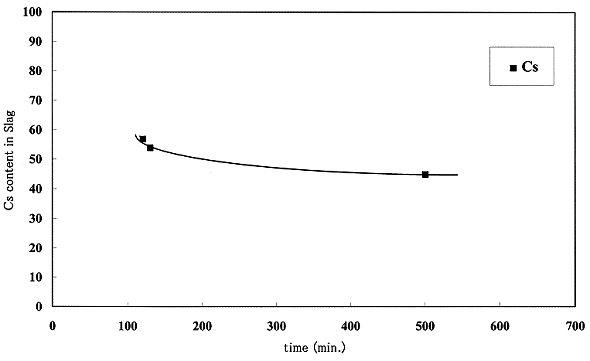
Fig. 1. Relation between Cs
distribution in the slag and operation time.
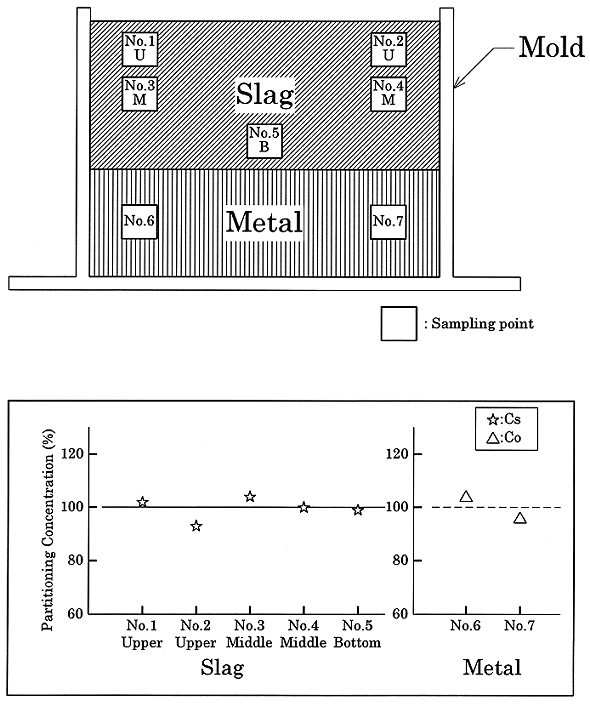
Fig. 2. Homogeneity
of surrogate nuclide in slag & metal.
CONTENT OF CONCEPTUAL DESIGN
Tsuruga Station has stored many Dry Active Wastes. Some special features about its station is that there are a little of many wastes: PVC, Rubber and the other organics. We have verified that PACT can adequately treat organics/inorganic waste mixture in our tests.
The conceptual flow diagram is shown in Fig.3 and we summarize the specification of Tsuruga plant in Table III.
Table III Plasma Melting Furnace General Specification
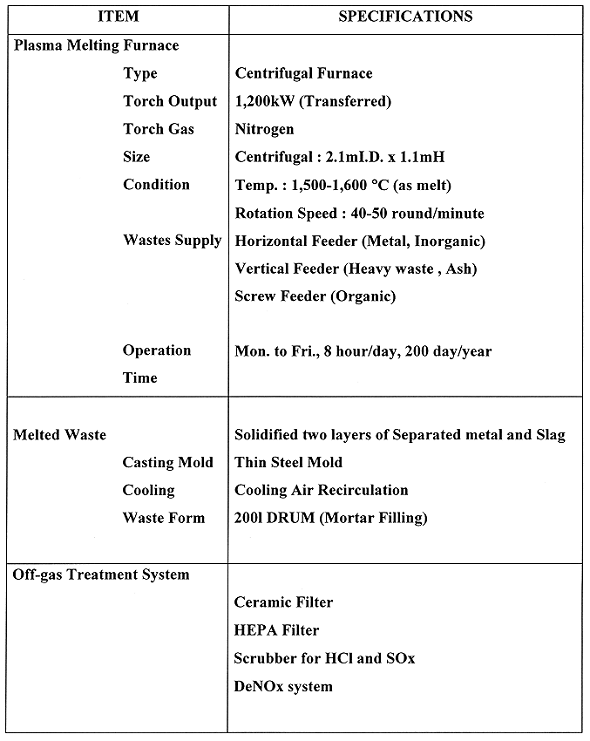
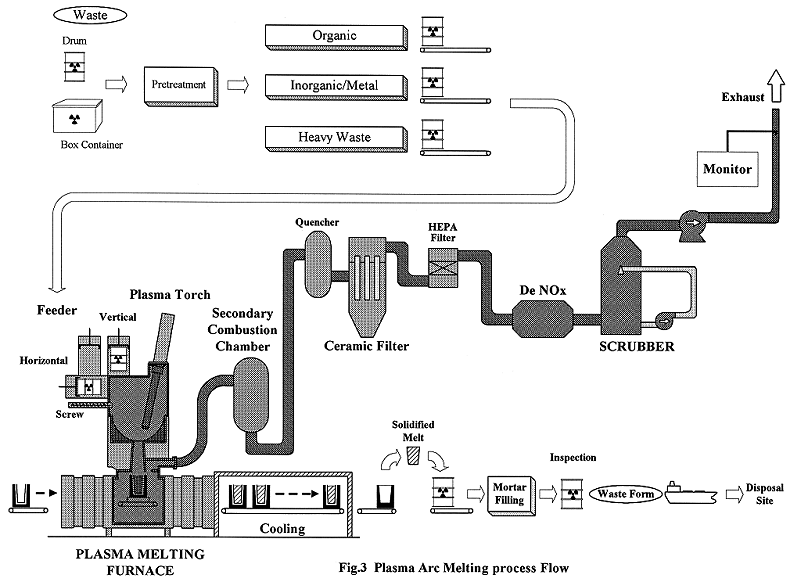
Fig. 3. Plasma arc
melting process flow.
Feeder System
We have discussed the way to feed into the furnace the following items: the weight, the shape and the size of waste, the chemical characteristics; organic, inorganic or metal and it's chlorine content and so on. We selected the following feeding system.
Operation Mode
Our basic operation mode is day time operation (8hr/ day) but the plasma furnace has adequate design for 24 hr. operation. Therefore we have to prepare the storage area of feed waste and solidified waste and adjust the capacity of pretreatment operation.
Optimum Operation Condition
We are now continuing the performance test and we will be able to get the optimum operation condition.
Process Flow and Material Balance
We discussed the rational waste stream and material balance. We are now continuing to analyze the material balance and activity balance. Especially concerning with activity balance, we must get detailed data to verify that public exposure from off gas is extremely low.
Off Gas Treatment Process
In Japan, they have approximately from 25 to 30 incinerators in nuclear field. Those incinerators have almost been installed with Ceramic Filter (CF) as dry off gas treatment systems. We also decided to adopt CF as removing radioactive nuclides but we have to solve the acid gas treatment due to HCl and SOx from organic waste. We are now planning to install a caustic scrubber after removing the radioactive nuclides with CF and discharge the scrubber waste water to sea after neutralizing and monitoring.
We are now performing the decontamination factor test of the off gas treatment system with both cold tracer and R.I. tracer. We will be able to get the result in the near future.
Final Waste Form
We have to condition waste to a final disposal form. Regulation of waste form is not yet finally decided but the following items will be required. We are planning to inspect these final wastes based on transport and disposal regulation and send them to the disposal site with steel container by ship.
We can solve some of those items because we adopted the melting process but we have to take care to limit the weight for example. We must adjust the feed ratio between inorganic and metal not to excess the weight of waste form over 1 ton/ drum.
Concept of Building
We discussed the basic equipment layout and the concept of building. Fig. 4 shows the appearance of our planned facility.
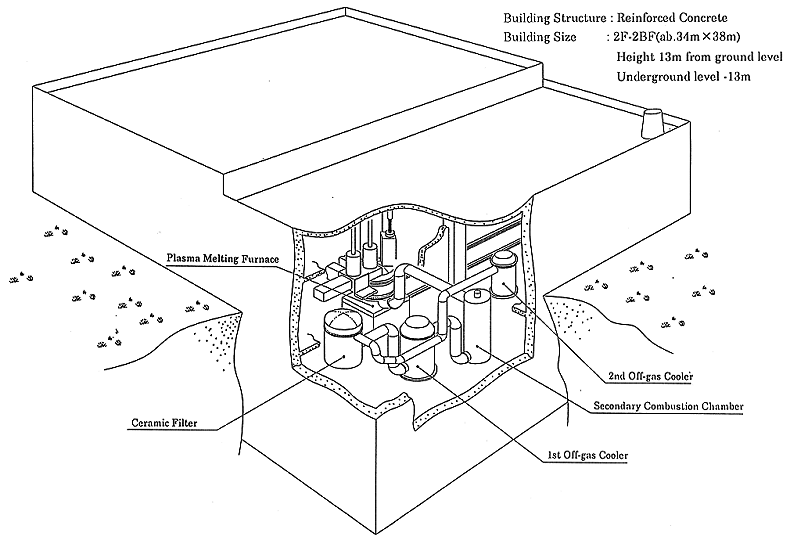
Fig. 4. Plasma
melting facility building.
CONCLUSION
We got good results of our certification test. Then we have started the basic design and the second phase of performance testing.
The basic design and this performance test now going on are used for application to the approval for installation to the Regulatory Authorities and of course are used as our detail design data. We hope to apply to the Regulatory Authorities within this year and start to construct in 1998. Turn over and operation start are expected in 2001.