Fig. 1. The rocky
flats benchmarking model.
Craig Elliott
Kaiser-Hill Company, L.L.C.
Glenn Doyle
DOE/RFFO
W. David Featherman
Project Performance Corporation
ABSTRACT
The Rocky Flats Environmental Technology Site (RFETS) has initiated a major work process improvement campaign using the tools of formalized benchmarking and streamlining. This paper provides insights into some of the process improvement activities performed at Rocky Flats from November 1995 through December 1996. It reviews the background, motivation, methodology, results, and lessons learned from this ongoing effort. The paper also presents important gains realized through process analysis and improvement including significant cost savings, productivity improvements, and an enhanced understanding of site work processes.
INTRODUCTION
Recently, considerable attention has been paid to the use of benchmarking and streamlining within the U.S. Department of Energy (DOE) and the nation's business community. In order to meet the challenge of reduced budgets and rising performance expectations, the Kaiser-Hill team at the Rocky Flats Environmental Technology Site (RFETS) has employed benchmarking as a means of examining its work processes and ultimately identifying and implementing improvements in the quality, productivity, and timeliness of products and services necessary to complete the site's mission. The results of the process improvement effort described below are being used to establish immediate and long-term performance improvement targets as well as to provide accurate estimates of future spending during site closure.
Benchmarking has been candidly defined as the practice of being humble enough to admit that someone else is better at something and being wise enough to try to learn how to match or surpass them at it. This has been a fundamental principle of the RFETS benchmarking approach, and consequently this effort has included some attributes not found in other approaches pursued across the DOE complex, namely:
MOTIVATION TO BENCHMARK
Three primary drivers led to the initiation of benchmarking and process improvement efforts at the Rocky Flats site:
To address these three drivers, the following objectives were identified prior to initiating the Rocky Flats benchmarking effort:
- to measure the efficiency and effectiveness of essential site cleanup and support processes,
- to identify similar processes at other public and commercial facilities perceived as having better performance,
- to perform quantitative and qualitative comparisons of key process performance measures,
- to understand the causes for performance gaps,
- to realize improvements in site performance consistent with the Rocky Flats ASAP,
- to develop Cost Reduction Proposals (CRPs) leading to the reallocation of funds to complete currently unfunded site activities, and
- to incorporate benchmarking and other performance improvement methods into the RFETS work culture.
BENCHMARKING METHODOLOGY
Benchmarking is one of many continuous improvement techniques that can be used to enhance organizational performance. Benchmarking is unique in that it employs comparative analyses with other organizations, called benchmarking partners, to generate creative solutions to process inefficiencies. A wide range of partners may be selected for a benchmarking study. It is not necessary to select partners that have identical organizational missions, only similar processes. One well-known example of utilizing benchmarking partners from different industries is the case of a shotgun shell manufacturer that sought help from a cosmetics company. Because the cosmetics company was doing an outstanding job producing lipstick cases, their manufacturing process was successfully adapted to produce high quality shotgun shell casings.
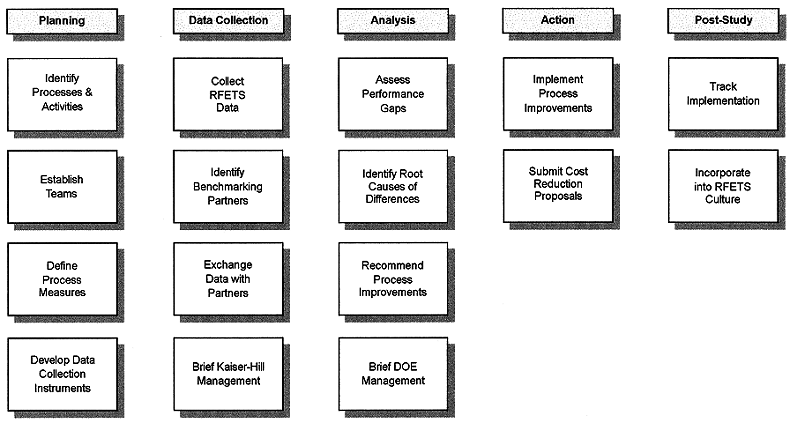
Experience gained during the past decade in both the public and private sectors has reinforced the practical value of benchmarking in environmental management activities. In January 1996, the DOE Office of Environmental Management published a benchmarking guide for use by federal and contractor personnel performing benchmarking analyses at its field sites. The Environmental Management Benchmarking Guide provides a flexible model for improving work processes through a series of discrete analysis activities (2). The benchmarking model employed at Rocky Flats, depicted in Fig. 1 below, was adapted directly from this guide. In some cases the benchmarking model was applied rather loosely to accommodate specific resource constraints encountered by process owners, while in others it was followed more rigorously to maximize returns on the analysis efforts.
The specific activities pursued during each step in the Rocky Flats benchmarking model are described below. Emphasis was consistently placed on the fact that benchmarking historically has been most effective when performed by the process owners themselves. To this end, the Kaiser-Hill benchmarking team served only to facilitate the process improvement activities, to maintain focus on the benchmarking objectives, and to provide status briefings to the managers and sponsors of the benchmarking initiative.
Fig. 1. The rocky
flats benchmarking model.
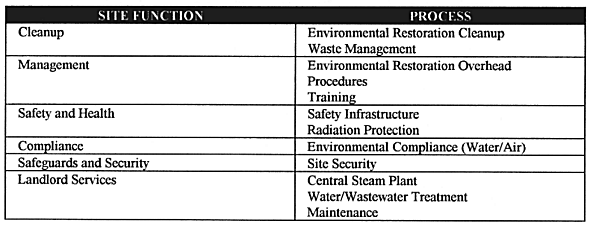
Table I. Processes Selected for Benchmarking
Following completion of these activities, the benchmarking facilitators continued to track the implementation of process improvements to ensure lasting change and to recalibrate process performance for future analyses. Benchmarking activities at Rocky Flats are currently ongoing in an effort to incorporate continuous process improvement into the site organizational culture.
RESULTS
Quantitative results for each of the twelve process analyses were presented in the Phase I Report prepared by the Kaiser-Hill benchmarking project team (4). Below is a summary of the root causes for performance gaps identified by the process owners in each area.
Environmental Restoration Cleanup: The primary causes for performance gaps in environmental restoration cleanup were 1) skill mix of site staff, 2) procedures, policies, and standards, and 3) a non-competitive work environment. To improve performance at Rocky Flats, the process team recommended staffing and work assignment changes, adoption of industry standards, and reduction of regulatory requirements.
Waste Management: The primary causes for performance gaps in waste management operations were 1) the configuration of site facilities and equipment, 2) technical bases for site operations, and 3) procedures, policies, and standards. To improve performance at Rocky Flats, the process team recommended streamlined sampling and analysis processes, reductions in staffing levels, and revised permitting and waste consolidation practices.
Environmental Restoration Overhead: The primary causes for performance gaps in environmental restoration overhead costs were 1) the configuration of site facilities and equipment, 2) technical bases for site operations, 3) procedures, policies, and standards, 4) a non-competitive work environment, and 5) training requirements. To improve performance at Rocky Flats, the process team recommended staffing changes, closer monitoring of equipment and travel, and reductions in training requirements.
Procedures: The primary cause for performance gaps in procedures was the unclear technical basis for procedure development and implementation at Rocky Flats. The process team recommended further analysis of this process by Kaiser-Hill management.
Training: The primary causes for performance gaps in training were 1) procedures, policies, and standards, 2) a non-competitive work environment, and 3) training requirements. To improve performance at Rocky Flats, the process team recommended streamlining and outsourcing site training duties.
Safety Infrastructure: The primary causes for performance gaps in the site safety infrastructure were 1) skill mix of site staff, 2) technical bases for site operations, and 3) the union bargaining agreement. To improve performance at Rocky Flats, the process team recommended site visits to partner organizations to further explore more effective safety processes and programs.
Radiation Protection: The primary causes for performance gaps in radiation protection activities were 1) the configuration of site facilities and equipment, 2) technical bases for site operations, and 3) procedures, policies, and standards. It should be noted that Rocky Flats exhibited significantly superior performance in the frequency of contamination incidents. To further improve performance at Rocky Flats, the process team recommended standardization and streamlining of procedures and requirements, and reduction in step-off pad staffing.
Environmental Compliance: The primary causes for performance gaps in compliance measures were 1) the configuration of site facilities and equipment, 2) skill mix of site staff, 3) technical bases for site operations, 4) procedures, policies, and standards, and 5) stakeholder and public expectations. To improve performance at Rocky Flats, the process team recommended reductions in the number and complexity of source assessments, a request for regulatory relief from the frequency of agency inspections, and streamlined compliance reporting procedures.
Site Security: The primary cause for performance gaps in site security was the configuration and type of site facilities and equipment. To improve performance at Rocky Flats, the process team recommended reduced training requirements and additional management review of security procedures and clearances, maintenance of classified information, and staffing of security posts.
Central Steam Plan: The primary causes for performance gaps in the operation of the site steam plant were 1) the union bargaining agreement and 2) training requirements. A significantly lower fuel cost for RFETS was the basis for superior overall cost performance. To further improve performance at Rocky Flats, the process team recommended modified training requirements and renegotiation of the collective bargaining agreement to allow plant operators to perform routine facility maintenance.
Water/Wastewater Treatment: This analysis demonstrated that the water treatment facility at Rocky Flats operates in a cost effective manner relative to the benchmarking partner. The primary causes for performance gaps in site wastewater treatment activities were 1) skill mix of site staff, 2) technical bases of site operations, and 3) procedures, policies, and standards. To improve performance at the Rocky Flats wastewater treatment facility, the process team recommended a review of current staffing requirements.
Maintenance: This analysis demonstrated that site maintenance is currently performed in a cost effective manner relative to one of the benchmarking partners. The primary causes for the performance gaps found between RFETS and a second partner organization, a commercial nuclear utility, were 1) the configuration of site facilities and equipment, 2) technical bases for site operations, and 3) procedures, policies, and standards. To further improve performance at Rocky Flats, the process team recommended a site visit to the commercial facility.
Team members from the twelve process areas experienced various degrees of success in terms of implementing process improvements based on their data collection and analysis efforts. Three process teams--training, radiation protection, and procedures--ultimately submitted Cost Reduction Proposals totaling $1.1 million as a result of the benchmarking initiative. To date, the training CRP (valued at nearly $350,000) has been approved by DOE. The other two CRPs developed during this benchmarking effort are still awaiting final evaluation. It should be noted that all the process teams achieved positive results through benchmarking, ranging from a more comprehensive understanding of existing work processes to insight gained from partner processes which eventually will lead to long-term productivity improvements at Rocky Flats. As a direct consequence of these gains, Kaiser-Hill has renewed its commitment to pursue benchmarking and other process improvement strategies in 1997 and beyond.
CONCLUSIONS
Several benchmarking teams cited similar causes for their performance deficiencies. Among the most prevalent of these factors were the following:
LESSONS LEARNED
Several interesting observations were made during the course of this year-long benchmarking initiative. The benchmarking project sponsors initially were uncertain of the level of participation and success this effort would generate at Rocky Flats, but to varying degrees each process team was able to achieve a positive outcome as a result of its endeavors. Some of the more useful lessons learned from the benchmarking analyses are discussed below.
FUTURE EFFORTS AT ROCKY FLATS
The Kaiser-Hill team will continue to employ benchmarking, streamlining, and reengineering techniques in pursuit of further improvements in process efficiency and effectiveness at the Rocky Flats Environmental Technology Site. The ultimate goal of these efforts will be the development of Cost Reduction Proposals leading to the reallocation of funds to complete currently unfunded site activities, thereby hastening site closure.
Currently, process owners have begun analysis of several functions within the Environmental Restoration/Waste Management & Integration organization at Rocky Flats. To date they have initiated efforts to generate CRPs for activities relating to 1) wastewater treatment, 2) building maintenance, and 3) groundwater monitoring . In addition, Kaiser-Hill has proposed a streamlining analysis of the current site budgeting process in advance of the FY1998 budget call. This analysis would include an objective evaluation of current practices and protocols, incorporation of lessons learned from the FY1996 and FY1997 budget calls, and comparative assessments of other DOE sites and/or private-sector business enterprises, as appropriate. Other site organizations currently being considered as candidates for process improvement include Human Resources and Finance and Administration.
Finally, as a result of this benchmarking effort, Kaiser-Hill management intends to institutionalize the process improvement philosophy within the organizational culture at Rocky Flats. This likely will require annual training seminars utilizing progressive knowledge transfer and organizational learning techniques, modification of annual work package approval requirements to include provisions for process improvement activities aimed at developing CRPs, and the adoption of annual performance reviews for work package managers to evaluate the impacts of process improvements. By incorporating these measures into their integrated management strategy, the Kaiser-Hill team is poised to accomplish their accelerated site closure goals while maintaining the highest standards of productivity, efficiency, and safety.
REFERENCES