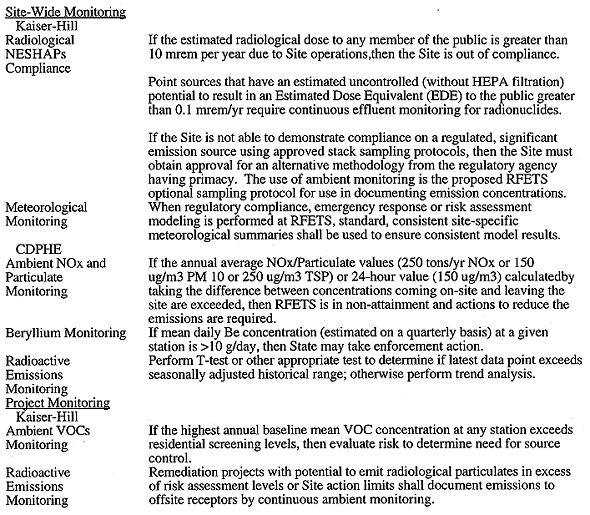
Table I Decision Rules for Air Quality Monitoring Program Elements
G. M. Kelly
Rocky Flats Environmental Technology Site
ABSTRACT
The Rocky Flats Environmental Technology Site (RFETS) has to conduct extensive monitoring to characterize emissions, assess emission impacts, and comply with numerous environmental laws and regulations associated with Site missions, including waste management, deactivation, decontamination and decommissioning, and environmental restoration. Historically, the Site has operated extensive monitoring programs, which grew over the years as new requirements were added, to cover surface water, ground water, air and various ecological systems. In the face of severe budget cuts in FY 95 and FY 96, Kaiser-Hill (K-H) undertook a structured, comprehensive, holistic reevaluation of all environmental monitoring programs. The objective of this effort was to identify monitoring needs, based on environmental management and compliance decisions that need to be made, and to develop specifications for monitoring utilizing the U.S. Environmental Protection Agency (EPA) data quality objectives (DQO) process. The effort involved EPA and the Colorado Department of Public Health and Environment (CDPHE) regulators, representatives from adjacent cities, and members of the K-H Team evaluating all monitoring being conducted by all parties. Using the consensus specifications (DQOs), optimal data collection schemes were determined and the media-specific programs of the parties were modified accordingly. Such an approach demonstrates compliance with the myriad of Federal and State regulations and Department of Energy (DOE) orders, and supports the decisions that must be made to protect human health and the environment with an acceptable degree of certainty. Additional effort is required to ensure that programs are integrated across media. The results will be a truly integrated, multi-party Site monitoring program.
NEED FOR MONITORING INTEGRATION
RFETS, like many other industrial facilities, has to conduct extensive monitoring to characterize emissions and effluents, determine the nature and extent of contaminant migration, assess environmental impacts, and comply with numerous environmental laws and regulations associated with Site missions, including waste management, decontamination and decommissioning, and environmental restoration. Over the years, various media- and regulation-specific monitoring programs were developed and grew as new requirements were imposed to cover surface water, groundwater, air, ecological resources under the CWA, CAA, RCRA, CERCLA, Federal natural resource protection laws and regulations, State regulations, compliance orders and agreements, DOE Orders, etc.
In addition, the monitoring requirements grew separately in a "stove-pipe" fashion, with agency personnel working separately on different regulatory programs, infrequently communicating. Also, EPA and State personnel working on the same programs came up with separate requirements. Because the regulations are media- specific, they do not address a holistic, integrated approach to compliance demonstration (e.g., monitoring), and no incentives exist for the regulators to communicate and integrate requirements. In addition, compliance programs developed by the regulated community to respond to the regulatory programs grew separately. The impact of this uncoordinated regulation is perfectly illustrated by monitoring requirements imposed on RFETS. For example, RFETS ended up with multiple requirements calling for 500 groundwater monitoring wells for a 10-acre site.
These monitoring programs became very expensive and are no longer affordable in todays budget environment. From a program management and cost standpoint, RFETS recognized it could no longer continue to have separate, duplicative and unfocused monitoring activities conducted by various entities at the Site (e.g., Environmental Protection and Environmental Restoration), or between the Site, the State, and the Cities. Therefore, to continue to protect the environment and comply with regulations, RFETS realized it needed to change its monitoring approach and do the following:
THE DQO PROCESS
The DQO process is a structured planning process that requires the identification of and agreement on decisions for which data are required, and results in the full set of specifications needed to develop a statistically-based, defensible data collection program. The process can be applied to various types of programs, including remedial investigations, waste characterization, and monitoring. Steps involved in the process include:
THE RFETS APPROACH
Development of an integrated, multi-media, multi-program monitoring plan is not a trivial effort. In fact, a similar effort may never have been attempted at a DOE facility before. Changes to the existing approach needed to be made, and change is never easy. In addition, objectives were ambitious:
In the past, the DQO process has been applied to individual programs, such as site investigations and waste characterization, and not used to integrate multiple programs. Because of the originality of this effort, DOE Headquarters (EM263) provided matching funds and technical assistance through PNL.
Rather than simply working to identify and remove these redundancies, the Site formed an integrated monitoring working group with representatives from EPA, the State, and adjacent cities to develop consensus on what decisions need to be made and what data need to be collected to make these decisions, and to develop sampling and analysis plans based data needs. The idea was not to evaluate existing programs and streamline them, but to identify the basis for each program and develop each program accordingly, very much like zero-based budgeting. In developing the requirements for an integrated monitoring plan, the decisions and multi-media data requirements associated with RCRA, CERCLA, CAA, CWA, CWQCC standards, natural resource protection regulations, Site-specific clean-up agreements, and several DOE orders were considered. After data requirements to support each of the desired decisions were identified, an attempt was made to streamline data collection by looking for opportunities to maximize multiple uses of each of the measurements to be made. The responsibility for data generation was then spread across these entities in a logical way.
To accomplish the work associated with developing an integrated monitoring plan, four media-specific DQO working groups were established. Each group met regularly to work their way through the DQO process for each decision that the group felt that data were needed to support. In addition, all four groups met together to discuss data needs across media, share progress, ensure consistency, and identify problems. DQO facilitators and statisticians assisted the integrated monitoring working group in developing the DQOs, evaluating the adequacy of existing designs, and developing new sampling and analysis plans.
DQO RESULTS
During 1996, RFETS developed DQOs for surface water, groundwater, air, and ecological monitoring, and revised monitoring programs accordingly. Emphasis was placed on individual programs. Effort went to develop relationships with the regulators and the cities; to understand the DQO process; to determine the type of monitoring required; and to specify locations, frequencies, and analytes. A draft Integrated Monitoring Plan has been assembled, which supports all FY 97 monitoring activities and related budget requests, and provides the basis for monitoring change as Site conditions and activities change. Based on results, significant cost-savings will be realized during FY 97. For example, the working group reduced the number of groundwater monitoring wells from 500 in FY 95 to 70 in FY 97.
Air Monitoring
Air Quality Management operates a monitoring program that supports both compliance demonstration and emergency response needs at the Site. Monitoring of radioactive emissions from building process vents support both DOE Order requirements and radionuclide NESHAP monitoring and reporting requirements. Effluent monitoring also supports ALARA (as low as is reasonably achievable) principals. Ambient monitoring of radionuclides on the Site and in the communities immediately adjacent to the Site also satisfy DOE Order requirements and is anticipated to be used in the near future to satisfy radionuclide NESHAP reporting requirements. Meteorological monitoring supports both the radionuclide NESHAP reporting requirements and emergency response requirements under the DOE orders.
The scope of this support includes both the characterization of airborne materials and the meteorology responsible for their transport and dispersion. Air Quality monitoring programs provide compliance and support data to other Site functional organizations. Effluent data supports Nuclear Safety evaluation of the building safety envelope. Ambient data can be used in the Human Health Risk Assessment evaluations of Operable Unit closure, and to validate effluent modeling results. Emergency response operations and their associated modeling efforts (Terrain Response Atmospheric Code) make major use out the AQ 61-meter meteorological tower. Air Quality monitoring programs do not include sampling conducted to support Industrial Hygiene or radiation worker safety programs.
The DQO process for air quality monitoring involved establishment of monitoring specificiations for the following program elements:
Radiological NESHAPs Compliance
Meteorological Monitoring
Ambient NOx and Particulates
Beryllium
Ambient Volatile Organic Compounds (VOCs)
Radioactive Emissions
Each set of specifications included decision inputs (data needs), monitoring boundaries, and decision rules. After these were established, monitoring requirements could be specified. Decision rules for each of the program elements are presented in Table I.
Table I Decision Rules for Air Quality Monitoring Program Elements
Approval for the use of ambient monitoring to demonstrate compliance with 40 CFR, Part 61, Subpart H and Appendix B is currently being negotiated by DOE and Kaiser Hill. This issue needs resolution due to the discontinuation of effluent sampling in buildings currently requiring continuous sampling yet scheduled for deactivation.
Surface Water Monitoring
Surface water monitoring objectives for the Site have been organized in a roughly upstream-to-downstream direction, beginning with process discharges within the Industrial Area and ending at the drinking water reservoirs downstream. The first set of objectives are driven by CERCLA requirements to identify and correct significant accidental or undetected releases of contaminants within the Industrial Area. In order to decide whether a significant release has occurred, the Site must monitor Industrial Area runoff for significant increases in contaminants. Also the Site must often decide whether incidental waters that accumulate outside buildings in berms, utility pits, etc. must be treated, or whether they can be discharged directly to the environment or to the sanitary system. In addition, individual high-risk projects will sometimes need performance monitoring to detect a spill or release of contaminants specifically from that project.
A second set of monitoring objectives deals with discharges from the Industrial Area to the ponds. To develop the NPDES Permit application, the Site must monitor the internal wastestreams of some processes within some facilities to establish what the Site might reasonably expect to see in discharges from these processes. The Site also is routinely required to determine whether some internal waste streams may be discharged from the Industrial Area to the wastewater treatment plant (WWTP). In addition, some monitoring must be performed on the influent from the wastewater collection system to the WWTP.
Water leaving the Site must also be monitored. Ponds must be monitored prior to discharge, and the Site must monitor specific point source discharges as specified by the NPDES permit. In addition, the Site must monitor downstream of point sources to demonstrate compliance with State stream standards. Furthermore, the State of Colorado and downstream communities are concerned that the water quality in downstream reservoirs might be degraded by Site discharges. Monitoring data from the reservoirs are used to make decisions regarding use of the water for drinking and irrigation, and for compensatory actions such as providing alternate water sources and reservoirs. Monitoring requirements also exist to characterize the interface between surface water and other media: soil, groundwater, air, and ecology. Groundwater and soil could conceivably contaminate surface water, and surface water could contaminate habitats of sensitive and endangered species. In addition, Site activities could alterflow patterns and quantities, which could adversely impact ecological systems.
There are also special monitoring objectives that do not fit in upstream/downstream sequence. For example, safe operation of the dams is dependent upon some monitoring to avoid breaching a dam. Another monitoring objective includes monitoring to locate a new source of contamination, if detected by other monitoring, that could take place anywhere on Site. In addition, there is ad hoc sampling for unanticipated needs. Some monitoring may be performed at various locations to evaluate alternatives for surface water management, such as changing the mode of pond operations from batch discharge to controlled detention, discharge of the Interceptor Trench System effluent into Walnut Creek, or re-routing of WWTP effluent.
Groundwater Monitoring
The DQO process for groundwater determined the need for a network consisting of the following wells:
DQOs were also developed for groundwater flow monitoring and sampling frequencies. Groundwater quantity, as well as magnitude and direction of groundwater flow, are necessary to assess the impacts of Site operations on surface water quality and potential impacts to valved and endangered species habitat. In addition, groundwater flow information is necessary to support the design and implementation of remedial decisions in which a knowledge of groundwater quantity and flow is critical. Sampling frequency should be established based on the velocity that groundwater is moving through the aquifer.
Ecological Monitoring
Since the Ecological Monitoring Program deals with a large and dynamic natural system, where established endpoints (e.g., discharge permit limitations) do not exist, a qualitative, rather than a statistical, monitoring approach was adopted. This approach focuses on collection of data necessary to ensure regulatory compliance and to assess the success or failure of DOEs resource conservation and vegetation community management efforts. These conservation and management efforts are aimed at achieving a set of management goals consistent with DOEs draft Buffer Zone Policy. In general, the goals include conservation of currently viable ecosystems, detection and management of problems or undesirable impacts to the Buffer Zone before they become severe, protection of unique and ecologically valuable natural resources in the Buffer Zone, protection of any special-concern species (threatened, endangered, candidate, proposed, state-listed, or other sensitive species), and compliance with applicable wildlife and natural resource protection regulations.
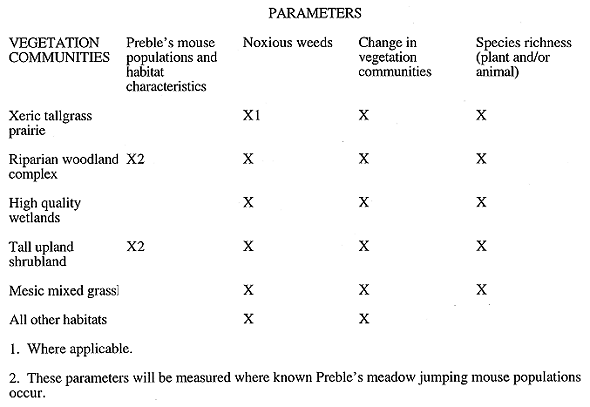
The design of the Ecological Monitoring Program follows the development of decision rules regarding conservation and regulatory compliance at RFETS. These decision rules specify the measurement and evaluation of analytical parameters for five vegetation communities and for Prebles meadow jumping mouse populations on the site. They also specify the criteria that will help ensure regulatory compliance. These criteria, if detected for any of the variables, will trigger a re-evaluation of ecological conservation actions or re-evaluation of RFETS project designs. These decision rules are formulated such that each can independently trigger an action. Key parameters to be measured and used in comparisons are presented in Table II.
Table II Ecological Parameters to be Measured vs Vegetation
Communities
In addition to ecological conservation and habitat protection, specific decisions on threatened and endangered (T & E) species, migratory birds and wetlands must be considered. The basic decision to be made is whether a proposed project has potential to impact T&E species, migratory birds, or wetlands. Such projects may require mitigating action to move forward. Much of the data to support these decisions will come from the data collected from monitoring each vegetation community as discussed above. This monitoring, however, does not focus on specific areas that may be affected by the footprint of a proposed project. Therefore, additional data needs may arise to support project-specific decisions in accordance with the regulatory requirements.
NEXT STEPS
Program refinement needs to continue, and additional cost-savings should be realized. Media-specific programs need now to use the DQO process to evaluate detection limits, quality control specifications, and other technical monitoring aspects (e.g., acceptable data recovery rate and exchange frequencies for ambient air samplers) not considered during FY 96. Plans for FY 97 also include:
PROBLEMS AND SUCCESSES
Problems
The major problem encountered in implementing the DQO process at RFETS was the time that it took to establish consensus on monitoring decisions needed. A factor was the fact that many of the players never truly had to work together before. They included the regulators, the regulated community, and community representatives with concerned constituents and political agendas. Many had been on the opposite side of the negotiationg table for several years, and relationships had tended to be adversarial. Old issues kept surfacing and had to be resolved. It also took time to educate individuals on the process and the terms used. To a great extent, the working groups moved through the process at a good pace after decisions had been established.
Another problem that had to be overcome and that is often encountered is that people tend to misunderstand the process and think that they are going through the process to trim down a program. So people tended to identify elements of a program that could be eliminated. This mind set also caused people to be a little defensive. It took time to convince players that the process was a bottom-up approach to identify the real drivers behind a program (i.e., the data needed to apply the decision rule).
Stakeholder Participation
The integrated monitoring working group brought all key parties together and forced them to develop consensus. The agencies and cities were very pleased to have been brought into the process early, instead of having been told about results (e.g., reductions in monitoring) after the fact, without understanding and being part of the process. This significantly strengthened working relationships. The process turned relationships from often being adversarial to being constructive and positive. Such relationships will enable easier negotiations in the future regarding the broad suite of environmental issues, such as clean-up levels, air and water quality standards, permit terms and conditions, and changes in monitoring programs.
Other stakeholders are very interested in monitoring, especially in light of planned environmental restoration and decontamination and decommissioning projects. There is significant concern that these projects will emit pollutants that might cause adverse health and environmental impacts. Stakeholders want to be assured that monitoring will be sufficient to identify and control releases. Application of the DQO process in a rigorous professional manner and participation of stakeholders in the working group should go a long way to allay concerns. During FY 96, RFETS and the State made presentations to stakeholder groups, including the RFETS Citizens Advisory Board, regarding monitoring at RFETS, the DQO process to improve monitoring, the integrated monitoring working group, and the integrated monitoring plan. Similar meetings are planned for FY 97.
The interest of stakeholders is reflected by the development of an integrated monitoring program having been made a requirement of the newly signed Rocky Flats Cleanup Agreement. The agreement commits the Site to preparation of an integrated monitoring plan, which will be updated annually and approved by the regulatory agencies, and development of a data exchange mechanism between all the parties.
Burden Reduction
Integrated monitoring based on DQOs will streamline monitoring activities and will reduce monitoring costs. The DQO process, implemented with stakeholder involvement, will also ensure that monitoring is performed correctly from the start. Results should be fewer calls for more data and less criticism about monitoring programs. The rationale behind monitoring programs will not have to be revisited over and over again. Stakeholders will understand the bases for the programs and will no longer question if RFETS collects necessary and sufficient data to make environmental management decisions. In addition, DQO-based monitoring programs will not have to undergo continual internal management and budget scrutiny. After the bases for each program is developed and clearly communicated, the programs will no longer need to be defended. Management will finally be able to see and understand the underlying bases to the monitoring programs and understand that funding can not be reduced. The programs have been reduced down to the essentials. Most importantly, resultant cost savings can be used for Site risk reduction activities, such as plutonium stabilization, decontamination and environmental clean-up.
Transferability Personnel from other industrial facilities who have to monitor to comply with several regulatory programs could benefit from the RFETS experience. Results of the DQO process at RFETS will yield an integrated, streamlined and defensible monitoring program approved by regulators and other stakeholders. Other facilities could experience cost-savings and improved relationships with the stakeholders.
CONCLUSION
The DQO process enabled the identification of and agreement on decisions for which data are required and yielded the full set of specifications needed to develop a statistically-based, defensible monitoring program. The outcome is an integrated monitoring plan that supports all existing monitoring activities, and related budget requests, and provides the basis for monitoring change as Site conditions and activities change. The process also identified monitoring activities that did not support some decisions, and therefore, cost-savings were realized. Most importantly, the process brought all parties together and forced them to develop consensus. The agencies and cities were very pleased to have been brought into the process early, instead of having been told about results after the fact. This significantly strengthened relationships. The process turned relationships from often being a dverserial to being constructive and positive. Such relationships will enable easier negotiations in the future regarding the broad suite of environmental issues, such as cleanup levels, air and water quality standards, permit terms and conditions, changes in monitoring programs, etc.