Vladimir I. Yatsevich, Larissa F. Rozdialovskaya, Andrei A.
Tukhto
Committee for Supervision of Industrial and Nuclear Safety
(Promatomnadzor)
Republic of Belarus
ABSTRACT
Since Belarus gained its independence a lot of problems have been arising with regard to institutional and capacity building of a newly independent state. The problems associated with establishing radiation safety and radioactive waste management infrastructure became especially acute after the Chernobyl catastrophe, when 70% of the radioactive blow-outs fell out on the Belarus territory. The paper's intention is to show the present situation and outline the actions taken to enhance developments in the field of managing of different categories of radioactive waste generated in Belarus.
INTRODUCTION
Belarus does not use nuclear power for energy production. It is partly for this reason that there has been no adequate infrastructure to address major issues in the field of radioactive waste management in a newly-independent country after break-up of the USSR. The overall goal of the national policy is that radioactive waste shall be handled, treated and disposed of in such a way that any unacceptable detriment to human healthand the environment is avoided, now and in the future. To meet the goal, the first steps are to establish competent organizations and legal regulation of the related activities. In this context, late in 1991 Gostekhnadzor of Belarus was transformed into Gospromatomnadzor - the State Committee forSupervision of Industrial and Nuclear Safety. The Committee incorporated theInterregional Nuclear and Radiation Safety Inspectorate which was later supplementedby the Department for Nuclear and Radiation Safety Regulation. By special decree ofthe Government, the Gospromatomnadzor was designated a national competent bodyin nuclear and radiation safety. Its functions include supervision of safe execution ofworks at all stages of radioactive waste management and organization of the development of regulations and standards in the field.
Today the Promatomnadzor is a part of the Ministry of Emergencies and Population Protection from the Chernobyl Catastrophe Consequences.
There are also other agencies dealing with radiation protection, nuclear safety and waste management in Belarus.
Ministry of Health controls radiation protection issues related with exposures of people involved in industrial activities, medicine and living in the fall-out-contaminated areas.
The Committee for Standardization, Metrology and Certification is responsible for operational protection and certification.
The Committee for Hydrology and Meteorology exercises monitoring of radioecological situation nationwide.
The National Commission on Radiation Protection is an expert consultative body making recommendations to higher governmental authorities on issues related to radiation safety.
It should be pointed out that after the Chernobyl accident radioactive waste in the Republic of Belarus is classified into at least two different categories, each requiring a separate approachtowards standardization, regulatory control and selection of processing technologies.
The first category can be defined as ordinary low- and intermediate-level "wastes from small producers". They arise from extensive use of radiation sources by more than 1000 firms and companies in medicine, industry and research. 8 tons of intermediate- and low-level waste and 3000-6000 of spent sealed sources are generated in the republic annually. Decommissioning of the shut-down research reactor has produced solid waste which is subject for disposal.
The second waste category is the so-called "Chernobyl wastes", i.e. wastes generated in the course of clean-up works, economic and other human activities on the territory contaminated by the "Chernobyl fallout". Thousands tons of low-level and very low-level waste arose just after the accident. Currently, several tens of tons of the waste is formed annually.
Owing to inadequate normative, technical and financial support, Belarus has serious difficulties in organization of proper handling and disposal of the waste mentioned as well as in establishing an effective supervision and control in the field.
Primarily the competent organizations focus their efforts on the solution of the following two issues that are identified as the most urgent:
MANAGING RADIOACTIVE WASTE FROM SMALL PRODUCERS
Collection, storage and disposal of the waste is carried out by specialized enterprise 'Ekores', which is located 10 km away from Minsk and is the only in the Republic. It is a typical 'Radon' facility equipped with two concrete vaults (1660 m3) for disposal of solid waste and with four repositories for disposal of spent sealed sources (1).
Until 1992, disposal of waste at the 'Ekores' facility was conducted without any waste segregation and with no appropriate record keeping.
At present, wastes containing 239Pu, 241Am, 226Ra are stored separately in special containers. Proper records of the incoming wastes are maintained. Decision has been taken to perform safety assessment of the facility and to work out a plan of its reconstruction. Financial expenses associated with the reconstruction have been estimated as 3 million dollars. At present, the Cabinet of Ministers of the Republic of Belarus studies the possibility of allocating at least partial funds for the project.
The Promatomnadzor has initiated a number of contacts with competent international organizations in trying to improve the operating conditions and technologies employed at the facility. As a result, a Technical Cooperation Project (TCO) with the IAEA 'Rehabilitation of 'Ekores' radioactive waste disposal facility' was approved for 1997- 1998. The intention is to supply the facility with modern technologies and equipment for disposing waste, including processing of liquid waste, compacting waste, decontamination of technical means, computerized record of materials to be disposed.
The serious issue is an urgent necessity for disposal (long-term storage) of high-activity Co-60 and Cs-137 sources from gamma-irradiators used in industry, research and medicine. The sources were manufactured and supplied to Belarus by the Russian enterprise 'Majak-69. In the former USSR standard procedure required spent sources to be returned to suppliers in exchange for new devices.
Now such practice is stopped because of the Russia's legislation, and Belarus is facing great difficulties with storage of spent sources in its territory. Besides, providing of Belarussian users with new sources is often a problem owing to their great cost.
As a temporary solution to the problem, a group of Belarussian specialists have worked out practical guidance and techniques allowing extension of operation life time of spent sources after appropriate qualification testing procedure. The National Regulations on the Management of Sealed Sources have been amended accordingly.
It should be noted that at present, prolongation of operating life time of gamma-sources seems to be the only way out for prolongation of economic life time of high-activity gamma-irradiators in Belarus.
Competent authorities are studying the following options as reasonable measures to be taken in the near future:
MANAGING THE "CHERNOBYL WASTE'
As regards development of the regulatory control criteria and handling technology, the following kinds of waste can be grouped under this category. Wastes resulting from the clean-up ('decontamination') procedures in the fallout- contaminated areas.
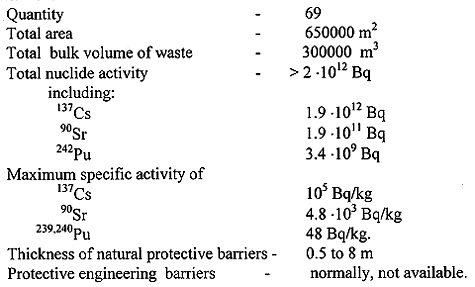
The main goal of clean-up work is to improve radiological situation in polluted populated areas and prevent propagation of radionuclides as a result of fires and unauthorized exportation of contaminated materials. That work includes removal of contaminated soil, decontamination of installations and industrial equipment, dismantling of structures and buildings being not subjected to clean-up. In the period of 1986-1989, about 500 settlements were decontaminated, (2). More than 300000 m3 of waste ware generated. The waste consisting of removed soil, roofing slate, boards, household articles, domestic garbage, structural elements were brought together into 69 interim storage sites. Ravines, sand pits, foundation pits, trenches, etc. were used as 'natural' locations for the sites with no due account taken of hydrogeological situation. In 1992, within the State Program launched, examination and inventory-taking of the storage sites have been completed (3,4). The sites have the following characteristics:
Among immediate measures taken to ensure safety of such sites, one should mention covering waste with the layer of earth, installation of perimeter fences and "radiation danger" notices.
Near the border with the Ukraine (see Fig.1) a concrete repository was constructed where 3088 tons of contaminated meat were disposed of just after the accident. The total activity of the wastes in the repository is 745 GBq.
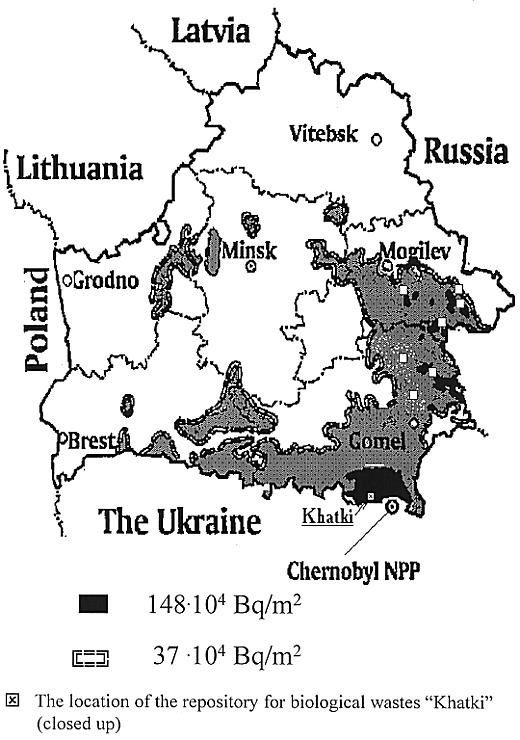
Fig. 1. Site locations of the
repositories in which "Chernobyl wastes" are currently disposed
(marked with white dots).
X= The location of the repository for biological wastes "Khatki" (closed up)
Since 1992 clean-up works in the abandoned areas have been carried out by two specialized state enterprises 'Polesye' (Gomel region) and 'Radon' (Mogilev region), which had been set up under the auspices of the Ministry of Emergencies. About 30000 tons of 'decontamination' waste are formed annually as a result of clean-up activities conducted by these enterprises. The wastes are disposed in 7 repositories constructed from type designs in the abandoned areas ('relocation zones'). All the repositories represent territories with one or two reservoirs banked up with embankments 4 m high. The compacted earth bottom and slopes are covered with pugged clay barriers of 0.5 m thick, which are then covered with stabilized polyethylene film. The film is buried with a protective earth layer 0.6 m thick (Fig. 2). The repository is equipped with a net of boreholes along its perimeter.
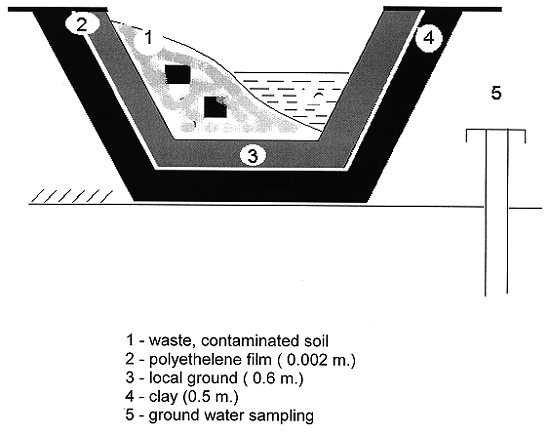
Fig. 2. Partly
fulfilled repository for "Chernobyl waste."
The repositories have the following parameters:
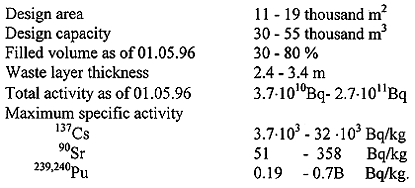
Because of the absence of drainage system, the reservoirs with wastes are heavily swamped, and free spaces are filled with rain water.
Assessment of the conditions of all sites with "decontamination wastes" has been made. The assessment data obtained by scientists of the Belarus Academy of Sciences within the State Chernobyl Program show that many of the disposal sites are potentially dangerous for population primarily as sources of radioactive contamination of ground and surface waters. In some cases, they can be a source of external exposure of people, who may remove from the site some items suitable for further use (e.g., construction materials).
Wastes arising from decontamination of industrial equipment is the second group of 'Chernobyl waste'. These wastes are formed at Gomel enterprises during clean-up of equipment contaminated owing to intensive work of ventilation systems in the period after the Chernobyl accident. In 1991-1995, about 390 ventilation systems with contamination level up to 1500 beta-particles/cm2/min were treated and about 1300 units were found to require decontamination. The work results in annual generation of up to 20 tons of liquid and of about 10-20 tons of solid radioactive waste with the following characteristics:
Liquid waste produced by chemical decontamination:
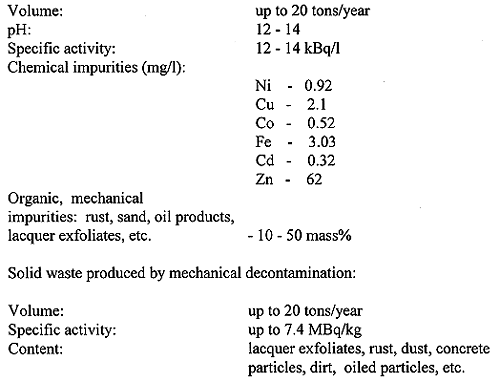
Decontamination is conducted by the personnel of the 'Polesye' enterprise, which is responsible for handling and disposal of produced wastes in a safe manner.
Liquid wastes are collected into special containers and transported to one of the seven repositories mentioned above which is equipped with a simple installation for cementation. The wastes are immediately conditioned into cement and buried as cement blocks owing to lack of storage conditions.
Solid wastes are packed into double polyethylene bags and transported to the repository by a special-purpose vehicle. The bags are kept on the territory of the repository under conditions allowing their subsequent removal and final disposal.
In contrast to other wastes of Chernobyl origin, this waste group does not essentially differ from wastes generated in industry and research. So, it must be regulated in accordance with the rules established for waste from small producers. At present, the technology employed does not meet the standards in many respects and large additional financing is needed to improve the situation.
Radioactive municipal domestic wastes include
The special research conducted in 1992-1995 within the framework of the Chernobyl Program has shown that the use of local fire-wood and peat for heating stoves and municipal furnaces generates about 18 thousand tons of radioactive ash waste (AW). In 75% of the waste, 137Cs specific activity is higher than 9.7 kBq/kg, that is the exemption level established in Belarus for radioactive waste. The highest AW specific activity values are 449.6, 22.5 and 0.72 kBq/kg for 137Cs, 90Sr and 239,240 Pu, respectively (5).
Sewage water sediments from waste-water treatment plants located in the Chernobyl zone have the level of 137Cs contamination from 27 to 60 kBq/kg (1), accumulated volumes of such wastes being 30 thousand cubic meters annually.
Migration ability of radionuclides in contaminated AW and SSW is relatively high: 30- 40% of 137Cs and 16-40% of 90Sr-90 are present in the waste in mobile forms. According to forecasts, 137Cs from SSW can reach underground water in 14-30 years (exceeding the exemption levels for drinking water). Consequently, there is a real risk of radionuclides entering the environment in a not so distant future, especially in case of habitual practice of using AW and SSW as fertilizers.
The main conclusion from the results obtained is that consistent measures have to be taken to isolate the waste in a safe and suitable manner. Preliminary recommendations have been prepared by working groups of researchers. However, due to lack of financing the issue is not expected to be addressed in the nearest future.
DEVELOPMENT OF LEGISLATION AND REGULATORY REQUIREMENTS
So far, there has been no law on radiation protection or use of atomic energy in Belarus. Drafts of the law 'On Radiation Protection' has passed the first reading in the Supreme Soviet, and the comprehensive law 'On the Uses of Atomic Energy' is scheduled for the first reading in the first part of 1997. Pending adoption of these two laws the process of reviewing the existing waste management regulations is somewhat delayed.
Hence, Belarus continues to rely upon the rules and norms of the former Soviet Union, which do not meet Belarus conditions in many respects. In recent years, the regulations in force have been supplemented by some subordinate ordinances issued by the Cabinet of Ministers. For example, the Ordinance 'On the list of activities subject to licensing' prescribes a license procedure for specific activities related to transportation, storage and disposal of radioactive waste.
Management of wastes generated as a result of clean-up work after the Chernobyl accident is regulated to a great extent by the law 'On legal treatment of territories contaminated as a result of the Chernobyl NPP catastrophe' enacted in 1991.
The law distinguishes between two types of wastes in the contaminated area: those with activity exceeding the exemption levels (radioactive waste) and 'very low level radioactive substances' with activity 10 times less. According to the Law, Promatomnadzor and the Ministry of Health exercise supervision of storage and disposal of radioactive waste, with the exception of very low-level radioactive substances'. In practice the disposed wastes of both types are placed together in the «Chernobyl repositories» without any intention of their subsequent separation. That is why the question whether or not the sites should be placed under supervision of Promatomnadzor is the issue debated for several years.
Moreover the rules of the former USSR designed for control of radioactive waste from small producers are absolutely unsuitable for 'Chernobyl waste' management even if they are classified as radioactive waste.
It is expected that most of the problems connected with the supervision of the Chernobyl waste sites will be settled when a special document 'Provisional sanitary rules for the management of decontamination waste of Chernobyl origin' is put in force . The draft of the document covers waste management activities in relation to all the wastes of Chernobyl origin with the only exception of municipal wastes.
CONCLUSION
In closing it should be noted that a great enthusiasm shown by specialists is retarded by low funding available for establishing improved waste management infrastructure. Of great importance is the development of the national strategy of radioactive waste management that was started within a Swedish-Belarussian cooperation project in 1996.
In addition to the above mentioned urgent issues, the draft strategy plan includes the development of:
Completion of the strategy planning as well as the time required for its implementation depends on the level of priority attached to the problem in this country. The decision to build the first Belarus NPP may shift the priorities favorably. Increased awareness of waste management problems by the public may also affect the attitudes, especially in the contaminated areas.
REFERENCES