Table I Release of Metals from Silt Soil During Leaching
Robert G.G. Holmes, Harry Eccles, Neil Smart
BNF plc
A. Scot Dam
BNFL Inc.
ABSTRACT
Restoration of contaminated land, either contaminated with toxic or hazardous materials, heavy metals or radionuclides, or indeed both remains a significant challenge. There are a number of technologies available that though successful in restoring land often utilize extreme conditions that may denature the soils e.g. high temperatures. British Nuclear Fuels plc in conjunction with a number of collaborators have attempted to develop or utilise technologies that avoid denaturing the land thereby avoiding additional concerns about the fate of the remediated soil. Two example technologies are presented to illustrate this approach, there are supercritical fluid extraction and bioremediation. At present these technologies are rapidly approaching deployment and the results of the projects to date are discussed.
INTRODUCTION
Contamination of sites with hazardous, radioactive and mixed contaminants remain a major challenge to the technologists. In the US alone some estimates suggest that there are an estimated 4000 contaminated sites of which ca 2000 are radioactively contaminated installations. The cost of remediating these is difficult to define but these are estimates that indicate cost is high and estimates vary but run into many billions of dollars.
A number of individual technologies have been developed and successfully (to varying degrees) demonstrated to remediate land.
There are essentially two types of technology, those that can be deployed in situ, that is without significant disruption of the soil strata and those ex-situ methods where it is necessary to remove the soil and present it to the remediation equipment. Successful examples of these two options are:-
Ex-Situ methods can be very aggressive to the extent that the soil structure is substantially modified and may in extreme cases still require the remediated soil to be considered a waste i.e. cannot be returned to its original use.
Our program of work set the challenging target of 'Restoration', that is, removal of contaminants either ex-situ or preferably in-situ such that the land can be reused or restored to use (e.g. for building land or agriculture). Development of technologies, therefore focused on Gentle Systems.
GENTLE SYSTEMS
The concept of a gentle restoration system is underpinned by a number of criteria. These can be summarized as follows:-
The search for technologies to fulfil these criteria resulted in two major development projects, bioremediation and supercritical fluid extraction.
BIOREMEDIATION
Bioremediation is based on a naturally occurring phenomena, the ability of thiobacillia to convert sulphide to sulphuric acid and then for reducing bacteria to reconvert the acid and subsequently remove the contaminants from the leachate by precipitation. Results of tests to date are shown in Table I for a range of contaminants.
Table I Release of Metals from Silt Soil During Leaching
The process scheme for ex situ removal of contaminants is shown in Fig 1 and this process is currently being developed jointly by BNFL and the IT Corporation at Knoxville (This process is the subject of a separate presentation at this conference).
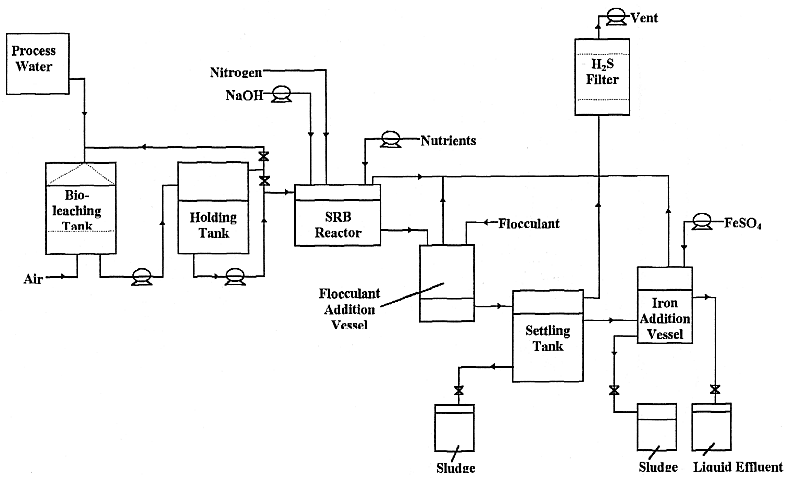
Fig. 1. Pilot-scale
bioremediation process.
In addition the process can be operated in-situ. Since it is an in-situ system then in addition to the process itself the restoration package also requires extensive site characterization, groundwater control and an ability to certify the site restored. This draws extensively on hydrogeology and associated modeling.
These processes have been demonstrated in the laboratory for a range of heavy metals including uranium, cadmium etc. However, contaminators of land are rarely thoughtful enough to contaminate with heavy metals alone and combined organics (particularly intractable organics) and radionuclides/heavy metals are often co-contaminants of sites. This process is, therefore, currently being developed to enable the organics to be destroyed microbially and the metals subsequently removed.
SUPERCRITICAL FLUID EXTRACTION
Supercritical Fluid Extraction is based on the ability of gases or liquids above their critical point to retain the solubility of a liquid and the diffusional properties of a gas (2). This means the extractants have a high capacity, a rapid rate of reaction and by modifying their properties with polar solvents or complexants develop a high degree of selectivity. In addition careful reduction of pressure can give a high level of selectivity of recovery. It should be noted that this technology is concerned with separation not destruction of contaminants. The process must operate at high pressures and Table II shows the supercritical conditions of a range of fluids.
Table II Characterics of Representative Supercritical Fluids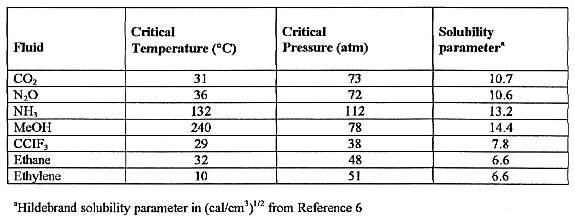
The process has already been successfully applied to organic (PCB) contaminants using propane as the supercritical fluid (3). This process is currently under deployment at other contaminated sites (4).
This process is already proven for the removal of intractable organics from soil and further development is underway to accommodate metal or radionuclide removal. Table III shows the solubility of a metal in supercritical CO2 i.e. the presence of various complexants. This work has resulted in a series of patents from researchers at the University of Idaho. These concepts are currently being tested against contaminated soils. Some results to date are shown in Figs. 2 & 3 and give a soil residue that has a very low leachability, a low contaminant content whilst presenting a soil product that has resisted denaturing. This process, despite being a high pressure process, therefore qualifies as 'gentle' and the ability to recycle the solvent clearly adheres to the tenets of Clean Technology.
Table III Solubility of Zn Cyanex 302 in Subcritical and SF CO2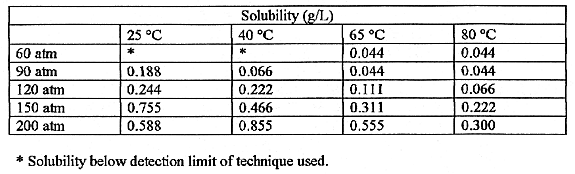
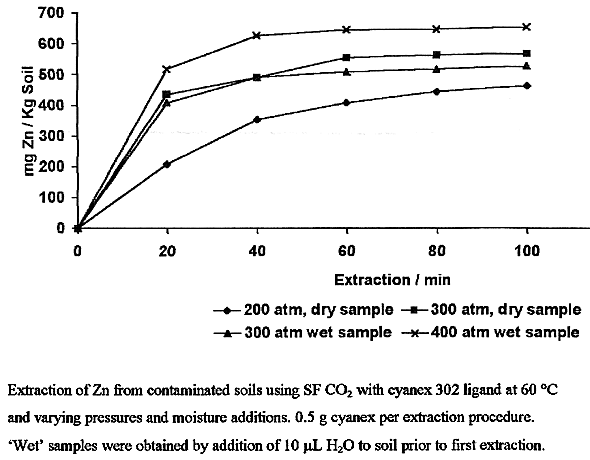
Fig. 2. Extraction of Zn from
contaminated soils using SF CO2.
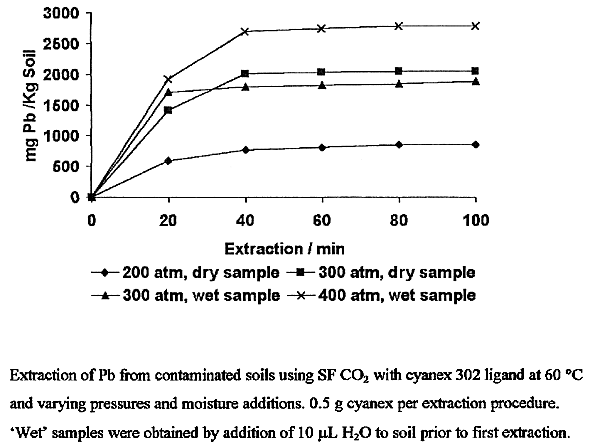
Fig. 3. Extraction of Pb from
contaminated soils using SF CO2.
SUMMARY
In an attempt to develop truly innovative processes for land restoration BNFL has developed some 'Gentle' technologies that can remediate soil so it can be neutralized. Two technologies, Supercritical Fluid Extraction and Bioremediation have been demonstrated at full or pilot scale for organic and radionuclide removal, respectively. Both show promise for application against a broad range of contaminants.
ACKNOWLEDGMENTS
The authors wish to thank Dr E Alperin of ITC, Professor Chien Wai of the University of Idaho, Drs Harry Eccles and Neil Smart of BNFL, Professor Tony Clifford of the University of Leeds plus the UK DTI for co-funding of the bioremediation project.
REFERENCES