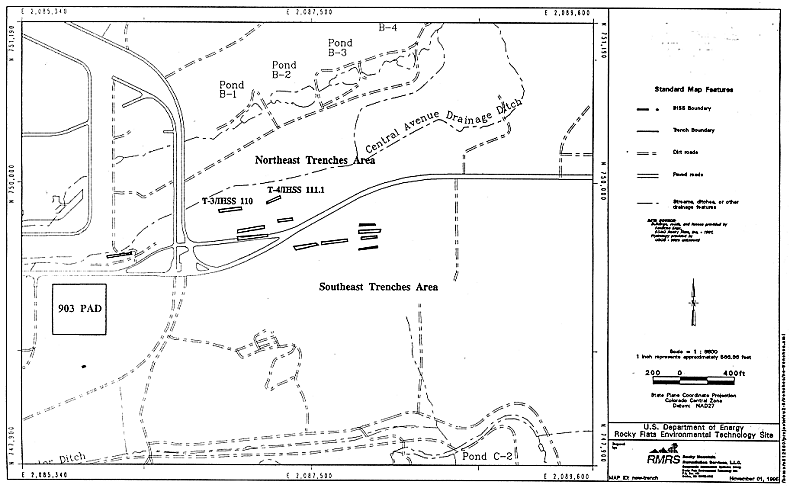
Fig. 1. Location of
Trenches T-3 and T-4.
Shaun L. Garner, Marcella C. Broussard, Ann M. Tyson
Rocky Mountain Remediation Services, L.L.C.
Rocky Flats, Colorado
Hopi Salomon
Morrison Knudsen Environmental Services
Denver, Colorado
ABSTRACT
The Trenches T-3 and T-4 Source Removal Project performed by Rocky Mountain Remediation Services under subcontract to Kaiser-Hill at the Rocky Flats Environmental Technology Site involved the excavation and treatment by thermal desorption of approximately 2,902 cubic meters of soil and debris contaminated with volatile organic compounds (VOCs). The trenches contained soil, drum carcasses, and miscellaneous debris contaminated with VOCs which were contributing to groundwater contamination. Primary contaminants of concern were tetrachloroethene, trichloroethene, and carbon tetrachloride, as well as low level radiological contamination. The project was scooped, planned, and executed within a single fiscal year and saved $2 million and 33 months over the originally proposed remedy.
Several factors were instrumental in successful completion of the project. Integration of union labor forces and subcontracted personnel and services was the primary key to the project. The use of an on-site laboratory and a modified analytical method allowed for near real time analytical results to both guide the excavation and verify treatment effectiveness greatly reduced downtime during project execution. Also, negotiations with the Environmental Protection Agency and the Colorado Department of Public Health and Environment for establishing realistic cleanup criteria and accepting simplified field sampling techniques facilitated timely completion of the project.
INTRODUCTION
The purpose of the source removal conducted by Rocky Mountain Remediation Services (RMRS) at Trenches T-3 and T-4 at the Rocky Flats Environmental Technology Site (RFETS) was to remove volatile organic compounds (VOC) contamination sources from the trenches which were contaminating the groundwater. Trench T-3 was used from 1964 to 1966, and Trench T-4 was used from 1966 to 1967 for disposal of sanitary sewage sludge contaminated with low levels of uranium and plutonium. Miscellaneous debris, primarily crushed drums which were also contaminated with VOCs, uranium, and plutonium, was placed in the trenches as well.
The project was authorized by a Proposed Action Memorandum (PAM)which was approved by the Department of Energy (DOE), the Environmental Protection Agency (EPA), and the Colorado Department of Health and Environment (CDPHE). Approximately 2,902 cubic meters of contaminated soil and debris were removed from the trenches and processed using thermal desorption to remove VOCs, primarily tetrachloroethene, trichloroethene, and carbon tetrachloride. Figure 1 shows the location of the trenches. The excavation of Trench T-3 was approximately 41.5 meters long, 5.5 to 7.3 meters wide, and approximately 4.6 meters deep, and included 1,304 cubic meters of material. The excavation was completed July 3, 1996, and treatment of Trench T-3 material was completed July 11, 1996. The excavation of Trench T-4 was 45.1 meters long, 5.8 to 6.7 meters wide, and approximately 3.7 meters deep, except where the excavation proceeded to bedrock at 7.9 meters, and included 1,598 cubic meters of material. The excavation was completed August 14, 1996, and treatment of the T-4 material was completed August 19, 1996.
This paper discusses the project in general and the methods used to demonstrate achievement of the excavation cleanup values and the treatment performance standards specified in the PAM. Additionally, this paper discusses compliance with the negotiated agreement between DOE, EPA, and CDPHE on meeting the agreed upon subsurface soils action levels.
EXCAVATION AND TREATMENT PROCESS DESCRIPTION
RFETS labor union personnel performed the excavation of the trenches and reclamation of the treatment area. A subcontractor performed the thermal desorption treatment. The excavation crew only removed sufficient material from the trenches (approximately 75-150 cubic meters per day) using a tracked excavator and front-end loader to keep the thermal desorption process operating on a continuous basis. Each load of excavated material was screened using a Field Instrument for the Detection of Low Energy Radiation (FIDLER). Material with instrument readings greater than 5,000 counts per minute (cpm) was segregated, stockpiled, and treated separately at the end of the project. Because the permissible exposure limits for the VOCs were so low and due to poor detection properties, the work was conducted using supplied air, level B personnel protective equipment (PPE). This posed heat stress concerns for both the excavation and thermal desorption crews, which were mitigated by using ice vests and limiting the individual stay time of the workers in the PPE.
Fig. 1. Location of
Trenches T-3 and T-4.
The thermal desorption crews worked 24 hours per day, five days per week, treating the contaminated material. The treatment process used six low-temperature thermal desorption units (TDUs), each holding approximately 3.8 cubic meters of material. The contaminated soils and debris were loaded into the TDUs on a batch basis, then heated using propane fueled infrared heaters to 82°C and held for an additional 30 minutes. These treatment parameters were developed in the field during a baseline process. This development process evaluated analytical results of material both before and after treatment while varying operation parameters such as temperature and hold times. Once established, these operating parameters were held constant and assured compliance with the PAM performance standards as demonstrated by confirmation sampling. A vacuum was drawn through the TDUs to reduce boiling points and to remove the liberated VOCs. The airstream was passed through a high efficiency air filter (HEAF) and a high efficiency particulate air (HEPA) filter to remove particulates. The airstream was then cooled in a condenser to approximately 4.4°C, causing the VOCs to return to liquid form for removal. The airstream then passed through a granular activated carbon (GAC) unit as a final polishing step to remove remaining VOCs. All treatment lines were discharged at a single stack and monitored to verify that appropriate discharge standards were met.
The condensate removed from the condensers was collected in a double walled tank, then passed through an oil/water separator to remove any dense non-aqueous phase liquids (DNAPL) and light non-aqueous phase liquids (LNAPL). Approximately 152 liters of DNAPL and approximately 95 liters of LNAPL were collected in drums. The vast majority of the condensate was an aqueous phase liquid, primarily water contaminated with dissolved VOCs. This was transported to the on-site Consolidated Water Treatment Facility for processing.
Water was used for dust suppression as each batch of material was removed from the TDUs and segregated until verification was obtained demonstrating compliance with the performance standards stipulated in the PAM. If a particular batch failed to meet the performance standards, the batch was re-treated and re-sampled. After the analytical results showed the treatment was acceptable, the individual batches were moved into the treated stockpile, using water sprays for dust control. A dust suppression agent, Concover™, was sprayed on the treated soils to control dust and prevent erosion. At least one radiological confirmation sample per 76 cubic meters of soil was taken from the treated stockpiles. For the segregated soils which exceeded 5,000 cpm from the initial FIDLER screen, the radiological sampling rate was increased per radiological engineering direction. These radiological confirmation samples were used to determine whether or not the soils met the action levels agreed upon for this project. The soil remained in the treated stockpile until the trench excavation was completed. Once trench verification samples indicated the excavation had achieved the cleanup values stipulated in the PAM, and radiological confirmation samples confirmed compliance with the radiological action levels, the treated soils were replaced in the trenches.
At the conclusion of the project, the stockpile and working areas were sampled and scraped to remove residual contamination, and the material was treated in the TDU. The work areas and trenches were regraded and seeded to return them to a condition comparable with the surrounding environment.
VERIFICATION OF SOURCE REMOVAL
The objective of the excavation was to remove the source material from the trenches. This required excavating until soil VOC concentrations in each trench were below the excavation cleanup values listed in Table I. At the completion of the excavation, each trench was subdivided into 16 grids for sampling purposes The samples were taken from the walls and floor of the excavated trench using the excavator so as not to require a person to enter the trench. The excavator bucket was decontaminated prior to the sampling event, then a sample was taken from the middle of the bucket of soil removed from the sampling location in the trench. Split samples were sent off-site to an independent lab for quality control.
Table I Excavation Cleanup Values and TDU Performance Standards
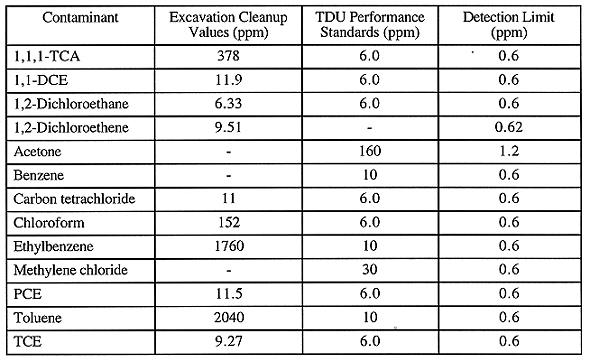
All the contaminant concentrations remaining after the source removal from Trench T-3 were below the cleanup values. Three of the initial grid samples from Trench T-4 exceeded the cleanup values. After further excavation, these three grids were then subdivided into four grids each for further sampling to increase the level of confidence of having removed the VOC contamination from the primary grid. If samples from any one of the subdivided grids exceeded the excavation cleanup values, the entire primary grid was treated as having failed. Excavation continued in these three primary grids, sampling the subdivided grids periodically to determine remaining concentrations. The subsequent samples from these three primary grids continued to show concentrations above the cleanup values. Bedrock was encountered at a depth of approximately 8 meters. Excavation ended at this point in accordance with the PAM and with concurrence from DOE, EPA, and CDPHE. At this depth final samples from the subdivided grids were collected. Two of the primary grids met the excavation cleanup values. However, one primary grid still contained TCE at 22 ppm, which was above the 9.27 ppm excavation cleanup value.
VERIFICATION OF TREATMENT PROCESS
The treatment performance standards stipulated in the PAM are listed in Table I. Process verification samples for the treated soils were taken from each batch, or every 23 cubic meters, as it was removed from the TDUs. A backhoe was used to remove a load of soil from the TDUs and a sample was taken from the interior of the bucket load or directly from the TDU during unloading operations. Every TDU was sampled until a baseline was established to determine the optimal treatment time and temperature. Then the sampling frequency decreased from sampling every TDU to taking one sample per 23 cubic meters of treated material (1 out of 6 TDUs). There were a total of 6 individual TDUs which failed to meet the performance standards. All six of these failures occurred during the initial "shake down period" before the baseline was established. During this shake down period, the temperature and treatment times of the individual TDUs were being modified in order to establish the optimum treatment parameters. All of the pre-baseline treatment loads which originally failed the performance standards were retreated and met the performance standards. All of the post-baseline samples met the treatment performance standards.
RADIOLOGICAL ANALYSIS
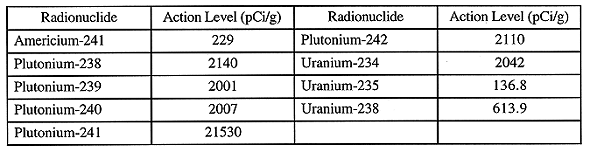
Radiological action levels are listed in Table II and were agreed upon by DOE, EPA, and CDPHE for this project. In order to determine if the treated soils met the agreed upon action levels for radiological contamination, the soils were initially screened using a FIDLER, then analyzed using gamma spectroscopy after treatment was completed. Each bucket load of the front end loader was screened as the material was moved into the contaminated material stockpile. Any material reading above 5,000 counts per minute was segregated into a separate pile. Both the non-segregated and segregated soils were treated by the TDU, but were kept separate throughout the treatment process. Soils below the 5,000 cpm screening level were placed in the VOC treated stockpile, while the other material was placed in a radiologically segregated, VOC treated stockpile. Both stockpiles were sampled for radionuclide analysis at the completion of treatment.
At the conclusion of the project, 1,304 cubic meters of soil from T-3 and 1,598 cubic meters of soil from T-4 had been treated. Of this material, approximately 380 cubic yards had been segregated as potentially radiologically contaminated material. At least one radiological sample per 76 cubic yards of treated material was taken from the treated stockpiles. The stockpiles were marked off into approximately equal grids, and samples were taken for isotopic characterization using gamma spectroscopy. The results of the isotopic characterization indicated that all of the soil, including the material initially segregated, met the action levels specified for the project. Furthermore, all but approximately 190 cubic meters of soil met more conservative action levels which were being discussed by DOE, EPA, and CDPHE for use in future projects.
After discussions with DOE, EPA, and CDPHE, it was decided that all of the soils could be replaced in the trenches, but that the 190 cubic meters which exceeded more conservative action levels should be kept together and delineated in the trench in the event it becomes necessary to exhume it in the future. The segregation and demarcation was accomplished by placing 18 meters of geotextile grid liner as a marker approximately 2.4 meters deep at the west end of Trench T-4. The 190 cubic meters which exceeded the more conservative action levels were then placed on top of the marker, and a second layer of the geotextile grid was placed over the soils. The top of this marker was approximately 1.2 meters below the trench surface. The marked off soils were then covered with the other treated T-4 material, which met the more conservative action levels, and top soil.
Table II Radiological Action Levels for Residential Exposure
DEBRIS AND OTHER WASTE STREAM DISPOSITION
The debris (drums, wood, concrete blocks, etc.) excavated from Trenches T-3 and T-4 was either treated by the TDU, or screened/sampled to verify that it was free from volatile organic contamination. Approximately 153 cubic meters of material, primarily crushed drums, treated by the TDU were crushed for further size reduction to meet waste acceptance criteria and placed in six roll-off containers for storage at the T-3/T-4 site until the material can be shipped off-site for disposal. The remaining debris (PPE, filter material, sections of duct work which could not be decontaminated, and plastic used during the project) was placed in another roll-off container and will likewise be stored at the T-3/T-4 site pending off-site shipment.
SITE RECLAMATION
At the conclusion of the project, the area around the TDUs, the traffic areas, and the contaminated material stockpile areas were sampled for VOC contamination and scraped to remove residual contamination. This material was treated by the TDU and ultimately placed in Trench T-4 as backfill. The TDU was demobilized. The work areas were then surveyed for radiological contamination, and any areas above 5,000 cpm were removed. Soils which met the release criteria were placed on the trenches. The rest was placed into two roll-off containers and three 3.2 cubic meter wooden waste crates. The work areas were re-graded and seeded with native grasses.
LESSONS LEARNED
Several noteworthy features of the project deserve discussion from a lessons learned standpoint. This section briefly discusses those points.
One portion of the project that worked well was the subcontracting. The project utilized a fixed unit price subcontract with the thermal desorption and propane vendors with no change orders being generated during the project. The fixed unit price subcontract had not previously been used at RFETS. This subcontract divided the vendor's scope of work into several line items. Each line item was bid independently as either lump sum or at a fixed unit rate based on an estimated quantity. This permitted great flexibility in executing the work. The fixed unit rate allowed the project to continue uninterrupted when the actual volume of material to be treated by the thermal desorber exceeded the original estimate. All that was necessary was a change in funding approval. The subcontract also included a clause that if the estimated quantities varied by more than 15 percent, both the contractor and the subcontractor had the right to renegotiate the unit rate. This reduced the risk to the subcontractor, which allowed the removal of contingency from the bid price resulting in a lower overall cost.
A challenge to the project was the support required from most of the major groups at RFETS, i.e., union work force, radiological engineering, radiation control, etc. The involvement of these support groups from the early planning stages of the project through execution helped to increase ownership and understanding of the project and avoid several problems concerning execution. This up-front communication also clearly established areas of responsibility for the support groups. No grievances from the union work force were filed against the project, even though subcontractor and union work forces worked together to accomplish their individual scopes of work, sometimes performing similar work in close proximity to each other. Furthermore, when challenges did arise in the field, lines of communication were well established, thus facilitating successful resolution.
Because of the radioactive nature of the T-3/T-4 soils and debris, the design of the thermal desorption off-gas treatment system included HEAF and HEPA filters. These filters were included to protect downstream equipment from radioactive contamination by removing particulates that may have been radioactively contaminated. Specifically, the HEAF filters removed particulates to 1.5 micron in size and the HEPA filters, plumbed immediately downstream of the HEAF units, removed particulates to 0.3 micron. However, the HEPA filter media occasionally got wet. Excess water from dust control activities during TDU unloading would periodically accumulate at the bottom of the TDUs. Upon initiation of the air flow to treat the next batch of material, the free water in the TDUs would be entrained in the air stream and transported to the HEPA units.
Unfortunately, when the HEPA media gets wet, the filtration efficiency drops significantly. Instead of the standard 99.7 percent filtration efficiency rating, the performance of a wet filter can drop to the low 90 percent range. In short, the presence of moisture on the filter media allows particulates to pass the filter that would normally be entrapped by a properly operating filter. In the extreme case of saturation, the thin, paper-like filter media can tear under the pressure exerted by the air flow. Once breached, the air flow and the particulates that may be entrained in it take the path of least resistance through the opening rather than through the filter media.
Reduced filtration efficiency and occasional breaching of the media resulted in low levels of radioactive contamination in the condensers and GAC, which were located downstream of the filters. This contamination rendered incineration of the spent GAC media infeasible and increased the overall disposal costs for the project.
The RMRS technical staff is examining several possible solutions to this problem. These include the addition of mist eliminators upstream of the filters to "knock down" entrained liquids. A possible future solution may be the use of HEPA filters fabricated with metal filtration media which are designed to operate at the filtration specification noted above when wet. This filtration technology is currently being developed by the filter manufacturers and such filters are not commercially available at the time of this writing.
An alternative solution may involve a design change to eliminate the addition of dust control water while the soils are still in the TDU. Specifically, the soil could be loaded into the TDU in trays rather than directly as was done in the T-3/T-4 project. After the soils is treated, the tray of soils would be removed from the TDU and dust control water applied to the soil outside the TDU. If successfully implemented, this would effectively eliminate accumulation of free water in the TDUs.
In addition to the technical problem of keeping the HEPA filter media dry, the periodic replacement of the HEPA filters throughout the project also presented an operational problem. As is typical in filtration operation, the differential pressure across each filter was monitored during operation. It was expected that the gradual increase in differential pressure would give sufficient advanced notice of pending filter replacement, allowing advance scheduling of the associated testing of the new filter elements. At times, however, loading of the filter media would occur rapidly, e.g., fine-grained loose soils. This lack of advanced notice often resulted in unanticipated downtime for the TDU, adversely impacting the production rate for the project.
Several solutions are being examined to correct this logistical problem. One option would be the inclusion of parallel filters on each desorber train. Duct valving could be used to immediately route the process air flow to new filters that are ready to be placed in service. Another improvement may be to display the HEPA filter differential pressure measurements outside the exclusion zone where project management and supervisors could better monitor these data, rather than rely on manual readings at the filter units.
CONCLUSION
The Source Removal at Trenches T-3 and T-4 performed at RFETS was successful in remediating VOC contamination sources at a significant cost and schedule savings to DOE. Soils were treated and returned to the trenches, thus eliminating the source of VOC contamination to groundwater. The project utilized several innovative elements to complete the project, and demonstrates thermal desorption as a viable treatment alternative, even in the presence of low-level radioactive contamination.