 ,
, -isotopes or
 -isotopes and in some cases
mixtures of both.
-isotopes and in some cases
mixtures of both.
K. Rose and H. Runge
DETEC GmbH
D-63755 Alzenau
Germany
D. Schmidt
NUKEM Nuclear Technologies
Columbian, SC
29210
ABSTRACT
Cleaning of radioactive contaminated ground is a very recent development in Western Europe. Technology development and projects performed are mainly reported from Germany. Namely, soil washing was applied in several projects.
NUKEM has demonstrated that the volume of contaminated ground which otherwise must be disposed as radioactive waste can be reduced by about two orders of magnitude if treated in combined sieving and washing processes.
INTRODUCTION
Soil near nuclear installations and near certain civil industrial sites is sometimes found contaminated by radioactive elements.
During the operational period of former installations, remediation of soil was of no great interest. Now with an increasing number of nuclear decommissioning projects, there is also an increasing need for the remediation of contaminated soil.
Radioactive polluted ground near nuclear installations either contains,
,-isotopes or
-isotopes and in some cases
mixtures of both.
Commerci al industrial areas when contaminated by radioactive elements are
mostly polluted with -emitters.
Namely in Germany, several sites exist which are contaminated with thorium. This
contamination results from former production of chemical catalysts and ceramics
for gas glow lamps.
In many cases, excavation of the contaminated soil can offer a direct remediation solution. But it may not be an economical solution to dispose all the excavated material in a nuclear repository. This means that the excavated soil needs some further treatment. Three principles should be followed with such treatment.
TECHNICAL PRINCIPLES; STATE OF DEVELOPMENT
Soil washing techniques have been applied for many years for cleaning soil and harbour sludges containing heavy metals or toxic organics.
These techniques proved to be very efficient for such kind of pollutants. Heavy metals, for example, can be cleaned down to less than 1 ppm.
It was therefore a logical step to apply soil washing techniques also for radioactive contaminated ground.
Such development started in Germany a few years ago. Washing of radioactive contaminated ground today consists of several different process steps. In some cases, wet sieving alone can be successful. In other cases, more sophisticated measures are necessary. Usually the treatment strategy must take into account that the radioactive contaminants are not equally distributed among the different grain fractions of the soil. In most cases, more than 90% of the contamination are bound to the finest fraction of soil with a grain size smaller than 1 mm.
In the initial process step, the gross material like gravel and debris, is separated mechanically from the excavated ground material. After separating and washing this gross material, it can normally be returned to the site.
The remaining material (particles less than 20 mm in diameter) is then divided into different grain size fractions by wet sieving and/or by passing it through hydrocyclones.
Separated fines like silt and sludge are the strongest contaminated fraction. After dewatering, this material is therefore filled into waste drums for final disposal.
In cases when the sludge volume makes more than 15% of the total soil volume, further treatment of the sludge can be recommended in order to further reduce the waste volume.
The sand fraction of some soils normally corresponds to about 45% of the soil volume. Although it is normally less contaminated than the sludge, further treatment may be necessary to lower the activity concentration down to the permitted limit values. In this case, a combined attrition/flotation process turns out to be a very helpful method for certain radioactive elements.
By attrition, the contaminants are first mobilized and then removed from the liquid suspension in a flotation cell by adding reactive and foaming agents and by passing a stream of air bubbles through the suspension. The foam/flotate contains the removed activity products. After dewatering, the flotate is handled as waste while the cleaned sand is returned to the site.
The soil washing/flotation process as developed for radioactive contaminants can be supplied today as a closed loop system housed in a mobile container. Modular units with a soil washing capacity ranging from 0.5 m3/hr to 10 m3/hr are available.
EXPERIENCE
Concentration limits in Germany for ,
,- emitters to remain on-site are
all in the same order of magnitude. Some of the most frequent radioactive
pollutants and their limit values are presented in Table I.
Table I Recommended German Concentration Values for Remaining
On-site Radionuclides
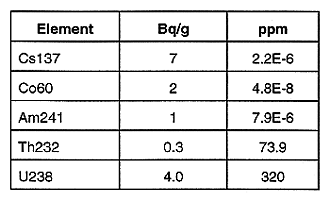
If the Bq/g values are transferred to the ppm scale the problems with removing certain radioactive pollutants become apparent. While Th232 and U238 concentrations can be compared with typical heavy metal concentrations found in polluted soil, the other isotopes all lie in the far sub-ppm range. So it was expected that soil washing would work fairly for thorium and uranium, but the situation with Am241 initially was less likely.
Treatment of U, Th Contaminated Soil
The flotation process as described above was optimized and applied for the
removal of uranium and thorium first. The site where the process was performed
belonged to a former German fuel element fabrication facility with
-contaminated soil around
the buildings.
Maximum concentrations of uranium and thorium in some areas exceeded the limit values even for deposition on a conventional dump. Remediation started with excavation of the contaminated soil. The soil was then sieved and homogenized on a 1 m3 scale. After this pre-treatment, the main part of the soil could then be refilled to the site or prepared for a conventional dump. About 40 m3 of soil however revealed a very high contamination level. It was then decided to treat this material by a combined washing/flotation process. The flotation equipment as described above was used for the treatment. Figure 1 shows the flotation container and its loading with soil. Within this 40 feet container all the process equipment was housed in a closed and vented area. Figure 2 gives an impression of the equipment inside the container.
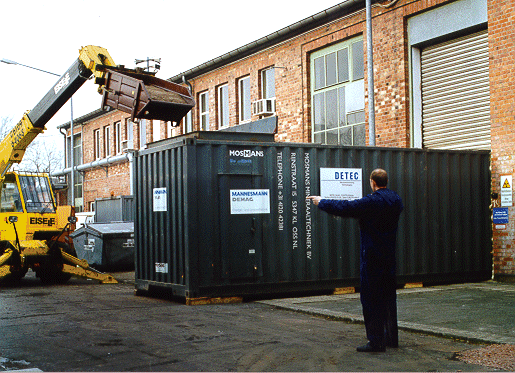
Fig. 1. Flotation
container being located with soil.
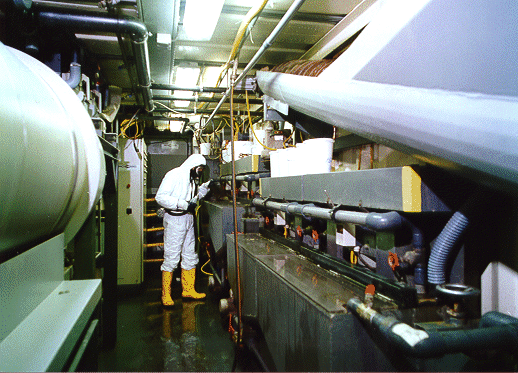
Fig. 2. Equipment
inside the flotation container.
The work performed by the beginning of 1996 demonstrated that all the material could be cleaned down below the limit values for deposition on a conventional landfill. These limit values were 2.9 Bq/g for U238 and 1 Bq/g for Th232. For a part of the washed soil volume, even the limit values for on-site remaining were achieved.
TREATMENT OF AM241 CONTAMINATED SOIL
In the vicinity of a nuclear lab, ground was found contaminated with Am241, up to a maximum value of about 1 Bq/g. About 150 m3 of soil had to be excavated.
Preliminary tests made by the operator of the lab revealed that it was possible to reduce the waste volume significantly. About 2 m3 of residual waste were calculated, while the remaining 148 m3 should remain on-site after treatment. The limit value for remaining on-site in this case was 0.04 Bq/g.
The remediation strategy started with sieving and homogenizing on a 1 m3 scale. This work is ongoing and will leave presumably 15 m3 by a two-step wet sieving/attrition process. Following the results of the preliminary tests, this treatment will lead to a decontamination factor of 10 and a final volume of about 2 m3 of radioactive waste.
The results are of special interest since the Am241 ppm concentration was in
the same order of magnitude as most ,
,-emitters. It can therefore be
expected that similar treatment will also be successful for elements like Co60
or Cs137.
Treatment of Th232 Contaminated Soil From Commercial Activities
In the eastern part of Germany, several former industrial sites exist where thorium was fabricated for different commercial applications. Remediation of these sites is planned for the near future.
Remediation of one site already started at the beginning of October 1996. Contaminated soil with a volume of some 100 m3 was pre-treated by sieving and homogenization, resulting in a contaminated volume of nearly 15 m3, while the remaining soil could be refilled to the site.
The 15 m3 of selected material are contaminated with some 1000 Bq/kg of thorium. Maximum concentration is about 100,000 Bq/kg. Preliminary treatment tests with wet sieving and washing are performed, a decontamination factor of about 10 is anticipated.
Other Soil Contamination Projects
Soil washing is considered for a nuclear research center in Belgium pre-analysis was performed for preparing the remediation of ground. The soil is contaminated by mainly seven isotopes, including Cs137, Co60 and Am241.
In the former soil washing project for the removal of U238 and Th232 as described above, it could also be demonstrated that Cs137 was removed with an efficiency of 70%. Therefore, there is good hope that also other elements like Co60 and Mn54 could be removed by this kind of technology for the Belgium research center.
CONCLUSIONS
Cleaning of radioactive contaminated ground by soil washing turns out to be a very promising remediation technique. The bulk volume of excavated soil can be returned to the site after appropriate treatment or at least disposed on a conventional . About 10% of the excavated material is finally treated as radioactive waste.
Like all volume reduction techniques, the economic savings are based on the alternatives. The specific costs for this kind of remediation is significantly lower than for direct disposal in a nuclear waste repository in Germany. Soil washing in many cases is therefore proven as an economical remediation alternative.