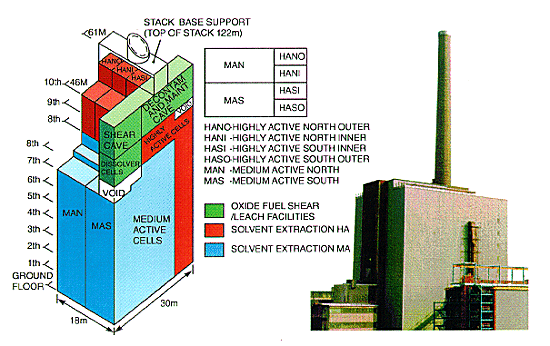
Fig. 1. Primary
separation plant.
S. F. Challinor, C. Eng.
BNFL
Sellafield, U.K.
ABSTRACT
Decommissioning of the first primary separation plant at Sellafield, U.K., is one of a number of major projects within BNFL's overall decommissioning program covering all aspects of the nuclear fuel cycle. The project demonstrates that large scale, highly contaminated, complex nuclear reprocessing installations can be safely and cost effectively decommissioned utilizing today's technologies. In order to reduce costs an integrated dismantling strategy has been developed which utilizes a mixture of manual and remote decommissioning techniques in a structured, phased approach. Experience from early phases is reviewed and fed into later stages to constantly improve safety and operating performance, reduce technical uncertainty and financial risk. Where remote systems are required the use of proprietary items for manipulators, deployment systems, tooling and computer modeling reduces development costs and time scales while providing robust, reliable and easily maintainable equipment.
This paper describes the operational experience of decommissioning the first primary separation plant at Sellafield. Construction of the 61m high facility commenced in 1947 and comprised two mirror image process lines to reprocess irradiated metal fuel from the Windscale piles. the facility operated between 1952 and 1964 until it was subsequently superseded by the current Magnox reprocessing facility. One of the original process line was converted to reprocess oxide fuels, operating from 1969 until 1973. The stage 2 decommissioning project commenced in 1990 and has been subdivided into 9 distinct decommissioning phases. The project is due to be complete in 2010 at an estimated cost of $155 Million (low case). Three preparatory phases have been completed to date at a cost of 97% of original estimate. Decommissioning operations are underway in the first of 8 major cell areas, decommissioning of a second area is due to commence in early 1997.
INTRODUCTION
Construction of the first primary separation plant at Sellafield commenced in 1947 and comprised two mirror image process lines, designated North and South, to reprocess irradiated metal fuel from the Windscale piles. The facility operated between 1952 and 1964 during which time two modifications were carried out to improve throughput. In 1964 the plant was superseded by the current reprocessing facility, rendering the original reprocessing facilities redundant. Following shutdown the plant underwent clean out and wash down and the South line was converted to reprocess oxide fuel operating from 1969 until 1973.
The facility was not constructed with eventual decommissioning in mind and is characterized by very large process cells with minimal physical access to process vessels and pipework. The physical size of the individual process cells coupled with the drive to reduce the dose exposure to operators and reduce decommissioning costs has resulted in the increased use of remote techniques for removal and size reduction of radioactive plant and equipment. This project utilizes a mix of men and machines to achieve the optimum benefits on cost and dose.
The scale of the stage 2 decommissioning project estimated at $155 million over 20 years resulted in a phased approach to decommissioning. Experience from the phased decommissioning operations is fed into subsequent phases to constantly improve safety performance and reduce technical uncertainty and financial risk. The project has been split into 9 phases, of which 5 have been sanctioned to a value of $48 million with the first three completed at 97% of project estimate. This paper concentrates on the experience gained from these completed projects and the ongoing work in decommissioning of the Medium Active North process cell, the fourth sanctioned project phase.
PROJECT OBJECTIVE
The objective of the decommissioning project is to dismantle the redundant process plant and equipment and to decontaminate the residual structure to meet low level waste (LLW) criteria on eventual demolition (stage 2 decommissioning). The possible re-use or demolition of the building is dependent upon the site closure policy. This project is one of a number of major decommissioning projects currently being carried out as part of BNFL' s Sellafield decommissioning program.
PLANT DESCRIPTION
The 61m high building, having a volume of 93,300 cubic meters and a total floor area of 16,000 square meters, dominates the center of the original Sellafield Separation Area, consists of a reinforced concrete process core surmounted by a 61m ventilation stack, see Fig. 1. The process core is divided into two process lines each comprising three cells; two highly active cells for fission product removal and a medium active cell for Plutonium and Uranium separation. Medium active cell shield walls are typically 60 cm thick while highly active cell walls are 1 rn thick. The process core is surrounded by a steel frame building of 11 floors, housing ventilation and effluent plants, inactive services, control stations, and process sampling facilities. As part of the modifications to the South process line for oxide reprocessing a shear cave suite with dedicated ventilation plant was added on the ninth floor and a silo for stainless steel hulls arising from the oxide fuel dissolution process was constructed within the base of the South Medium Active cell.
Fig. 1. Primary
separation plant.
RADIOLOGICAL CONDITIONS
The varied use of the building has resulted in several distinct radiological zones within the building:
PROJECT STRATEGY
Decommissioning of the original primary separation plant has been deferred to benefit from the reduced radiation levels arising from the decay of the shorter lived fission products (Ruthenium 106, Zirconium 95, and the Lanthanides). The remaining significant fission products are Caesium 137 (half life 30 years), Strontium 90 (half life 29 years) and their daughters. Further deferral by a few years will have minimal effect on radiation levels, while deferral by 30 years would be constrained by the deterioration of plant and equipment and the building fabric. The resultant implications on safety, and the ongoing surveillance and maintenance costs resulted in a decision to commence decommissioning studies in 1989.
The scale and complexity of the decommissioning project resulted in splitting the project into 9 distinct phases. Experience from each decommissioning operation could then be fed into subsequent phases to constantly improve safety and cost performance, reduce technical uncertainty and financial risk. The physical size of the building and the limited strength of the building annulus steelwork resulted in an integrated decommissioning project strategy comprising:
The construction of a single waste handling and conditioning facility capable of size reducing process vessels utilizing remote technology and plasma cutting, decontamination facilities, waste monitoring for compliance with disposal site requirements and waste export facilities.
Of the 8 main process cell areas existing in the building the MAN cell was chosen to commence decommissioning operations as it has the least hazardous radiological conditions and is representative of the types of decommissioning challenges to be found in other plant areas. Decommissioning operations for the MAN cell were designed to utilize remote equipment combined with manual techniques even though decommissioning could be done completely manually in this case. This strategy allows remote operating techniques to be developed in an area where manual intervention is possible before decommissioning of the higher radiation cells commences. The in-cell manipulator is located in position by contact deployment with subsequent operations viewed and controlled remotely from a central control room.
DESIGN AND CONSTRUCTION PROBLEMS
In common with a number of nuclear facilities constructed in the late 1940's there is limited installation design data remaining. These problems have been compounded with a number of throughput modifications being carried out to the original flowsheet specification with the modification drawings being incomplete. The civil structure was completed before the final mechanical process design and with the subsequent modifications results in some plant being installed in very cramped and inaccessible locations. The process plants were designed to a lower seismic qualification than is currently in force. This has made the design and integration of new facilities and the construction of cell access holes difficult.
The cell structures are extremely large with no consideration being given to decommissioning requirements at the time of design. No cell access facilities are provide for the addition or removal of pant and equipment, man access is only provided at every 5 meter level via narrow central walkways. No in-cell lifting equipment or lifting support facilities are provided. The large scale un-segregated cell design has resulted in large volumes of low level waste being mixed with plutonium contaminated waste with the resulting complications to criticality control, waste segregation and subsequent monitoring for disposal.
Following plant operations a washout program was carried out but the results are not formally documented. A program of intrusive sampling has been carried out to obtain the design date required for shielding, criticality and waste disposal assessments. The separation process utilized an organic solvent, dibutoxy di ethyl ether (Butex), residual solvents or solvent tars can give rise to explosions or fires and special consideration of this needs to be given during the decommissioning process.
With the deferral of decommissioning operations the building has been left unoccupied for a number of years, being maintained on a minimum surveillance and maintenance regime. This has led to a general deterioration in the condition of the building and associated facilities with the requirement to re-clad the external structure to ensure physical integrity for the remainder of the decommissioning program and upgrade the internal services and systems to meet the decommissioning projects current and future needs.
Changes in the regulatory standards for dose control, aerial and liquid effluent discharge authorizations, and UK and EEC conventional safety standards have resulted in the requirement from the Site Regulators to introduce a building environmental surveillance system for aerial activity monitoring and building evacuation and an upgraded cell ventilation system to reduce activity discharges to the environment before physical decommissioning could
DECOMMISSIONING FACILITIES
Due to space constraints within the Sellafield separation area the waste handling and conditioning facilities had to be constructed within the original confines of the building. An area of the annulus to the north of the MAN cell was cleared of plant and equipment on three floors and the new shielded facility designed to handle all the beta gamma waste arising from the decommissioning operations for the life of the project was installed. Operational control is facilitated from the shielded central control room adjacent to the Waste Handling Facility (WHF). Operators control the operation of the in-cell crane and manipulator from two pilot chairs using 2 mode 3 axis joysticks viewing operations on a bank of 2D and 3D CCTV monitors thus reducing operator dose. The CCTV system can be switched to view in-cell or building operations and has video recording capabilities. Control panels for the WHF waste conveyor, shield doors, in-cell 5te EOTC crane, decontamination facilities, gamma spectrum monitoring equipment, size reduction facilities and waste export route are located in the control room similarly allow operators to remotely control the WHF equipment utilizing either the CCTV facilities or the installed shielded viewing window overlooking the WHF. A schematic of the decommissioning facilities is shown in Fig. 2.
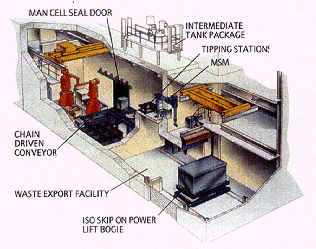
Fig. 2. Schematic of
the waste handling facilities.
Decontamination facilities
The plant design and operating history has resulted in a mixture of low level waste, and beta gamma and plutonium contaminated intermediate level waste being present in the same cell. This causes significant problems for criticality, waste segregation and waste disposal. Physical sampling programs of pipes and vessels based on the chemical flowsheet have provided data for the segregation of high alpha contaminated material which must be embargoed during the initial LLW disposal campaign. The original design option considered decontamination of intermediate level beta gamma material in two decontamination and rinse tanks to declassify it to LLW with significant project cost savings. The decontamination process utilizes an optimized nitric acid recirculation or soak cycle utilizing variable temperatures, acid concentrations and ultrasonics. An identical tank is used to provide rinse facilities prior to the waste being transferred for activity monitoring and disposal. Decontamination liquors are sampled prior to dispatch to the site low active drain system. PCM material was to be exported via dedicated facilities constructed adjacent to the MAN cell in existing cells which form part of the overall decommissioning program.
Trials on plant samples obtained during the decommissioning operations have shown that it is possible to decontaminate some of the PCM material to LLW using the installed decontamination system for ILW beta gamma material giving significant PCM waste cost reductions. This has resulted in a plant modification to allow decontamination liquors to be sampled before sentencing to the site Enhanced Actinide Recovery Plant (EARP) effluent treatment facilities. The reduction in PCM volumes has initiated a review for the need for the dedicated PCM export facilities and cost benefit analysis studies are currently being carried out.
Monitoring Facilities
The alpha contamination present throughout the process plant makes waste
monitoring difficult as alpha monitoring inside pipework is not practicable. The
in-cell plant sampling campaign provides detailed isotopic contamination data
which is fed into a gamma spectrum monitoring system. The system measures the
dominant gamma spectrum from the Caesium 137 isotope and determines the amounts
of other contaminants by ratio and assesses the weight of waste in the waste
transfer container. The control computer is programmed to compute the compliance
of the individual waste baskets and the cumulative ISO skip consignment with the
Drigg disposal site conditions for acceptance (simplistically <12 GBq/te
total ,  <4 GBq/te total

Ventilation Facilities
The original plant design did not provide on-line filtered cell ventilation, however, it is a regulatory requirement to meet current aerial discharge criteria before decommissioning operations can commence. The existing cell ventilation fans were not capable of supporting new primary and secondary filter banks and had to be replaced. The building ventilation plant is located on the eighth floor and the structural limitations of the annular steelwork resulted in the provision of proprietary unshielded HEPA filter units which are constantly monitored for radiation build-up so that filters can be manually changed and disposed of as LLW to Drigg. The new ventilation system has been sized to ensure correct ventilation of the new WHF and access facilities.
REMOTE OPERATIONS
The majority of the plant items to be removed from the cells are process vessels, pipes and columns manufactured from stainless steel, supporting steelwork is manufactured from mild steel. An in-cell manipulator and crane are utilized to remove the plant items to the WHF. Pipework, columns and support steelwork are remotely size reduced in-situ by the in-cell manipulator, utilizing a range of specially adapted tools, to approximately one meter lengths and placed in a one cubic meter nominal capacity waste transfer container. The waste container is subsequently lowered down the cell by the in-cell crane and transferred to the WHF by conveyor. Process vessels have small holes cut into them to facilitate sampling and internal inspection prior to removal of connecting pipework, rigging, releasing from support steelwork and lowering to the conveyor for transfer to the WHF for size reduction in a purpose built cutting station. Although the cutting station is primarily intended to deal with the process vessels it can also be utilized to reduce pipes, columns and structural steelwork as required. The process vessels vary in size from approximately 800 to 2,400 mm in diameter and 800 to 3000 mm in height and up to a maximum of 1.5 te with a mixture of dished and flat ends. Vessel wall thickness varies from 6 mm to 19 mm. with composite flanged areas up to 70 mm thick.
The cells to be cleared of plant and equipment are physically large, the MAN cell is 23 m long, 8.5 m wide and 36.5 m high without internal access floors. Access to the cell is via man access walkways located on each of seven floors 5 m high, man access to individual pieces of equipment is therefore not possible without the provision of access staging. The size of the cells and thus the large quantities of access staging required would incur a large dose burden to operators during erection and dismantling plus the additional cost of the secondary radioactive waste produced from the contaminated staging. The cell is not equipped with any form of lifting equipment and so both an in-cell manipulator and crane are required to aid the dismantling process. The manipulator and crane are based upon the same deployment principle of utilizing a four degree of freedom (DOF) telescopic deployment arm upon a rail mounted bogie and attaching the lifting features or remote manipulator to the end of the telescopic arm. All in-cell hydraulic systems are based on ethylene glycol fluids for compatibility with the site effluent disposal facilities.
Operational control is facilitated from the shielded central control room adjacent to the Waste Handling Facility (WHF). Operators control the operation of the in-cell crane and manipulator from two pilot chairs using 2 mode 3 axis joysticks viewing operations on a bank of 2D CCTV monitors, thus reducing operator dose. The CCTV system can be switched to view in-cell or building operations with split screen and video recording capabilities and is used for teleoperational control. It is proposed to update the 2D television system to a 3D system to improve the productivity of the teleoperations and to reduce the potential for damage to the manipulator from accidental collisions with pipes and vessels.
In-cell Crane
Physical and radiological conditions within the cells have resulted in the provision of a remotely operated crane which is introduced into the cell at high level and can be withdrawn into an out-cell enclosure for maintenance with sub-change access has been provided in the building annulus protected from the cell by a steel shield door. The in-cell crane is mounted upon a captive rail system running North to South and joins the East to West man access walkway adjacent to an internal 'hoistwell' created during plant construction. These rails have been installed at the top (seventh floor level) of the cell through a 3 m square access hole cut through the 600 mm thick cell wall.
A proprietary hydraulic telescopic arm fitted with an hydraulic winch with a lifting capacity of 2.71e at full extension, 4te at 2/3 extension has been developed for the project to provide the in-cell lifting capacity and coverage while still being able to be removed from the cell via the newly constructed access apertures which do not have an impact on the seismic capabilities of the cell structure. The 4 DOF telescopic ann is fitted on a slew ring with + 185 rotation, shoulder joint with + 70 of vertical movement, elbow joint with - 90 of vertical movement and 6 m of reach.
The system is fired with 2D CCTV cameras for remote control. During normal operation the crane is operated from the main control room located at the 5 m level of the building. Local control facilities are provided for maintenance operation and in-cell control if required. The crane is used to transfer the in-cell manipulator, lower waste transfer containers and to rig vessels for transfer to the WHF for size reduction as described above.
In-ceil Manipulator
The in-cell manipulator is designed to operate from rails installed on each of the East to West running in-cell man access walkways with operations commencing at the top of the cell and professing downwards on a level by level basis to enable full crane coverage. The 3.751e manipulator system is lowered down the cell, level by level, as decommissioning operations progress, by the in-cell crane. The manipulator is located above, and clamped to, each of three reinforced concrete structural members to resist torsional stresses during operation at full extension. This system is giving some operational problems in that some pipework and vessel clearance is having to be carried out manually before the system can be introduced in the first location in the cell. Although this is acceptable for current cell operations a revised system is being developed for the next cell where radiological conditions restrict man access to approximately 40 minutes per day and will be tested in the MAN cell.
The same telescopic arm is used as in the in-ceil crane but a specially modified proprietary hydraulic manipulator mounted on a self leveling tilt table is fitted to the end of the arm. The 6 DOF hydraulic manipulator has a 2 m reach with an optimum carrying capacity of 125 Kg. To reduce downtime and dose to personnel the manipulator was specially modified, in conjunction with the manufacturers, to provide a remote tool change capability with hydraulic, a.c. and d.c. electrical supplies, camera feeds and tool recognition services running through the manipulator body to prevent snagging and supply failures during operation. A remote tool change tool rack is provided to allow different tools to be selected and utilizes a built in tool recognition system to prevent incorrect services being fed to the tools and causing damage to the units.
Manipulator Tooling
Tools are based on the principle that they will be roughly located telerobotically using the telescopic arm, more precisely located using the manipulator and then finally damped onto the work piece prior to operation. The in-cell manipulator and remote tooting is shown in Fig. 3. Tools are fitted with clamps to retain cut items to reduce the risk of items falling to the cell floor and damaging the stainless steel floor cladding and conveyor system. This principle removes the requirement to employ a highly accurate robot system, minimizes reaction forces from the tools to the manipulator and reduces costs while ensuring good payload capabilities for the range of heavy duty tooling employed. Operations are carried out remotely from the central control room utilizing 2D CCTV systems to aid effective teleoperation.
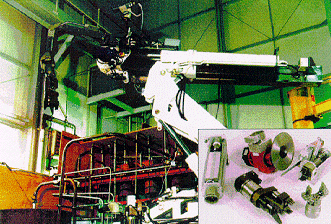
Fig. 3. In-cell
manipulator and remote tooling.
Restrictions on the disposal of solvent to the site effluent system and problems associated with the in-sire clean out of pipework and vessels resulting in the remaining fire and explosion hazards associated with the potential residual process solvent, a variety of cold cutting tools for different applications have been provided for manual operation and manipulator operation including;
Development work with tool manufacturers has been undertaken to ensure that the tools are able to comply with the major project constraints of effluent control and explosion hazards and continue to have effective service times. Particular problems encountered were;
Both these problems have now been resolved and are being utilized on plant.
Size Reduction Facilities
The strategy for decommissioning all the areas of the plant identified the need for remote size reduction capabilities for high radiation vessels. Although the MAN cell vessels have radiological conditions which permit manual size reduction techniques it was decided to reduce the overall cost base and enable continuous development and improvements to provide remote facilities for all vessels at an early stage. An air plasma system was originally chosen to size reduce vessels based upon operating experience from the BNFL Capenhurst decommissioning project. However, factory trials showed that this system was only capable of cutting through 40 nun of stainless steel and not capable of cutting through the maximum 70 mm thickness required to cut some vessel flanges when air gaps and cutting angles were considered. A proprietary 200 amp mixed gas (argon/hydrogen) plasma arc system was then selected with the additional benefit of the inerting effect of the Argon gas eliminating iron oxides, reducing fume and dross volumes.
The use of a plasma arc torch demands reliable, accurate control of its distance from the work piece and of its cutting speed. All these can be achieved by using conventional industrial robots, designed for continuous use in car and related manufacturing environments, in conjunction with a laser stand-off measuring system. Much of this reliability results from the use of a.c. brushless synchronous servomotors coupled to simple robust gearboxes in the manipulators and the lack of complex electronic systems in-cell improves the radiation tolerance of the robots. The robot computer panels and the cutting station electrical and control cubicles are located in the control room adjacent to the WHF. Two large six axis industrial robots have been designed to work in tandem with the turntable, on which the vessels are located, controlled by the robot computer systems as the seventh axis.
Two industrial robots, each with a radius of action of approximately 2500 mm are located adjacent to the turntable, the robot centrelines subtend at 90 through the center of the turntable. This allows both robots to work in same area; one robot cutting the other handling the pieces, as described later in this paper, and simplifies calibration and CCTV observation. Fume extraction from the vessel and cutting area with subsequent serf cleaning cyclonic particle removal facilities, followed by HEPA filtration are provided.
Initial inactive cutting trials with the hydrogen argon plasma torch showed no adverse effects and the system behaved as expected from the results of previous air plasma trials. However, when the cutting station was connected to the active facilities and subject to the effects of the cell ventilation system is was noted that not all the fume was collected by the Tedak cyclonic extraction system and that there was a slight migration of activity towards the cell entrance. The fume characteristics were reassessed and small particulate between 0.03 and 0.3 micron identified which is much smaller than anticipated. A cost benefit analysis has revealed that it is more cost effective to erect an enclosure around the cutting to contain the fume than allow contamination to spread within the facility with the impact upon intervention protective clothing requirements and an increase in operating costs over the anticipated 15 year life of the facility. Consequently, a new containment enclosure has been designed and fabricated for installation in the near future.
Size Reduction Philosophy
Based upon conventional manual size reduction techniques the simplest method of vessel reduction is to cut out individual sections which would then be removed for monitoring and disposal. Initial trials using the pair of industrial robots in tandem using one robot to plasma cut while the other would handle the cut pieces were successfully completed using this principle but it soon became apparent that some other system would be required to control the volumes of contaminated dross in the cutting area which needed to be cleaned up either by the robots using remote housekeeping programs or by manual intervention with the problem of operator dose.
The "quilt cut" method has therefore been adopted for vessel reduction. This method involves completely sectioning the vessel but leaving bridges of metal between each section so that the vessel remains in its original shape, hence the name quilt The majority of the dross from the cutting operation is thus retained within the vessel, in smaller vessels it will stick to the inside surfaces as a coal When the vessel "quilt cut" is complete the bridges are cut and the handling robot transports the piece to the waste basket. A small amount of dross is unavoidably generated by this operation but will be controlled by robotic vacuuming of the cutting station area.
The control systems available with the industrial robots chosen in 1991 were based on the teach and repeat programming principle. Although this was satisfactory for programming a small number of cut paths it became unsatisfactory for the large number required for the numbers of effectively unique vessels to be size reduced during the life of the project The main draw-backs with this process were that teach and repeat programming is very slow and does not lend itself to remote, television based, viewing with a high potential for damage to the robot cutting head due to collisions with the work piece during positioning operations. Local programming was much more practicable for the basic programming requirements but would have resulted in high dose to operators, the very principle that the remote systems are trying to reduce. The next stage in the project development program looked into computer model system and totally remote systems and are described below.
Robot Programming
An automatic programming method was required to allow large numbers of points to be programmed efficiently and without entry to the curing station. This was achieved using off-line programming via 3D computer simulation. The IGRIP (Interactive Graphical Robotic Instruction Program) simulation developed in the American automobile industry to eliminate teach and repeat has been adapted to the requirements of the curing station, see Fig. 4. IGRIP allows programs to be produced in the simulated world using models of the vessels then checked in the real world, corrected and run. The simulated models enable singularity conditions and clashes to be identified and resolved prior to size reduction commencing. The configuration of the system computer hardware was chosen to allow the maximum use of proprietary software packages, thus vastly reducing development times and costs.
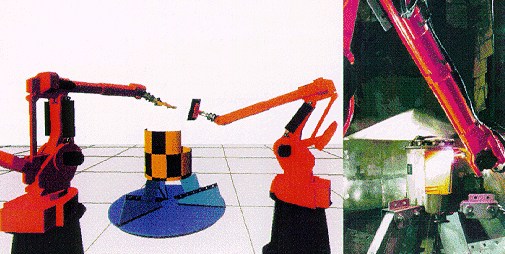
Fig. 4. Remote vessel size reduction
by plasma cutting using IGRIP simulation.
Each robot has a control panel which contains the computer systems to drive the robot arms and any external axes and contain inputs/outputs (i/o) for interfacing with other robots and work cell hardware and a serial link to connect a supervisory computer. The controllers have hand held robot programming panels to allow conventional "teach and repeat" operations if required. A supervisory computer is connected to each computer and to a proprietary i/o system which controls and collects data from all the other systems, principally the plasma arc cutter and laser triangulation unit. Two Silicon Graphics workstations are provided, one in the control room for generating the robot programs, the other in the project management centre to generate the models and initial programs in conjunction with AutoCad 3D which is quicker and more accurate than IGRIP's restricted CAD features allow.
This system is now in operation and is being used to size reduce vessels from the MAN cell and has successfully reduced the vessels from the first two levels within the cell. The limiting factor on the time to generate the cut paths for vessel reduction is the calibration time of the vessel "tag" points due to restrictions in the response time of the supervisory computer. Development work has continued on the supervisory system and a new control system has just been developed that reduces calibration time by a factor of 100.
CONCLUSIONS
Where in situ decontamination of plant and equipment is infeasible, deferral of decommissioning of high radiation beta gamma contaminated facilities, to permit manual intervention, provides significant operating cost benefits but can result in additional cost to bring plant and equipment up to current operating and safety standards.
Records of the plant construction, modification, operation, incidents, physical and radiological status should be retained and adequately archived. It is important that when operations cease plants are thoroughly cleaned out and the results formally documented.
It is important that in order to provide a cost effective decommissioning solution, projects are considered holistically and that learning areas can be identified in advance for the reduction of uncertainty in other areas. The experience gained and procedures developed during these stages will be fed into the subsequent work to improve safety, operating capabilities and reduce financial risk
An integrated strategy of using a mixture of man and machines can provide a safe and cost effective solution to complex decommissioning operations, reducing dose to personnel while limiting the cost of fully remote technology. Where remote systems are required the use of proprietary items for manipulators, deployment systems, tooling and computer modeling reduces development costs and time scales while providing robust, reliable and easily maintainable equipment. Complex operations beyond the scope of these machines can be carried out by carefully planned manual intervention.