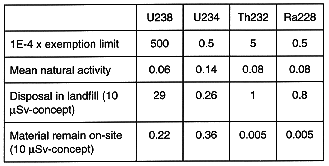
Table I Limits for the Acitivity Concentration (Bq/g)
Hartmut Runge, B. Sohnius
DETEC GmbH
P. Borner,
NUKEM GmbH
D. Schmidt
NUKEM Nuclear
ABSTRACT
As the first of four German fuel element fabrication sites requiring decommissioning, the HOBEG facility in Hanau has completed the decommissioning process.
This project took six years due to complicated German licensing procedures. After removal of all nuclear material, the process equipment was dismantled and the buildings were cleared from all installations. This initial work was followed by remediation of outside areas and decontamination of the process buildings. Problems were encountered since the natural background of the site exceeded the regulatory clean-up guidelines.
After extensive radiological control measures and regulatory negotiations, the facility was released from the atomic law and is now used for civilian purposes.
INTRODUCTION
In the HOBEG fuel element fabrication plant, spherical graphite fuel elements were fabricated for the German gas cooled high temperature reactors, namely the Thorium High Temperature Reactor (THTR in Hamm Uentrop). Development and operation of these reactors were abandoned a few years ago due to political reasons. Consequently, there was no longer a need for THTR-fuel elements.
In 1989, as the owner of the HOBEG facility, NUKEM applied for a license to shut down the HOBEG fabrication site, in compliance with the German Atomic Law and the German Radiation Protection Code (GRPC).
The HOBEG site is comprised of 6000 m2 inside its fenced area, which includes an office and laboratory building, as well as the fabrication building. Since only coated fuel particles were processed into fuel elements, contamination inside and outside the buildings was at a low level. Thus a decision to decontaminate and release the facility from the atomic law for further civilian use was made rather than to destroy the buildings.
It took five years to successfully complete all licensing procedures. Equipment and machinery was dismantled on the basis of single planning permits and single applications and released for further use in the nuclear field, remelting, or intermediate storage.
Approval for remediation and decontamination was received in April 1995.
PRINCIPALS OF REMEDIATION
Remediation work was based on the so-called 10 µSv-concept for mass specific activity concentrations (Becquerels per gram) in disposed material. This implies that any radiation exposure of the public or special workers (for example, workers at landfills), resulting from the deposition of material, must not exceed 10 µSv/year. There were similar regulations for surface contamination. Regulatory guidelines are controlled by the GRPC. Considering these principles, the following strategies were applied for remediation and material handling:
Extensive calculations and evaluation of natural activity on-site and its surrounding area revealed that strict application of this concept would have led to contradictions. The relevant radionuclides for the HOBEG site were U238, U234, Th232, and Ra228.
The remediation thus was impacted by the 10 µSv-concept for the mass related activity concentration and the attachment IX of the German radiation protection code (StrlSchV paragraphs 35 and 64) concerning the surface contamination.
Table I shows the results of the radio-ecology calculations of uranium and thorium for the two options, either storing on a non nuclear waste landfill or remaining on site. The limits presented include the requirement that any additional radiation impacts to the public, i.e. special personnel groups, are limited to 10 µSv/year.
For comparison purposes, the activity concentrations are presented as calculated from the 1/10,000 values of the exemption limits (according to the German radiation protection code) and the measured values of the natural material
The limitations of the 10 µSv-concept are demonstrated by the comparison between the calculated concentration values of Th-232 and Ra-228 for remaining on site and the values of the natural material which show that the material with the natural radioactivty would have required removal out of the plant.
Table I Limits for the Acitivity Concentration (Bq/g)
Material contaminated by Th232 and its daughter element, Ra228, can only remain on-site (according to µSv conditions) when its activity concentration is more than one order of magnitude lower than the natural activity values.
These results lead to the paradoxical situation that no material could remain on-site and that the natural ground material had to be excavated and deposited on a conventional landfill. Since this is absurd, the authorities agreed to accept higher values as listed in Table II.
The limits for the activity concentration of the uranium isotopes were halved and the limits for Th-232 and Ra-228 were adjusted to the values of the natural clean material on site.
Table II Agreed Activity Concentration Limits in Bq/g
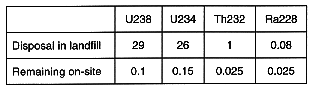
On the basis of these agreed values, remediation could then be performed.
REMEDIATION OF OUTSIDE AREAS
Remediation of outer areas was performed differently depending on the nature of the area, i.e. whether it was covered or uncovered ground.
Remediation of Uncovered Ground
Remediation of uncovered ground started with surface measurements on a 4 m2 grid scale. When contaminated areas were detected, the soil was excavated, homogenized, and measured. Depending on the measured activity concentration, the material was then handled in accordance with Table II (i.e. it was either returned to the excavation area or it was prepared for shipment to a conventional landfill). If the activity concentration exceeded the limit values for deposit at a landfill, the material was sent to an intermediate storage area at a nearby facility.
On-site excavation was suspended when the surface activity at the base of the excavated hole reached natural surrounding values and when the activity concentration in 100 kg samples taken from the base was below the limit value for remaining on-site.
Laboratory control analyses were performed on 200 kg samples taken on a 10 m2 grid scale for uncontaminated surface areas.
Remediation of Covered Ground
Surface contamination measurements were taken on a 1 m2 scale or denser at critical locations on areas covered by concrete or asphalt. Detected contamination was removed with needle pistols or by centrifugal steel shop blasting.
If cracks or gaps were visible on contaminated surface areas, the contaminated penetration depth was determined by taking bore samples. The surface cover was removed and the contaminated soil was excavated and treated in the same manner as described for uncovered areas.
DECONTAMINATION OF BUILDINGS
Contamination was found only in buildings where radioactive material was handled during the operational period, (i.e. in controlled areas). Individual plans were designed for each room to be decontaminated. Before starting decontamination, all installations which were no longer needed, were removed, packaged in drums and transferred to a nearby intermediate storage area. Steel scrap resulting from this dismantling work is then decontaminated for free release with centrifugal steel shot blasting.
After internal dismantling, the extent of pre-remediation, as well as the decontamination technique and the protection measures during and after decontamination, was determined with an independent examiner.
Pre-remediation primarily consisted of chiseling cracks in walls and floor. Dowel holes had to be bored completely and then sealed prior to decontamination. One fabrication hallway had more than 2000 holes. After pre-remediation, the walls and floors were decontaminated using dry techniques. The primary object was to generate contamination free surfaces by completely removing the outer material layer. The technique applied for this purpose was centrifugal steel shot blasting on all plane areas. Special blasting machines were used on floors and building walls. Inaccessible areas were treated with needle pistols.
This abrasive decontamination technique was accepted by independent examiners and authorities prior to its application and after demonstration proving surfaces to be free of contamination. It was therefore, unnecessary to measure contamination after the wall and floor treatment.
Decontaminated surfaces were sealed with foils in order to protect from re-contamination.
The waste material produced by the decontamination process was collected with a vacuum device and transferred in drums to an intermediate storage area.
Decontamination was unnecessary in outer building surfaces since no contamination was found, however surfaces were completely measured for free release.
CONTROL MEASUREMENTS FOR UNRESTRICTED RELEASE
As mentioned above, no control measurement was necessary after surfaces were treated by centrifugal shot blasting.
Other areas within the controlled operational zones, which were not decontaminated, had to be completely measured for free release, even though no contamination was detected during preliminary measurements. The German surface contamination limit value for free release is for alpha-emitters <0.05 Bq/cm2. Measurements had to be performed on a scale depending on the presumed contamination risk. Such areas were then measured and released from the atomic law one room at a time.
Special efforts were necessary to control the outer building surfaces. As mentioned above, no contamination resulting from the former HOBEG operation was found. Nevertheless, activity was detected on the outer surfaces. By measurements and analyses it was proven that this activity consisted mainly of the natural radionuclides of the uranium series, especially Po210. Consequently, activity exceeding the release limit values on the outer surfaces, for example - old window sills, did not have to be removed (window sills cleaned tentatively were found re- contaminated within a few days).
The complete field decontamination work was performed within half a year and the HOBEG facility was then released by the local government office from the atomic law by end of 1995.
OUTLOOK ON FURTHER PROJECTS
After the HOBEG site was successfully decommissioned and released from the atomic law, the second former NUKEM facility began the decommissioning phase. The so-called NUKEM-A facility was a former fabrication site for MTR fuel elements and is located only 1 km away from the HOBEG site. No building refurbishment is planned for NUKEM-A, all buildings will completely be dismantled and demolished.