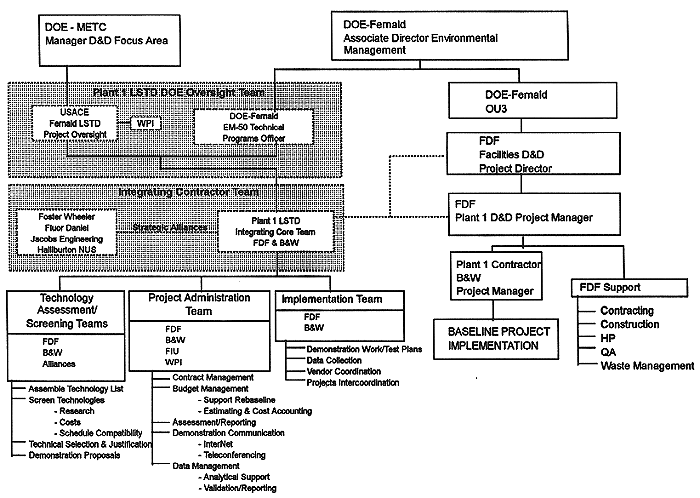
Fig. 1. Plant 1 large-scale
demonstration organizational structure.
R. A. Martineit, P. J. Pettit
FDF**/HNUS
T. D. Borgman, M. S. Peters, G. P. Ruesink, L. L. Stebbins
FDF
S.
J. Bossart
DOE-FETC
D. M. Brown, D. R. Krause
B&W NESI
R. D. Warner
DOE-FEMP
ABSTRACT
The Department of Energy's (DOE) Office of Science and Technology Decontamination and Decommissioning (D&D) Focus Area, led by the Federal Energy Technology Center, has been charged with improving upon baseline D&D technologies with the goal of demonstrating and validating more cost-effective and safer technologies to characterize, deactivate, survey, decontaminate, dismantle, and dispose of surplus structures, buildings, and their contents at DOE sites. The D&D Focus Area's approach to verifying the benefits of the improved D&D technologies is to use them in large-scale technology demonstration (LSTD) projects at several DOE sites.
The Fernald Environmental Management Project (FEMP) was selected to host one of the first three LSTD's awarded by the D&D Focus Area. The FEMP is a DOE facility near Cincinnati, Ohio, that was formerly engaged in the production of high quality uranium metal. The FEMP is a Superfund site which has completed its RI/FS process and is currently undergoing environmental restoration.
With the FEMP's selection to host an LSTD, the FEMP was immediately faced with some challenges. The primary challenge was that this LSTD was to be integrated into the FEMP's Plant 1 D&D Project which was an ongoing D&D Project for which a firm fixed price contract had been issued to the D&D Contractor. Thus, interferences with the baseline D&D project could have significant financial implications. Other challenges include defining and selecting meaningful technology demonstrations, finding/selecting technology providers, and integrating the technology into the baseline D&D project.
To date, twelve technologies have been selected, and six have been demonstrated. The technology demonstrations have yielded a high proportion of "winners." All demonstrated technologies will be evaluated for incorporation into the FEMP's baseline D&D strategy. Those technologies that are not added to the FEMP's baseline D&D strategy will be documented to aid other sites/companies engaged in D&D activities with their D&D technology selection process.
BACKGROUND OF THE LARGE-SCALE TECHNOLOGY DEMONSTRATION (LSTD) PROJECT
In early 1995, the Department of Energy's (DOE's) Federal Energy Technology Center (FETC) was selected as the lead organization for the Decontamination and Decommissioning (D&D) Focus Area. The DOE's D&D Focus Area is charged with developing technologies or finding existing technologies, being used in other fields, that are more cost effective and/or safer than existing baseline D&D technologies. The merit of these new technologies is to be demonstrated through a commercial-scale application as part of LSTD. The objective of the LSTD Project is to transfer technologies proven to provide cost and/or safety improvements to FETC's customers (technology "users") in the Office of Waste Management (EM-30), the Office of Environmental Restoration (EM-40), and the Office of Nuclear Materials and Facilities Stabilization (EM-60). Others may benefit from the LSTD Project as well, including commercial sector organizations which must decommission their facilities, D&D contractors who will be provided with a larger "D&D tool box," and technology providers who potentially could benefit commercially from the use of their technologies.
In mid-1995, the D&D Focus Area issued its first Request for Proposal (RFP) to select LSTD's. The goals of each LSTD awarded under this RFP were as follows:
The LSTD's were to demonstrate existing/developed technologies ready for field deployment and were not to be a technology development program. Instead, they were to be demonstration programs developing "real-world" data on cost and performance of "ready" technologies. Technologies which could be included in the LSTD's are those developed under other DOE programs but which have not yet been used in a commercial application, technologies that have not yet been used within the DOE Complex as part of a D&D project, or technologies being used in non-D&D applications which represent potential improvements over current baseline D&D technologies.
THE FEMP'S PLANT 1 D&D PROJECT
The Fernald Environmental Management Project's (FEMP's) proposal to use its Plant 1 D&D Project as a vehicle for LSTD was accepted in October, 1995 by the D&D Focus Area. The Plant 1 D&D Project consisted of Building 1A and six smaller associated buildings. All enriched uranium materials (typically 4.5 to 6 wt % U-235 and occasionally up to 16 wt % U-235) that were processed at the FEMP as well as other materials were received in Building 1A. Non-enriched ore concentrates and recycled materials were weighed, sampled, and milled in this plant for distribution to other processes. Uranyl nitrate hexahydrate solution was also prepared in this building for use in the Ore Refinery Plant. In total, Building 1A had seven process areas: drum sampling, crushing/milling, enriched materials reclamation, drum washing, solvent reclamation, waste water handling, and repacking.
The total cost of the Plant 1 D&D Project, including the cost to complete safe shutdown activities, was estimated to be $10.9 million. The contracted duration for completion of the Plant 1 D&D Project once it was turned over to the D&D Contractor was eighteen months.
Building 1A was a four-story irregularly shaped process building having a footprint of 16,600 square feet and an interior volume of 830,000 cubic feet. It was constructed with a structural steel frame, transite walls (interior and exterior with batt insulation in between) and roofing, and a poured concrete floor with some interior concrete-masonry walls.
Of the other six buildings in the Plant 1 D&D Project, one was a process facility and the others were storage facilities consisting of steel frame, single-story structures constructed on a poured concrete floor. The storage facilities ranged in size from approximately 700 square feet to 4,000 square feet. Typically these facilities were contaminated with uranium; however, both uranium and thorium may have been present.
At the completion of the Plant 1 D&D Project, all structures will have been removed down to their concrete pads with the transite panels palletized and wrapped and the structural steel segmented and stacked on the Plant 1 pad. Debris will have been boxed awaiting disposal in the on-site disposal facility (OSDF) along with the transite and structural steel. Debris not in compliance with the FEMP's waste acceptance criteria for the OSDF will be sent to the Nevada Test Site (NTS) for disposal.
The contract for the D&D of Building 1A and the six other buildings had been awarded to B&W Nuclear Environmental Services, Inc. (NESI) before the receipt of the LSTD RFP from the D&D Focus Area. The contract between Fluor Daniel Fernald (FDF) and B&W NESI is a firm fixed price contact with milestones and a fixed completion date. Thus, a challenge was the integration of technology demonstrations into the baseline D&D project without adversely impacting on the baseline project or missing the opportunity to perform a demonstration because the related D&D activity had already been completed.
THE FEMP'S LSTD PROJECT ORGANIZATION
As a result of the underlying Plant 1 D&D Project being an independent project for which a contract had already been awarded, this LSTD Project organization was comprised of two parallel organizational structures as shown in Fig. 1, "Plant 1 Large-Scale Demonstration Organizational Structure." This organizational structure allowed both projects to progress so that both could meet their individual requirements while permitting the LSTD Project to
Fig. 1. Plant 1 large-scale
demonstration organizational structure.
integrate activities into the Plant 1 D&D Project with no critical path interference and with the support of the ongoing D&D project. The key to success for this organizational structure has been the integration of representatives from the Plant 1 D&D Project into the LSTD Project. Thus, the two parallel project organizations were joined not only at the top but also at the heart of each organization's structure. This second point of integration between the two projects was at the "IC Team," which included the FDF Plant 1 Project Manager and the Plant 1 D&D Contractor, and provided the direction for the LSTD as well as approval of all the technology demonstrations. This integration of the two projects within the IC Team ensured that decisions made were focused on the D&D needs of the Plant 1 Project.
TECHNOLOGY SELECTION AND APPROVAL FOR DEMONSTRATION
The Plant 1 LSTD Project developed a D&D "Needs Statement" with two distinct parts. The first part provided general guidance on the performance objectives for the new technologies. The second part of the Needs Statement defined specific FEMP D&D tasks that would benefit from new technologies. A team consisting of representatives from Fernald Operable Unit 3 (responsible for the D&D of all process facilities), FDF Construction, B&W NESI (the D&D Contractor), and FDF Technology Development was formed to develop the Needs Statement. This team was dominated by members familiar with the already completed D&D of the FEMP's Plant 7 and/or the ongoing D&D of the FEMP's Plant 4. Thus, their input was keyed toward improving the currently employed baseline D&D technologies. This effort would also benefit D&D projects involving similar facilities throughout the DOE Complex.
The performance objectives for the demonstration D&D technologies, as defined in the FEMP's "Needs Statement," are as follows:
The FEMP D&D technology needs as defined in the Needs Statement are summarized below.
The Screening Team had the primary responsibility for evaluating D&D technologies and making the initial determination on which technologies should be included in the LSTD. However, all members of the IC Team were encouraged to screen technologies, and regardless of who performed the screening, the screening processes were standardized through the use of the "Plant 1 LSTD Technology Evaluation Form." The first part of this form summarized the technology evaluation and presented the following information:
In the second part of the technology screening form, 12 specific evaluation criteria were addressed which were as follows:
Technologies were reviewed in groups rather than one at a time. Once the screening process for a group of technologies was completed, an oral presentation was made to the IC Team on the technologies recommended for acceptance or rejection. The IC Team could recommend another look at a rejected technology, reject a recommended technology, or approve the preparation of a TechnicalProposal (a more detailed evaluation) for technologies receiving conditional acceptance of the IC Team. The Technical Proposal presented the following information on the proposed demonstration technology:
Based on the information presented in the Technical Proposal, coupled with a "question and answer session," the IC Team decided whether to approve or reject the proposed technology demonstration. In addition to the IC Team's approval to demonstrate a technology, the DOE-FEMP's approval is also required prior to starting the demonstration.
To date, the Screening Team has reviewed 184 technologies and recommended 32 for demonstration from which the IC Team approved 17 for the preparation of a Technical Proposal. From these 17 technologies, 12 were accepted for demonstration. Technology screening efforts continued until the Plant 1 D&D Project reached a point which precluded any possibility for further integration of technology demonstrations.
TECHNOLOGY INTEGRATION
Once a technology was approved for demonstration, two parallel efforts were set in motion. One of these efforts related to the administrative and procedural requirements of the project and included activities such as preparation of an FDF Work Plan, preparation of the technology demonstration Data Package, issuance of a Request for Proposal to B&W NESI, and preparation of the Demonstration Work Plan by B&W NESI.
The above activities took place when the demonstration was being conducted by B&W NESI. However, characterization activities at the FEMP are the responsibility of FDF personnel and were not part of the EM-40 Plant 1 D&D contract with B&W NESI. Therefore, it was decided that characterization technology demonstrations would involve those groups within FDF that would be responsible for using the technologies. For these demonstrations, FDF prepared all support documents and performed procurement activities.
The other parallel effort involved integrating the demonstration into the ongoing Plant 1 D&D Project. For several of the technology demonstrations this was not a straight forward effort. Problems related to scheduling technology demonstrations within the Plant 1 D&D Project resulted from the Plant 1 D&D Project being well underway, and the LSTD Project was, in effect, chasing a moving train. One problem encountered was missing desired or even approved technology demonstrations because the baseline activities had been completed or would be completed before the demonstration could be started.
B&W NESI was very cooperative in its support for the LSTD demonstrations. Actions taken by B&W NESI to support the Plant 1 LSTD include leaving some activities unfinished so that they could be completed as part of the LSTD, removing materials and components and holding them aside to support demonstrations, moving ahead with a baseline activity while collecting D&D data to support future comparisons with LSTD technologies, and when possible, changing the sequence of D&D activities.
SELECTED TECHNOLOGIES
Twelve technologies have been approved for demonstration of which six have been completed, three are yet to be started, one is on hold, and two have been canceled. The 12 technologies are discussed in the following subsections.
Steam Cleaning of Segmented Equipment (Kelly System by Container Products Corporation)
All process equipment and components (segmented or not) must be washed before they can be placed in the on-site disposal facility. The baseline washing involved the use of a power wash system. This system used heated, pressurized water at flow rates of four to five gpm with no integral waste collection system. This demonstration evaluated the use of a steam cleaning technology which has been commercially available for some time and has been used in numerous commercial nuclear applications. It uses high-pressure, low-flow super-heated water as the cleaning medium and a cleaning head that incorporates spray nozzles within a vacuum head. Therefore, as the water impacts on the surface to be cleaned and flashes to steam, the vacuum system removes the steam and removed/loosened contaminants. It was expected that the new technology would reduce water consumption/waste generation, as well as the potential for recontamination of either just washed material or material staged nearby for drying from the splashing high-pressure wash water.
Demonstration Status: The demonstration of this technology is finished, and its findings include that, except for the wand, the various cleaning heads that were demonstrated did minimize the potential for recontamination. This technology resulted in the metal surfaces drying very fast, thus reducing the time washed equipment had to be held in the drying staging area. The system did not remove grease; it just moved it around. Ergonomically the system was not designed for the way it was used in this demonstration. Also, it was difficult to clean corners and weld seams. The laborers' overall assessment was that the best application for this technology was in the cleaning of large, flat surfaces.
Vacuum Removal of Insulation (VecLoader by Vector Technologies)
Under the baseline D&D approach, insulation was manually removed from the transite wall panels, placed into disposal bags, and removed from the work area. The alternative technology was a self-contained trailer-mounted vacuum system capable of transporting material up to 1,000 feet through a five-inch hose. The alternative technology (the VecLoader) came from the asbestos removal industry and included both a HEPA filtered exhaust and direct feed into the disposal bag located outside the facility. This technology demonstration compared insulation removal using the baseline technology to insulation removal using the VecLoader technology.
Demonstration Status: This technology demonstration has been completed. Overall the technology was successful to the point that the D&D Contractor had plans to convert the VecLoader into a "central D&D vacuum system." This plan had to be abandoned because the VecLoader had to be returned to the technology provider. Findings from this demonstration include that the learning curve for this technology was longer than projected with the insulation removed on the last day of the demonstration equaling the total insulation removed during the first three days. Also this "off-the-shelf" system should have been tailored to this specific application. This was evidenced by the laborers jury-rigging modifications to make the equipment more "user friendly." In addition, the original vacuum end section was a 2 ½-inch pipe which was quickly clogged by the removed insulation. This hose end section was removed, and the laborers wrestled with the heavy five-inch hose. One disappointing situation was noise level at the VecLoader. Due to the elevated noise level, the site health and safety department significantly shortened the worker stay time even with double ear protection being worn by the laborers. One of the D&D laborers had used this technology in the asbestos removal industry and reported that when ear protection was worn, the allowable work duration was not shortened to less than eight hours.
Soft Media Cleaning of Segmented Equipment (AEA Technologies, Inc.)
This demonstration evaluated the use of a soft media ("sponge") cleaning technology as an alternative to steam cleaning and as a potential replacement for the baseline power washing technology. The soft media cleaning technology uses pneumatically transported and propelled pieces of soft medium to clean contaminated surfaces. The soft cleaning media comes in five grades from "non-aggressive" to "heavy and aggressive." The aggressiveness is controlled by the type of material with which the medium is impregnated. Due to the hydrophilic cell structure of the prepolymer of the cleaning media, it absorbs and traps contaminants carrying them away from the substrate. This demonstration used the two least aggressive types of soft media to clean segmented process components, including those that had processed enriched material, which could not be cleaned as easily using water. This demonstration was to assess the technology's ability to eliminate the problems associated with using water to clean components having contained enriched uranium and to reduce waste disposal costs by minimizing the quantity of waste shipped to the Nevada Test Site. There were also expectations of improved productivity.
Demonstration Status: The demonstration of this technology has been completed. Findings of this technology demonstration were that the nozzle supplied with the system was awkward to use, and the soft medium was easy to clean up. Because of the associated noise level, laborers here were limited to one hour of work while wearing double hearing protection. (The technology provider claimed that elsewhere operators of this technology, when wearing ear protection, were not limited to less than an eight hours.) The next-to- the-least aggressive medium easily removed the lead-based paint resulting in highly increased airborne lead levels so use of this medium was curtailed. It was noted that when this medium was used, the dust in the air was visually greater. The least-aggressive medium was reported to have reduced contamination levels on a piece of equipment from 1,500,000 dpm per 100 square centimeters to background.
Oxy-gasoline Torch (Petrogen)
Components/equipment going into the on-site disposal facility (OSDF) are segmented to facilitate their placement within the OSDF. Much of the segmenting is performed using an acetylene torch (the baseline technology). This technology demonstration evaluated the use of an oxy-gasoline torch in lieu of the acetylene torch. It was expected that the new technology would reduce the overall project segmenting cost as well as improve segmenting productivity which could benefit the overall project schedule. The D&D Contractor, B&W NESI, was so convinced of this technology's capabilities that it ordered an oxy-gasoline torch for its own use before the LSTD demonstration of the torch actually started.
Demonstration Status: The demonstration of this technology has been completed. It was quite successful with the oxy-gasoline torch providing superior performance when cutting thick steel (>1 inch) or when cutting steel tanks whose interior surface has significantly rusted. This torch also provided superior economics with 2 ½-gallons of gasoline lasting as long as a standard acetylene bottle when cutting thick steel. Also a three-gallon gasoline can is much more mobile than an acetylene bottle.
Field Raman Spectroscopy (EIC Laboratories)
To ensure radiation areas are properly posted, the radionuclide of concern must be properly identified. The baseline approach for performing this activity involves the taking of swipes which are then sent to either an on-site or off-site laboratory for an analysis requiring two or more weeks to complete. Until the analysis has been completed and the results received, no work can be performed in the subject area. At the FEMP the two primary radionuclides are uranium and thorium. The objective of this demonstration was to evaluate the use of a field raman spectroscopy unit to perform a field analysis of the swipes as an alternative to sending the swipes to a laboratory. It was expected that this technology would reduce the delay experienced while waiting for the laboratory's analytical results and thus benefit the overall project schedule as well as eliminating the cost incurred for this laboratory support.
Demonstration Status: All swipes have been taken and read with the field raman unit. Site personnel were quite pleased with the system's performance. Readings were obtained for both uranium and thorium contaminants before sending the swipes to an off-site laboratory for analysis. The results of these two analytical efforts will then be compared, and the assessment of the field raman spectroscopy system will be finalized.
Pipe Inspection (Visual Inspection Technologies and Radiological Services Inc.)
In order for process pipe to be disposed of in the FEMP's OSDF, the full length of the pipe's interior surface would have to be visually inspected to ensure there was no process residue present. Currently there is no baseline pipe inspection technology, and thus, all process pipe requiring such inspection is simply boxed up for disposal at NTS. Since there is no corresponding baseline technology, this demonstration performed a comparative evaluation between two different pipe inspection technologies to determine if the visual inspection requirements could be met by both or either of the selected technologies. The two selected technologies represent the two ends of the cost spectrum for this type of technology. A successful demonstration would provide the FEMP with an approach for achieving significant cost savings by reducing the volume of waste being shipped to NTS for disposal. Preliminary estimates indicate that, on an average, the cost to inspect and then dispose of a ten-foot section of pipe in the FEMP's OSDF is 80% less than the cost to send that same section of pipe to NTS.
Demonstration Status: One of the two inspection technologies has been demonstrated to date. About 50 pieces of pipe, varying in size from two to twenty-four inches, were inspected with approximately 67% of the inspected pipes being found free of any process residue. This residue-free pipe was set aside for disposal in the FEMP's OSDF. The avoided costs resulting from redirecting the residue-free pipe to the OSDF for disposal was greater than the cost incurred to perform the demonstration.
Laser Induced Fluorescence (Special Technology Laboratory)
Prior to opening structures, their interior surfaces must be surveyed to ensure that levels of loose surface contaminants are below defined limits. Under the baseline technology, this determination is made through a swipe and count program which requires the swipes to be counted overnight. This program also includes the need to work off ladders and/or platforms in order to take swipes higher up the walls and from the overheads. The objective of this demonstration was to evaluate the use of laser induced fluorescence (LIF) as a replacement for the swipe and count approach thereby reducing the time required to complete such a survey since an overnight count of the swipes would not be required. In addition, the LIF System being evaluated permits a working standoff distance of 25 feet, thus eliminating the need to climb ladders and to work off platforms when taking swipes.
Demonstration Status: This technology has not been started.
Void Filling Using Both a Foam (Urethane Foam Specialist) and a Low-Density Cellular Concrete (Pacific International Grout)
Process components that meet the FEMP's waste acceptance criteria for the OSDF are segmented prior to disposal. Segmentation facilitates the disposal of large items and provides a way of eliminating void volumes within the waste material being placed in the OSDF. However, there are cases where the additional effort needed to place large, intact pieces of equipment are more than offset by the elimination of additional cost, problems, safety issues, etc. that would be encountered in attempts to segment such components. For any unsegmented component to be placed in the OSDF, voids must be filled with a structurally acceptable material. This demonstration was to evaluate two void filling media, one a foam material and the other a low-density cellular grout. Since void filling is not currently performed at the FEMP, there is no baseline void filling technology. When a baseline technology did not exist, the preferred approach was to perform a comparative demonstration between two alternative technologies as in this case.
Demonstration Status: These two void filling demonstrations have not yet started.
Personal Protective Equipment - Personal Ice Cooling System (GEOMET Technologies Inc.)
High daytime temperatures during the spring and summer months increased the potential for the D&D laborers to experience heat stress. The FEMP's baseline approach for minimizing the potential for heat stress involves the use of reduced work periods and a "cool room" where workers can cool down and have their physiological condition monitored. As a result of this practice, productivity factors well below 50% were experienced during the hotter summer days. This demonstration was to assess the benefits of a personal ice cooling system. This system looked like a set of "long underwear" with integrated cooling tubes through which cooling water would be pumped to provide total body cooling. The suit would be worn under the Anti-C's and treated as non-contaminated clothing.
Demonstration Status: This technology demonstration is on hold awaiting the higher temperatures of spring/summer. The demonstration of this technology lasted about one day during which the temperature never reached 80°F. Since then the temperature has remained below the level where heat stress is a concern. The one day this suit was worn, the laborers that wore it were very pleased with its performance.
Passive Aerosol Generator (PANGEA Inc.)
When survey results indicate the need for "lock down" of loose contamination on a facility's inside surfaces prior to opening a facility, it is performed using a painting crew to spray paint the facility's interior surface. For large buildings, this requires the laborers to work on platforms and ladders in order to access surfaces that can not be reached from the floor. The objective of this demonstration was to evaluate the use of a passive aerosol generator (PAG) to perform the lock down. The PAG System maintains a mist of surface coating material in the facility's atmosphere which, over time, deposits out on the facility's surfaces. The PAG System only requires the periodic filling of the coating material reservoir. Several types of coatings are being developed. This LSTD demonstration was to be the first commercial application of this technology. It was expected that the new technology would reduce labor cost and improve the overall economics related to the lock-down process. Demonstration Status: This demonstration has been canceled. The only coating currently available was not compatible with site requirements.
Transite Pulverizer/Transfer System (Vector Technologies)
Removal of the transite roof panels and the sandwiched transite/insulation/transite panels below the roof panels is a time consuming process. The panels are manually removed and carried to a skip box. Once the skip box is full, it is lowered to the ground via a crane where the panels are again manually transferred to a pallet, and when the pallet is full, it is wrapped. This technology demonstration was to evaluate placing a pulverizer on the roof, feeding the panels into the pulverizer, and vacuum transferring (with a VecLoader) the pulverized material to a bladder bag.
Demonstration Status: Due to delays in the release of FY-97 funding for the FEMP Plant 1 LSTD, this demonstration could not be implemented in time to meet the Plant 1 D&D project schedule.
DATA COLLECTION AND INFORMATION DISSEMINATION
Early in the preparation for the LSTD it was recognized that the data collected on both the baseline and new technology demonstrations would be the key to determining the success of each technology demonstration. To ensure the results of each technology demonstration were adequately documented, a detailed data package was prepared to collect the proper data. The following are typical examples of the type of data collected on both the baseline and new technology:
The data packages were also supplemented through the video documentation of the baseline and new technology demonstrations and the debriefing of the D&D laborers that used the new technology. In addition, a member of the USACE observed each demonstration and participated in the debriefing sessions as a representative of the D&D Focus Area.
The D&D Focus Area's support of the LSTD Project will be wasted if the results of this project are not disseminated to areas within the DOE Complex and commercial sectors actively involved in D&D or responsible for future D&D activities. Having completed the Plant 1 LSTD Project, the mechanisms for disseminating theresults of the LSTD are as follows:
LESSONS LEARNED
The capturing of lessons learned is one of the most meaningful products of any undertaking no matter how complex or simple it may be. As they relate to the FEMP's Plant 1 LSTD, lessons learned can be developed on the use or design of each individual technology, the conduct of the individual demonstrations, the conduct of the LSTD Project at the FDF -B&W NESI level, and the conduct of the LSTD by the D&D Focus Area. Lessons learned at the level of the individual demonstration or as they related to a specific technology will be dealt with in the individual technology reports which will also provide the necessary details to support the discussion of lessons learned at this level. This discussion of lessons learned will relate to the overall conduct of LSTD in general and of the FEMP LSTD in particular.
*This technical information was prepared as an account of work sponsored by an agency of the United States Government. Reference herein to any specific commercial product, process, or service by trade name, trademark, manufacturer, or otherwise does not constitute or imply its endorsement, recommendation, or favoring by the United States Government or any agency thereof. The views and options of the authors expressed herein do not necessarily state or reflect those of the United States Government or any agency thereof, or Fluor Daniel Fernald, its affiliates or its parent company.
By acceptance of this paper, the publisher and/or recipient acknowledges the U.S. Government right to retain a non-exclusive, royalty-free license to any copyright covering this technical information.
**FDF with the U.S. Department of Energy, under Contract No. DE-AC24-920R21972
Fluor Daniel Fernald
P.O. BOX 538704
Cincinnati,
Ohio 45253-8704