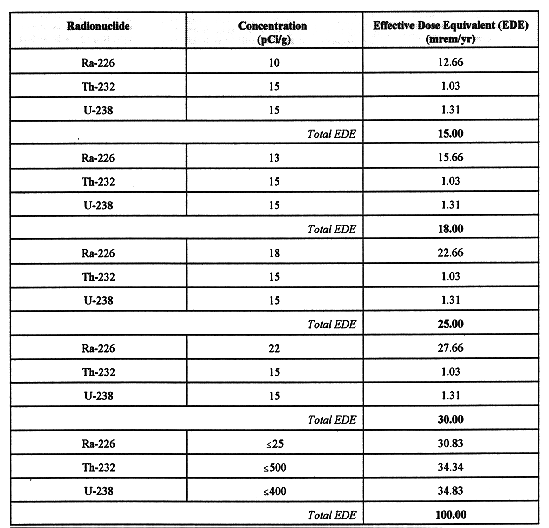
Table I Recommended Average Volume Concentrations of Radionuclides
for Compliance with Specific Dose Limits
R.L. Bauer
EG&G Mound Applied Technologies
S.A. Spesard
USDOE
Laura S. Crane, J.D. Smyth
Project Performance
Corporation
ABSTRACT
EG&G Mound Applied Technologies (MAT) and the Department of Energy (DOE)-Miamisburg Environmental Management Project Office (MEMP) conducted an evaluation to determine the viability of unconditional release of demolition debris from Building 21 at Mound. The primary advantage of pursuing unconditional release of debris is the economic benefit derived from disposal of debris as other than low-level waste. However, if extensive decontamination is required prior to release, the decontamination and verification costs can exceed the benefit of unconditional release. This paper describes the evaluation to determine the feasibility of decontamination of Building 21 in order to unconditionally release demolition debris.
The feasibility analysis for the unconditional release of Building 21 demolition debris was comprised of three sections: 1) an evaluation of criteria to unconditionally release the debris, 2) an evaluation of existing information to determine the extent of decontamination that would be required, and 3) an order of magnitude comparative cost evaluation to approximate the probable magnitude of economic benefit possible.
Based on existing information, the contaminants of concern in Building 21 are Th-232 and its decay products, and U-238 and its decay products. To date, a dose limit or generic criteria for unconditional release of D&D debris to a construction and debris (C&D) landfill have not been established. In order to proceed, a range of dose limit criteria (i.e., 15, 18, 25, 30, and 100 mrem) were used to develop recommended average volume concentrations (i.e., a range of criteria) for the unconditional release of Building 21 debris. EG&G MAT and DOE-MEMP developed specific guideline criteria, derived from basic dose limits, for the average volume residual radioactivity acceptable for release.
The analysis outlines the considerations for developing an unconditional release process related to the disposal of D&D debris, details an order of magnitude cost comparison, and provides a recommendation for the preferred disposition alternative, including next steps, for Building 21's demolition debris.
PROJECT HISTORY
EG&G Mound Applied Technologies (MAT) and the Department of Energy (DOE)-Miamisburg Environmental Management Project Office (MEMP) conducted an evaluation to determine the viability of unconditional release of demolition debris from Building 21 at Mound. The goal of the evaluation was to use existing process history information and characterization data to determine 1) if the conditions of Building 21 were such that the debris resulting from demolition would meet regulatory criteria for disposal as demolition debris rather than as low-level waste; and 2) if there was an economic benefit to decontaminating Building 21 to levels appropriate for disposal as demolition debris. In order to evaluate the feasibility of decontamination for demolition and unconditional release, DOE-MEMP and EG&G MAT also had to evaluate the appropriate criteria for unconditional release of the debris, and conduct an order of magnitude comparative cost evaluation to approximate the probable magnitude of economic benefit.
EVALUATION OF CRITERIA TO UNCONDITIONALLY RELEASE DEBRIS
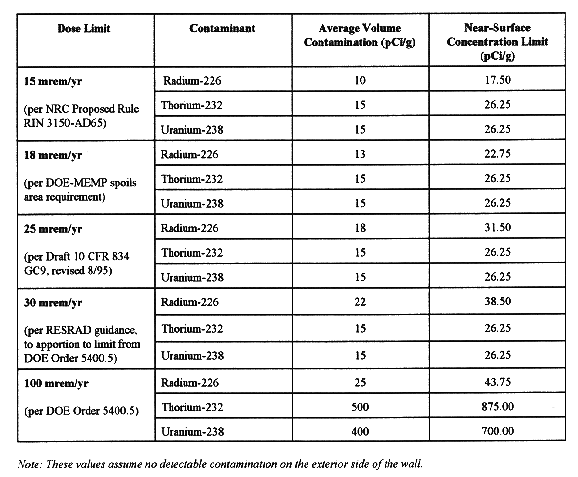
The first step in the evaluation to determine the feasibility of unconditional release of demolition debris from Building 21 was to identify the appropriate criteria for release. Generic guidelines (i.e., guidelines independent of the property, taken from existing radiation protection standards) do not exist for determining when debris is radiologically clean. Therefore, per DOE Order 5400.5, specific guidelines were derived from basic dose limits, using specific property models and data. To date, the Department of Energy (DOE), the Environmental Protection Agency (EPA) and the Nuclear Regulatory Agency (NRC) have not reached consensus on an appropriate dose limit for unconditional release of materials from a Federal Facility. In order to proceed, a range of dose limit criteria (i.e., 15, 18, 25, 30 and 100 mrem) were used to develop recommended average volume radionuclide concentrations (i.e., a range of criteria for unconditional release) for Building 21 debris. These criteria are based on current and draft regulations and guidance, as noted in Table III: Near-Surface Concentration Guideline Values for Unconditional Release.
The criteria were developed based on the end use of the material. In this case, it was known that Building 21 would be demolished. Therefore, concentration criteria, rather than surface criteria, were developed to reflect that the debris would be disposed of in a landfill. The average volume residual concentration guidelines for Building 21 were developed using RESRAD (Version 5.61). Existing information about the contamination in Building 21, as well as input pertaining to C&D landfills in the state of Ohio, was used in developing realistic RESRAD parameters. For instance, the average volume concentration criteria were developed based on the contaminants of concerns identified in existing characterization reports. The characterization effort did not attempt to define locations of specific contaminants of concern. Therefore, this analysis assumed all three contaminants of concern are present and contribute to the effective dose equivalent. The pathways activated in RESRAD were also based on the specific end use of the debris. Since Building 21 debris was going to be disposed of, the pathways were evaluated for debris in a landfill. For this evaluation the applicable pathways were split into two phases: active operation and post-closure. During the operational phase of the landfill, it was assumed that no cover was present and therefore the following pathways were assumed applicable: inhalation, soil ingestion, and drinking water. During the post-closure phase, cover material and deed restrictions were assumed to be in place. For this phase, the only credible exposure pathway was assumed to be drinking water.
Based on the RESRAD model, recommended residual radionuclide concentrations for compliance with specific dose limits were developed specifically for Building 21 debris, and are included in Table I Recommended Average Volume Concentrations of Radionuclides for Compliance with Specific Dose Limits.
Table I Recommended Average Volume Concentrations of Radionuclides
for Compliance with Specific Dose Limits
In order to use the average volume concentration criteria included in Table I, project- specific near-surface concentration criteria were developed for comparison to analytic/field samples. To develop Building 21-specific near-surface contamination criteria based on the average volume concentration guidelines, assumptions were made regarding the expected conditions. These assumptions are listed in Table II: Assumptions Used to Develop Building 21-Specific Near-Surface Contamination Criteria.
Table II Assumptions Used to Develop Building 21-Specific
Near-Surface Contamination Criteria
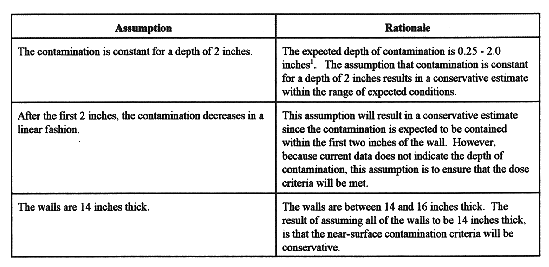
The near-surface concentration limit cannot be exceeded for any of the contaminants of concern for Building 21 if the dose limit is to be met. Based on the above assumptions, near-surface contamination limits for the contaminants of concern for Building 21 were calculated and are summarized in Table III.
Table III Near-Surface Concentration Guidance Values for
Unconditional Release for contaminants of Concern for Building 21 (assuming
contamination to a depth of 2 inches)
EVALUATION OF EXISTING INFORMATION AGAINST CRITERIA TO UNCONDITIONALLY RELEASE
Characterization data for Building 21 was available for comparison against the near- surface contamination criteria. In order to evaluate the feasibility of disposal of Building 21 debris as demolition debris without decontamination, a decision-rule was developed. The basic purpose of a decision-rule is to summarize: 1) the problem statement (i.e., what the problem is and why), 2) data or information necessary to support determination of whether the problem exists (i.e., a decision), and 3) the ensuing action. In this case, a problem exists if the building is not radiologically clean. If the building is radiologically clean, it can be released unconditionally for disposal.
Given the expected residual radiological contaminants in Building 21 of Ra-226, Th-232, U-238, and their daughter products, the near-surface contamination criteria (included in Table III) essentially define when a problem exists. Based on the end use of the material (i.e., disposal in a landfill) concentration criteria, rather than surface criteria, should be used. Therefore, destructive sampling is necessary for comparison to concentration criteria. Although the decision rule was used in this initial evaluation, it will not be finalized until DOE-MEMP and the appropriate decision-making agencies (e.g., Ohio EPA, US EPA) agree upon a concentration distribution model. In addition, consensus is needed on 1) the area that each individual or composite sample represents, and 2) how a number of destructive samples should be averaged to develop a concentration level prior to finalization of the decision rule. The following is a decision rule for the unconditional release of debris from Building 21, pending finalization as mentioned above:
If all concentrations of Ra-226, Th-232, and U-238, measured using composite or discrete concrete/paint chip samples adjusted for their distribution (i.e., according to the agreed upon model) across the concrete depth do not exceed specific guidelines equivalent to a dose rate of 30 mrem/yr (specified in Table III), then the entire component (e.g., wall, floor, etc) from which they were taken is radiologically clean and can be unconditionally released as debris.
Existing data was compared to concentration criteria for unconditional release. The following assumptions were made to analyze the data:
An evaluation of existing data through the decision-rule indicated that all of the destructive samples taken from the building walls and floor were below the 100 mrem/yr concentration criteria, with the exception of samples taken in two locations (i.e., one from the north wall and one from the west wall). One set of samples taken from the building floor met the 30 mrem/yr concentration criteria, and one set of samples, also taken from the building floor, met the 15 mrem/yr concentration criteria.
Based on this analysis, Building 21 as a whole, does not meet the recommended dose criteria of 30 mrem/yr and therefore, is not radiologically clean. Existing information does not support identification of specific areas/volumes within the building that may be radiologically clean. Note that neither ability to unconditionally release the building or parts of the building were expected outcomes when Building 21 was characterized. Therefore, data was not collected to specifically enable these decisions.
Therefore, without decontamination, the debris resulting from the demolition of Building 21 may not be unconditionally released to a C&D landfill.
ORDER OF MAGNITUDE COMPARATIVE COST EVALUATION TO DETERMINE THE FEASIBILITY OF DECONTAMINATION AND UNCONDITIONAL RELEASE OF DEMOLITION DEBRIS
Based on the above analysis, debris from Building 21 could not be unconditionally released without decontamination. The purpose of the order of magnitude comparative cost evaluation was to determine if it was feasible, from an economic standpoint, to decontaminate prior to demolition so that debris could be disposed of in a C&D landfill rather than a LLW facility.
The order of magnitude cost/benefit analysis allowed an approximate probable magnitude of benefit to be estimated. The cost benefit derived from disposing of demolition debris from Building 21 as demolition debris (i.e., unconditional release) rather than as LLW is the assumed lower cost through waste management and disposal. For the purpose of the comparative analysis, it was assumed that the cost of demolishing Building 21 would be identical given any disposal option (i.e., did not account for decontamination costs). The practical impact of this assumption is that this estimate is the optimal cost benefit that could ever be realized from unconditional release of this material. Actual project savings would likely be less.
The comparative analysis showed that the maximum benefit realized from unconditional release of demolition material from Building 21 is $545,502 compared to disposal at Nevada Test Site, and the maximum likely potential savings (based on the likely disposition alternative) is $159,411 compared to disposal at Envirocare (hauled by lined railcar). This maximum potential benefit was then compared to existing cost estimates for the decontamination of Building 21. The estimated cost of decontamination, including labor and D&D air monitoring costs, for scabbling 100% of the interior walls ranged from $179,570 to $716,000 (assuming a 0.28 m2/hr rate of removal), depending on the assumed depth of decontamination required. The low end estimates reflect decontamination to 1 inch, and the high end estimates assume decontamination to 2 inches.
The maximum savings from the unconditional release did not reflect the cost of decontamination of the building; nor did it account for obtaining regulator approval, and conducting verification sampling. Even if the decontamination effort was conducted at the low end of the price estimate range, the time expected to work with the regulators to get approval and the cost of conducting verification sampling, make unconditional release of the debris appear more costly than demolition and disposal as LLW. Based on this evaluation, there did not appear to be any economic benefit to unconditional release of the D&D debris from Building 21.
CONCLUSION
EG&G MAT and DOE-MEMP decided to proceed with the demolition of Building 21 and will dispose of the waste as low-level radioactive waste. This decision was based on 1) the evaluation and development of unconditional release criteria for the Building 21 debris, 2) the determination of the extent of the contamination in the building, and 3) the cost comparison between unconditional release of the Building 21 debris and disposal of the Building 21 debris as low level radioactive waste. Mound determined it was not economically feasible to unconditionally release the Building 21 debris.
Building 21 is one of many buildings in the Mound Ten Year Plan. The goal of that plan is to transfer the Mound plant to the City of Miamisburg. The preceding evaluation led Mound to realize similar decisions and processes for the disposition of buildings and building materials would be required. In an attempt to address some of the issues associated with disposition of buildings that have actual or potential radiological contamination, DOE-MEMP has been participating on the Ohio Cleanup Standards Committee, which has developed a process for making disposition decisions, including unconditional release, for buildings with actual or potential radioactive contamination. Future efforts will address for buildings with actual or potential chemical contamination.