Table I Applicble of Relevant and Appropriate Requirements
Jack D. Parrott
Project Scientist
Division of Waste
Management
U.S. Nuclear Regulatory Commission
ABSTRACT
Radionuclides contaminate ground water at certain U.S. Nuclear Regulatory Commission-licensed facilities undergoing decommissioning. For these sites, NRC generally has only guidance (as opposed to regulations) for "decommissioning" contaminated ground water. Recently, it has proposed new dose-based release limits for decommissioning sites as part of a rulemaking regarding decommissioning criteria. Because the proposed rulemaking specifically identifies ground water as an exposure pathway of concern, ground-water contamination at NRC-licensed sites undergoing decommissioning will be specifically regulated once the rule becomes final. The specific regulation of contaminated ground water at decommissioning sites will help to clarify the requirements for decommissioning these sites.
INTRODUCTION
NRC's mission is to protect the public health and safety, the common defense and security, and the environment from the adverse effects of the use of nuclear and other radioactive materials. As such, NRC licensees are required to leave their sites suitable for unrestricted use after decommissioning, as explained in NRC's 1988 decommissioning rules (1).
With regard to ground-water contamination at NRC-licensed sites, NRC, in its regulations, does not specifically regulate the ground-water pathway as a dose pathway. There are currently no specific regulations for limiting releases to ground water, at NRC-licensed facilities, as there are for effluent releases to air, surface water, and sewerage systems, in 10 CFR Part 20. Monitoring of on-site ground water for NRC-licensed material is generally done on a site-specific basis through licensing.
Because there are currently no specific NRC regulations covering contamination of ground water, the current reference standards that NRC uses for the unrestricted release of ground water at decommissioning NRC-licensed facilities are the U.S. Environmental Protection Agency's (EPA's) maximum contaminant levels (MCLs) for drinking water (2). Use of EPA's MCLs for decommissioning is referenced in the "Action Plan to Ensure Timely Cleanup of Site Decommissioning Management Plan Sites" (Site Decommissioning Management Plan (SDMP) Action Plan, (3). Therefore, ground water at decommissioning NRC-licensed facilities, with contaminate concentrations above MCLs, needs to be identified. Once identified, it must be characterized and remediated before the NRC license can be terminated.
Radionuclide contamination of ground water has occurred at a wide range of facility types licensed by NRC (see accompanying table). Because ground-water contamination at these facilities is generally regulated on a site-specific basis by license condition, on-site ground-water-monitoring samples have not always been analyzed using consistent methods, nor have the results always been reported in consistent units across all the sites. In addition to radioactive constituents in ground water, many of these sites have nonradioactive constituents as well. The most common of these at NRC-licensed facilities is nitrate (e.g., many fuel cycle facilities used nitric acid that was neutralized to a nitrate salt which became a waste product).
Table I Applicble of Relevant and Appropriate Requirements
The sites listed in the accompanying table represent a wide range of NRC-licensed facilities and include: 1) fuel cycle facilities with mainly uranium, fission product, and nitrate contamination, 2) rare earth processors with mainly natural uranium contamination, 3) power reactors with mainly tritium contamination, and 4) other material licensees with, in addition to some of the radionuclides listed above, mainly strontium-90 and technetium-99 contamination.
NRC'S APPROACH TO "DECOMMISSIONING" CONTAMINATED GROUND WATER
NRC's guidance to licensees on how to approach the decommissioning of their facilities is contained in a number of regulations and guidance documents (3-6). Guidance on the approach to take for sites with contaminated ground water is summarized here.
Identification of Ground-water Contamination
Identification of ground-water contamination at decommissioning facilities usually has already occurred during the site's operational period. Site-specific conditions (e.g., the presence of lagoons or a history of release events) usually leads to monitoring wells having been installed on-site during the operational phase. However, this is not always the case. Sometimes ground-water contamination is not discovered until decommissioning, when a review of records, site conditions, and/or site characterization results indicates a potential for ground-water contamination.
Records/Site History
The first step of the decommissioning process should always be the records review. Regulations in 10 CFR Parts 20, 30, 40, 70, and 72 require licensees to generate and keep records, during the site operational period, that will be relevant to decommissioning. These records should contain, among other things, information on such activities as on-site releases and waste disposals. If it is not already known if ground-water contamination exists at a facility, a review of the decommissioning records may indicate the potential for ground-water contamination. Based on the experience gained from operational and decommissioning NRC-licensed facilities, the following is a list of potential indicators for ground-water contamination at decommissioning facilities:
High Potential - If a site has a history of or currently has:
Medium Potential - If a site has a history of or currently has:
Low Potential - If a site has a history of or currently has:
The potential for ground-water contamination at any of these sites is conditioned by certain site characteristics such as depth to ground water, amount of yearly precipitation and hydraulic conductivity, and by certain source characteristics such as half-life, solubility, and distribution coefficient.
Scooping Survey
If records review or site conditions suggest that there is a potential for ground-water contamination at a site, then the licensee may want to undertake a scooping survey of the ground water, as described in NUREG/CR-5849 (4). A scooping survey is performed to obtain actual data to identify the general characteristics of the contamination (if any). A scooping survey of ground water may include the use of geophysical techniques, borings, temporary ground water sampling points, and new or existing ground-water wells.
Site Characterization
NRC has draft guidance on site characterization for decommissioning (5). This guidance describes NRC's general expectations regarding characterization of ground-water contamination at facilities undergoing decommissioning. Specific nationally accepted procedures and methods for ground-water characterization are referenced in this guidance.
Remediation
Once site characterization has been completed, three possibilities exist: 1) no ground-water contamination is found; 2) ground-water contamination was found but at concentrations that are below the MCL or would result in doses that are below any established dose criterion; or 3) ground-water contamination is found at concentrations that are above the MCL or would result in doses above any established dose criterion. Sites with ground-water contamination above decommissioning criteria may have to be remediated.
To date, the types of ground-water remediation that are occurring or have occurred at NRC-licensed facilities are "natural flushing" and "pump and treat." Natural flushing occurs when there is a body of surface water on or adjacent to the facility that the contaminated ground water discharges to directly or through on-site surface springs, or seeps that flow into the surface-water body. The resulting concentration of radionuclides in the surface-water body is usually so low as to be undetectable. Pump and treat, which is the physical extraction of contaminated ground water, treating to acceptable levels, and release, is ongoing at least one decommissioning NRC-licensed facility.
The options for remediating ground water at any particular NRC-licensed facility will depend on site characteristics and time required for a remediation scheme to work.
Final Surveys/License Termination
If remediation of ground-water contamination has to be undertaken, then a final survey will need to be performed to demonstrate that all radiological parameters in ground water satisfy the guideline values. The results of the final survey are documented in a report to NRC, which becomes part of the licensee's application to terminate the license and release the site for unrestricted use. After review of the final survey report, NRC may elect to perform a confirmatory survey of the ground water to corroborate the adequacy and accuracy of the licensee's final survey. NRC uses the confirmatory survey report to support a decision on the licensee's request to terminate a license and release the facility for unrestricted use.
A CHANGE IN THE DIRECTION OF REGULATION OF GROUND-WATER CONTAMINATION AT DECOMMISSIONING NRC-LICENSED FACILITIES
Proposed Rule
NRC's 1988 decommissioning rules (1) did not address radiological criteria for decommissioning. Currently these criteria are partially addressed in various guidance documents referenced in the SDMP Action Plan. In August 1994, NRC published a proposed rule (6) to codify consistent dose-based criteria for all decommissioning sites. This proposed rule poses a dose limit of 150 microsieverts (15 millirem) per year (total effective dose equivalent), from residual radioactivity through all dose pathways, for a site to be considered acceptable for release for unrestricted use and termination of the license. However, one of the provisions of the proposed rule would also require a licensee to demonstrate a reasonable expectation that the level of radioactivity in the ground water has not or will not exceed EPA's MCLs (2). For beta-particle and photon-emitting radionuclides, this dose limit is 40 microsieverts (4 millirem) per year to the most critically exposed organ. For the alpha-emitting radionuclides uranium and radon, there is no current MCL.
Table II Example of reported* radionuclide concentrations in ground
water at NRC-licensed facilities, not including uranium milling and mining
sites.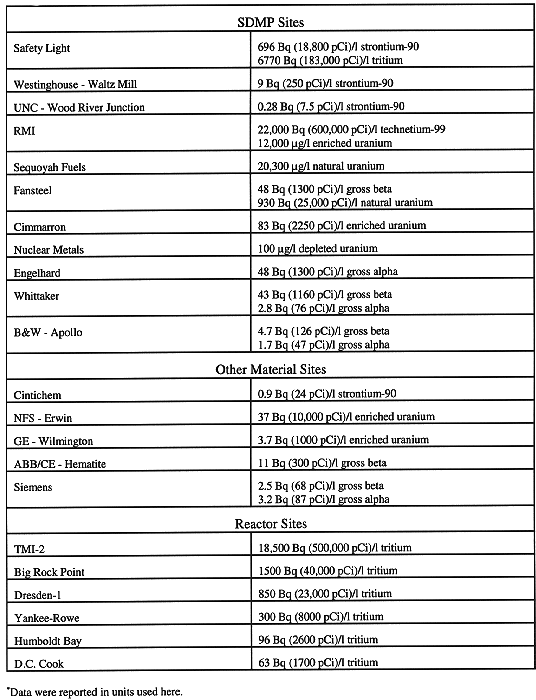
Therefore, the proposed rule would essentially codify NRC's existing reference guidelines for ground-water contamination by beta-particle and photon-emitting radionuclides, and would provide a dose basis for establishing ground-water decommissioning criteria for uranium contamination. An additional aspect of the proposed rule, which would have an effect on sites with ground-water contamination, is a provision for releasing, for restricted use, sites where the dose level from residual contamination remains above the unrestricted use maximum limit.
Impacts on Current Approaches
If the currently proposed decommissioning criterion of using MCLs for ground water is retained, this would have very little effect on the current approach for beta-particle and photon-emitting radionuclides in ground water, except that the 150 microsievert (15 millirem) per year dose standard could be applied to uranium in ground water, for which there is no current MCL. In addition, adoption of a restricted release option may allow licensees with significant ground-water contamination an alternative to what can be an extremely costly remediation, per unit reduction of dose, of ground water, to meet MCLs.
UPDATE
Recent public remarks (7) by Shirley Ann Jackson, NRC Chairman, indicate that the Commission is considering eliminating the separate ground-water standard from the rule. The Commission is thinking of making these changes in part because of public comments on the proposed rulemaking and also because a separate ground-water standard has not been justified on either a technical or cost-benefit basis.
The Commission believes that NRC's role of protecting public health and safety can be provided by establishing an all-pathways dose criterion that restricts the amount of radiation dose a person can potentially receive through all dose pathways at a decommissioned site, including doses received from the ground-water pathway. Information and data currently available to the Commission indicate that a separate ground-water standard appears to have a minimal additional safety benefit compared with an all-pathways dose criterion, and that the costs to obtain this benefit appear to be unreasonably large.
CONCLUSIONS
Ground water at certain NRC-licensed facilities that are or will be undergoing decommissioning is contaminated with radionuclides. Promulgation of currently proposed rules will help clarify NRC's decommissioning criterion for ground water, and, therefore, the goals that licensees must meet to terminate the licenses for their facilities with ground-water contamination.
REFERENCES