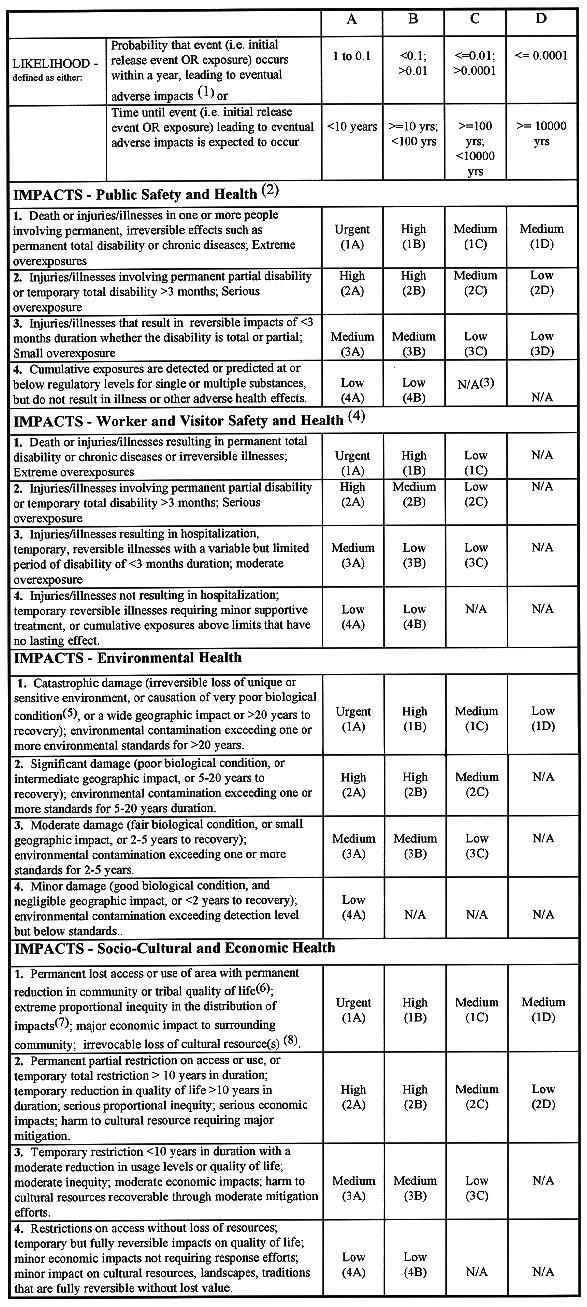
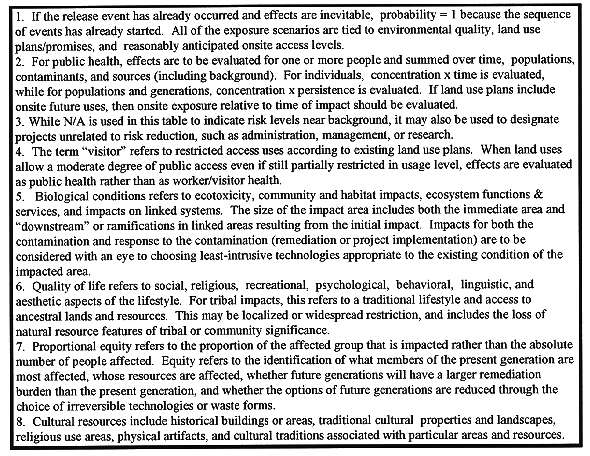
Table I Revised Management Evaluation Matrix
Stuart G Harris
Natural Resource Specialist
Confederated Tribes of the Umatilla Indian Reservation (CTUIR)
Department
of Natural Resources
Special Science and Resources Program
P.O. Box
638, Pendleton, OR 97801
(541) 276-0105 (voice), (541) 278-5380 (fax).
Barbara L Harper
Pacific Northwest National Laboratory
P.O. Box 999
MSIN K3-54
Richland, WA, 99352
(509) 372-6490
(voice), (509) 375-2019 (fax)
ABSTRACT
U.S. Department of Energy (DOE) managers commonly perceive that engaging tribal nations and public stakeholders as partners in decision making results in unnecessary delays and a reduction in information quality. However, the old paradigm "stakeholders versus science" is wrong, and the correct paradigm is "stakeholders + science = better science." In particular, certain information is needed about long-term endstate risk commitments after the DOE cleanup mission is done. Decisions are being made now that create commitments affecting environmental quality, and interrelated eco-cultural integrity because residual contamination and eventual leaks from stored/disposed waste will be released into the environment. These decisions are embedded (sometimes hidden) in Site Baselines and the Ten Year Plan. The right information is not being gathered in the current ten-year planning effort and is likely to result in its rejection by tribes and stakeholders. Tribal nations need information regarding community-level exposures and impacts over time, the anticipated endstate quality, quantity, and fragmentation of natural resources and cultural landscapes, and our ability to regain access to ceded lands in order to exercise treaty-reserved rights. The federal government is the trustee of the lands on which Hanford is located and is obligated to protect our treaty rights (this is not optional any more than regulatory compliance is optional). The complexity of a traditional persons ties to the environment means that conventional suburban exposure scenarios are inadequate to evaluate human health impacts, so we have developed a Native American Subsistence Scenario suitablefor applications in the Columbia River Basin. We have also revised the Ten Year Plans Management Evaluation Matrix used for qualitatively estimating project risks to also include socio-cultural impacts and to correct major deficiencies and internal inconsistencies in the public health and environmental impact categories.
INTRODUCTION
Risk management methodologies for traditional American Indian lifestyles are inadequate, and have gone unnoticed as decision makers fold classical risk assessments into management practices. Risk management policies typically focus on protecting single individuals living suburban lifestyles from one contaminant or one source at a time. Protecting the maximally exposed individual (MEI) is presumed to protect the entire community using the rationale that if the MEI is protected, then the entire community is protected because no single individual would likely be exposed more than the MEI. What is overlooked in this approach with tribal nations is that there may be a contaminant burden spread over the entire community. For example, sharing is a basic principle of traditional indigenous communities and remains very important today, so a hunters shares meat with many people even beyond his immediate family, the fisherman shares fish, and the gatherer shares roots, and medicines, and so on. Thus, a single contaminated resource can expose an entire community. The Environmental Justice Executive Order 12898 requires that for major federal actions information must be collected about subsistence lifestyles, natural resources upon which those lifestyles depend, and social and economic welfare. The most effective risk management decisions should come from an environmental justice perspective that incorporates those inseparable factors associated with the human receptor to include the "maximally exposed community" and "maximally exposed gene pool." The basic concepts of risk evaluation which evaluate the maximally exposed individual or MEI, are the same, but applied to higher levels of organization.
In addition, from a tribal or community perspective undergoing real-time exposure, the MEI is not a hypothetical or statistical person, but a real person who may even be identifiable by name. The degree to which a community is affected when particular individuals are harmed is overlooked in the non-native society, but is more important and widespread from a tribal perspective than from a suburban perspective. A suburban community member will ask "which person is the allowable one-in-a-million cancer death?" while a tribal member may be able to identify the person in advance due to knowledge of hunting, fishing, or gathering activities that individuals specialize in. A potential risk from nuclear or hazardous waste that affects one member of the Confederated Tribes of the Umatilla Indian Reservation (CTUIR) may affect all of the tribal members and may have lasting impacts throughout the entire indigenous community for all time. For example, if a specific individual responsible for imparting unique knowledge to younger generations is harmed, then the thread of that particular knowledge may be lost. If thatknowledge is about specific locations, linguistic information such as place names may also be lost. This concept is analogous to lost progeny if an ancestor dies prematurely, or new stories never told or new songs never sung. These may be "intangible externalities" to a western scientist, but they are real to the tribe, and are of far greater importance than similar concepts such as lost income and lost companionship which are commonly recognized. Altered tribal community patterns in response to the need to avoid contamination is another socio-cultural impact that can be easily quantified.
Because human beings cannot be truly separated from the environment, it is inherently unsatisfactory to focus on human exposure as isolated from environmental effects. Evaluating human health involves much more than making simple mechanistic exposure estimates. People, in general, and Native Americans, in particular (because of their unique lifestyles derived from thousands of years of sustainable interactions with the environment), are not truly healthy unless the environment is healthy and unless their community is healthy. Therefore it is imperative to incorporate a functional exposure model within risk management practices that recognizes the environmental complexity of a traditional lifestyle and subsistence diet as well as indirect health effects occurring simultaneously in people, biota, and tribal communities when the environment is degraded.
Tribal members are going to increasingly regain access to utilize Hanfords lands and resources, therefore we need to better understand how cleanup decisions and resulting exposures from residual contamination could (or inevitably will) occur. Risk management evaluations must begin to address the overwhelming problems related to the CTUIRs unique exposure parameters and pathways through time. The need for understanding the pathways and associated exposures that directly involve the CTUIR traditional American Indian and her/his community cannot be understated. The traditional CTUIR American Indians ties to the environment are overwhelmingly more significant and complex than is currently understood by managers, contemporary risk assessors, and probably most of the rest of the population except for tribal members.
NATIVE AMERICAN SUBSISTENCE SCENARIO
A generic subsistence scenario was developed by the CTUIR (Harris 1996) to ensure that risk management incorporates the exposure factors designed to adequately reflect general traditional activities within an active lifestyle that includes higher environmental contact rates than a suburban scenario, over a full lifetime (70 yrs). Using this exposure scenario gives the CTUIR a measure of protection that is already given to suburban residents, workers and recreationalists. Even this generic subsistence scenario, however, clearly does not represent the highest possible exposure, but is designed to represent a mid-range traditional lifestyle. It thus partially satisfying the recommendation of the U.S. Environmental Protection Agency to evaluate average members of the highest exposure groups, and alsopartially satisfies Executive Order 12898, which requires the evaluation of subsistence lifestyles as part of the evaluation of impacts to human health and the social and economic welfare from federal actions. It is also intended that this scenario provides approximately the same level of conservatism for a subsistence lifestyle as the conventional residential scenario does for a suburban lifestyle, but there remain several aspects of risk assessment in general that underestimate exposures and risks which are magnified with risk management including but not limited to: 1) lack of breadth of coverage, 2) lack of integration, 3) deficiencies related to ignoring or inadequately addressing the CTUIR traditional American Indians quality of life, 4) the interrelated and inseparable eco-culture, and 5) the unique exposure parameters and pathways.
APPLICATION TO HANFORDS TEN YEAR PLAN
The Ten Year Plan is intended to describe the conditions at DOE Sites in 2007, but it is clear that the evaluation method contained in the current Ten Year Plan Guidance (Jim 1996) would be completely inadequate to do so in a way that even approaches the information needed by Indian Tribes and by environmental justice criteria. In order to answer questions about long-term risk commitments made at a sitewide or multi-project level over long time periods, our revised risk matrix must be used. Our concerns center around questions such as "When will the Site be clean enough for the full and safe exercise of treaty-reserved rights?" and "Will the natural and cultural resources be of adequate quality and integrity for religious, subsistence, recreational, conservation, and similar uses?" A Ten Year Plan that is not able to answer these questions will not be acceptable.
The Hanford Site is grappling with the consequences of managing an environmental tragedy, and Hanford management is increasingly relying on definitions of end state land uses to determine the extent of cleanup and ultimate environmental quality. This endstate land use is seldom if ever expressed in terms of restoring treaty-reserved rights. Any cleanup other than one that allows members of the CTUIR to exercise in full their Treaty reserved rights will not be acceptable. Therefore, a description of the endstate conditions that will be achieved by Hanfords Ten Year Plan and associated technical baseline must provide enough information to answer our basic questions. For example, evaluating project risks by using the Ten Year Plans Management Evaluation Matrix without a Native American Subsistence Scenario produces results for such a short time span that decisions could result that cause disastrous impacts in a few years. Events and risks need to be considered over a much larger span of time because decision being made now will have consequences for thousands of years. Simply put, common sense tells one that as long as something is intrinsically dangerous one must make decisions now so it will be managed appropriately, which in some cases means in perpetuity.
In order to encompass the wide range of factors directly tied to the culture of the traditional American Indians of the CTUIR,Hanfords Ten Year Plan must restructure its risk management evaluation process. Hanford is located entirely on lands ceded by CTUIR and other tribes, and the treaties that were signed in 1855 between those tribes and the US government specifically reserve on-site access and use of natural resources. The treaties were intended to protect the traditional lifestyle, including all the resources and areas needed for complete and safe practice of the Tribes religion, culture, lifestyles and future. More recently, natural resource trusteeship, environmental justice and related concepts have been codified in various statutes or Executive Orders. In this paper, We refer most often to the Environmental Justice Executive Order 12898, which has been overlooked as a source of information requirements even though there is a DOE policy covering its application to the NEPA process and other major federal actions.
REVISION OF DOES RISK EVALUATION MATRIX (TEN YEAR PLAN GUIDANCE)
DOE has issued risk evaluation guidance to be used by DOE field offices in preparing the DOE Ten Year Plan (DOE 1996). While this guidance represents a reasonable starting point for making qualitative estimates of endstate risks, it has deficiencies that are serious enough to make it unacceptable from a tribal perspective. In particular, the original planning horizon was merely 100 years for materials that remain intrinsically hazardous or radioactive for much longer, the definition of event of concern did not include the initial release event, socio-cultural impacts were completely omitted, and the definitions of public and environmental health were inadequate and in places internally inconsistent. We have revised this matrix so that, while it is still not perfect, it now partially satisfies the major information requirements as described in E.O. 12898 and DOEs Environmental Justice Policy (Table I). The exposure scenario used to evaluate risks in the risk matrix should match all reasonably anticipated land uses, which for Hanford generally means subsistence scenarios.
Table I Revised Management Evaluation Matrix
USING THE REVISED MATRIX FOR WASTE MANAGEMENT DECISIONS
This revised matrix is now suitable for qualitatively estimating long-term risk commitments made by various waste management decisions, and for comparing endstate conditions among technical options. For example, a waste management technical option that results in irretrievable waste (such as in situ vitrification of high level tank waste) would:
In such a situation, a complete evaluation of endstate (long-term) impacts across all the types of risk would indicate that this technical option is not cost effective. This example illustrates how important it is to consider the long-term impacts of short-term decisions. The new mantra "quicker, faster, cheaper" must also include "better and more responsible or sustainable" in order to meet environmental justice and natural resource trusteeship obligations.
CONCLUSION AND RECOMMENDATIONS
Incorporating the Native American Subsistence Scenario into risk management decision contexts will not give the answer the full question about how contaminants or other stressors affect the eco-cultural systems or overall human-eco-cultural health. It will, however, enhance information about how much exposure a person and community might receive during particular activities. When used in combination with more appropriate environmental parameters and socio-cultural impact analysis, the requirements of environmental justice are much more likely to be met than most current assessments, including NEPA environmental impact statements. This may be done either qualitatively using the revised Ten Year Plan matrix or quantitatively using conventional modeling in combination with an expanded scope.
BIBLIOGRAPHY
HARRIS, S.G.; HARPER B.L., 1996 "Native American ExposureScenarios and a Tribal Risk Model" (manuscript submitted for publication).
R. JIM, 1997. "Changes required in this years budget process" letter from R Jim, Yakama Indian Nation to John Wagoner (Manager, DOE Richland Field Office), January 24, 1997.
DOE, 1996. Ten Year Plan Guidance, December 20, 1996.