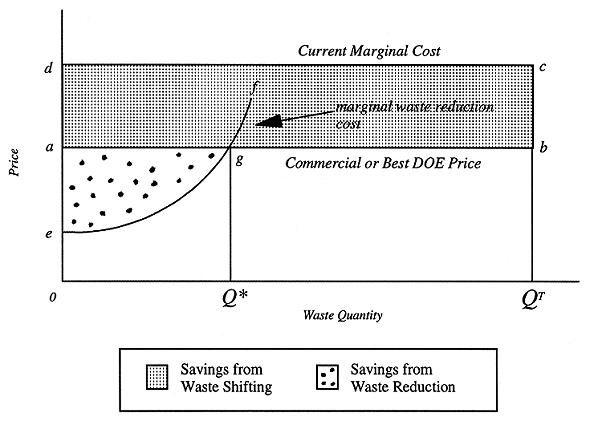
Fig. 1. Potential cost
savings fromwaste chargeback system.
Paul Higgins
Project Performance Corporation
ABSTRACT
The Department of Energy (DOE) is planning to implement an internal transfer pricing ("waste chargeback") system under which some waste generators would be charged for the cost of wastes that are treated, stored or disposed by its Office of Waste Management. This innovation has the potential to significantly reduce DOE's total waste management costs while improving the overall efficiency of its waste management operations. However, successful implementation is by no means certain, and depends on several factors, including how prices are set, how broadly DOE decides to apply the chargeback plan, and whether the necessary regulatory reforms are forthcoming. Using existing data sources, we describe the proposed chargeback system, discuss the role of waste management in the overall structure of DOE's costs, review the economic theory of costs, and provide rough estimates of the possible savings which could be realized.
BACKGROUND AND SUMMARY
The Department of Energy's (DOE's) Office of Environmental Management (EM) is considering charging some generators for waste management services performed by its Office of Waste Management. This innovation could lead to significant reductions in DOE's total waste management costs; it may also have significant effects on waste generators, waste managers, and unit costs. This report explores the likely effects of the proposed waste chargeback system, relying on economic theory, available data, and some rough deductive inference. We focus on four issues: 1) the magnitude of possible cost savings, and how it could be achieved; 2) the impact on unit waste management costs; 3) efficient chargeback fee setting; and 4) barriers to implementation.
The central aim of a waste chargeback system is to establish a market-based mechanism for waste management to promote efficiency, lower costs, and reduce waste generation. Waste treatment, storage, and disposal have historically been virtually "free goods" for many waste generators: the costs of operating DOE's waste management system are mostly borne by, and budgeted directly to, DOE's Office of Waste Management. Under a chargeback system, funds for waste management would instead be budgeted or transferred to waste generators, who would then be responsible for arranging their own waste treatment and disposal services, and would pay any necessary costs. A chargeback system provides incentives to waste generators to reduce waste, and to waste management service providers to operate more efficiently. It also encourages generators to shop for least-cost waste management options, and introduces competition among waste service providers.
We draw five major conclusions:
- The proposed waste chargeback system has the potential to reduce DOE's waste management costs significantly, while improving overall departmental efficiency.
- Cost savings would be due largely to two types of generator responses to chargeback fees - shifts in waste volumes from high-cost to low-cost managers, and waste stream reduction.
- The size of the savings depends in part on how broadly DOE applies the chargeback plan -the larger the volume of wastes involved, the greater the potential savings.
- For the maximum savings to be realized, chargeback fees must be set at levels approximating marginal waste management costs; any other approach could lead, perversely, to cost increases, or to increases rather than decreases in waste volumes.
- Successful implementation of a waste chargeback system faces significant barriers, including the limited number of treatment and disposal options available for some waste types, the need to comply with existing agreements, statutory barriers, and the presence of state compacts limiting the participation of commercial treatment and disposal sites in some regions.
The remainder of this paper is organized into five additional sections: a description of the proposed waste chargeback system; a discussion of the structure of EM costs; a review of some pertinent aspects of the economic theory of costs; estimation of the expected impacts of a waste chargeback system on life cycle costs; and a conclusion.
THE PROPOSED WASTE CHARGEBACK SYSTEM
This section describes the major features of the proposed waste chargeback system for DOE, the waste streams most likely to be included in the program, and the likely ways that costs would be reduced as a result.
Current System Is Inefficient and Leads to High Costs
Currently, DOE waste generators often do not bear a significant portion of the management costs associated with the wastes they produce: once waste is generated, responsibility for its treatment, long-term storage, and disposal passes to DOE's Office of Waste Management (EM-30).a This separation of the decision to incur costs from the responsibility of paying for them results in a costly externality: since generators do not pay the full cost of waste management, they have little incentive to act efficiently, either in choosing how much waste to generate or in choosing from among waste management options where alternatives exist. Nor do EM-30 waste managers have much incentive to behave efficiently, since they receive wastes, and funds to manage them, regardless of whether their costs are high or low. We can infer, therefore, that DOE is doubly inefficient: not only does it generate more than the optimal amount of waste, but it also pays more than it should to manage the waste that it generates.
This externality is a special case of a more general problem, efficient provision/utilization of intermediate goods or services, pervasive in large organizations. While in some cases such organizations may purchase directly from commercial suppliers, they often choose to supply products or services internally, for reasons of historical precedent, bureaucratic inertia, or the presence of economies of scale or scope. It is difficult in such situations to ensure that users of internally supplied inputs (waste generators in this discussion) are motivated to make efficient use of those inputs, given the cost to the organization of producing them. A related concern is ensuring that the suppliers of internally supplied inputs (waste managers in this case) are motivated to produce them as efficiently as possible.
A common solution to the externality problem in internally supplied products and services is the use of internal transfer pricing. Under this arrangement, the supplier sets a price for each input it provides equal to its cost. Users of internally supplied inputs then purchase them, much as they would in dealing with outside suppliers. This practice is widespread, for example, in U.S. defense procurement: in 1993, organizations within the Defense Business Operations Fund, the group of establishments within DoD that sell their outputs to other DoD organizations, had sales of $81 billion, or roughly one-third of the defense budget.b
Waste Chargeback System Would Provide Incentives for Cost Savings
The proposed chargeback system would address the problem of efficient provision of waste management services by setting up what amounts to a market for waste management services within DOE, with the aim of ensuring that waste generators consider the life-cycle cost of treating, storing, and disposing of the wastes they generate when they formulate their plans, while at the same time giving waste managers an incentive to improve the efficiency with which they manage waste. The major features of the chargeback proposal include:
Waste managers would be forced to compete - with each other, with commercial providers, and, in an important sense, with waste reduction efforts by generators - for access to wastes and funds to stay in business; successful competition would mean offering management services at prices that are lower than, or at least comparable to, those of similar providers. Managers with higher costs or inferior service would presumably not receive many contracts for their services. This, in turn, implies that all but the lowest-cost providers would either have to reduce their costs or exit the waste management business. The waste chargeback system would thus encourage waste managers to become efficient (cost-minimizing) vendors of waste management services.
Costs Lowered Via Waste Shifting and Waste Reduction
A chargeback system will affect costs principally in three ways: by inducing shifts in wastes to lower-cost managers, encouraging waste reduction, and driving costs down at high-cost sites in response to their loss of business. Generators, faced with having to pay the full cost of waste management, will find it worthwhile to transfer waste treatment, storage and disposal to low-cost providers when the cost savings exceeds the cost of switching. As a result, under a chargeback system wastes will tend to shift from high-cost to low-cost providers. Generators will also find it worthwhile to reduce their volume of waste generation, where feasible, when the cost savings exceeds the cost of obtaining volume reductions and compares favorably to what they can attain by waste shifting.c
The options facing a hypothetical DOE waste generator under a chargeback system are illustrated in Fig. 1. Waste volume is measured on the horizontal axis, with the generator's total output without a chargeback system being the amount QT. The vertical axis measures unit waste management cost. Prior to introduction of a chargeback system the generator pays none of the management cost for its waste, but EM-30's cost for this service is d dollars per unit, for a total cost of dQT, represented in the figure by the rectangle 0dcQT. Once the generator becomes responsible for these costs, it can either shop around for a low-cost management provider, engage in waste reduction, or both. Which option is chosen will depend on the relative costs involved.
Fig. 1. Potential cost
savings fromwaste chargeback system.
In the figure, the least-cost provider of management services (either another DOE facility or a commercial provider) charges a dollars per unit of waste. Thus, the shaded rectangle abcd represents the potential savings DOE could realize under a chargeback system if this generator shifted all its waste to the low-cost manager. However, the generator may have some opportunities for eliminating a portion of its waste that would save more than relying on waste shifting alone. This won't be costless, since waste reduction generally entails additional expenditures; moreover, while some waste reduction opportunities may be quite inexpensive for example exerting more stringent control over existing practices others will require both changes in production practices and investment in new equipment and training, which would entail significant new costs. For clarity, waste units are sorted along the horizontal axis in increasing order of waste reduction cost as shown by the upward-sloping curve ef indicating the increasing marginal cost of eliminating additional units of waste. The generator in Fig. 1 would find it cost-effective to eliminate the units of waste lying between 0 and Q* on the horizontal axis by engaging in waste reduction, and to continue generating the remaining units of waste between Q* and QT while switching to a low-cost manager. The total cost savings is represented by the area egbcd.
What Wastes Included?
The chargeback system currently under discussion at DOE would apply only to newly generated wastes from non-EM sources. It would not apply to waste inventories currently stored by the Office of Waste Management, or to wastes generated by the Environmental Management program in the future.d In principle, however, a chargeback system could be applied to all wastestreams, or to specific subsets (i.e., non-EM waste generation, EM waste generation, or EM inventory), with the expected benefits depending to some extent on the breadth of scope.
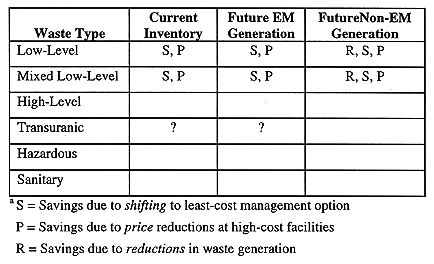
All the potential benefits of a chargeback system - waste reduction, waste shifting, price reductions - would apply to the case of future non-EM waste generation; this is a relatively small waste stream compared to EM waste generation, however, accounting for roughly half of the expected lifecycle volume of hazardous waste, one-third of low-level waste, 11 percent of mixed low-level waste, and lesser amounts of the other waste types according to BEMR. Since regulations will largely determine the volume of future EM waste generation (largely excavated dirt from environmental remediation projects and debris from facility deactivation/decommissioning) there is scant possibility of significant waste reduction by EM generators without regulatory changes, but the other benefits would apply. And with current waste inventories materials previously transferred to EM-30 waste reduction is by definition impossible; again, however, the other benefits would apply. Restricting the chargeback system to non-EM wastes would limit the size of the potential benefit that could be realized from implementing the program since, in general, the potential savings is greatest when the largest proportion of waste is included.
In terms of waste types, the greatest benefit from implementing a chargeback system would be obtained by applying it to low-level and mixed low-level waste streams; lesser benefits would be obtained by application to other waste types. Most treatment and disposal services for DOE's hazardous waste, and for much of its sanitary waste, are provided by commercial or municipal facilities already, so introducing an internal chargeback system for these wastes would offer little in the way of additional savings. Alternatives for treatment and disposal of high-level and transuranic wastes are quite limited, which reduces the possibility that competition for these waste streams could be successfully introduced (although privatization of some transuranic waste treatment in the future is conceivable). However, because there is a fledgling but growing market for treatment and disposal of low-level and mixed low-level wastes, and the restrictions on their treatment and disposal are less onerous than for most other waste types, the greatest opportunity for realizing significant cost savings lies with them (see Table I).
Table I Potential Benefits of a Chargeback Systema
Several questions remain: How much can DOE expect to save on waste management costs as a result of a chargeback system, and how can the magnitude of this savings be estimated? What price should managers charge generators? What level of funding should generators be budgeted for these costs? These issues are explored in subsequent sections. Prior to this, we first delineate the basic structure of EM's waste management costs and volumes, putting these costs into the context of total EM costs. We then discuss some pertinent aspects of the economics of cost. Finally, we return to these questions, seeking to answer them to the extent possible given current knowledge.
THE STRUCTURE OF DOE WASTE MANAGEMENT COSTS
This section places DOE's projected waste management costs in perspective by comparing them to total EM costs. It then disaggregates costs and volumes by waste type and origin (inventory, EM generated, non-EM generated). Finally, it examines the implications of limiting the chargeback system to non-EM wastes.
Life-Cycle Waste Management Costs in Perspective
The Environmental Management program is expected to entail a life-cycle cost of between $100 billion and $300 billion.e Waste management activities constitute EM's largest single cost element, accounting for 49 percent of EM life-cycle cost. By comparison, environmental restoration, the second largest cost element, accounts for one-fourth of the total, while all other EM activities make up the remaining 25 percent (see Fig. 2).
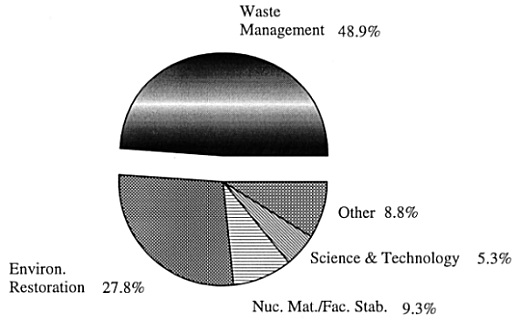
Fig. 2.DOE EM
lifecycle costs by program.
Life-Cycle Waste Management Costs and Volumes
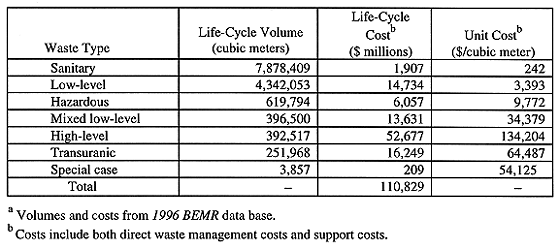
Table II shows life-cycle waste management costs and volumes by waste type. While sanitary and low-level wastes constitute the largest waste types on a volume basis, high-level waste management is the most costly, accounting for 48 percent of all life-cycle waste management costs. Low-level and low-level mixed wastes combined account for another 26 percent of costs, while the remaining waste types, primarily transuranic and hazardous, comprise the remainder.
Table II Life-Cycle Waste Volumes and Costs by Waste Typea
As we can see in Table III, the bulk of life-cycle waste - three-fourths of the total volume - will be generated by EM programs. Partial exceptions are low-level waste, 32 percent of which will come from non-EM sources; hazardous waste, which is evenly split between EM and non-EM sources; and high level and transuranic wastes, where inventory plays an important role.
Table III Life-cycle Waste Volumes by Origina
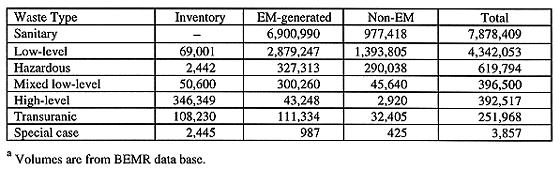
In principle, EM-generated wastes could also be included in a chargeback system. Indeed, excluding them would effectively shield two-thirds of the expected life-cycle volume of low-level waste and three-fourths of the volume of mixed low-level waste from the system, substantially reducing its potential impact. While efficiency improvements by waste managers could theoretically be passed on to EM generators as well under a chargeback system in which the latter do not participate, in practice there would be a strong incentive for waste managers to subsidize their non-EM waste management activities, where they will face competition, at the expense of EM waste generators, thereby dissipating much of the savings. Finally, there is the danger that excluding EM wastes would "balkanize" the chargeback system: if the chargeback system includes too small a fraction of DOE's total wastes, waste managers could conceivably afford to ignore it rather than change their practices.
ECONOMIC EFFICIENCY IN CHARGEBACK SYSTEMS
This section explains how chargeback fees should be set in order to induce users and suppliers of waste management services to make choices that are efficient for DOE as a whole.
Basics
Suppose a waste manager provides management services for n different wastes to generators within DOE under the proposed chargeback plan, and xi denotes the amount of the ith waste it manages (i=1,...,n) measured in cubic meters. Suppose, too, that the facility manages r other wastes outside the chargeback system; generators of these wastes are not charged, and funds for their management are funded instead by headquarters directly in EM-30's budget (these would include, for example, management of EM-generated wastes and legacy wastes under the proposed chargeback plan). Again, xi is the amount of the ith nonpriced service the waste management facility provides for i=n+1,...,n+r. Assume that the total cost of supplying these n+m waste management services can be represented by:
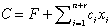 (1)
(1)
The F term represents fixed costs, those that do not vary with the quantity of any provided service, including the majority of support costs as well as the non-volume variable portion of direct costs. The amount cixi is often referred to as the variable cost of managing the ith waste, since this cost varies directly with the amount of that waste. The marginal cost of managing the ith waste is defined as the cost of managing an additional unit of waste i. In this simple representation the marginal cost of managing the ith waste is the coefficient ci.
Now consider a simple resource allocation decision by a DOE office that undertakes an activity that will generate a quantity of the ith waste, Qi. Suppose there are two alternatives it can use for managing this waste. Under one alternative, it hires the services of a commercial waste management firm to treat and dispose of the waste at a cost of pi dollars per unit. Under the second, the generator sends its waste to an EM-30 facility where the marginal cost for handling this waste is ci dollars per unit. Let us assume for the moment that the alternatives are alike in all other respects. Which should the generator choose?
The efficient choice would be for the generator to choose the least costly option; anything else would be wasteful. More precisely, efficiency would require the generator to opt for internal waste management if ciQi < piQi, and the commercial provider if ciQi > piQi. But how would we expect a rational generator, intent on maximizing the non-waste management portion of its budget, to behave? Under the traditional method of operation, where the generator doesn't have to pay the management costs, relative costs are irrelevant to the generator, and presumably the efficient option would be only be chosen by random luck. But under a chargeback system, if the internal chargeback price for managing this waste is di dollars per unit, then generator's cost of sending waste to the internal provider is diQi; presumably, the generator will send the waste there if diQi < piQi, and to the commercial provider if diQi > piQi. Comparing these two decision rules makes clear that the only way of ensuring that a generator has the right incentive 100 percent of the time is to price at marginal cost (i.e., set di = ci). Any other pricing system would lead waste generators to make decisions that are inefficient from the viewpoint of the organization as a whole at least some of the time.
The reason for this is simple. The waste generator operating under a chargeback system views each price it faces - the commercial price, pi, or the chargeback price, di, - as the marginal cost of managing its waste under each alternative. The true cost to DOE of managing an additional unit of this waste is the marginal cost of the EM-30 facility, ci - since fixed costs don't change, this is the amount a manager could avoid by accepting one unit less of the ith waste. Therefore, setting the chargeback price equal to the marginal waste management cost ensures generators will perceive their cost to be the true cost to DOE of supplying an additional unit of waste management services. No other pricing rule allows chargeback prices to effectively communicate information on marginal costs throughout the organization.
Nothing of consequence in this logic changes if we extend this simple example to other, more realistic, cases. In particular, it extends easily to cases where the decision is between two or more internal waste managers, whether or not there is an outside commercial provider in the picture, with the additional proviso that each management facility should set its chargeback price equal to its own respective marginal cost.
Implications
The implications of the marginal cost pricing principle for setting chargeback fees can be summarized in three simple rules: 1) don't allocate fixed costs; 2) don't allocate costs of nonmarketed services to marketed services; and 3) services with different marginal costs should be priced differently. We elaborate on each rule in turn.
HOW WILL A CHARGEBACK SYSTEM AFFECT WASTE MANAGEMENT COSTS?
This section presents a range of estimates of the potential savings DOE could realize under a waste chargeback system. The possible effects of a chargeback system on unit waste management costs are also explored.
How Much Could DOE Save in Aggregate?
Obtaining accurate estimates of the aggregate savings potential of a waste chargeback system applied to low-level and mixed wastes in DOE would require site-specific cost models for each waste type and sub-type, something that is beyond the scope of this paper. Instead, we relied on complex-wide average costs and volumes, and some simplifying assumptions to obtain ranges of estimates. They should therefore be viewed as rough (i.e., order-of-magnitude) estimates rather than precise predictions.
Our approach is based on Fig. 1: we estimated the savings from waste shifting as the area of rectangle abcd. It is a conservative estimate, in that it ignores the possibility of savings arising from waste reduction (area aeg in Fig. 1); we do not have reliable information on potential waste reductions and their associated net cost savings, and therefore chose to ignore it. This method involves taking the difference between the EM-wide average marginal cost and the current best available price for low-level and mixed low-level wastes, multiplying each by its expected lifecycle volume, and summing up over waste types. In terms of the figure, this amounts to attaching numbers to points a, d, and QT for each waste type and performing the appropriate multiplication. Unfortunately, while estimates of the current best available management costs are known for each waste type, current marginal costs of waste management differ widely across sites, tending to be higher at small, low-volume sites and lower at the larger, high-throughput sites. What we have done in this paper is to rely on estimates of complex average marginal costs for each waste type, on the assumption that the mean is a good indicator of the central tendency of the population. Further, we had no reliable information on the proportion of these wastes that would flow to the least-cost provider when a chargeback system is instituted. We therefore judge mentally applied a range of possibilities. The next section describes how these estimates were derived; we then present the savings estimates.
The Elasticity of Waste Management Costs
The first step is using the cost elasticity to obtain estimates of marginal waste management costs. The cost elasticity is the ratio of the percent change in cost associated with a given percent change in quantity:
 (2)
(2)
where d indicates a small change, C is cost, and Q is
quantity. It measures the sensitivity of costs to volume changes, where values
of  c greater than, less
than, and equal to unity imply that cost rises more than, less than, or exactly
proportionally to quantity, respectively. Algebraic manipulation of (2) gives
the relationship between marginal cost and unit or average cost:
c greater than, less
than, and equal to unity imply that cost rises more than, less than, or exactly
proportionally to quantity, respectively. Algebraic manipulation of (2) gives
the relationship between marginal cost and unit or average cost:
 (3)
(3)
Equation (3) shows that marginal cost (the lefthand side of the equation) is directly proportional to average cost, with the factor of proportionality being the cost elasticity. Since complex-wide average waste management costs are known for each waste type, our method of estimating marginal cost consists of developing a range of estimates for the cost elasticity of waste management for each waste type, and applying this to complex-wide average cost.
Waste management costs can be separated into two major categories:
We estimated the elasticity of waste management costs for low-level and mixed low-level wastes as the dollar-weighted average of the elasticities of direct mission costs and support costs.
Recent studies indicate that direct mission costs make up roughly one-half of total DOE waste management costs, while support costs constitute the other half.f The Waste Management Facility Cost Information reports prepared for EM-30 indicate that, on average, the elasticity of direct waste management costs for low-level and mixed low-level wastes is 50-60 percent depending on the particular waste sub-type.g That is, on average direct costs change 5 to 6 percent for every 10 percent change in waste volume. However, these elasticities do not apply to support costs, so the support cost elasticity will have to be estimated separately.
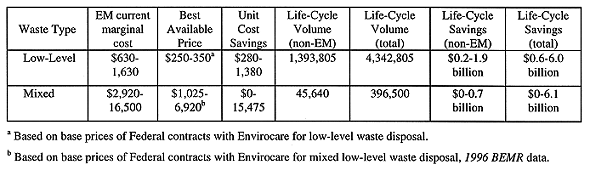
Recent studies of support costs in waste management suggest that, as a rule of thumb, support cost elasticities range between 20 and 60 percent with respect to waste management costs.h These two sets of elasticity ranges imply a total waste management cost elasticity of 0.30 to 0.48 for both low-level and mixed low-level wastes.i Our unit cost estimates were derived from two sources. The first, taken from Table II, is simply the total life-cycle waste management cost, including support costs, for each waste type, divided by its corresponding life-cycle volume;. we treated these as upper bound estimates. The lower bound unit costs were taken from a recent DOE waste management document.j Taken together, these cost elasticity and unit cost ranges imply marginal waste management cost ranges of $634 to $1,629 for low-level waste, and $2,922 to $16,502 for mixed low-level waste (see Table IV).
Table IV Estimating Marginal Cost Using Cost Elasticities and Unit
Costs

Finally, using these marginal cost estimates, the best available DOE or commercial price for management of each waste type, and life-cycle volume data reported in Table III, we estimate the likely range of possible cost savings under a waste chargeback system. As indicated in Table V, cost savings due to implementing a waste chargeback system involving low-level and mixed low-level wastes in DOE would amount to $0.4 - $2.6 billion from waste shift ting, and an unknown amount from waste reduction, when applied only to non-EM waste generation. If the program were expanded to include EM-generated wastes, the estimated savings from waste shifting would be $1.2 billion to $12.1 billion; including EM wastes would have little impact on the amount of waste reduction induced by the chargeback system.
Table V Potential Savings Under a DOE Waste Chargeback System
Impact on Unit Costs
While not directly relevant to the question of total cost savings, DOE officials have also expressed interest in how a chargeback system would affect unit waste management costs. As it happens, the effect on unit costs is ambiguous, as it depends not only on the structure of costs at any given facility, but also on whether the site is a net gainer or loser of waste volumes in the waste shifting that occurs following the introduction of the chargeback system. While we can't put any numbers to these effects for reasons we have already discussed, we will lay out the main issues in this section.
Because both direct waste management costs and support costs have large fixed components, total cost is not directly proportion to waste volume, but rather is increasing and concave as shown in the lefthand panel of Fig. 3; this is the necessary result of fixed costs being spread over increasing amounts of waste as volume rises. This implies, in turn, that unit costs must be decreasing and convex, as shown in the righth and panel. There is some empirical evidence that unit waste management costs for low-level and mixed low-level waste treatment, storage, and disposal do, in fact, decline at a decreasing rate with increased waste volumes. Data provided in the August 1996 Waste Management Progress Report, referenced in footnote 11, consistently show a negative correlation between waste volume and unit cost of -0.4 to -0.6 for these wastes, and regressions fitted to the data are convex.
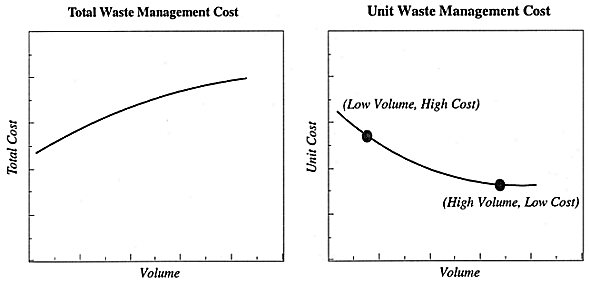
Fig. 3. Total and
Average (unit) Waste Management Costs.
The implications for unit costs can be most easily understood if we first imagine that the world contains just one waste management facility, which would preclude the possibility of any waste shifting. If this were the case, the only cost-cutting option generators would have for responding to the introduction of a chargeback system would be to develop methods for reducing the amount of wastes they generate. With just one management facility, each reduction in waste would immediately result in a reduction in the amount of waste received by the sole management facility, illustrated in Fig. 3 by the movement from the righthand point to the lefthand point on the unit cost curve. This results in an unambiguously higher unit cost. How much unit costs would rise in this counterfactual is driven by just two factors: how successful generators are in formulating and implementing their waste reduction strategies (i.e., how far to the left volume shifts), and the shape of the unit cost curve (i.e., how steep and how convex it is).
However, this is not a one-facility world. There are multiple facilities for the treatment and disposal of low-level and mixed low-level wastes, with unit costs scattered along the relevant unit cost curve. For example,
It is this diversity that makes waste shifting by generators likely to occur in response to the imposition of chargeback fees. To the extent that waste shifting in response to the chargeback system leads to a consolidation of waste management at a small number of larger facilities with low unit costs, unit costs overall could well decline (see Fig. 4).
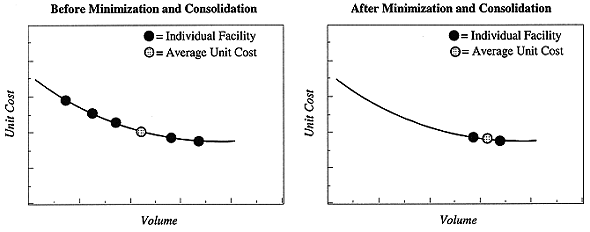
Fig. 4. Unit costs
with waste shifting.
CONCLUSIONS
Implementation of a chargeback system within DOE for low-level and mixed low-level wastes has the potential for cost savings on the order of several millions, and perhaps billions, of lifecycle dollars. A number of caveats deserve mention, however. First, a chargeback system will not succeed in inducing waste managers to compete against one another for waste streams and funds without an adequate number of players. Yet for some waste types only one or at most a few facilities may be appropriate; for example, there is only one mixed low-level waste landfill in the U.S. which is currently accepting wastes. Clearly, the availability of more facilities offering a broader range of treatment and disposal alternatives for different wastes will be necessary if the full potential of cost savings are to be realized.
Secondly, treatment options for many DOE mixed wastes are limited by compliance agreements between individual DOE sites and state regulatory agencies that were developed in response to the Federal Facility Compliance Act. These agreements typically specify onsite treatment of waste, for example. Changing the treatment plans for mixed waste could entail negotiating with the affected regulatory agencies and revising the agreements. Shipping waste between DOE sites could require changes to existing compliance agreements at both sending and receiving sites. Support from headquarters in ensuring that these agreements can be readily modified to accommodate additional treatment alternatives would reduce the extent to which these agreements serve as a barrier.
Third, the proportion of low-level and mixed low-level wastes generated by non-EM sources is likely to decrease in the future relative to that generated within EM. As the cleanup of the weapons complex continues, the quantities of EM wastes from remediation and facility deactivation and decommissioning may increase, while non-EM generators implementing pollution control and waste minimization techniques will likely decrease. If non-EM wastes do not represent a sizable portion of the market, waste service providers occupied with EM wastes may not be motivated to lower their costs to attract the non-EM wastes.
Finally, even discounting the above concerns, there remains a danger that waste service providers would seek to implicitly subsidize the non-EM portion of their business at the expense of their EM customers. Because EM wastes will continue to be funded directly in a cost-plus manner, managers may try to keep their costs artificially low when bidding for non-EM waste by shifting costs to the EM side of the business. Such cross-subsidization would tend to dissipate whatever cost savings is possible from a chargeback system.
REFERENCES
aSome generators also perform initial characterization and packaging. "Generators" refers to DOE facilities and programs that generate radioactive or hazardous waste as part of their activities, both inside and outside of EM. "Managers" refers to EM-30 waste treatment, storage and disposal facilities and, where applicable, commercial facilities.
bGAO.
cWaste reduction could entail enhanced generator treatment prior to storage or disposal to reduce bulk or toxicity; introduction of new techniques to reduce the quantities of waste generated; or shifting away from waste-intensive products, practices, or experiments.
d"...[F]inancial responsibility for management of newly generated waste outside the EM program will be assumed by the generating program by about FY 2000." DOE (1996a).
eThis range covers estimates of life-cycle costs from the 10-Year Plan and the 1996 BEMR (DOE 1996b). We use the latter except where indicated.
fDOE 1994, 1995, 1996b.
gI.e., whether it is alpha or non-alpha, contact-handled or remote-handled, etc. See Shropshire et al. 1995.
hDOE 1995, 1996b. See also Noreen and Soderstrom 1994 for a discussion of support costs in hospitals.
iI.e., (.5 x .5) + (.5 x .2 x .5) = 0.30 for the lower bound, and (.5 x .6) + (.5 x .6 x .6) = 0.48 for the upper bound.
jDOE 1996c. These cost figures were obtained as the sum of the average costs of treatment, storage, and disposal per cubic meter for each waste type, where the averages were taken across DOE Operations Offices reporting positive amounts of each waste.