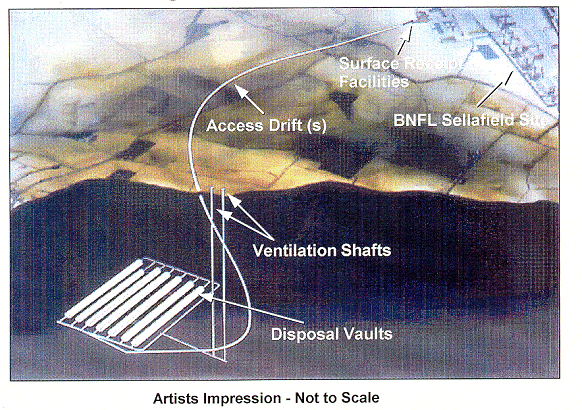
Fig. 1. General Configuration of
1996 Design Concepts
H. Beale, B. J. McKirdy, M. Sweatman
UK Nirex Limited
Curie Avenue, Harwell, Didcot
Oxon OX11 0RH, UK
ABSTRACT
The Nirex mission is to provide a safe environmentally sound and efficient service to dispose of the United Kingdom's intermediate and some low-level radioactive wastes. The disposal system being developed is based on isolating conditioned and packaged waste deep underground in a stable geological environment. Nirex is concentrating its investigations on Sellafield, in Cumbria - England, as a potential location for a deep repository.
The complexity and magnitude of the task facing Nirex demands the adoption of a rational and systematic approach to achieving its mission in an optimal manner. The specification and design of the disposal system are therefore being developed interactively and assessed in terms of performance requirements at each stage.
The disposal system specification covers a large number of interacting variables relating to the waste, its packaging, transport and disposal. Further, it integrates results from the Company's scientific and technical programs, to provide a unified and justified system specification for design work and the preparation of operational and post-closure safety assessments.
The overall system has been structured into a hierarchy of subsystems to facilitate its analysis and optimization. As an aid to improving or optimizing the system a computer model, designed to run on a fast PC, has been developed based on a number of interdependent modules representing the subsystems. The model includes variable parameters (e.g. depth, waste package throughput etc.), and fixed parameters (e.g. regulatory requirements). It relates these parameters to the objective function - the total detriment. Optimization of the model is achieved automatically by use of a numerical method that interactively adjusts the variable parameters. The model can readily deal with new information and data, that will inevitably arise through time, and can be used to assess the implications of changes ahead of each revision to the specification.
The paper describes the approach adopted by Nirex to ensure that it delivers a disposal system capable of meeting all that is required of it in terms of performance, cost and program.
INTRODUCTION
The Nirex mission is to provide a safe, environmentally sound and efficient service to dispose of the United Kingdom's intermediate-level radioactive waste (ILW) and some low-level waste (LLW). That service includes guiding waste producers on requirements for waste conditioning and packaging, developing an integrated transport system and constructing and operating a disposal facility. Nirex is concentrating its investigations on Sellafield, in Cumbria, England as a potential location for a deep repository. The Nirex disposal concept is illustrated in Fig 1.
Fig. 1. General Configuration of
1996 Design Concepts
The complexity and magnitude of the task facing the Company demands a rational and systematic approach to achieving its mission in an optimal manner. The specification and design of the disposal system are therefore being developed interactively, and are assessed in terms of performance, with respect to safety, environmental effects and cost, at each stage of their development.
The Disposal System Specification covers a large number of interacting variables relating to the waste and its packaging, transport and disposal. The specification includes constraints imposed on the system by Regulators, planning (land use) legislation and land availability as well as the requirements of customers (the waste producers) and those within the Company having responsibility for aspects of system performance e.g. safety, environmental effects and cost.
The specification also integrates results from the Company's scientific and technical programs, including site characterization information from Sellafield, to provide a unified and justified system specification for design work, operational and post-closure safety assessments, and environmental impact assessment.
Development of the Disposal System Specification and the repository design will continue for some years, as an iterative process with assessments of safety, environmental effects and cost. Account will be taken of results from the ongoing program involving geological investigations, laboratory research, engineering design, cost estimating and the Company's developing commercial policy. This paper describes the approach adopted by Nirex to ensure that it delivers a disposal system capable of meeting all that is required of it in terms of performance, cost and program.
DISPOSAL CONCEPT
The disposal concept being developed is based on isolating conditioned and packaged waste deep underground in a stable geological environment. Both engineered and natural barriers will be used to make certain that waste is adequately isolated from the human environment to meet regulatory safety targets. This multi-barrier approach to containment (1) involves packaging wastes in either metal or concrete containers, emplacing these in underground openings and backfilling the remaining void with a cement-based material. It is planned that waste emplacement will be carried out over a period of some 50 years. The general configuration of current design concepts for the facility (Fig. 1) consists of an array of underground openings accessed by drift from the above-ground waste reception facility. Excavations would be made in a suitable stable rock mass using conventional mining technology, and are currently planned to provide space for waste volumes ranging from 200,000 to 275,000 m3. Nirex is currently focusing its attention on the suitability of disposal in hard rock at a depth of about 750 meters below ground level.
Conditioned and packaged radioactive waste would be transported to the disposal facility by either road and/or rail. Waste packages that require additional shielding and containment would be transported in Reusable Shielded Transport Containers (RSTCs) as Type B transport packages in accordance with IAEA Transport Regulations (2). Some waste packages would not require additional shielding or containment for transport, and these are designed as transport packages in their own right. (2).
On arrival at the disposal facility, transport packages would be unloaded from vehicles at the surface and taken down the access drift by a rack-and-pinion rail system. RSTCs would be unloaded in an underground inlet cell and the unshielded waste packages would be transferred to disposal vaults for emplacement, using remote handling techniques throughout. The empty RSTCs would then be returned to customers for further use. Waste packages not requiring an additional transport container would also not need remote handling at the repository, and would be emplaced in a separate vault.
The void space around the emplaced waste packages would be filled with a cement-based material. The physical barrier, provided by the steel and concrete packaging, is predicted to provide containment lasting several hundred years; sufficiently long for short-lived relatively mobile radionuclides, such as 90Sr and 137Cs, to decay to insignificant levels. However, there would also be a longer-term chemical barrier against the dissolution and migration of radionuclides in groundwater. This barrier, provided by the cementitious backfill surrounding the waste packages, has been carefully specified to:
The geological environment provides an additional natural barrier. Both the host rock and the overlying strata play a role, in that the engineered system is to be placed at an adequate depth to prevent inadvertent intrusion and to be remote from surface erosion, and it would be positioned in a region of naturally low (and predictable) groundwater flow. This would delay the migration of radionuclides to the biosphere and ensure that any radionuclides that have not decayed would emerge only gradually.
The large number of interacting constraints and requirements for the design of the disposal system are being specified to establish a baseline from which existing design concepts can be developed into a reference design. The baseline specification and reference design will be specific to the Sellafield site and will be continually refined to reflect results from the Company's ongoing program of work.
DISPOSAL SYSTEM SPECIFICATION
As an illustration, some of the many constraints and requirements applying to the UK disposal system are set out below.
NIREX COMPANY STRUCTURE
The Company consists of several departments, each responsible for different aspects of disposal system performance. The Corporate Safety, Technical and Engineering, Science, and Commercial Departments each have an interest in repository performance but with different objectives and priorities, and therefore different requirements which need to be balanced to find the optimum solution.
The Nirex Systems Specification Department draws on the expertise of all departments within the Company to establish what is required of the disposal system, and to continually refine those requirements in the light of results from ongoing programs of work. It must make sure that all requirements are justified, unambiguous and ultimately do not conflict. The Department's output is embodied in a Disposal System Specification that will be, in essence, a definitive statement of what is required.
As stated earlier, requirements will inevitably change with time. Such changes have the potential to disturb the balance between cost and benefit, and can significantly influence the overall optimization of the disposal system. A computer model is being used as an aid to optimizing or improving the disposal system, and to assess the implications of proposed changes to the specification. The model will also help to identify where formal assessments are required to demonstrate that radiation doses and other adverse impacts are as low as reasonably practicable. Figure 2 illustrates the iterative process of specification, engineering design, cost estimating and assessment of the system performance that will continue over the coming years, until the Disposal System Specification and the resulting engineering design are optimized with respect to both safety and cost-effectiveness.
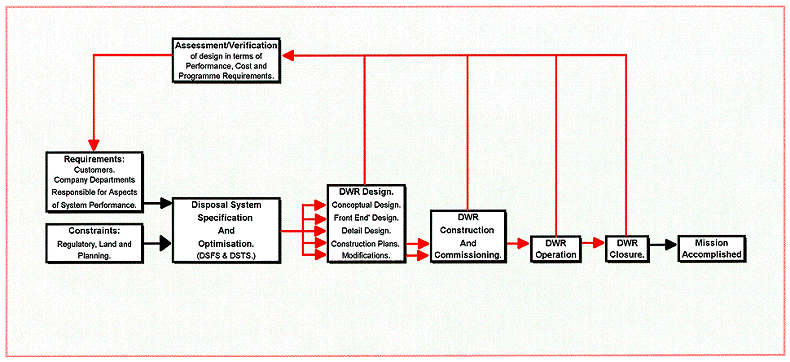
Fig. 2. Iterative Development of
Specification and Design.
SYSTEMS APPROACH
Departments within Nirex that are responsible for specifying and justifying requirements can do this initially only for those aspects of system performance for which they are responsible. This can lead to inconsistencies and conflicts between requirements. The task of reconciling differences rests with the Company's Systems Specification Department.
The overall system has been structured into a hierarchy of subsystems so that it can be studied in its totality. This also facilitates analysis and optimization of the system. The hierarchical structure is helpful in identifying the interdependencies between subsystems and incomplete, ambiguous or conflicting requirements. It also serves to focus attention on topics about which knowledge is lacking.
There is no one method that will always provide the best approach to defining a system. It could be arranged in the same manner as the information is provided, i.e. by functional department within the Company; it could be arranged by type of plant, e.g. mechanical equipment, civil works etc.; or it could be by plant area, e.g. surface facilities, access to underground, underground facilities etc.
A system arranged by plant area was chosen as the best option, because it is best suited to highlighting inconsistencies and conflicts within the system, and also lends itself to analysis of system performance. The arrangement of sub-systems is shown in Fig 3. All constraints and requirements are stored in a computer database, and interdependencies between constraints and requirements are logged.
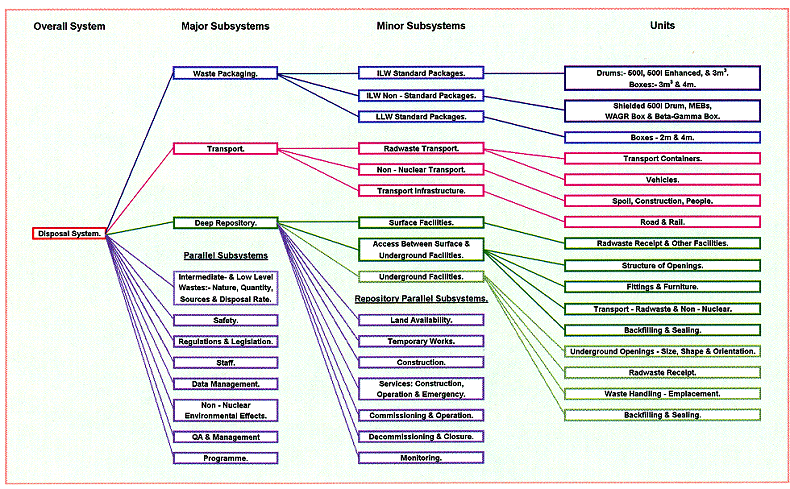
Fig. 3. Arrangment of Subsystems.
SYSTEM ANALYSIS AND OPTIMIZATION
The methods and techniques of systems analysis are used to assist the systems approach by objective analysis of quantifiable factors. Subjective analysis is used to determine non-quantifiable factors. Numerical optimization requires that the repository specification can be represented by a single number, the 'detriment', indicative of its perceived quality. This number can then be optimized using standard mathematical techniques. The detriment is a sum of costs (capital, operating and closure expenditures) and other factors associated with safety, social issues and the environment. A computer model has been developed to quickly calculate the key contributions to the detriment and achieve numerical optimization of the system.
The aim of the disposal system model is to relate variations in the key specification parameters to variations in the associated detriment. Precisely how the detriment is quantified is subjective. For example, current literature (3) provides a relationship between cost and collective dose. 'Key specification parameters' are defined as those that most influence the detriment and can also be changed by Nirex, such as the depth of the repository. These are readily identified from cost estimates, safety studies etc. The relations that link these key parameters to the detriment are determined by the modeller. These factors all influence the level of detail within the model. Since the total cost is expected to be of the order of billions of pounds, an appropriate level of detail is at least a few orders of magnitude smaller. All estimates of detriment are required to be realistic (rather than pessimistic).
The model is divided into interdependent sub-models reflecting the division of the disposal system into subsystems as described earlier. In each sub-model, factors that significantly affect the detriment are identified - the 'detriment drivers'. These can also be quantities over which Nirex has no control, such as the geological environment underlying the site in question. Such drivers are then related to key specification parameters, the detriment and other drivers in other sub-models. This network of relations is shown schematically in Fig 4 which is arranged according to the systems approach and indicates the qualitative relationships that form the foundations of the model. For example, the chart shows that excavation is a key driver in the underground sub-model, but it is affected by the maximum spoil removal rate - which is a driver in the underground/surface access sub-model. These drivers are identified in the same way as the key specification parameters.
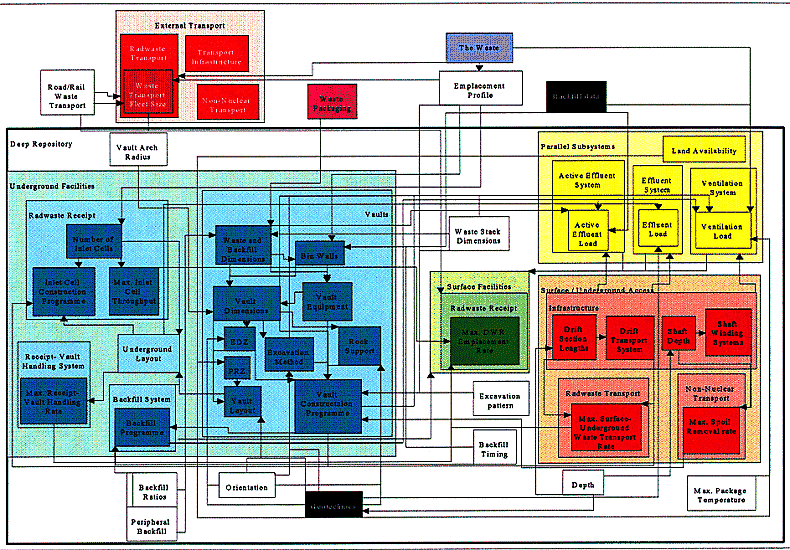
Fig. 4. DSTS Optimisation Model
Relations that link the specification drivers are determined by analyzing available data within the Company. Currently, the best available data are to be found in the form of design documents, cost estimates, safety assessments and the Disposal System Specification itself. The aim of the model is to be able to generate other options for the specification that are represented by changes in key parameters. This can be achieved only if the modeller makes suitable extrapolations using base case information. For example, the base case cost of cavern vault crane rails is estimated from their length and so, by extrapolation, the cost of crane rails can be estimated for a cavern vault of various lengths. All such approximations, together with supporting data, are documented and regularly reviewed within the Company. Future updates of the base case documents will be used to improve and validate the model.
OPTIMIZATION OF PROTECTION
The 'optimization of protection' is a central theme of UK Government policy for radioactive waste disposal and the associated regulations and guidelines (4,5). When interpreted in the context of the repository, this general phrase includes the concept of satisfying dose and risk constraints and targets as well as the concept of varying key repository parameters to optimize the total detriment. The development of a numerical model that quantitatively links these key repository parameters to the detriment can aid the optimization process because numerical optimization can be performed by a variety of simple, powerful and efficient mathematical techniques.
NUMERICAL MODEL
The individual dose and risk constraints and targets are required to be satisfied conservatively and this limits the number of specification options available to the model. However, the estimate of detriment described above is required to be realistic. 'Protection' can be optimized according to different standards. Generally, the aim is to satisfy individual protection standards and to achieve a balance between radiological and other detriments, including cost. The post-closure safety estimate is particularly difficult to incorporate into the model and remains a subject for further consideration.
Numerical optimization can be achieved by various methods. A simple 'what-if?' analysis can choose between the values of two different key parameters. Sensitivity analysis can reveal how significant a parameter is with respect to a particular specification option. Sensitivity analysis can also be used to confirm an optimal specification. More advanced optimization techniques (6) can automatically find optimal solutions of the model. These techniques are well documented and widely used. The computational method currently being used is simulated annealing. This is a computationally demanding method, but has the advantage that it avoids the distraction of local minima, i.e. it provides greater confidence that the overall optimum is attained.
The model outlined is an initial version that will be progressively improved and updated as new information is produced within the Company. In particular, the modeled estimate of safety requires further development. Future editions of the design, cost, program and safety documents will be used to assess the accuracy of the model, and hence its validation.
PRELIMINARY RESULTS AND KEY COST DRIVERS
In developing the model a number of key cost drivers have been identified. The most significant of these include: the waste emplacement rate, the excavation and backfilling schedules, the cavern vault dimensions (of which height is the most significant), and repository depth. Development of the cost model is therefore concentrating on those parameters which have an effect on the key cost drivers.
Preliminary results have been obtained from the model which suggest that the base case scenario can be improved significantly. A combination of rescheduling cavern vault excavation and ramping up the emplacement rate results in significant cost savings. These potential savings confirm the need to balance customer requirements against disposal costs. Increasing cavern vault cross-sectional area and deferring backfilling until all vaults are filled also result in significant savings. Since these cost drivers have an insignificant effect on other detriments, these conclusions are valid despite the preliminary nature of the model.
CONCLUSIONS
In working towards achieving its mission Nirex is using a systems approach, with the help of systems analysis, to develop an optimal Disposal System Specification and repository design. This approach creates a proper mood of inquiry and brings objectivity to the task. The aim is to make certain that the disposal system will achieve all that is required of it in terms of performance, cost and program.
Preliminary results indicate that the computer model which has been developed will prove a valuable tool in optimizing the disposal system.
REFERENCES