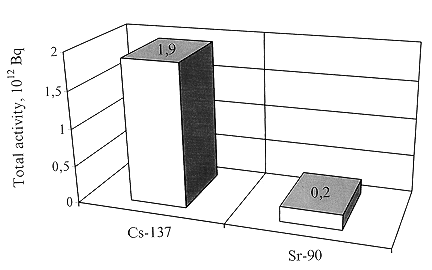
Fig. 1. Total activity of the
products of decontamination.
N. Golikova, I. Rolevich, A. Gvozdev, G. Serebryanyi, S.
Starobinets
Institute of Radioecological Problems of Academy of Sciences
Republic of Belarus
ABSTRACT
In carrying out the works on decontamination of the populated areas, contaminated with radionuclides as a result of the accident at the Chernobyl NPP, 69 repositories for the products of decontamination have been arranged at the territory of Belarus in 1986-
1987. There are no protective engineered barriers, waterproofing shields for the majority of repositories and the ingress of radionuclides into the ground water is possible. It makes them potentially dangerous for environment. The results of studies on determination of the effect of radioactive waste repositories on environment are given in the article. The forms of existence of 137Cs and 90Sr in wastes have been studied, the data on distribution of radionuclides in natural barriers under repositories have been obtained and the radioecological monitoring of the ground water in the zones of location of wastes repositories have been carried out too.
INTRODUCTION
As result of the accident at the Chernobyl NPP, the main fraction of released radioactive isotopes has deposited on the territory of Belarus. Nearly 23% of the territory of the Republic are in the zone of the contamination, including 3668 populated areas with the population more than 2 millions. The resulting radiation-ecological situation has needed large-scale works on decontamination. Decontamination has been mainly accompanied by removal of surface layer of the soil, demolishing the ramshackle buildings, ets. Ravines, sand-pits, foundation pits, trenches have been used for the waste disposal. Only in single cases the disposal of radioactive products of decontamination has been carried out in specially built repositories. The waste storage sites have been arranged in the flood-lands of the Pripyat and the Sozh rivers and their tributaries. Some of the waste storage sites are near swamps, in the areas with high level of the ground water. Some of the repositories are periodically flooded, there are no protective engineered barriers for the majority of them. All this makes them potentially dangerous for environment due to possible ingress of radionuclides into the ground water. Owing to this, the effect of the radioactive waste repositories on environment has been studied. Total activity of the wastes, generated as result of decontamination, in the disposal sites has been determined. The forms of existence of 137Cs and 90Sr radionuclides, the distribution of radionuclides in natural barriers under repositories have been studied. The radioecological monitoring of the ground water in the areas of location of repositories has been carried out.
RADIOACTIVE WASTE STORAGE SITES
In 1986-1987, 69 repositories have been altogether arranged for 3 ·.105 m3 of wastes (1). In 1992-1993 the repositories have been examined and registered. The vital fraction of long-lived radionuclides in the nearest zone (the Pripyat trace) has been deposited as fuel particles with the density of contamination 230-1470 kBq/m2 and 15-30 kBq/m2 for 137Cs and 90Sr, respectively. The average specific activity of the products of decontamination in the disposal sites of this zone accounts for 3.4-7.5 kBq/kg for 137Cs and 290-900 Bq/kg for 90Sr. The depositions of the distant zone (the Sozh trace), which are the highly enriched volatile compounds of radionuclides, are characterized by density of contamination for 137Cs 500-2700 kBq/m2 and for 90Sr 5-25 kBq/m2. Average specific activity of radioactive products of decontamination is 1.6-14 kBq/kg and 40-200Bq/kg for 137Cs and 90Sr, respectively. Total activity of the products of decontamination are given on Fig.1.
Fig. 1. Total activity of the
products of decontamination.
The analysis of the forms of existence of radionuclides in the products of decontamination has shown, that in the nearest zone there is 137Cs in water-soluble (0.4-1.6%), exchangeable (3.7-18.2%) and non-exchangeable (80.8-95.9%) forms. For the products of decontamination of the distant zone (the Sozh trace) the fraction of water-soluble, exchangeable and non-exchangeable forms of 137Cs is lower - 0.1-0.17%, 5.5-15.1% and 84.7-94.4%, respectively. The analysis of distribution of 90Sr in radioactive wastes of the nearest and distant zones according to the forms of existence has shown, that they differ essentially. Thus in the nearest zone 90Sr is in the water-soluble (0.6-3.3%), exchangeable (8.2-31.6%) and non-exchangeable (65.1-91.2%) forms, and in the distant zone (the Sozh trace) these values are 5.0-7.7%, 45.4-61.0% and 31.8-46.9%, respectively. The ratio between the forms of existence of radionuclides in the products of decontamination are given on Fig. 2.
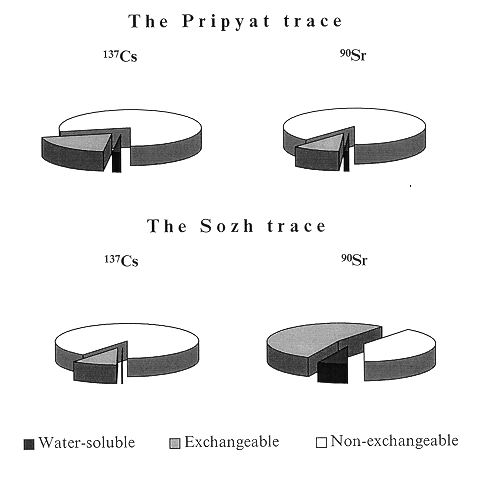
Fig. 2. The ratio between the forms
of existence of radionuclides in the products of decontamination.
The obtained results show, that the process of transfer of 90Sr from non-exchangeable into exchangeable forms proceeds extremely slowly for the products of decontamination of the nearest zone. The coefficients of mobility of radionuclides in wastes have been calculated on the basis of the obtained data. They are the ratio between the sum of water-soluble and exchangeable forms and non-exchangeable forms. The values of the coefficients of 137Cs and 90Sr mobility in the wastes of the nearest zone are in the range 0.06-0.23 and 0.12-0.39 and in the wastes of the distant zone they are 0.06-0.11 and 1.0-1.8, respectively. It evidences the lower migration ability of 90Sr in the wastes of the nearest zone in comparison with the distant zone.
The distribution of radionuclides below the foundation of the waste storage sites into 2m depth of the protective layer of the soil has been studied. The activity decreases abruptly with the depth of the layers, and at the depth of 2 m the content of 137Cs is 0.7-32.0 Bq/kg, 90Sr - 0.9-2.5 Bq/kg. The thickness of the layer of the natural protective barrier is within 0.5-8 m for all radioactive waste storage sites.
RADIOECOLOGICAL MONITORING OF THE GROUND WATER
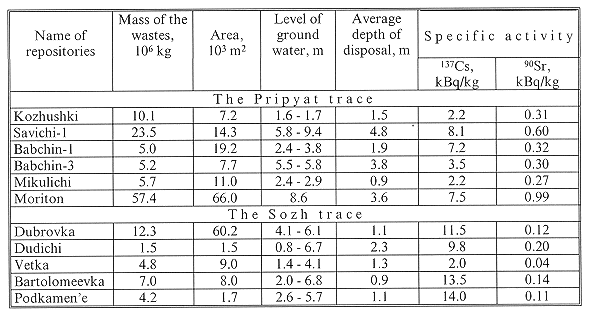
The system of radiation control and supervision over the processes of migration of 137Cs and 90Sr radionuclides from the storage sites into the ground water has been developed during 1993-94. The system of supervision has been fitted out at 11 largest storage sites, involving practically the whole spectrum of typical natural and technological conditions of disposal of the products of decontamination. Each of the storage sites chosen for supervisions has been fitted out with 4-5 hydrogeological holes, arranged below and above the storages downstream the ground water. The character of disposition of the holes for supervision, the utilized methods of sampling, preparation and measurement of samples allow the change of activity of radionuclides in the ground water to be recorded with sufficient reliability. In 1994, radioecological monitoring of the ground water in the areas of arrangement of storage sites for products of decontamination is carried out (2). Main characteristics of the disposal sites for radioactive wastes of decontamination, chosen for control are given in Table I.
Table I Main Characteristics of the Disposal Sites for Radioactive
Wastes of Decontamination
In spring and autumn, sampling of the ground water has been conducted. The content of 137Cs and 90Sr has been determined in the water samples by the methods of gamma-spectrometry and radiochemical analysis. Activity of the ground water in the locations of repositories for radioactive wastes of decontamination are given in Table II.
Table II Activity of the Ground Water in the Locations of
Repositories for Radioactive Wastes of Decontamination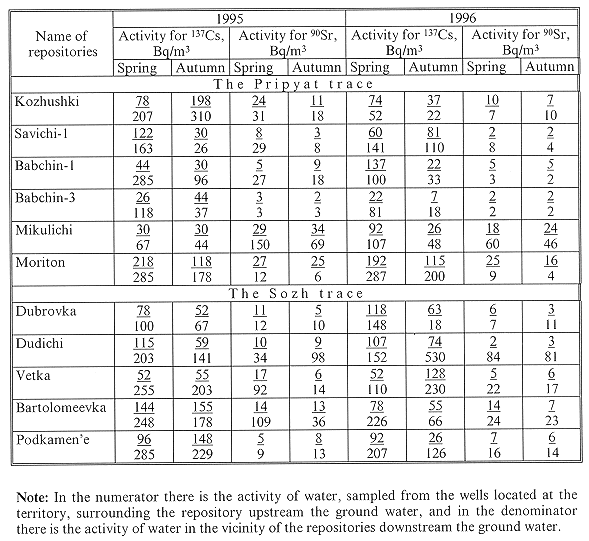
The results, have shown, that the specific activity of the ground water in spring is as a rule higher, than in the autumn period of control. For the most repositories the excess of the content of 137Cs and 90Sr in water samples from the wells located downstream of the ground water has been registered. It is the reason for argument, that there is the migration of radionuclides from the wastes of decontamination. As a result of carried out studies it has been found out, that in 1994-1996 there has been no marked change in the content of radionuclides in the ground water in the locations of repositories. Maximum values of activities of the ground water for 137Cs and 90Sr are within the level 530 and 150 Bq/m3, respectively. It is substantially higher, than the activity of the ground water in the basins of the Pripyat and Sozh rivers before the accident at the Chernobyl NPP, when the activity of caesium and strontium radionuclides in the ground waters has been less, than 1 Bq/m3. For all controlled repositories the content of radionuclides in the ground water don't exceed the permissible levels accepted in the Republic of Belarus for drinking water equal to 18500 Bq/m3 and 370 Bq/m3 for 137Cs and 90Sr, respectively.
REFERENCES