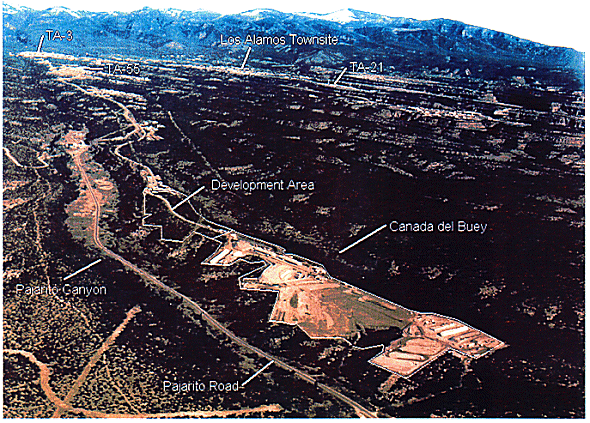
Fig. 1. Aerial photograph of Area G
and its environs
Tony Stanford
Environmental Management Division, Solid
Waste Operations Group
Los Alamos National Laboratory
Los Alamos, New
Mexico 87545
ABSTRACT
Los Alamos National Laboratory (LANL) generates low-level radioactive waste (LLW) from various activities: research and development, medical radioisotope production, decommissioning and decontamination of facilities, and nuclear-weapons stockpile stewardship. The Laboratory has an on-site LLW disposal facility located at Technical Area 54, Area G. Because it supports the fundamental mandates of the Laboratory, Area G is considered a mission-critical facility. Nonetheless, it must be used in a safe, compliant, and cost-effective manner. The natural characteristics of the site and conscientious operation and management of the facility allow these objectives to be met. Those features and uses of the LANL Area G LLW disposal facility are described in this paper.
INTRODUCTION
The Los Alamos National Laboratory (LANL) Material Disposal Area G (Area G) has been used for disposal of radioactive waste since 1957. The site was selected for radioactive waste disposal by the U.S. Geological Survey (U.S.G.S.) in 1957 due to its natural characteristics, which provide an effective barrier against radionuclide migration. Over the years, the Laboratory's waste management program evolved in response to contemporaneous regulatory structure, including transuranic (TRU) and low-level waste (LLW) segregation in 1971 and mixed waste and LLW segregation in 1985. The current program reflects the requirements of DOE Order 5820.2A, which was issued September 26, 1988. Consistent with the Order, TRU and Mixed wastes are stored above ground at MDA G, while LLW is permanently disposed of there.
Facility description
Material Disposal Area G is located at Technical Area (TA) 54, which is adjacent on two sides to public land. To the east-southeast of TA-54 and about 1.5 miles from Area G is the residential community of White Rock. Land to the north of TA-54, Area G is owned by the San Ildefonso Indian Tribe. Tribal land extends into Canada del Buey, the canyon directly north of Mesita del Buey, the name of the narrow, flat mesa upon which Area G resides.
The Area G facility occupies about 100 acres. To date, 36 pits and over 200 shafts have been excavated and filled over an area of about 65 acres. The remaining 35 acres are expected to meet the LLW disposal needs of the Laboratory into the foreseeable future.
Figure 1 is a aerial photograph of the site.
Fig. 1. Aerial photograph of Area G
and its environs
Site Characteristics
The surface of Mesita del Buey is about 275 m (900 ft) above the regional aquifer, which supplies the drinking water for area residents. The mesa is about 30 m (99 ft) above two canyons, Canada del Buey to the north and Pajarito Canyon to the south. The host bedrock is known as Bandelier Tuff, which was deposited about 1.5 million years ago by volcanic eruptions in the Jemez Mountains to the west. The Bandelier Tuff comprises roughly 30 percent of the 275 m (900 ft) thick vadose zone.
The geohydrologic properties of the Bandelier Tuff provide very effective natural containment of radioactivity. The moisture content of the tuff comprising the mesa is low, on average about five percent water by volume. The porous fractured rock allows deep evaporation within the mesa and removal of water vapor by barometric pumping. In addition, the Bandelier Tuff and pore water contain minerals that hold, or sorb, many of the radionuclides in the Area G inventory.
The natural characteristics of the site have important implications regarding the ability of the site to contain radioactive waste. This is especially true in terms of groundwater migration. In the semiarid climate of the region, most of the moisture from precipitation is removed from the host rock by evaporation and transpiration (collectively termed evapotranspiration) from the surface of the mesa. Evapotranspiration is effective to depths of one to two meters (3 to 7 ft), where plant roots are abundant. In addition to this near-surface drying, evaporation appears to occur along the sides of the mesa, and in fractures and surge beds, which are layers within the mesa that appear to allow air flow. This relative absence of moisture practically eliminates the possibility that radioactivity will be carried down through the tuff to the regional water table, which is about 275 m (900 ft) below the surface of the mesa. The movement of radioactivity through the tuff is further reduced by natural minerals in the tuff that bind many radionuclides.
Facility Characteristics
Of the 100 acres comprising Area G, 65 acres have already been used for waste disposal. A portion of the remaining available acreage is expected to be developed as necessary to meet the LLW disposal needs of the Laboratory.
Waste is disposed of in unlined pits (or trenches) and augered shafts, which are excavated to depths of about 18 m (60 ft), set back a distance of 15 m (50 ft) from the sides of the mesa. Typical rectangular pit dimensions are 20 m wide by 150 m long by 21 m deep (~65 ft by 500 ft by 65 ft). Typical cylindrical shafts are 20 m (~65 ft) deep and range in diameter from 0.5 to 1 m (~1.5 to 3 ft); one exception is a 4 m (~12 ft) diameter "triple-augered shaft" used solely for the disposal of activated components from the LANL Neutron Science Center and Meson Physics Facility. Pits are filled with waste to within 1 to 2 m (3.3 to 6.6 ft) of the ground surface, then backfilled and covered with consolidated crushed tuff. Topsoil and native grass seeds are emplaced over the tuff to form a vegetative cover that prevents erosion and water infiltration, and provides an esthetic appearance. Shafts are filled to within 1 m (3.3 ft) of the rim, then backfilled with tuff and capped with concrete.
WASTE CHARACTERISTICS
The current waste management operations performed at Area G include permanent disposal of LLW, temporary storage of transuranic (TRU) waste awaiting final disposal at the Waste Isolation Pilot Plant (WIPP), and temporary storage of Mixed LLW (MLLW) awaiting final treatment under the Federal Facilities Compliance Act (FFCA). In terms of volume, LLW accounts for over 90 percent of the waste at Area G.
The largest volume of LLW disposed of at Area G is referred to as "routine" LLW, including slightly contaminated refuse like paper and personnel protective equipment. The majority of the radioactivity disposed of is associated with a relatively small volume of "nonroutine" LLW, including highly activated metals and large concentrations of tritium. Routine LLW is disposed of in unlined pits, while nonroutine LLW is disposed of in lined and unlined vertical shafts, which additional personnel protection and/or segregation.
In terms of activity, tritium (generally in the form of tritiated water on molecular sieves) represents over 90 percent of the total. Significant excursions in average radioactivity inventories occur with disposals of activated materials. The inventory includes large quantities of tritium, 60Co (in activated metals), and 137Cs (in irradiation sources); special nuclear materials (e.g., 239Pu, 241Am, and 235U); and residues from medical radioisotope separations (e.g., 95mTc and 94Nb). In all, there are well over 100 radionuclides in the LLW disposal inventory.
In addition to the shafts used exclusively for certain categories of nonroutine LLW, Area G also maintains a monofill pit that is reserved for disposal of asbestos-containing LLW. There are also shafts that are used for the disposal oof PCB-contaminated waste.
Annual average disposal volumes are about 4,000 m3 for pits and 40 m3 for shafts, while average annual disposal activities are about 40,000 Ci for shafts and 20 Ci for pits. Table 1 lists the approximate total LLW volumes and activities disposed of in pits and shafts between 19578 and 1996. Again, tritium disposal of in monofill shafts accounts for about 90 percent of the radioactivity inventory at MDA G.
Table I. Waste Volume and Radioactivity Disposed of in Pits and
Shafts at Area G Between 1957 and 1996

Routine Waste
By definition, routine LLW is disposed of in pits at Area G. Routine waste is generally packaged, but is accepted in bulk under certain circumstances. Waste is delivered into pits in dump truck or flatbed trucks, and offloaded with fork lifts or cranes, if possible. An example of unpackaged waste disposed of at Area G is the small experimental nuclear reactor vessel (400 ft3, 30 tons) from the Ultra High Temperature Reactor Experiment (UHTREX), which is shown in Fig. 2.
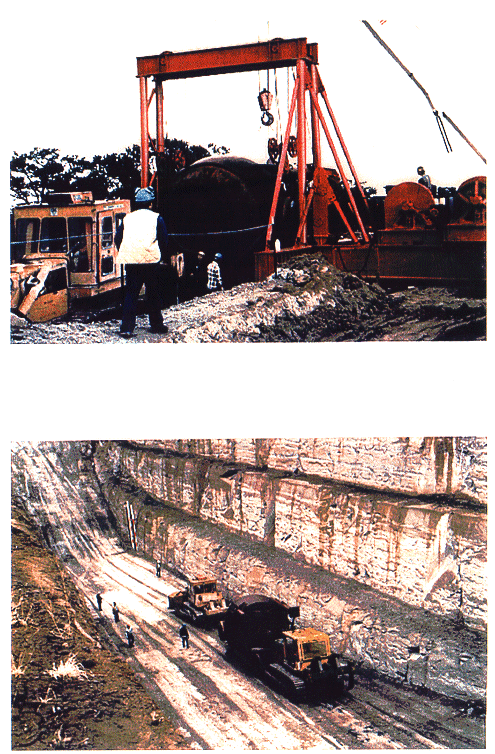
Fig. 2. Disposal of the UHTREX
reactor vessel in a pit at Area G
While this example is unusual, it is not unique; there are two experimental reactors buried at Area G. In general, waste is placed in the pit in layers or lifts. Waste is covered with clean crushed tuff, and the tuff is consolidated using heavy equipment, as shown in the photograph in Fig. 3.

Fig. 3. Routine waste disposal
operations in a pit at Area G
The practice of layering waste and backfill and compacting the layers in place has proven very effective in conferring stability to the pits at Area G. In nearly 40 years, no significant subsidences have occurred at Area G. However, this practice requires the liberal use of clean backfill, which is not very efficient. As the disposal capacity is expended, there is greater interest in increased pit efficiency.
Nonroutine Waste
Nonroutine waste, which by definition is disposed of in shafts, includes high-activity tritium waste (generally greater than 40 Ci/m3, but as high as 10,000 Ci/m3) beryllium- contaminated waste, animal tissue, and high exposure-rate waste. The high exposure-rate waste is generated within "hot cells" where medical radioisotopes are harvested from activated targets, and also includes activated metals from a neutron-beam facility which can be greater than 20,000 R/hr. The shipment of these high exposure rate wastes requires a road closure and a specially-designed shipping container. Once on site at Area G, the disposal occurs remotely.
WASTE MANAGEMENT PROGRAM
As stated above, the Area G radioactive waste management program is consistent with the specifications of DOE Order 5820.2A. The major elements of the program include:
Performance Assessment
The Performance Assessment (PA) is a systematic analysis of the long-term potential radiological impact of radioactive waste disposal activities at TA-54, Area G to the general public. It models release, transport, uptake, and consequence of radioactive materials buried at Area G using various mathematical and numerical calculations to simulate site-specific features of the disposal facility. To provide reasonable assurance that the facility performs as modeled to 10,000 years (where modeling uncertainties are always high), conservatism are built in to the analysis. The results of the PA establish the technical basis for several elements of the Area G LLW management program, including:
Results to date suggest that the Area G facility is highly competent, able to contain and isolate radioactivity from the accessible environment for many thousands of years, even under the very conservative modeling conditions. Only the most mobile species (e.g., 14C, 99Tc, and 129I) migrate through the vadose zone within 10,000 years, and the inventories of all species are small enough that off-site doses are well below the performance objectives (4 mrem/year water ingestion, 10 mrem/year air pathway, 25 mrem/year all-pathways). Exposures to inadvertent intruders can be maintained below the performance objective (100 mrem/year) by imposing concentration and inventory limits, and by controlling depth-of-burial for certain wastes.
Waste Characterization
The physical, chemical, and radiological characteristics of all waste stored and disposed of at Area G is described by the waste generator on various forms. These forms are reviewed by waste management personnel prior to waste shipments to ensure that all waste meets applicable acceptance criteria regarding waste form, packaging, chemical content, and radioactivity content. Once approved, these documents become permanent quality records. Both paper copies and electronic data are retained indefinitely. The LLW disposal records are used to develop the PA and inventories, and to compare projected inventory with actual disposals.
Once received by Area G, waste packages and documentation are checked for consistency and acceptability. If any significant discrepancies are identified, the receiving technician issues a nonconformance report to the waste generator describing the problem. The generator is then responsible for correcting the problem, either at Area G or, if necessary, after the waste is returned to the generating facility. Nonconformance reports are also permanent quality records. They are reviewed to identify trends that indicate either inadequate guidance or surveillance on the part of waste management or recalcitrant waste generators. The documentation, review, approval, and acceptance process are all elements of the generator certification programs implemented LLW.
DISPOSAL IMPROVEMENTS AND FUTURE OPERATIONS
The Laboratory has restructured its waste management program to streamline its operations and reduce costs. At Area G, management has instituted a rigorous program for configuration management and formality of operations. These improvements have reduced operating costs by 30 percent. The cost of disposing waste at Area G is now at or below the cost of disposing of waste at commercial facilities.
The DOE has requested that the Laboratory secure Area G for disposal and storage of waste until the year 2001. While the PA demonstrates that the site can effectively contain the anticipated inventory, past practices (especially low disposal efficiencies) must be modified to ensure sufficient capacity to support mission-critical programs and avoid offsite disposal alternatives. The LLW management program is applying administrative controls and advanced volume-reduction technologies to minimize the volume of waste disposed of at MDA G.
Current Program Improvements
There have been several improvements in the performance aspects of the Area G operation. These include:
Future Expectations
A long-range plan has been generated to develop a 30-acre tract that would provide the Laboratory with the disposal capability for the next 50 to 100 years. However, the development is conditional on the approval of the SWEIS that is currently under review. Several administrative contingencies may be instituted in the meantime. The most likely (?) scenario is a combination of on-site and off-site disposal.
To provide an incentive for generators to minimize LLW, the DOE and LANL are considering imposing a fee-for-service on generators to pay for LLW management. Waste generators have never been charged for LLW disposal at Area G. They are taxed a "set-aside fee," which is returned to generators to support self-initiated waste minimization efforts. In the future, Area G may begin charging a surcharge to any generator that does not have the following:
In addition, LLW volume quotas may be established for generators. If such quatas are significantly exceeded, a penalty fee will be imposed. (I MADE THAT UP...) Finally, the LLW management program is using the results of the PA to develop a technical basis for free-release criteria for potentially volume-contaminated materials, which at present must be disposed of as LLW even though contamination is neither measured nor known to be present.
CONCLUSION
The LANL is able to support national security and environmental stewardship missions in a cost-effective manner largely because Area G is endowed with favorable natural characteristics and is managed in a conscientious manner. It is the mission of the Solid Waste Operations Group, which manages Area G, is to manage the Laboratory's solid radioactive waste safely and efficiently in a manner that demonstrates technical excellence, is sensitive to stakeholder values, protects the environment, and complies with all applicable regulations and DOE Orders. In the early 1990's, the DOE designated Area G a category II nonreactor nuclear facility requiring rigorous quality assurance and control and formality of operations.
There is approximately 23,000 m3 of constricted capacity. Within Area G, there is another 50 to 100 years of disposal capability available; however, construction is on hold pending the out come of the Site-Wide Environmental Impact Statement (SWEIS). It is hoped that the SWEIS will allow development adjacent to the current disposal operations, which has been demonstrated by the PA to result in no radiological consequence to future members of the public.