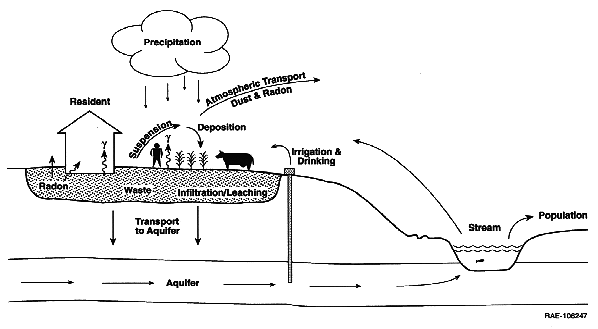
Fig. 1. Environmental transport
pathways in PRESTO codes.
Vern Rogers and Gary B. Merrell
Rogers & Associates
Engineering Corporation
P.O. Box 330
Salt Lake City, UT 84110-0330
Phone: (801) 263-1600
FAX: (801) 262-1527
Cheng Y. Hung
U.S. Environmental Protection Agency
Office of Radiation and Indoor Air
Judiary Square, Room 3202A
501
Third Street, N.W., Third Floor
Washington, D.C. 20005
(202) 233-9204
ABSTRACT
State and federal regulatory agencies have promulgated and continue to promulgate numerous sites with regulations regarding radioactively contaminated soil. The primary health risk posed by exposure to radiation levels associated with radioactively contaminated soils is that of contracting cancer. Two new additions to the U.S. Environmental Protection Agency's PRESTO family of computer codes, PRESTO-EPA-CLNCPG and PRESTO-EPA-CLNPOP, have been developed to estimate the impacts of radioactively contaminated soils on humans and the environment. PRESTO-EPA- CLNCPG and PRESTO-EPA-CLNPOP evaluate the health impacts to individuals and populations using potentially contaminated ground water, surface water, produce vegetables, milk, meat, and fish are evaluated. They also estimate additional exposures from inhaling contaminated dust and radon gas, inadvertently ingesting soil, and from being exposed to direct gamma radiation. The methodologies and uses of the two codes have been discussed. The codes also have been compared to RESRAD which is often applied to conservatively assess radioactively contaminated soil sites. Finally, it was concluded that the methodology used in PRESTO-EPA- CLNCPG and PRESTO-EPA-CLNPOP is less conservative and more realistic than that used in RESRAD.
INTRODUCTION
Rogers & Associates Engineering Corporation (RAE) created two new members of the PRESTO family of computer codes in support of the U.S. Environmental Protection Agency's (EPA) responsibility for developing generally applicable standards for decontaminating radioactively contaminated soil sites. These two new codes, PRESTO-EPA-CLNCPG and PRESTO-EPA-CLNPOP, provide technical support by estimating the impacts of radioactively contaminated soils on humans and the environment.
The PRESTO-EPA-CLNCPG model estimates the maximum doses to individuals living on a contaminated soil site. Individual may use potentially contaminated vegetables, milk, and meat on the site. Additionally, they may inhale dust and radon gas, inadvertently ingest contaminated soil, be exposed to direct gamma radiation, and ingest contaminated fish from a local stream. The PRESTO-EPA-CLNPOP model estimates the cumulative health effects (cancer and genetic effects) to populations living on a contaminated soil site, near a contaminated site, and in a regional basin. The population groups may come in contact with the contaminant through the same means as those described for PRESTO-EPA-CLNCPG.
The PRESTO family of computer codes was originally developed as part of the EPA's rulemaking for low-level radioactive waste disposal. The EPA used these codes to evaluate a range of low- level radioactive waste disposal methods at generic sites. The PRESTO-EPA-CLNCPG and PRESTO-EPA-CLNPOP computer codes are extensions of two original members of the PRESTO family (PRESTO-EPA-CPG and PRESTO-EPA-POP). The model extensions make it more flexible for evaluating sites with contaminated soil. The most significant improvements are in the capability to model two distinct layers of contamination, improvements in the water infiltration calculations, and in the addition of the radon, soil ingestion, and fish ingestion pathways. In addition, a new user friendly input file preparation program was developed to automate input file preparation. Information on obtaining complete documentation and user's manuals for the PRESTO-EPA family of (1,2) is available from EPA.
This paper discusses the improvements and uses of PRESTO-EPA- CLNCPG and PRESTO-EPA-CLNPOP for analyzing contaminated soil sites. The codes are benchmarked against actual monitoring data from a contaminated soil site and are also compared to RESRAD, (3) which is often applied to conservatively assess radioactively contaminated soil sites. Finally, conclusions are drawn.
MODEL DESCRIPTION
PRESTO-EPA-CLNCPG and PRESTO-EPA-CLNPOP were designed to model almost any site with radioactive contamination on or near the ground surface. For such sites, the contamination generally does not extend more than a few meters below the ground surface. Figure1 displays the numerous pathways by which radionuclides can be transported from a contaminated site.
Fig. 1. Environmental transport
pathways in PRESTO codes.
Radionuclides may be carried away from a contaminated soil site as a result of precipitation. Precipitation water at a site will either infiltrate into the soil, run off the site by overland flow, or evaporate into the atmosphere. Infiltrated water entering the contaminated zone leaches out radionuclides from the contaminated soil. This contaminated infiltration water may either overflow the ground surface of the contaminated site or percolate further downward towards an aquifer. Radionuclides transported in the aquifer may be drawn out be either wells or through additive communication with local streams. The contaminated stream and well water may be used for irrigation, drinking, or cattle feed. Ground surface contamination and radionuclides deposited on the surface from irrigation and excavation activities may also be transported overland by erosion.
Windblown dust and mechanical resuspension can also transport contamination away from the original site. Airborne contamination can be inhaled directly, deposited on crops and ingested, or can be deposited directly onto the ground surface. Ground surface contaminant also may result in external exposures from direct gamma radiation.
The added pathways and other improvements used in creating PRESTO-EPA-CLNCPG and PRESTO-EPA-CLNPOP are discussed below. A discussion of the transport equations and methodologies inherent in the original PRESTO family if codes is available from the appropriate EPA documents.
Model Enhancements
Although the number and degree of changes and improvements in the development of PRESTO-EPA-CLNCPG and PRESTO-EPA-CLNPOP were significant, they can be grouped into nine main categories: impact receptors, exposure pathways, two layer soil contamination, indoor and outdoor radon inhalation using both diffusion and advection transported gases, waste forms, water infiltration, cover failure, water overflow from site, and plant roots.
Impact Receptors
Impact receptors refers to the individual or population for whom doses and risks are calculated. The PRESTO-EPA-CLNCPG code models one impact receptor and the PRESTO-EPA-CLNPOP code models three impact receptors. In the PRESTO-EPA-CLNCPG model, the receptor is an individual or a small group of individuals who resides on the contaminated site. Previously, only a local offsite resident was modeled. The code has been modified to model a receptor residing on the contaminated site. The main differences between an onsite resident and a local resident is that the onsite resident is exposed to different nuclide concentrations and additional exposure pathways. For example, the onsite resident may produce vegetables whose roots penetrate into the contaminated soil.
In the PRESTO-EPA-CLNPOP model, three receptor groups are modeled: an onsite population, a local offsite population, and a regional basin population. The onsite and local population is modeled in the same way as in the PRESTO-CLNCPG model. The local population is modeled similarly, evaluating impacts from contaminants transported offsite. The third impact receptor, the regional basin population, is exposed to radioactivity through the use of contaminated river water. The regional basin population is assumed to be far enough from the contaminated soil site that the river water is the only potential exposure pathway. Cumulative health risks are calculated for all three receptor groups.
Exposure Pathways
The PRESTO-EPA-CLNCPG and PRESTO-EPA-CLNPOP codes have been modified to add fish and soil ingestion pathways. This enables the model to simulate a wider range of possible exposure pathways. The soil ingestion pathway accounts for exposure due to inadvertent ingestion of contaminated soil, such as residual soil on vegetables or soil on the hands. The soil concentration is calculated internally and considers soil contamination due to atmospheric deposition, irrigation, and exposed waste on the ground surface.
The ingestion of fish uses the nuclide concentrations in the stream and the water-to-fish bioconcentration factors to calculate the nuclide concentrations in fish. When combined with the quantity of fish consumed, the nuclide exposure is calculated. The fish consumption rate and bioconcentration factors are new inputs read by the modified codes. The stream concentration is already calculated.
Two Layer Soil Contamination
The codes have also been modified to give them the capability of modeling two layers of contaminated soil. The top layer is at the ground surface and may be specified as clean or contaminated soil. Immediately below this layer is a layer of contaminated soil. The two layers may contain different radionuclides at different concentrations, if desired. The only restriction is that the second (bottom) layer must contain radionuclides. The leaching subroutine was modified to allow radionuclides to migrate from one layer to the other.
The leaching subroutine was also modified to make it more applicable to soil contamination sites. The leach options now provide the following three options: 1) chemical exchange using a distribution coefficient, 2) chemical exchange with a check of the radionuclide solubility, and 3) a constant release fraction model. The chemical exchange option, with or without the solubility check, will apply to most contaminated soil cleanup sites. This is because the radioactivity in contaminated soil can readily contact infiltrating water. The constant release fraction leach model, while normally not applicable to contaminated soils, was retained in the model to allow user flexibility. The constant release fraction model allows the user to directly input a release fraction for modeling unusual waste forms or for doing sensitivity studies.
Waste Forms
Previously, the PRESTO-EPA family of codes were not comparable in their treatment of waste forms. The PRESTO-EPA-POP code modeled only one waste form. The PRESTO-EPA-CPG code modeled up to five waste forms, all with different leaching characteristics. In order to simplify the models and make them consistent, two waste forms were selected and implemented in PRESTO-EPA-CLNCPG and PRESTO-EPA-CLNPOP.
The new codes can model absorbing waste and solidified waste. Absorbing waste is a soil-like waste form where radionuclides are held on the surfaces of solid particles. Solidified waste is a concrete-like waste form where the radionuclides are contained in a solid matrix. The two waste forms are distinguished only by their leaching characteristics.
Initial radionuclide inventories for both waste forms are entered separately in the input data set. It is anticipated that most contaminated soil sites will be best represented by the absorbing waste form. The solidified waste form is included as an option to facilitate sensitivity analyses and to allow flexibility in conducting assessments.
Water Infiltration
The original PRESTO-EPA family of codes could not calculate water infiltration rates in cases where there was no protective soil cover. The codes contain detailed algorithms for calculating the infiltration rate, but these routines were not used if there was no protective soil cover. The new PRESTO-EPA codes have been expanded so that both codes now have the option to input the infiltration rate directly. This allows the user some flexibility in cases where detailed meteorological input data are lacking and for performing infiltration sensitivity studies. However, in most simulations, the infiltration rate is calculated by the infiltration subroutines in order to ensure that a reasonable infiltration value is used and to take advantage of the sophisticated water balance algorithms in PRESTO-EPA.
Cover Failure
The PRESTO-EPA family of codes contain calculations for the gradual failure of the cover layer. Initial and final failure percentages at specified times are entered in the data set. Failure is assumed to be linear with time. In the previous codes, as the cover layer fails, more water is allowed to infiltrate through the contaminated layers. The new PRESTO-EPA codes have the additional capability to calculate the effects of cover degradation on the outdoor radon flux. Failed portions of the cover release a higher flux of radon gas to the atmosphere than the non-failed portions. As time progresses, the radon flux increases.
Water Overflow From Site
In most contaminated soil site analyses, water infiltrates downward through the soil and carries radionuclides toward the water table. However, for certain site conditions (such as a low hydraulic conductivity) the soil is not able to conduct the water downward and the site becomes saturated. In these cases, water that contacts the contaminated soil may leave the site by overland flow. This situation occurs in the PRESTO-EPA family codes whenever the calculated amount of infiltrating water exceeds the saturated hydraulic conductivity of the soil.
The modification involves the calculation of radionuclide concentrations in the overflowing water. Since the new PRESTO codes now have the capability to handle two distinct layers of contamination, the radionuclide concentrations in the overflow must consider both of these layers. Immediately before overflowing from the site, water is in contact with contamination in the top layer. Therefore, the radionuclide concentrations in the top layer are used to calculate the concentrations in the overflowing water. When overflow occurs it is also possible for radionuclides to be transported upward from the bottom contaminated layer to the top layer. This calculation is also included in the new PRESTO codes.
Radon Gas
The new PRESTO codes now contain a radon gas pathway to calculate doses from indoor and outdoor radon exposure. Indoor and outdoor radon exposures are calculated for a hypothetical house that is constructed on a contaminated soil site. Indoor radon enters the house through the basement floor. Outdoor radon is generated in the contaminated soil and released to the atmosphere. The radon calculations take into account the two layers of contamination. The two contaminated layers may have different radium concentrations and generate different amounts of radon gas. The modified PRESTO codes account for the radon gas contribution from both contaminated layers.
There are two main processes by which radon can be transported in soil: diffusion and advection. Depending on the conditions, either of these processes may dominate. Both processes are included in the new PRESTO codes. Diffusive radon gas transport is driven by the radon concentration gradient and is the dominant transport process when there is little or no movement of the soil gas. The radon concentration gradient is maintained by the continuous generation of radon gas in the soil.
Typically, a significant portion of the radon that enters a house is due to a negative pressurization of the house's interior. This causes a flow of soil gas into the house through joints and cracks in the foundation and basement floor. The negative pressure in the house causes a flow of soil gas from the ground surface near the house, downward and into the basement through shrinkage cracks, usually around the perimeter of the basement floor. The air that is drawn into the basement comes from the atmosphere outside the house. It is assumed that the radon concentration in the outdoor atmosphere is zero, or at least very small. However, as the atmospheric air is drawn downward through the soil, it picks up and accumulates radon that is always being produced in the soil. The longer it takes the air to travel from the surface to the basement crack, the more radon it accumulates. In the limit of very long air travel times, the radon concentration approaches a limiting value determined by the radium content of the soil. Alternatively, for very rapid air flow, the radon entry rate into the house approaches a limiting value.
Plant Roots
One of the exposure pathways in the previous PRESTO-EPA family of codes is the absorption of radionuclides by plant roots. Radioactivity is absorbed by the plants which are later consumed by humans and animals. Previously, the root density in the PRESTO-EPA models was assumed to be constant with depth. A more realistic model has now been implemented that accounts for varying root density with depth.
User Interface Program
A graphic user interface program has been developed to assist users of the new PRESTO-EPA codes in creating input data sets. The interface program runs under the Microsoft Windows environment, is menu driven, and contains default parameter values for site and meteorology input data.
BENCHMARK STUDY
PRESTO-EPA-CLNCPG is benchmarked against actual well water data measured at the burial grounds of the Savannah River Plant (SRP). The SRP, located in southwestern South Carolina, is a major installation of the U.S. Department of Energy for production of defense-related nuclear materials. SRP has generated various radioactive and hazardous wastes as byproducts of operations, and these have been retained on site since disposal, some for more than 30 years. The burial grounds are located in the central area of the SRP. The burial grounds were used to store or dispose radioactive solid waste produced at the SRP from 1952 through 1986. Table I compares the PRESTO-EPA-CLNCPG-calculated concentrations and actual contaminants measured in a 1 meter well at the burial grounds. RESRAD-calculated well water concentrations are also given in TableI.
Table I Summary of Benchmark Concentrations for PRESTO-EPA-CLNCPG
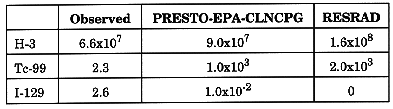
As is illustrated in Table I, the PRESTO-EPA-CLNCPG overestimate the observed well concentrations of H-3 by a factor of 1.37 (well within the uncertainty in the site and waste characterization data). A comparable analysis performed by RESRAD illustrates an overestimate of H-3 concentration by a factor of 2.42. Comparisons for Tc-99 show PRESTO-EPA-CLNCPG overestimates the concentration by 435 while RESTAD overestimates the concentration by 870. A reverse trend, though, is observed with I-129. While RESRAD does not show any well water contaminant left at the time of measurement, PRESTO-EPA-CLNCPG estimates 0.01 pCi/l.
SUMMARY
In summary, PRESTO-EPA-CLNCPG is a useful methodology for evaluating remedial actions at contaminated soil sites with respect to state and federal regulatory agency regulations. As is illustrated by the benchmark data, PRESTO-EPA-CLNCPG provides a more realistic and less conservative analysis than generally given by RESRAD.
REFERENCES